I agonized over pruning my trees because I thought it would harm them. Pruning, whether physical or spiritual, doesn't seem pleasant, but it really is necessary for health and growth.
Our backyard has two bowl willow trees. In the past 10 years, they have grown to about 25 feet tall and nearly 25 feet in diameter. We love their shade and the privacy they provide during the summer. In the fall, however, we noticed they needed some care. The branches were getting thick and rubbing against each other and there were quite a few dead limbs.
Now I am not a tree expert, and at the time I knew virtually nothing about trimming trees. So, I had an arborist come out to our home and inspect our trees. He told me that although our trees were basically healthy, they needed pruning.
Like the trees in my backyard, we sometimes need pruning in our spiritual life. Jesus Christ reminds us of this when He says, "I am the true vine, and My Father is the vinedresser. Every branch in Me that does not bear fruit He takes away; and every branch that bears fruit He prunes, that it may bear more fruit" (John 15:1-2 [1] I am the true vine, and my Father is the husbandman.
[2] Every branch in me that beareth not fruit he taketh away: and every branch that beareth fruit, he purgeth it, that it may bring forth more fruit.
See All...). Pruning involves cutting off superfluous branches. This is done to make the tree bear better fruit, grow higher or to give the tree a more handsome appearance.
All trees need attention and care if they are to flourish and beautify our yards. Before we prune, we need to have a mental picture of what we desire our tree to look like. According to the Better Homes & Gardens New Garden Book, "Grown under optimum conditions... a tree has a good chance to become the beauty you hope it will be."
In similar fashion, God knows the beauty that He hopes we can become when He says, "For I know the thoughts that I think toward you, says the LORD, thoughts of peace and not of evil, to give you a future and a hope" (Jeremiah 29:11For I know the thoughts that I think toward you, saith the LORD, thoughts of peace, and not of evil, to give you an expected end.
See All...). God envisions us becoming part of His family. When He prunes us, He has that vision in mind.
How to Prune
Before I pruned our trees, I had to learn how to prune so I wouldn't injure the trees. We can be very thankful that God "pities those who fear Him. For He knows our frame; He remembers that we are dust" (Psalm 103:13-14 [13] Like as a father pitieth his children, so the LORD pitieth them that fear him.
[14] For he knoweth our frame; he remembereth that we are dust.
See All...).
A very encouraging scripture from one of the newer translations available today called The Message, reads, "No test or temptation that comes your way is beyond the course of what others have had to face. All you need to remember is that God will never let you down; he'll never let you be pushed past your limit; he'll always be there to help you come through it" (1 Corinthians 10:13There hath no temptation taken you but such as is common to man: but God is faithful, who will not suffer you to be tempted above that ye are able; but will with the temptation also make a way to escape, that ye may be able to bear it.
See All...). Pruning is a process through which God mercifully helps us.
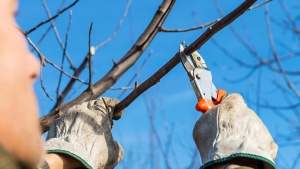
When pruning a tree, it is important to use the right tool. Although chain saws work well for large branches, they are not appropriate for smaller branches that require a gentler touch. Hand pruners and small pruning saws work better for this. Also, tools need to be sharp to reduce the possible harm to the tree.
God's Word is the perfect tool for pruning us. God's Word is sharp so that it can remove the unwanted "branches" in our lives without harming us. "For the word of God is living and powerful, and sharper than any two-edged sword, piercing even to the division of soul and spirit, and of joints and marrow, and is a discerner of the thoughts and intents of the heart" (Hebrews 4:12For the word of God is quick, and powerful, and sharper than any twoedged sword, piercing even to the dividing asunder of soul and spirit, and of the joints and marrow, and is a discerner of the thoughts and intents of the heart.
See All...). God's Word helps us to discern our intentions and thoughts.
God directs our pruning through the Holy Spirit. God's Spirit guides us "into all truth," helping us to study what we need (John 16:13Howbeit when he, the Spirit of truth, is come, he will guide you into all truth: for he shall not speak of himself; but whatsoever he shall hear, that shall he speak: and he will shew you things to come.
See All...). It also helps us to see what God is working out in our lives. The Holy Spirit encourages us and directs our minds.
Pruning must also be done at the proper time. The U.S. Department of Agriculture Forestry Service recommends pruning trees during the dormant season so that the wounds will close during the next growing season and minimize the transmission of disease. A tree pruned at the wrong time of year is more susceptible to a fatal disease.
God knows the perfect time to prune us. Read again the story of Esther. God is very much a part of our lives despite how separated we sometimes might feel. Mordecai's response to Esther in Esther 4:12-14 [12] And they told to Mordecai Esther's words.
[13] Then Mordecai commanded to answer Esther, Think not with thyself that thou shalt escape in the king's house, more than all the Jews.
[14] For if thou altogether holdest thy peace at this time, then shall there enlargement and deliverance arise to the Jews from another place; but thou and thy father's house shall be destroyed: and who knoweth whether thou art come to the kingdom for such a time as this?
See All... after learning of Haman's evil plot to exterminate the Jews shows God's providence. God placed Esther in the exact position necessary to be used by God for intervention. It is sometimes difficult to realize that God's timing is perfect, but God knows what we can become when properly pruned.
Why Prune?
Pruning improves tree health and strength. Pruning for health involves removing diseased or insect-infested wood. Typically it involves thinning the crown to increase airflow and reduce pest problems, and removing crossing or rubbing branches. Pruning encourages trees to develop a strong structure and reduces the likelihood of damage during severe weather. All of these actions encourage growth of the main trunk.
As we are pruned in our spiritual lives, we must "seek those things which are above" (Colossians 3:1If ye then be risen with Christ, seek those things which are above, where Christ sitteth on the right hand of God.
See All...). Paul instructs us, "Therefore put to death your members which are on the earth: fornication, uncleanness, passion, evil desire, and covetousness, which is idolatry" (Colossians 3:5Mortify therefore your members which are upon the earth; fornication, uncleanness, inordinate affection, evil concupiscence, and covetousness, which is idolatry:
See All...). These attitudes and actions are things that "rub" against God's ways, much like the branches in trees.
Our pruning must be extensive for us to grow in God's character. Just a few verses down Paul says, "You yourselves are to put off all these: anger, wrath, malice, blasphemy, filthy language out of your mouth. Do not lie to one another, since you have put off the old man with his deeds, and have put on the new man who is renewed in knowledge according to the image of Him who created him" (Colossians 3:8-10 [8] But now ye also put off all these; anger, wrath, malice, blasphemy, filthy communication out of your mouth.
[9] Lie not one to another, seeing that ye have put off the old man with his deeds;
[10] And have put on the new man, which is renewed in knowledge after the image of him that created him:
See All...).
God's pruning process uses the circumstances in our lives to help us grow in His character and appearance. Even Jesus Christ was pruned. Hebrews 5:8-10 [8] Though he were a Son, yet learned he obedience by the things which he suffered;
[9] And being made perfect, he became the author of eternal salvation unto all them that obey him;
[10] Called of God an high priest after the order of Melchisedec.
See All... tells us, "He learned obedience by the things which He suffered." Vincent Word Studies says that "Jesus did not have to learn to obey... but he required the special discipline of a severe human experience as a training for his office as a high priest who could be touched with the feeling of human infirmities... The fundamental idea in verse nine perfected is the bringing of a person or thing to the goal fixed by God."
Don't Be Discouraged
Sometimes pruning does involve trials. We must remember Hebrews 12:5-6 [5] And ye have forgotten the exhortation which speaketh unto you as unto children, My son, despise not thou the chastening of the Lord, nor faint when thou art rebuked of him:
[6] For whom the Lord loveth he chasteneth, and scourgeth every son whom he receiveth.
See All..., which says, "Do not despise the chastening of the LORD, nor be discouraged when you are rebuked by Him; for whom the LORD loves He chastens."
The Adam Clarke Commentary says the following about these verses: "Here is the reason why we should neither neglect correction, nor faint under it: it is a proof of the fatherly love of God Almighty, and shows his most gracious designs towards us; from which we may be fully convinced that the affliction will prove the means of good to our souls, if we make a proper use of it."
The Barnes commentary on verse 10 follows with a similar thought: "This is the elevated object at which God aims by our trials. It is not that he delights to produce pain; not that he envies us and would rob us of our little comforts... it is, that he may make us more pure and holy, and thus promote our own best interest." Remember, God is pruning us to become like Him.
Producing Growth
Pruning is also done to improve appearance and produce growth. This involves enhancing the natural form and character of the tree by removing limbs that turn inward, cross or extend. It means removing anything that competes with the growth of the main trunk—water sprouts, root suckers and excess lateral branches. Thinning lateral shoots will let the remaining branches get better air circulation, water and sunlight.
Any Y-shape in the main trunk creates a weak zone with two competing branches. The lesson for us is to choose whom we will serve. As Christ says, "You cannot serve God and mammon" (Matthew 6:24No man can serve two masters: for either he will hate the one, and love the other; or else he will hold to the one, and despise the other. Ye cannot serve God and mammon.
See All...).
We must remember that we are the work of God's hand and that we "are being built together for a dwelling place of God in the Spirit" (Isaiah 64:8But now, O LORD, thou art our father; we are the clay, and thou our potter; and we all are the work of thy hand.
See All...; Ephesians 2:19-22 [19] Now therefore ye are no more strangers and foreigners, but fellowcitizens with the saints, and of the household of God;
[20] And are built upon the foundation of the apostles and prophets, Jesus Christ himself being the chief corner stone;
[21] In whom all the building fitly framed together groweth unto an holy temple in the Lord:
[22] In whom ye also are builded together for an habitation of God through the Spirit.
See All...). As our inward man changes, our actions will also.
I agonized over pruning my trees because I thought it would harm them, but what I learned is that pruning actually improves health and strength. Our pruning may not be pleasant sometimes, but we can take comfort because God says, "Our light affliction, which is but for a moment, is working for us a far more exceeding and eternal weight of glory" (2 Corinthians 4:17For our light affliction, which is but for a moment, worketh for us a far more exceeding and eternal weight of glory;
See All...).
Before the priests could enter into the temple, symbolically coming before God, they had to be cleansed. God had the Israelites create the bronze laver between the tabernacle of meeting and the altar for this purpose (Exodus 30:17-21 [17] And the LORD spake unto Moses, saying,
[18] Thou shalt also make a laver of brass, and his foot also of brass, to wash withal: and thou shalt put it between the tabernacle of the congregation and the altar, and thou shalt put water therein.
[19] For AaronBrother of Moses, First High Priest and his sons shall wash their hands and their feet thereat:
[20] When they go into the tabernacle of the congregation, they shall wash with water, that they die not; or when they come near to the altar to minister, to burn offering made by fire unto the LORD:
[21] So they shall wash their hands and their feet, that they die not: and it shall be a statute for ever to them, even to him and to his seed throughout their generations.
See All...). We too must be cleansed to serve as priests before God (Exodus 29:1-4 [1] And this is the thing that thou shalt do unto them to hallow them, to minister unto me in the priest's office: Take one young bullock, and two rams without blemish,
[2] And unleavened bread, and cakes unleavened tempered with oil, and wafers unleavened anointed with oil: of wheaten flour shalt thou make them.
[3] And thou shalt put them into one basket, and bring them in the basket, with the bullock and the two rams.
[4] And AaronBrother of Moses, First High Priest and his sons thou shalt bring unto the door of the tabernacle of the congregation, and shalt wash them with water.
See All...; Leviticus 8:1-6 [1] And the LORD spake unto Moses, saying,
[2] Take AaronBrother of Moses, First High Priest and his sons with him, and the garments, and the anointing oil, and a bullock for the sin offering, and two rams, and a basket of unleavened bread;
[3] And gather thou all the congregation together unto the door of the tabernacle of the congregation.
[4] And Moses did as the LORD commanded him; and the assembly was gathered together unto the door of the tabernacle of the congregation.
[5] And Moses said unto the congregation, This is the thing which the LORD commanded to be done.
[6] And Moses brought AaronBrother of Moses, First High Priest and his sons, and washed them with water.
See All...; Ephesians 5:25-27 [25] Husbands, love your wives, even as Christ also loved the church, and gave himself for it;
[26] That he might sanctify and cleanse it with the washing of water by the word,
[27] That he might present it to himself a glorious church, not having spot, or wrinkle, or any such thing; but that it should be holy and without blemish.
See All...).
The word cleanse (Strong's number G2511, katharizo) that Paul mentions in 2 Corinthians 7:1Having therefore these promises, dearly beloved, let us cleanse ourselves from all filthiness of the flesh and spirit, perfecting holiness in the fear of God.
See All..., when he says, "Let us cleanse ourselves from all filthiness of the flesh and spirit, perfecting holiness in the fear of God," comes from the same root word that the word prunes (Strong's G2508, kathairo) in John 15:1-2 [1] I am the true vine, and my Father is the husbandman.
[2] Every branch in me that beareth not fruit he taketh away: and every branch that beareth fruit, he purgeth it, that it may bring forth more fruit.
See All... comes from. It means to purify.
Before we can serve God as kings and priests, we must be cleansed. It is through the pruning process that God develops His strength in us and molds us with His character and in His appearance so that we can serve Him for eternity. UN
Andy McClain attends the Indianapolis, Indiana, congregation.
Nobody has commented yet. Be the first to kick off the discussion!