Are the Biblical Holy Days Christian Festivals?
Why do most people keep holidays that are different from the festivals listed and described in the pages of the Bible?
Why do most people keep holidays that are different from the festivals listed and described in the pages of the Bible? When were the biblical feasts abandoned, and why? How can we be sure which sacred days Christians should observe?
Here are the answers!
Jesus Himself set an example for us (1 John 2:6) in observing the sacred festivals commanded in the Holy Scriptures (Matthew 26:17; Mark 1:21; Luke 4:16-31; John 7:8-10; John 7:14; John 7:37). His apostles and their converts, walking in His footsteps and following His example, continued observing the same festivals (Acts 2:1; Acts 12:2-4; Acts 16:13; Acts 18:4; Acts 18:19-21; Acts 20:6; Acts 27:9; 1 Corinthians 5:7-8). The Encyclopaedia Britannica (13th edition), under "Festivals," states that it is "abundantly clear that Christ and His disciples observed the appointed Jewish feasts."
Faithful Christians continued, for several centuries after Christ's death, to follow His and the apostles' examples in keeping the festivals. But this all changed when a politicized and paganized form of Christianity developed within the Roman Empire.
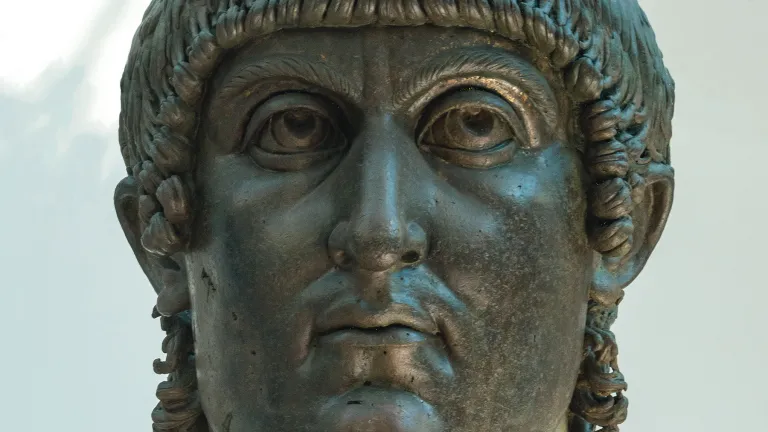
Historian Stewart Easton explains how and when the change occurred—with the help of the Roman emperors. "Constantine [A.D. 306-337], though not baptized a Christian until he was on his deathbed, took an active interest in the [Christian] religion, presiding over the important Council of Nicea ... During the fourth century, under imperial protection ..., the Christian religion ... made rapid progress, even in the rural areas where the old gods had never altogether lost their appeal. When at the end of the century (A.D. 392) [Emperor] Theodosius I decreed that henceforth Christianity was to be the only religion in the [Roman] empire, the countryside perforce had to submit and adopt at least the forms of Christianity. But it would probably have been difficult for any observer to detect much difference ... It is clear that these folk knew little enough of the teachings or theology of Christianity, and the festivals and ceremonies of paganism for the most part were incorporated directly into the new official religion (The Heritage of the Past: From the Earliest Times to 1500, 1964, p. 402, emphasis added).
Charles Guignebert, who was a professor of the history of Christianity at the University of Paris, describes the continuation of the process: "Now at the beginning of the fifth century, the ignorant and the semi-Christians thronged into the Church in numbers ... They had forgotten none of their pagan customs ... The bishops of that period had to content themselves with redressing, as best they could, and in experimental fashion, the shocking malformations of the Christian faith which they perceived around them ... They had to be content with ... postponing until a later date the task of eradicating their superstitions, which they preserved intact ... This 'later date' never arrived, and the Church adapted to herself, as well as she could, them and their customs and beliefs. On their side, they were content to dress up their paganism in a Christian cloak" (The Early History of Christianity, 1927, pp. 208-210, emphasis added).
During this time—in the early centuries after the passing of the original apostles—observance of biblical practices, including the seventh-day Sabbath and God's festivals, practically disappeared from the new and growing religion. They were replaced with other practices and a new set of religious holidays.
Prophecy, however, reveals that God will require the whole world to observe these same biblical festivals in the future. For example, Zechariah prophesies that God will require people to attend the Feast of Tabernacles after Christ returns (Zechariah 14:16). Isaiah prophesies that people of all lands will regularly keep the weekly Sabbath during Christ's millennial reign (Isaiah 66:23). Isaiah and Micah prophesy of that time: "Many nations shall come and say, 'Come, and let us go up to the mountain of the LORD, to the house of the God of Jacob; He will teach us His ways, and we shall walk in His paths.' For out of Zion the law shall go forth, and the word of the LORD from Jerusalem" (Micah 4:2; compare Isaiah 2:3).
Some faithful Christians to this day observe the sacred festivals, the same festivals of God that Christ kept. God instituted these annual occasions to keep His people aware of Christ's mission as the Messiah. These sacred days really are Christian festivals in every respect, and Christians everywhere should observe them.