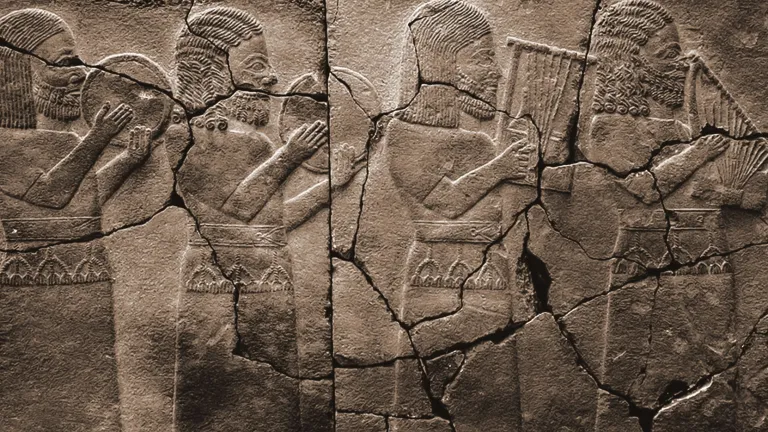
A Staggering Archaelogical Discovery: The Mighty Assyrian Empire Emerges From the Dust

One of the greatest archaeological discoveries of all time is the unearthing of the ancient Assyrian Empire. Did the biblical stories involving this empire really happen, or are they fables?
Ranked among the greatest archaeological discoveries of all time is the unearthing of the ancient Assyrian Empire.
Assyria first appeared as an empire early in the second millennium B.C. The remains of a ziggurat, or temple tower, from that era still stand near the site of its ancient capital.
In the ninth century B.C., Assyria developed into an aggressive and powerful empire. By this time, about 40 years after the reign of Solomon, Israel had split into two distinct kingdoms—Israel and Judah (1 Kings 12:16-24). Led by able and ruthless monarchs, the Assyrians began to menace and conquer their neighbors. They eventually subjugated the whole of the Fertile Crescent from Mesopotamia to Egypt. By the late eighth century they crushed the kingdom of Israel.
About this same time they also invaded the southern kingdom of Judah, conquering its major cities and besieging its capital, Jerusalem (Isaiah 36:1-2). The Bible records the boastful words of the arrogant Assyrian monarch, Sennacherib, as he tried to intimidate and humiliate Hezekiah, king of Judah (Isaiah 36:4-10).
Did the biblical stories involving this empire really happen, or are they fables? Remember, many scoffers at one time disputed even the very existence of the Assyrian Empire. But it was no myth. As the debris of centuries was removed from Nineveh, one of the empire's capitals, dramatic proof of the Assyrian invasion was laid bare.
Assyrian records of these events quote King Sennacherib of Assyria boasting of his devastating invasion of Judah: "Forty-six of [Hezekiah's] strong walled towns and innumerable smaller villages...I besieged and conquered...As for Hezekiah, the awful splendor of my lordship overwhelmed him" (Erika Bleibtreu, "Grisly Assyrian Record of Torture and Death," Biblical Archaeology Review, January-February 1991, p. 60). Sennacherib noted that he had made Hezekiah "a prisoner in Jerusalem, his royal residence, like a bird in a cage" (Magnus Magnusson, Archaeology and the Bible, 1977, p. 186).
The biblical record agrees with Sennacherib's account of the Assyrian invasion and notes the desperation of the kingdom of Judah as the Assyrians laid siege to Jerusalem, their last surviving stronghold. However, the Bible continues the story where the Assyrian records are silent. With Jerusalem facing imminent destruction, the people of Judah, led by King Hezekiah, prayed fervently to God (Isaiah 37:15-20) and were miraculously delivered against overwhelming odds.
Sennacherib, the warrior king, had bragged about his humbling of Hezekiah, trapping him in Jerusalem as he surrounded and prepared to storm the city.
Although Sennacherib painstakingly recorded the cities he captured and destroyed, one city is conspicuously absent—Jerusalem. He speaks only of besieging Hezekiah in the city—not of taking it or Judah's king. What happened? The Assyrians, like other great empires of the time, left no records of their military defeats. As the Bible reports, disaster befell them as they waited to storm Jerusalem's walls:
"And it came to pass on a certain night that the angel of the Lord went out, and killed in the camp of the Assyrians one hundred and eighty-five thousand; and when people arose early in the morning, there were the corpses—all dead. So Sennacherib king of Assyria departed and went away, returned home, and remained at Nineveh" (2 Kings 19:35-36).
Sennacherib himself would later ignominiously die at the hands of two of his sons. "Now it came to pass, as he was worshiping in the temple of Nisroch his god, that his sons Adrammelech and Sharezer struck him down with the sword " (2 Kings 19:37). Assyrian records also confirm this assassination. Sennacherib's son Esarhaddon took his father's place, but the Assyrian Empire soon peaked and fell into decline. Assyria had been an instrument to punish Israel for its repugnant sins (Isaiah 10:5-6). In turn, the Assyrians were punished for their sins (Isaiah 10:12). Nineveh, the capital city, fell to the Babylonians in 612 B.C. About 50 years after its peak, this voracious empire collapsed and virtually vanished from history.
By the time of Jesus Christ and the apostles, no physical evidence of Nineveh could be seen. Lucian of Samosata (A.D. 120-180), a Greek writer, lamented: "Nineveh has perished. No trace of it remains. No one can say where once it existed" (Magnusson, p. 175). Such a lack of visible remains led some scholars of the 19th century to express skepticism that Nineveh or any part of the Assyrian Empire even existed, much less dominated a significant part of the world.
Indeed the only historical source in those days that verified the existence of the empire was the Bible. The Old Testament histories and prophecies spoke about Assyria. Jesus proclaimed the existence of Nineveh as a historical fact (Matthew 12:41). Yet some scholars disputed the testimony of Jesus and the prophets—that is, until "one spectacular decade in the middle of the nineteenth century...[when] Austen Henry Layard and Paul Emile Botta rediscovered in northern Iraq the ancient remains of three Assyrian cities [including Nineveh] and evidence of the military panoply that had crushed all resistance from the Tigris to the Nile. The Assyrian empire...in all its awesome power had been resurrected through archaeology" (Magnusson, p. 175).
The skeptics were silenced. There was nothing they could say. The excavations at Nineveh and other cities in the area yielded a staggering wealth of historical evidence including "tens of thousands of tablets" containing "an immense amount of data" (The Interpreter's Dictionary of the Bible, 1962, Vol. 1, "Assyria and Babylon," p. 275). The Bible had been right all along.