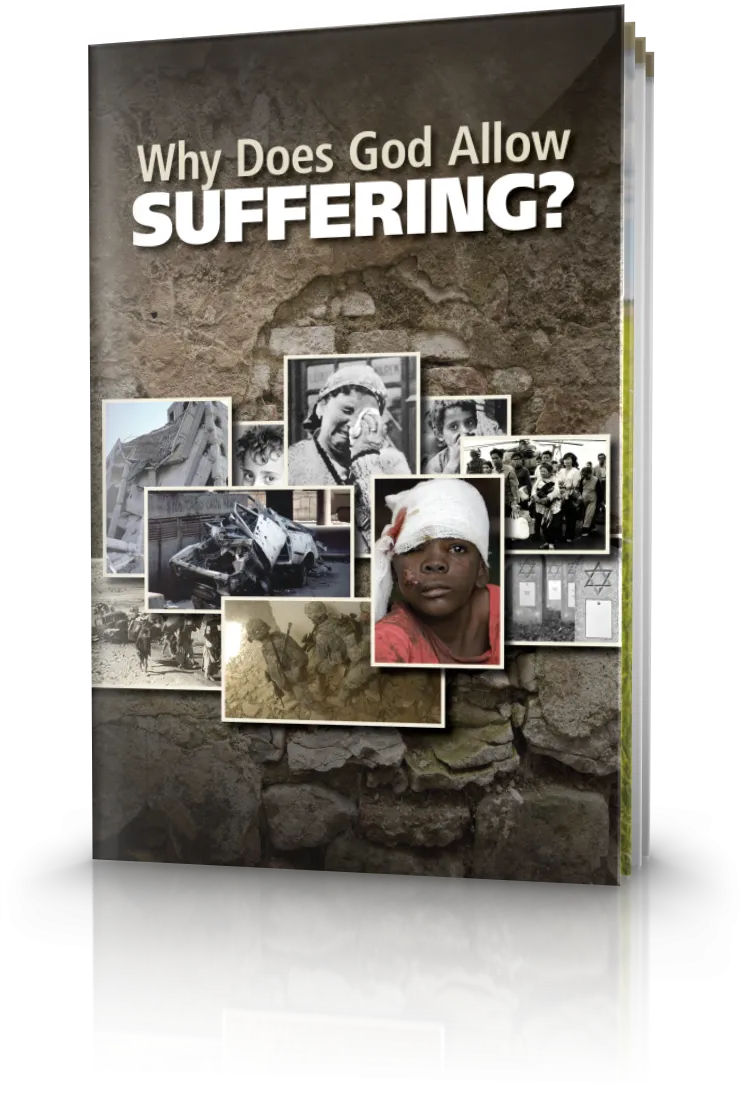
Why a Loving God Allows Suffering

If God is truly a God of love and mercy, why does He not intervene?
Some have concluded that God simply doesn't exist. The answer, however, is much more complex. What does the Bible reveal about the causes of suffering?
British author and historian Paul Johnson writes of one of mankind's greatest theological dilemmas in his book The Quest for God, stating,"I suspect that the problem of evil drives more thoughtful people away from religion than any other difficulty" (1996, p. 61).
Many people believe that if God is truly the God of love and mercy, He would be bound by His own character and principles to prevent suffering in the world. This brings up a good question. Why doesn't God intervene to prevent suffering?
The evil that God allows, and the tragedies He chooses not to prevent, leads many to question the wisdom, goodness and even existence of God. Some atheists cite the reality of evil as their trump card in the argument about the existence of God. Julian Huxley, one of the 20th century's leading proponents of evolution, opined that the existence of evil "is a challenge to God's moral character" (Religion Without Revelation, 1957, p. 109).
Huxley concluded that divine revelation and a divine Revealer do not exist. (For proof that God is indeed real and evolution a fable, please read our free booklets Life's Ultimate Question: Does God Exist? and Creation or Evolution: Does It Really Matter What You Believe?)
Why does God allow evil? Anyone who has ever felt pain or experienced tragedy wonders about this. Theologians, philosophers, historians and scientists have mused over the issue. Let's consider some of their conclusions.
An evil God vs. a good God?
The second-century gnostic teacher Marcion, who was declared a heretic because of his views, believed that "there were two rival Gods: one, the tyrannical creator and lawgiver of the Old Testament; the other, the unknown God of love and mercy who sent Jesus to purchase salvation from the creator God" (Webster Encyclopedia, one-volume edition, 1985, p. 561).
In Marcion's view the lawgiver God was responsible for the existence of pain and evil, and the work of the Savior was to deliver the world from the pain and evil caused by that God. Ironically, this erroneous outlook was modified and refined by others and gradually took root in the body of the doctrine of the mainstream church, where its influence has fostered confusion and misunderstanding to this day.
Many assume God angrily intervenes to punish us whenever we step out of line, when in reality He generally allows us to suffer the consequences of our own selfish, shortsighted behavior (see Jeremiah 2:19; Jeremiah 10:23). Most people fail to recognize that God doesn't have to directly intervene every time we sin; the spiritual laws He set in motion are self-enforcing, bringing their own punishment in the form of painful consequences when we break them.
Is this God's handiwork?
Historians have addressed the seeming contradiction of a world created by God but replete with evil. The English historian Arnold Toynbee noted that "one of the conclusions that have been drawn by human spectators of the moral evil of the Universe is that this chamber of horrors cannot be any God's handiwork" (A Study of History, abridged version, 1957, Vol. 10, p. 300).
Toynbee recognized that much of the world's suffering is caused by the misrule of tyrants. Scripture shows that God can remove wicked men from power (Daniel 2:21). He humbled and removed Babylon's King Nebuchadnezzar, the mightiest ruler of his era. As an emperor over many conquered peoples, Nebuchadnezzar "executed whom-ever he wished" (Daniel 5:18-19). Yet God brought him down to size, neutralizing his influence for seven years.
So why doesn't God do this more often? Nebuchadnezzar, in his pomp and arrogance, caused only a fraction of the misery inflicted by some dictatorial rulers of our era.
Physicist Paul Davies reflects on this side of the good-vs.-evil argument. He considers the issue of why God, if He truly is all-powerful, does not simply intervene and stop all evil. "Is God free to prevent evil?" Davies wonders. "If he is omnipotent, yes. Why then does He fail to do so?" (God and the New Physics, 1983, p. 143).
Davies' questions are reasonable. Is God powerless in the face of suffering? If He exists, why doesn't He act to remove evil and pain from the face of the earth? The questions are troubling, though not because they are hard to understand. They are unsettling because the answers are not what we would want them to be.
The truth of the matter forces us to reconsider our ideas about God and His plan and purpose for us. When we understand those, we understand that God has His reasons for not acting now.
A greater purpose?
Why doesn't God simply ban evil? To understand the answer, we must consider the consequences such an action would bring.
Understanding why God allows evil and its resultant suffering requires a fundamental understanding of one of God's greatest gifts—as well as how man has continually abused that gift.
The gift is free will—or, as it is more popularly called, freedom of choice. God granted this freedom to our first human parents, Adam and Eve, at creation. But over the millennia we have proven ourselves to be woefully inept stewards of this precious gift and its far-reaching responsibility.
As God explained to ancient Israel, the freedom to make choices is essential to developing righteous character (Deuteronomy 30:15-19). Without freedom to choose, we would be little more than robots, with our behavior either preprogrammed and unchangeable or dictated in all its details by an outside force such as God Himself.
But that is not God's intent. He has different expectations of us because of His much higher purpose for us. He wants us to choose to obey Him from the heart. He wants us to enthusiastically love and cherish His values and standards, which are based on two overriding principles —loving Him with all our hearts and loving others as much as we love ourselves (Matthew 22:35-40).
As we will see, choosing to obey God and learning to love others when we have the freedom to do otherwise is vital for the future God has planned for us.
Different levels of decision making
Of all the earth's physical creatures that God has made, man alone can exercise free will. Simpler life-forms, such as microbes and insects, are preprogrammed to react in certain ways to certain stimuli. They behave in accordance with their environment and have virtually no independent decision-making abilities in the sense that man does.
The actions of more-complicated life-forms, such as mammals, are also largely governed by instinct, though they do make rudimentary decisions when reacting to stimuli and adapting to situations.
Human beings alone among earthly creatures have an advanced sense of time. Ecclesiastes 3:11 says that God "has put eternity in [our] hearts." In other words, we can contemplate the future. We make far-reaching decisions and plan our lives months and years in advance.
We also study the past; we have a sense of history. We learn lessons from our experiences and the experiences of others. God gave the capacity for advanced decision-making abilities only to man among His earthly creation.
God designed human beings to make choices. Yet we have never learned how to make consistently wise and properly informed choices. Nor have we learned how to effectively manage our emotions, motives and desires and their influence on our decisions.
The first exercise of man's freedom of choice
Our freedom to decide what we want to do can result in acts of good or evil. God gave us freedom both to reach out and help our fellow man and freedom to act self-servingly and in ways that harm ourselves and others.
We frequently exercise our freedom of choice in wrong ways, and we reap the consequences—which take the form of often-unexpected penalties. This is nothing new; it occurred in the Garden of Eden with the first human beings, Adam and Eve.
God had placed two trees in the garden. One was the tree of life and the other the tree of the knowledge of good and evil (Genesis 2:9). God told Adam he could eat of the former, but he was not to partake of the latter: "Of every tree of the garden you may freely eat; but of the tree of the knowledge of good and evil you shall not eat, for in the day that you eat of it you shall surely die" (Genesis 2:16-17).
As the book of Revelation explains, the tree of life symbolized obedience to God that would ultimately lead to eternal life (Revelation 2:7; Revelation 22:1-2). The other tree—the tree of the knowledge of good and evil—represented rejection of God's direction by determining good and evil for oneself. This choice would eventually lead to death.
Eve, tempted by the serpent, exercised her free will unwisely and was deceived (2 Corinthians 11:3). She rationalized her way around God's instruction. Although the apostle Paul tells us that Adam was not deceived (1 Timothy 2:13-14), he allowed his wife to persuade him to join her in disobeying God (Genesis 3:17).
Adam's full realization of his actions made him all the more guilty for what happened; God held him responsible even more so than Eve. Nevertheless, acting together they chose to listen to and follow the serpent (Genesis 3:1-6), identified in Revelation 12:9 as the devil and Satan. (To better understand Satan's influence, be sure to read Is There Really a Devil?)
Adam and Eve reaped the consequences of their sin. God told them they would die—and eventually they did—but the immediate consequence was that God expelled them from the garden and cut them off from the tree of life.
Now they had to make their own way in a difficult world (Genesis 3:22-24). They were left to their flawed wisdom—their own judgment (Genesis 3:6). Life from that point would include sorrow, pain and toil because of their rebellion against God's clear instruction (Genesis 3:16-19).
Since that time "all have sinned" (Romans 3:23; Romans 5:12) and reaped the penalties Adam and Eve incurred.
Many people disdain the Bible because it includes many accounts of people's bad behavior. Yet we should understand that Scripture, in part, is a historical account of the sinful way of life man chose when he rejected God's commandments and reaped the resulting consequences.
God inspired the recording of the lessons in the Old Testament so that we might learn from the experiences of others (1 Corinthians 10:6-11; Romans 15:4). Although the New Testament includes similar lessons for us, its focus is mostly on the message of the Kingdom of God and the good news that God sent His Son to save us from our sins (John 3:16). It also reveals how suffering and sorrow will eventually cease.
A choice of blessings or curses
About 2,500 years after Adam and Eve, God offered tangible relief from suffering to the Israelites. He began working with them while they were still in bondage in Egypt. He promised not only to free them from slavery but to give them the opportunity to be a model nation others would want to emulate (Deuteronomy 4:5-8).
As a part of God's agreement with them, they were to become His obedient people (Exodus 19:5). He instructed them in the 10 cardinal points of His eternal, spiritual law—the Ten Commandments (Exodus 20:1-26). He gave them additional laws and statutes, which we find primarily in the books written by Moses (the Pentateuch).
That law, He told them, would be their "wisdom" and "understanding in the sight of the peoples who will hear all these statutes, and say, 'Surely this great nation is a wise and understanding people'" (Deuteronomy 4:6).
God told the Israelites they had the freedom to choose between the two ways of living: "I call heaven and earth as witnesses today against you, that I have set before you life and death, blessing and cursing; therefore choose life, that both you and your descendants may live; that you may love the LORD your God, that you may obey His voice, and that you may cling to Him, for He is your life and the length of your days" (Deuteronomy 30:19-20).
He informed them that if they obeyed they would reap many blessings (Deuteronomy 28:2), but if they disobeyed they would be accursed (Deuteronomy 28:15). Many of the curses God said would result from disobedience (Deuteronomy 28:15-68) are virtually identical to the pain and suffering that wrack modern nations. Some of these troubles would affect the nation as a whole. Others were to be personal afflictions, both physical and mental.
Regrettably, Israel disobeyed and reaped terrible misery that God foretold. These included agricultural catastrophes, poverty, family problems, ill health, crime and violence, military defeats and eventual captivity.
After the Israelites' centuries-long experiment with freedom of choice—during which they consistently chose to ignore God and do things their own way—they were returned to a state of national enslavement.
Cause and effect: often overlooked
God has often tried to impress on man the crucial principle that every effect has a cause. But we have difficulty grasping this truth, so we continue to suffer the debilitating effects of our transgressions.
We can trace many tragedies and much suffering to our own all-too-human actions and decisions. In a world of freedom of choice, some choices inevitably lead to harmful and painful results.
Actions yield consequences. Many people recognize the saying "You reap what you sow," but they do not realize that it comes from the Bible (see Galatians 6:6-7). Proverbs 22:8 says that "He who sows iniquity will reap sorrow."
When we analyze the phenomenon of suffering, we can learn much if we will trace the circumstances back to their cause. Proverbs 22:3 warns us to consider the long-term consequences of our actions: "A prudent man foresees evil and hides himself, but the simple pass on and are punished."
When we look for the main causes of suffering, we often need look no further than ourselves—the decisions and actions of individuals and humanity as a whole. In one way or another sin is usually the underlying cause, and suffering is the effect.
Causes of misery
Nations and individuals suffer many miseries because of ignorance of and disobedience to the same spiritual laws of God that Israel disobeyed. God's commandments are living laws, with universal application, providing benefits for obedience and punishments for disobedience. His inspired Word tells us that those who love His law have "great peace" (Psalm 119:165), but the way of the lawless and unfaithful is difficult (Proverbs 13:15).
The Bible points to many agonizing human experiences that are direct results of sin. One such example is military aggression. The apostle James wrote of the origin of armed conflict: "Where do wars and fights come from among you? Do they not come from your desires for pleasure that war in your members? You lust and do not have. You murder and covet and cannot obtain. You fight and war" (James 4:1-2).
These words apply to nations as well as individuals, since nations are simply groups of people looking out for their own interests. Aggressors go to war out of a desire to enhance their power, prestige and wealth. In so doing they thrust aside law, ethics, morality and peace. They kill and maim to further their ends, putting into practice the might-makes-right principle and the maxim that to the victor go the spoils.
Will and Ariel Durant understood this human tendency when they wrote in The Lessons of History: "The causes of war are the same as the causes of competition among individuals: acquisitiveness, pugnacity, and pride; the desire for food, land, materials, fuels, mastery" (1968, p. 81).
Ironically, nations that freely choose violence, including warfare, often inherit a fate similar to that of the countries they crush. Jesus understood this when He said: "All who take the sword will perish by the sword" (Matthew 26:52). History is a chronicle of the succession of empires conquering and being conquered. Mankind is doomed to repeat the cycle as long as disobeying God remains our chosen way.
Decisions have consequences
Many forms of suffering are simply the inevitable consequences of personal decisions. For example, in many advanced nations pockets of poverty persist in spite of billions of tax dollars spent to combat the problem.
Often that poverty can be traced to individual decisions. Students drop out of school, cutting short their education and consigning themselves to lifetimes of difficult jobs, low wages, financial hardship and frustrated ambitions.
Many teenagers become sexually active, with millions of girls giving birth out of wedlock to children who may never see their fathers. Studies have shown that children abandoned by their fathers are far more likely at an early age to turn to drugs, alcohol and tobacco, adopt criminal behavior and become sexually promiscuous in their own turn, bringing suffering on themselves and others.
Many young mothers—often unmarried because the fathers ran from responsibility—find themselves trapped in low-paying jobs with young mouths to feed and forced to rely on handouts, usually from the government or charities, to survive. The pattern repeats itself in a cycle of poverty spanning generations—usually because of shortsighted personal choices and actions.
Health and choices
Untold health problems plague us because of our individual decisions. We eat poorly, fail to exercise, consume harmful substances and carelessly injure ourselves and others in accidents. Many suffer from mental afflictions as a result of violating the principles governing relationships that the Bible clearly spells out.
Physical and psychological problems result from the abuse of alcohol and other drugs. Such abusers not only risk taking years off their own lives, but their habits exact a huge toll on their families and friends. Even more tragically, many abusers are involved in accidents that cripple or take the lives of innocent bystanders.
The physical harm caused by smoking is solidly documented. Smoking-related illnesses take 400,000 lives each year in the United States and millions more worldwide. Many of these deaths are excruciatingly painful and slow. We readily acknowledge that the best cure for the grief caused by smoking is simply to quit, yet many are so addicted they spurn this obvious solution.
Smoking is but one of many behaviors that cause pain. Dr. Paul Martin notes that instances of seemingly innocuous behavior can add up over time: "There are plenty of commonplace behavior patterns that kill people gradually but in huge numbers" (The Healing Mind, 1997, p. 58).
In a book with Philip Yancey, Dr. Paul Brand reported that, at a major national health conference, he began a list of the serious behavior-related health problems on the agenda that take a serious toll on Americans' health. They include "heart disease and hypertension exacerbated by stress, stomach ulcers, cancers associated with a toxic environment, AIDS, sexually transmitted diseases, emphysema and lung cancer caused by cigarette smoking, fetal damage stemming from maternal alcohol and drug abuse, diabetes and other diet-related disorders, violent crime, automobile accidents involving alcohol. These were the endemic, even epidemic concerns for health experts in the United States" (The Gift Nobody Wants, 1993, pp. 226-227).
In making decisions that lead to such problems, our bodies often alert us to the dangers. Brand and Yancey note that "an astounding proportion of the health problems stem from behavior choices that show disregard for the body's clear signals" (p. 226).
We reap what we sow
The conclusion should be obvious. Much suffering is caused by wrong choices. The Bible offers guidance as to how we should live. Yet as far back as Adam and Eve we have repeatedly spurned God's instruction and brought enormous pain and sorrow on ourselves.
The Bible offers practical advice on virtually all aspects of life. Many of its principles reveal how to avoid—and to some extent relieve—suffering. (We have compiled much of this guidance in Making Life Work, a booklet showing that many things in life go better if we simply apply principles God reveals in His Word.)
We cannot live substantially free from suffering until we are reconciled to God and His commandments: "My son, do not forget my law, but let your heart keep my commands; for length of days and long life and peace they will add to you" (Proverbs 3:1-2, emphasis added throughout).
Were we to follow God's instruction on a national scale, we would see immediate and drastic reductions in crime, disease, hostilities between nations, pollution, accidents, mental illness, broken families, shattered relationships and many other phenomena that cause us grief. God's law is not harsh or onerously restrictive. It is a law of liberty (James 1:25) that would eliminate most of the world's pain if it were universally obeyed.