Reconciliation: The True Path to Healing and Salvation
Someone has already shown the way to a harmonious relationship with not only our Creator, but also our fellow men and women. So where and how do we start on this path to reconciliation?
As human beings, we were created to develop deep, long-lasting relationships with one another. When those bonds are severed through misunderstandings and perhaps abuse, we feel incomplete, isolated and without purpose.
But how does one begin the healing process? Human empathy can prove very helpful and is often essential to positive progress. The one providing the empathy, however, is sometimes limited in his or her capacity to completely understand and identify with the wounded spirit. King Solomon wrote, "The spirit of a man will sustain him in sickness, but who can bear a broken spirit?" (Proverbs 18:14).
Who will help us?
So who should be our ultimate comforter and helper? Who can transcend the limited scope of human help? Who can encourage us out of our dejections and point us toward the healing and salvation we desire?
The truest consolation available comes from an individual always willing to help, One who Himself has experienced painful rejection and even betrayal. The Scriptures show that He was "rejected by men" and "a Man of sorrows and acquainted with grief" (Isaiah 53:3). He even knew what it was like to face rejection by His own people. "He came to His own, and His own did not receive Him" (John 1:11).
Knowledge of this "Man of sorrows" who is unique among all who have ever lived—understanding that He suffered the most brutal sort of rejection and betrayal and successfully overcame them—can bring us much closer to the healing we are seeking.
But how can we reconstruct broken bonds and rebuild right relationships? How can we be reconciled first to our Creator and then to our fellow men and women?
Scripture tells us that God desires a positive relationship with us, but it also tells us that "your iniquities [sins] have separated you from your God" (Isaiah 59:2, emphasis added throughout). To fulfill His great purpose and to reconcile human beings to their Creator, the penalty for breaking God's law had to be paid. Someone had to redeem humankind and reconcile us to God the Father.
Enter Jesus Christ into the world
The experiences Jesus Christ went through have been crucial in helping Him understand the serious difficulties we human beings experience during our lives. As Hebrews 4:15 tells us, "We do not have a High Priest who cannot sympathize with our weaknesses, but was in all points tempted as we are, yet without sin."
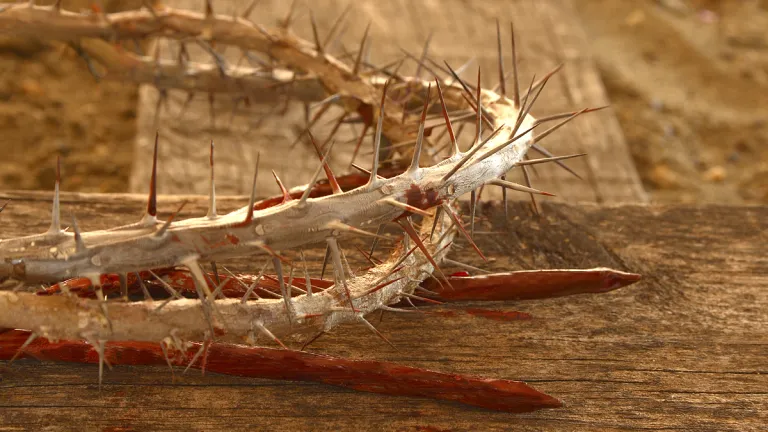
Ironically, at perhaps the most dramatic moment in human history—His crucifixion—Jesus cried out to His Father, "My God, My God, why have You forsaken Me?" (Matthew 27:46). His quoting of Psalm 22:1 occurred at the very time that the enormous gulf between God and man was about to be bridged.
But on account of what Jesus Christ represented to God for those few brief moments—the sin-bearer for all of humanity—"He made Him who knew no sin to be sin for us" (2 Corinthians 5:21).
Sin—biblically defined as the transgression of God's law (1 John 3:4, King James Version; Psalm 51:1-3)—is a major barrier to reconciliation and rebuilding right relationships with God and other people. So Jesus took the sins of humanity on His shoulders.
We have a very merciful Advocate in our Saviour, who, like the human high priests who preceded Him in that office, "is able to bear patiently with the ignorant and erring, since he too [was] beset by weakness . . ." (Hebrews 5:2, Revised English Bible).
Reconciliation requires genuine repentance and forgiveness on our part. But only God can absolve our sins and remove guilt and suffering, and this is only possible through the sacrificial death of His Son Jesus Christ. The apostle Paul wrote that "God was in Christ reconciling the world to Himself" (2 Corinthians 5:19).
Symbols of reconciliation to God
This forgiveness and reconciliation is depicted for us in Jesus Christ's final hours with His disciples. He observed the Passover with them the night before His death.
Paul recounts the events: "The Lord Jesus on the same night in which He was betrayed took bread; and when He had given thanks, He broke it and said, 'Take, eat; this is My body which is broken for you; do this in remembrance of Me.'
"In the same manner He also took the cup after supper, saying, 'This cup is the new covenant in My blood. This do, as often as you drink it, in remembrance of Me. ' For as often as you eat this bread and drink this cup, you proclaim the Lord's death till He comes" (1 Corinthians 11:23-26).
Jesus said that the wine symbolized His blood, which He would "shed for many for the remission of sins" (Matthew 26:28). God forgives our sins through Christ's precious blood, cleansing us so that we may be reconciled to God (1 John 1:7). Remember that "without shedding of blood there is no remission" of sins (Hebrews 9:22).
In just one of its dimensions, the bread represented a new way of life based on a personal relationship with Jesus Christ. "I am the bread of life . . . This is the bread which comes down from heaven, that one may eat of it and not die . . . If anyone eats of this bread, he will live forever; and the bread that I shall give is My flesh, which I shall give for the life of the world" (John 6:48-51).
From resentment to reconciliation with others
Although the Bible shows that the first and great commandment is to love God, the second one is to love our neighbor as ourselves (Matthew 22:36-40). Reconciliation to God goes hand in hand with reconciliation to other human beings (Matthew 6:15).
Yet sometimes we bless God while simultaneously cursing men and women who are made in His image and likeness (James 3:9-10). We can't seem to let go of regrettable past occurrences involving others.
Only God through Jesus Christ can help us fully divest ourselves of past misfortunes. God's intervention in our lives is the only path to the true reconciliation with our fellow man that is so essential for our emotional and mental health. But our fellowship with each other has to be firmly based on a right relationship with God and Christ (see 1 John 1:3-7).
Paul wrote, "Through Him [Jesus Christ] we . . . have access by one Spirit to the Father" (Ephesians 2:18). God's Holy Spirit helps heal serious breaches between human beings. It is the Spirit of reassurance and reconciliation. It is the Spirit of tolerance and cooperation. It is the Spirit of mutual acceptance. It is the Spirit of love—of always sincerely wanting the best for others.
We receive the Holy Spirit from God after we have genuinely repented of our past sins, received forgiveness from Him and been baptized in water (see Acts 2:37-41).
The ministry of reconciliation
Then God will enable us to participate in "the ministry of reconciliation" (2 Corinthians 5:18) through which is delivered the "the word of reconciliation" (verse 19), aptly referring to Christians as "ambassadors for Christ" (verse 20).
This magnificent ministry has a personal element. It strongly relates to other human beings as well as to our Creator. True diplomacy, encouragement, forgiveness and friendship—made possible through His Holy Spirit, part of His own divine nature dwelling within us—are all important aspects of reconciliation.
The rewards for reconciliation are infinite! No human life is complete without it. GN
Course Content

John Ross Schroeder
John died on March 8, 2014, in Oxford, England, four days after suffering cardiac arrest while returning home from a press event in London. John was 77 and still going strong.
Some of John's work for The Good News appeared under his byline, but much didn't. He wrote more than a thousand articles over the years, but also wrote the Questions and Answers section of the magazine, compiled our Letters From Our Readers, and wrote many of the items in the Current Events and Trends section. He also contributed greatly to a number of our study guides and Bible Study Course lessons. His writing has touched the lives of literally millions of people over the years.
John traveled widely over the years as an accredited journalist, especially in Europe. His knowledge of European and Middle East history added a great deal to his articles on history and Bible prophecy.
In his later years he also pastored congregations in Northern Ireland and East Sussex, and that experience added another dimension to his writing. He and his wife Jan were an effective team in our British Isles office near their home.
John was a humble servant who dedicated his life to sharing the gospel—the good news—of Jesus Christ and the Kingdom of God to all the world, and his work was known to readers in nearly every country of the world.