Thanksgiving: A Timeless Lesson

Are we aware of the true source of blessings and wealth?
The Yoruba people of West Africa have an old saying: "However far the stream flows, it never forgets its source." But, we may ask, have the people of the United States forgotten the source of their blessings?
The United States observes the national holiday of Thanksgiving, dedicated to remembering the many blessings America enjoys: hills and plains filled with mineral riches; fertile soil that grows endless crops of grain; waters teeming with fish; pastures feeding millions of head of livestock; forests for building homes, schools, hospitals and industrial complexes; two long borders on oceans providing transportation, food and natural barriers for defense.
There is more, of course. But, when we ask ourselves how we have been blessed, another question should come to mind: How grateful are we for these blessings? And, perhaps more crucial, do we remember the real source of these blessings?
Although Thanksgiving Day is an American institution, any country derives the benefits from following the biblical principle of always being thankful to God for His bountiful blessings.
The origins of Thanksgiving
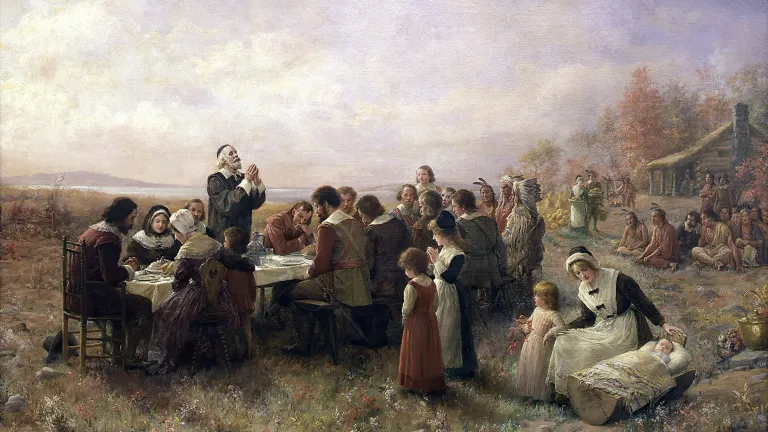
The first Thanksgiving celebration, in 1621, lasted three days. Plymouth Colony's Governor William Bradford, issued a thanksgiving proclamation, and for three days the Pilgrims feasted with their Indian guests on wild turkey and venison.
Days of thanksgiving were celebrated sporadically until President George Washington proclaimed a nationwide day of thanksgiving on November 26, 1789. He made it clear that the day should be dedicated to prayer and giving thanks to God.
Due credit for finally establishing Thanksgiving Day as a lasting national holiday goes to Sarah J. Hale, editor and founder of the Ladies' Magazine. Her editorials and letters to President Abraham Lincoln resulted in Lincoln's proclamation, in 1863, designating the last Thursday in November as a national holiday of thanksgiving. Later, in 1941, Congress adopted a joint resolution setting the date on the fourth Thursday of November.
For 376 years, and with few exceptions, this holiday has been kept. But what does it mean to us? Do we truly show our gratitude to God for His bountiful blessings, or are they merely something we've come to take for granted?
The rigors of pilgrimage
America is a nation of immigrants. In the New World, settlers sought spiritual and economic renewal. America represented an opportunity to escape war, despotism, material want and religious persecution. The New World was a place to avoid some of the problems of the Old World.
But the earliest settlements of New England were not established easily. The first permanent settlement had its origins in the restlessness of a small, devoutly religious group of Englishmen living in the Netherlands. Since they felt that their only hope was withdrawal from the established church, they were called Separatists.
Persecution had forced them to flee to Holland in 1609. Yet, after a decade in the Netherlands, the English Separatists were eager to move again. Holland's society was hospitable and tolerant, but it was too densely settled for the Separatists, who desired to remain apart from the world.
William Bradford, in his History of Plymouth Plantation, explained why the Separatists moved from Holland: "But that which was more lamentable, and of all sorrows most heavy to be borne, was that many of their children ... were drawn by evil examples into extravagant and dangerous courses, getting the reins off their necks and departing from their parents. Some became soldiers; others took upon them far voyages by sea; and others some worse courses tending to dissoluteness and danger of their souls to the great grief of their parents and dishonor of God" (Louis B. Wright, The Atlantic Frontier, Cornell University Press, Ithaca, New York, 1959, p. 105).
Another of their reasons, says Bradford, was an "inward zeal ... of laying some good foundation ... for the propagating and advancing the gospel of the kingdom of Christ in those remote parts of the world; yea, though they should be but even as stepping stones unto others for the performing of so great a work" (Wright, p. 106).
So it was that the Mayflower weighed anchor September 16, 1620, with 101 prospective settlers aboard. After 65 storm-tossed days, the Mayflower landed, not on Virginia soil that the sojourners had contracted for, but at Cape Cod. Ill and weary, the Pilgrims abandoned their hope for Virginia land and settled in New England. Throughout the rough voyage, they had lost one by death and added two by birth (ibid.).
Landing in November, they were unprepared for the harsh winter ahead. They had been led to believe glowing reports that the fertile country would have a climate similar to southern France, since the two areas lie at the same latitude. Instead, the Pilgrims were confronted with a severe winter on a rockbound coast. Come spring, half of the Mayflower passengers were dead, including 13 of the 18 married women. William Bradford led the survivors, now settled at Plymouth. His leadership would be considered strict and even harsh by today's norms, but it helped the early Pilgrims survive.
They escaped Indian attacks during that first winter. "By a freak chance, two Indians in the neighborhood, Samoset and Squanto, could speak English, and the settlers made a treaty with a tribal chief through them" (Wright, p. 108). The settlers thought it an act of God that these two English-speaking Indians were available to help them through their time of distress.
The settlement at Plymouth survived. When the Mayflower sailed for home in April 1621, not one of the settlers returned on it. By autumn, with health restored, the settlers gathered their harvest and celebrated with a feast, washing down roasted venison, wild duck and cornbread with wine made from native grapes. Thus they began the tradition of Thanksgiving that President Lincoln declared a national holiday in 1863.
Lincoln and Thanksgiving
James Russell Lowell wrote an introduction to The Works of Abraham Lincoln, State Papers, 1861-1865 (edited by John H. Clifford and Marion M. Miller, The University Society, New York, 1908, Vol. 6). In it Lowell describes the terrible conditions facing the Union and Mr. Lincoln. He especially addresses the notion that from that time forward the South and North would experience increasing difficulty feeling at ease and comfortable with one another. It was a sad time.
Note part of the "Proclamation of Thanksgiving" that President Lincoln delivered October 20, 1863: "It has pleased almighty God to prolong our national life another year. Now, therefore, I, Abraham Lincoln, President of the United States, do hereby appoint and set apart the last Thursday of November next as a day which I desire to be observed by all my fellow citizens, wherever they may then be, as a day of thanksgiving and praise to almighty God, the beneficent Creator and Ruler of the universe. "And I do further recommend to my fellow-citizens aforesaid, that on that occasion they do reverently humble themselves in the dust, and from thence offer up penitent and fervent prayers and supplications to the great Disposer of events for a return of the inestimable blessings of peace, union, and harmony throughout the land which it has pleased him to assign as a dwelling-place for ourselves and for our posterity throughout all generations" (ibid., p. 166).
These expressions of praise, thankfulness and humility can guide us in the late 20th century, as some presidents of this century have reminded us. How far have we come as a society since President Lincoln's formal proclamation?
Modern signs of ingratitude
Sadly, much of society has strayed from the moral and religious underpinnings that characterized America's earlier years. Hedonism-"If it feels good, do it"-has become the order of the day, continually evidenced in the entertainment media and modern culture. Self-oriented social fragmentation is replacing a once-common outlook of concern about our personal example and the welfare of others. Increasingly, the prevailing attitude is epitomized by the saying, "I've got mine; you get your own." These attitudes are pervasive, corrupting the lives of our children, our future leaders.
President Lincoln issued a timeless warning: Our greatest enemy is not beyond our shores, but the enemy within. On January 27, 1838, he warned his fellow Americans with these words: "All the armies of Europe, Asia and Africa combined, with all the treasure of the earth (our own excepted) in their military chest; with a Bonaparte for a commander, could not by force, take a drink from the Ohio, or make a track on the Blue Ridge, in a trial of a thousand years.
"At what point then is the approach of danger to be expected? I answer, if it ever reach us, it must spring up amongst us. It cannot come from abroad. If destruction be our lot, we must ourselves be its author and finisher. As a nation of freemen, we must live through all time, or die by suicide" (Don E. Fehrenbacher, Abraham Lincoln, Speeches and Writings, 1832-1858, Literary Classics of the United States, New York, 1989, pp. 28-29).
The unrealized link
One of the greatest basic weaknesses of human nature is that of ingratitude. The Bible has much to say about it.
After their Exodus from Egypt, the ancient Israelites spent 40 years wandering in the wilderness until the earlier, faithless generation died out. In the book of Deuteronomy, God through Moses reminded members of the new generation of the importance of obedience if they were to learn from the sad example of their parents. They were exhorted to remember God's law and their parents' lack of obedience to it. The law was to be repeated in their hearing lest they forget God's requirements and be cursed.
Moses repeated God's Ten Commandments to Israel (Deuteronomy 5). God expressed His sorrow that Israel simply didn't have the heart to obey Him consistently: "Oh, that they had such a heart in them that they would fear Me and always keep all My commandments, that it might be well with them and with their children forever!" (Deuteronomy 5:29).
Lack of obedience to God may indicate ingratitude. If we acknowledge that God's standards are superior to ours, but we fail to obey them, we indicate our lack of understanding, our personal weakness or a willfulness to disobey. All may demonstrate our lack of gratitude for what God has given us. An attitude of thankfulness, on the other hand, can help counteract this weakness.
We see these principles clearly brought out in Scripture. In Deuteronomy 8 God addresses the importance and blessings of gratitude and strongly cautions us to avoid the curses of ingratitude. "Every commandment which I command you today you must be careful to observe, that you may live and multiply, and go in and possess the land of which the LORD swore to your fathers" (Deuteronomy 8:1).
Moses reminded the people of how God had so carefully taken care of them in the wilderness. He miraculously fed them with manna 40 years, but also reminded them that "man shall not live by [physical] bread alone; but man lives by every word that proceeds from the mouth of the LORD (Deuteronomy 8:3). Their garments didn't wear, nor did their feet swell, during those 40 years in the wilderness (Deuteronomy 8:4).
Biblical warning against ingratitude
Since God was bringing His people Israel into a fertile, productive land, filled with "brooks of water, of fountains and springs, . . . a land of wheat and barley, of vines and fig trees and pomegranates, a land of olive oil and honey" as well as mineral wealth, they should have been grateful (Deuteronomy 8:7-9).
God warned them about the all-too-human weakness to give oneself, not Him, credit for what one has.
"When you have eaten and are full, then you shall bless the LORD your God for the good land which He has given you. Beware that you do not forget the LORD your God by not keeping His commandments, His judgments, and His statutes which I command you today, lest-when you have eaten and are full, and have built beautiful houses and dwell in them; and when your herds and your flocks multiply, and your silver and your gold are multiplied, and all that you have is multiplied; when your heart is lifted up, and you forget the LORD your God . . . , then you say in your heart, 'My power and the might of my hand have gained me this wealth'...
"Then it shall be, if you by any means forget the LORD your God, ... you shall perish, because you would not be obedient to the voice of the LORD your God" (Deuteronomy 8:10-20, emphasis added).
This warning against ingratitude is not for ancient Israel alone. Lack of gratitude to God is all too common across the ages! The apostle Peter exhorts his readers not to forget God's blessings and promises so freely given them (1 Peter 1:2-7).
Gratitude plays a major role in any kind of right relationship with God!
The blessings of gratitude
Most people overlook a simple fact recorded thousands of years ago: "The earth is the LORD'S, and all its fullness, the world and those who dwell therein" (Psalm 24:1). All our blessings come from God, but our actions don't always acknowledge this wonderful truth.
To its credit, America has set aside Thanksgiving Day for annually reflecting on national blessings. Of course, we should all be thankful every day of every year, but there is certainly nothing wrong with a special day every year to remind us that we should continually be thankful.
In 1621 Plymouth Colony-made up of refugees seeking religious freedom in the New World-observed the first day of Thanksgiving to honor the God who had preserved their lives through a harsh winter, then blessed them with a good summer and a plentiful fall harvest. On October 20, 1864, President Abraham Lincoln proclaimed Thanksgiving Day to be an American national holiday, a time during which he called on all its citizens to thank the great God who bestowed such great bounties on them.
All nations would do well to remember the wise axiom of the Yoruba people of West Africa: "However far the stream flows, it never forgets its source." May all peoples of the earth remember to give thanks to God, from whom all blessings flow (James 1:17).

An Article from:
Good News Magazine: November - December 1997
Course Content

Jerold Aust
Jerold Aust has served in the ministry for 52 years, as a public speaker for 58 years, a published writer for 38 years, and is employed by UCG’s Media and Communications Services. He is a Senior Writer, interviewer, and editor for Beyond Today Magazine and has taught Speech Communication for UCG’s ministerial online program and the Book of Revelation for ABC.
Jerold holds a BA in theology from Ambassador College, Pasadena (1968), an MA in Communication from California State University, Fullerton (1995), a distance-learning Ph.D (2006), and a Famous Writers School diploma in non-fiction writing (1973). Additionally, he studied post-grad communication at University of Southern California (1995), radio, TV, voice-overs, and Public Relations at Fullerton College (1995-1996), and graduate communication at Wichita State University (1978). Jerold has taught communication at the University of South Alabama (7 years) and ABC (17 years). His published works include, Ronald Reagan’s Rhetoric: Metaphor as Persuasion and EZSpeakers: Public Speaking Made Easy in 7 Steps. Jerold's overarching goal is to share with humankind its incredible destiny!