America's Declaration of Dependence on Divine Providence
Do we still perceive the need for God's guidance and blessings?
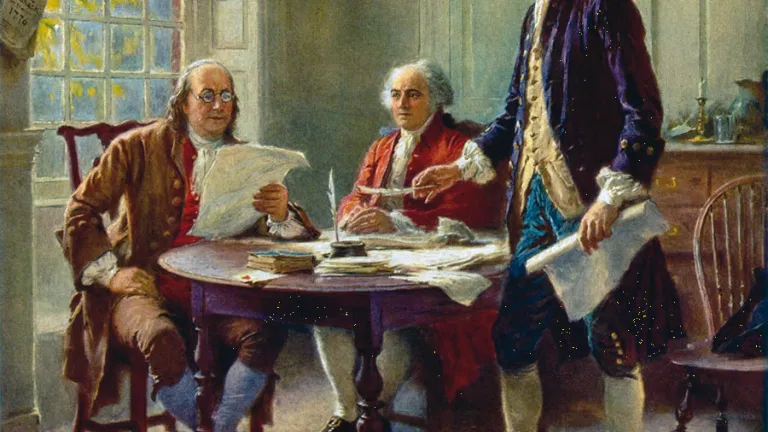
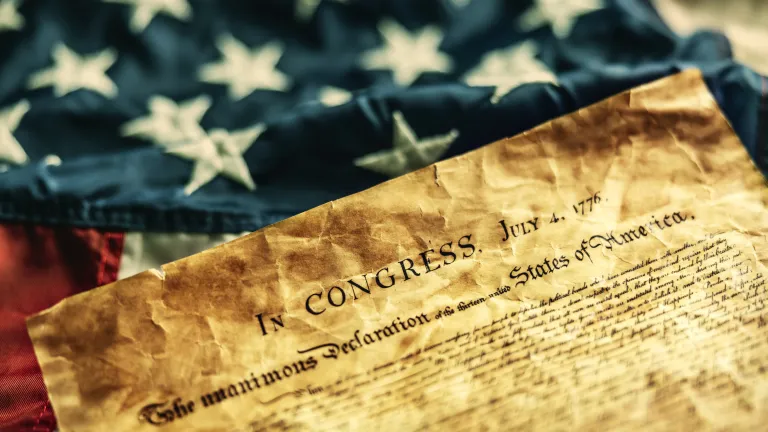
America's Declaration of Independence is as much a declaration of dependence on Divine Providence as it is a declaration of independence from an oppressive monarch.
The Continental Congress in its first session on September 6, 1774 passed this resolution: "Resolved, that the Rev. Mr. Duché be desired to open Congress tomorrow morning with prayer, at Carpenter's hall, at nine o'clock."
Prayer for divine favor
Duché's prayer on September 7, 1774 pleaded: "O Lord! our heavenly Father, high and mighty, King of kings, and Lord of lords, who dost from thy throne behold all the dwellers on earth, and reignest with power supreme and uncontrolled over all kingdoms, empires, and governments. Look down in mercy, we beseech thee, on these our American States who have fled to thee from the rod of the oppressor, and thrown themselves on thy gracious protection, desiring to be henceforth dependent only on thee … All this we ask in the name, and through the merits of Jesus Christ thy Son and our Savior. Amen" (Thatcher's Military Biography, p. 121).
The Declaration of Independence begins by attributing the States' "entitlement" to become a "separate and equal station" to "the Laws of Nature and of Nature's God" and concludes with an appeal "to the Supreme Judge of the world for the rectitude of [their] intentions."
While it certainly declares the founding fathers' intent "to dissolve the political bands" to a despotic British sovereign and lists his "repeated injuries and usurpations," it does so on the basis of "unalienable rights" and principles endowed to them by Almighty God; their Creator, the Supreme Judge of the world.
The major founding personalities—despite their varying individual beliefs regarding religious matters—acknowledge that the success of their seemingly fragile endeavor rested firmly on the grace of God.
Confirmed by Franklin and Adams
Benjamin Franklin stated in a speech to the Continental Convention: "We have been assured, Sir, in the Sacred Writings, that 'except the Lord build the House they labor in vain who build it.' I firmly believe this; and I also believe that without his concurring Aid, we shall succeed in this political Building no better than the Builders of Babel" (The Works of Benjamin Franklin, by John Bigelow, p. 377).
John Adams confirms decades later in an 1813 letter to Thomas Jefferson the original intent of those formative years: "The general Principles, on which the Fathers Achieved Independence, were the only Principles in which that beautiful Assembly of young Gentlemen could Unite…Now I will avow, that I then believed, and now believe, that those general Principles of Christianity, are as eternal and immutable, as the Existence and Attributes of God" (John Adams to Thomas Jefferson, June 28th, 1813, from Quincy in The Adams-Jefferson Letters).
The founders' unabashed declaration of dependence on Divine Providence both for the justification of their cause and for the success of their endeavor should give us pause to ponder 233 years later.
Will it last?
Are we still on the same course? Do we still perceive the need for God's guidance and blessings?
That the God who created the Universe has blessed our nation with the choicest bounties of heaven is a matter of historical fact. One can argue about the manifold faults of our nation's endeavors, but no one can dispute the historical fact that the United States of America has become the most powerful and influential nation in the history of man.
But can it last? Foreclosures on the American dream are rampant. Jobs have been exported by the thousands. Plant closings are common. Not only is it difficult to buy products made in America, it may soon become difficult to find companies that are owned by Americans.
Perhaps a business associate of mine from Pennsylvania said it best a few years ago in a discussion about some of our impending challenges. "Greed," he said, "will become our undoing."
Today's moral bankruptcy
But should this surprise us? In contrast to our founding fathers who thought it necessary to invoke the principles and favor of Divine Providence, we live in a morally bankrupt materialistic society that wants more for less yesterday and hopes to pay for it tomorrow.
As a nation we deny the existence of our Creator, worshipping instead an evolving creation. We have banned prayer from public schools, driven God from the public square, banished His Law for the courtroom and scorned His guiding principles.
Course Content

John Miller Jr
John Miller is a United Church of God minister. He has been involved in ministry in various capacities in the United States and Europe since 1993. He holds a BA in Theology and a MA in Organizational Management and is also President of SUPERB Industries, Inc.