The Mediterranean Union: Another Roman Empire?
The increasing political integration of the European Union and the development of the Union for the Mediterranean resembles the ancient map of the Roman Empire. What does Bible prophecy reveal about the Roman Empire in the end time?
A media firestorm raged as Barack Obama was greeted in the Middle East and Europe as a political superstar last week—but a potentially far more important development in that part of the world the week before garnered little attention.
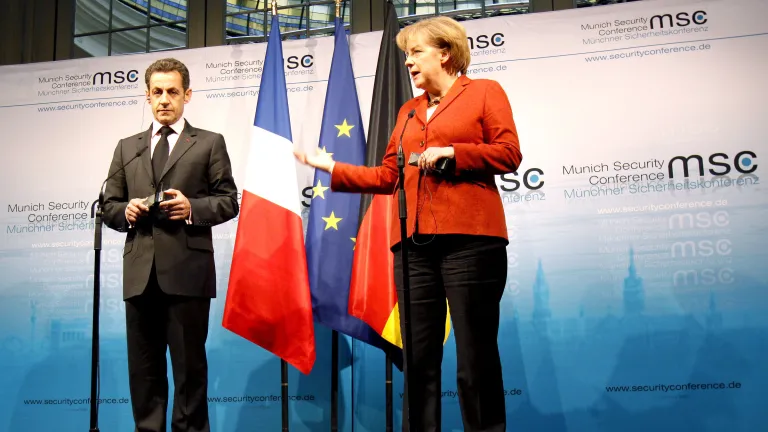
On July 13, leaders of 43 countries surrounding the Mediterranean (from Europe, North Africa and the Middle East) joined together in Paris to launch a new regional union—the Mediterranean Union or, as it's now officially called, the Union for the Mediterranean. "It brought together around one table for the first time dignitaries of such rival nations as Israel and Syria, Algeria and Morocco, Turkey and Greece" (Associated Press).
This was a dream come true for French president Nicolas Sarkozy, who championed the creation of the bloc upon assuming office just last year. Sarkozy chaired the meeting jointly with Egyptian President Hosni Mubarak—the two serving as interim presidents together, as the union is to operate under a co-presidency of north and south.
The union goes beyond the stalled 1995 Barcelona Process, in which the European Union and many of its neighbors to the south and southeast formed the Euro-Mediterranean Partnership to promote regional stability and prosperity.
Sarkozy proposed his union with grander aims—as "a means to end all hatreds, to make way for a great dream of peace and a great dream of civilization." Yet he initially limited it to nations bordering the Mediterranean with the intent of enhancing France's status.
Germany and other northern EU states, however, were outraged at being cut out of this bloc that would take on a European character and use European funds. In pushing forward with the new union, Sarkozy was ultimately pressured into inscribing it within the EU framework of the Barcelona Process.
For wider acceptance the initiative has been scaled back, so touchy issues like immigration have given way to projects on solar energy, marine pollution, and antiterrorism coordination. But it's a start, and major issues will likely follow.
Some consider Sarkozy's plan to have faltered. But if that's so, we must wonder why so many heads of state gathered to launch the union, including Arab leaders sitting down at the same table with Israel's prime minister. This was certainly a diplomatic coup.
Notably absent was Libyan leader Col. Muammar Gaddafi, who did send a representative. Angry that original plans for only a few southern European and North African states were changed to include the whole EU and the Middle East, including Israel (making it dangerous for him to support), Gaddafi boycotted the meeting, saying, "We shall have another Roman Empire and imperialist design" (quoted in The Daily Telegraph, July 10).
Indeed, you too may find that the map of this new union looks uncomfortably like the one in the back of your Bible of the ancient Roman Empire. That empire likewise surrounded the Mediterranean—the Romans taking pride in referring to it as Mare Nostrum, "Our Sea."
Frankly, Gaddafi in this case is exactly right. Another Roman Empire is indeed where things are headed even though most of the participants are themselves blind to it.
Bible prophecy reveals that the Roman Empire—the fourth in a succession of ancient empires—will be resurrected in the last days (see Daniel 2; 7; Revelation 13; 17). We have long seen this coming together in the increasing political integration of the European Union, which began with the Treaty of Rome in 1957. But in the past few years, integration has really picked up speed. And now we have a larger union encompassing the breadth of the ancient Roman Empire and then some.
Of further interest is the north-south co-presidency of the new union. A lengthy prophecy in Daniel 11 details the historical struggle in the Middle East between powers to the north and south of the land of Israel. The "king of the South" of the end time will attack the "king of the North," the ruler of Europe who will retaliate and occupy parts of North Africa and the Middle East, including Israel (verses 40-45). While North and South here are often thought to be separate political entities entirely, they could initially be participants in some sort of union who turn against one another.
In any case, those who place their hope in this union to bring peace to the Middle East and even the world will be sorely disappointed. For prophecy speaks to this as well, warning us of a time of false peace to be followed by the worst period in human history.
Course Content

Tom Robinson
Tom is an elder in the United Church of God who works from his home near St. Louis, Missouri as managing editor and senior writer for Beyond Today magazine, church study guides and the UCG Bible Commentary. He is a visiting instructor at Ambassador Bible College. And he serves as chairman of the church's Prophecy Advisory Committee and a member of the Fundamental Beliefs Amendment Committee.
Tom began attending God's Church at the age of 16 in 1985 and was baptized a year later. He attended Ambassador College in both Texas and California and served for a year as a history teacher at the college's overseas project in Sri Lanka. He graduated from the Texas campus in 1992 with a Bachelor of Arts in theology along with minors in English and mass communications. Since 1994, he has been employed as an editor and writer for church publications and has served in local congregations through regular preaching of sermons.
Tom was ordained to the ministry in 2012 and attends the Columbia-Fulton, Missouri congregation with his wife Donna and their two teen children.