"Pink" Politicians are "in"
The major political parties in Germany are traditionally identified by color. Conservatives are black, socialists red, liberals yellow and environmentalists green. Now a new color has arrived on the political scene: pink.
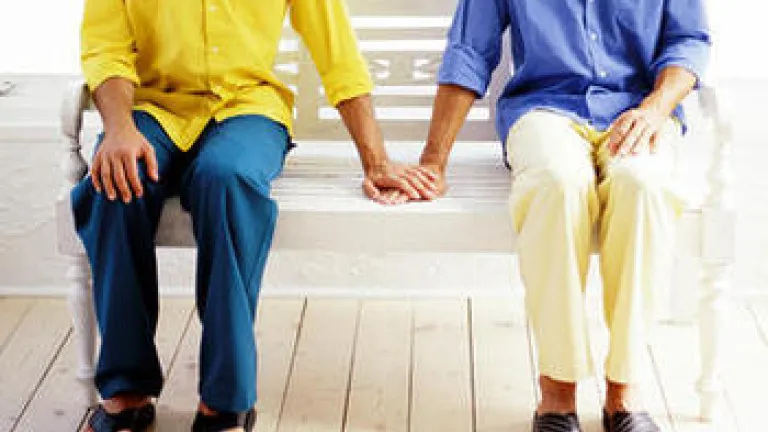
Pink is the color now associated with the gay rights movement. In contrast to the other colors already mentioned, "pink" politicians do not represent a single party. Instead, they are found in influential positions in all of Germany's main parties, including those parties that use the term "Christian" in their names.
It is quite a media event when a politician confesses to being pink. The latest example, made public only two weeks ago, is Guido Westerwelle, chairman of the liberal Free Democratic Party. According to surveys, Westerwelle's party is likely to become a junior partner in a new government when the next national election is held in 2006. If the election results validate current surveys, Westerwelle would then become Germany's foreign minister — the Federal Republic's first professing homosexual foreign minister.
Politicians in Germany openly court the gay vote. The "Christopher Street Day" parade in July each year in Cologne attracts nearly a million spectators, including a number of well-known politicians. This year's parade featured Berlin's mayor Klaus Woworeit as grand master, a homosexual who announced his sexual preference in a speech at a party convention with the words "I'm gay, and it's good that way!"
Just a couple of days after announcing his sexual preference, Guido Westerwelle voiced support for giving gay civil unions full marital status and expanding adoption rights for gay couples. "If the choice is between having a child grow up in a protected, loving environment or in an orphanage, then the decision should be made in favor of the protected environment" was the explanation Westerwelle offered for his position.
The situation in Germany is no different than in other Western countries. The gay rights movement is slowly but surely redefining "marriage" and "family" in a society that rejects absolute standards of moral behaviour.
This hardly seems what those delegates to the United Nations General Assembly had in mind on December 10, 1948 when they adopted the UN "Universal Declaration of Human Rights." Article 16 of that declaration states that "men and women of full age, without any limitation due to race, nationality or religion, have the right to marry and to found a family." The same article declares that "the family is the natural and fundamental group unit of society and is entitled to protection by society and the State."
Can there be any doubt that those delegates more than 50 years ago wanted to protect the natural marriage union and family, comprised of a husband, wife and children? Similarly, the men who voted for Germany's constitution in May 1949 could not have imagined that their country's highest court would need to decide 53 years later whether a homosexual partnership fulfills the meaning of Article 6 of that constitution: "Marriage and family enjoy the special protection of the state."
Today's society is rapidly redefining marriage and family, the basic building block of any community, in a manner never intended by those who used these terms in establishing basic civil rights for any number of nations.
Is the definition of marriage and the family subject to democratic whim and changing majorities? Or is there a standard set for all time that we can use in defining these key relationships? The Bible offers the same definition of marriage that the founders of the United Nations and the original crafters of modern Germany’s constitution had in mind (Genesis 2:18-24, Matthew 19:4-5). The Apostle Paul clearly states that homosexuality is not an acceptable alternative life style (Romans 1:24-27, 1 Corinthians 6:9-10).