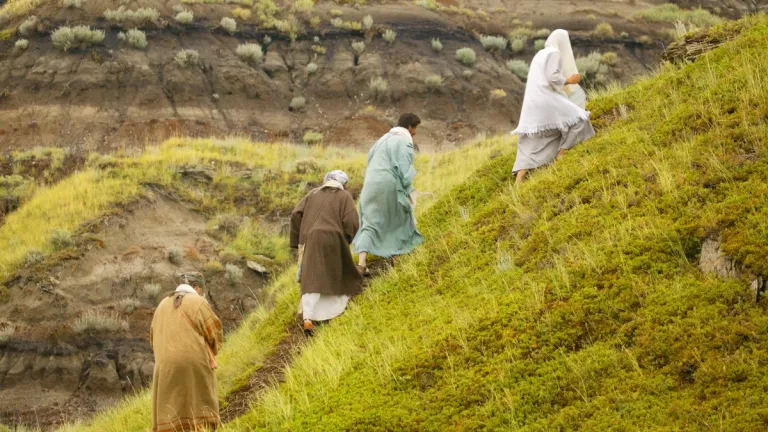
Profiles of Faith: John - An Apostle of Godly Love

John was an apostle who reflected God's love. He taught the truth and worth of godly love and left us an outstanding example.
The apostle John had an impressive biblical résumé. We first learn of him when he and his brother left their nets on the Sea of Galilee to become "fishers of men" (Mark 1:17) with Jesus of Nazareth. He helped arrange the last Passover meal and service for Jesus and his fellow disciples. He was known to the high priest and moved freely among the Jewish leadership.
If you want to know about the way of God, study Jesus Christ. If you want to know the love of Christ, study John.
John faithfully remained with Jesus' mother during her Son's crucifixion. On the morning after Jesus' resurrection, John ran with Peter to the empty tomb. He saw the risen Christ walking on the Tiberias shore. With his brother James and the other apostles, he helped establish the first church in Jerusalem. Later he served other congregations in Ephesus and Asia Minor.
As if that weren't enough, he wrote five books of the Bible: the Gospel and three letters that bear his name, and the book of Revelation.
John's Gospel and his three epistles focus on love. In His Gospel he refers to himself as that disciple whom Jesus loved.
If you want to know about the way of God, study Jesus Christ. If you want to know the love of Christ, study John.
John's background
John was a Judean Jew who knew well the geography and customs of his homeland. His meticulous attention to numbers (John 2:6; John 6:13; John 6:19; John 21:8; John 21:11), names and other details substantiates his claim as an eyewitness of Jesus and His teachings and miracles (John 19:35; John 21:24-25).
John's father was Zebedee (Matthew 4:21). His mother was apparently the Salome who served Jesus in Galilee and was present at the crucifixion (compare Mark 15:40-41 and Matthew 27:56). Salome appears to have been a sister of Mary the mother of Jesus (compare John 19:25 and Mark 15:40).
If so, then John was Jesus' cousin and probably about the same age. Since Jesus and John the Baptist were also cousins, this would also make him a cousin to John the Baptist, whose mother, Elizabeth, was a close relative of Jesus' mother (Luke 1:36).
John appears to have worked in partnership with his brother James and his father, Zebedee (Matthew 4:21), as well as with Simon Peter (Luke 5:10). He had not only his fishing business in Capernaum, complete with hired servants, but he may have also had a house in Jerusalem (Mark 1:19-20; John 19:27). He was even an acquaintance of the high priest in Jerusalem (John 18:15-16).
Originally John appears to have been a disciple of John the Baptist (he is apparently the unnamed disciple in John 1:35; John 1:40). Scripture shows that, after heeding the persuasive preaching of John the Baptist, John the future apostle was ready to take his stand with his Savior. He was one of Jesus' first five disciples (John 1:35-51). He was with Christ when He performed His first recorded miracle at the wedding feast at Cana in Galilee (John 2:2-11).
Later, John apparently returned to his fishing enterprise at Capernaum. After a while Jesus called him and his brother to leave their business and follow Him (Mark 1:19-20). From that point on, John became a close friend and an eyewitness of the words and deeds of Jesus, which he wrote about in what would become the Gospel of John.
Jesus nicknamed John a Son of Thunder (Mark 3:17). The Gospels don't explain why, but it could be because John appears to have originally had a flaring temper. Early in Jesus' ministry, for example, John forbade a stranger to use the name of Christ while casting out demons (Mark 9:38). On another occasion Jesus had to rebuke John for his hotheadedness when he wanted to call down fire from heaven onto a Samaritan village (Luke 9:52-56). Rubbing shoulders with Jesus, hearing Him speak of godly love and watching Him practice it among those who didn't appreciate Him could have been what transformed John into an apostle John was one of the three disciples of Jesus' inner circle (Mark 5:37; Mark 9:1-9; Mark 14:33). He was recognized as the one closest to Jesus.
In fact, at the 12 original disciples' last Passover together, the Bible portrays John leaning on Jesus' chest (John 13:23-25), an expression of friendship and brotherly love. If a picture is worth a thousand words, this image is priceless. John's writings explain why he was so close to Jesus: This disciple practiced the godly love he wrote about. "The disciple whom Jesus loved" John used an interesting writing style in his Gospel. Throughout the book he wrote of himself indirectly, as though he were another person. For example, five times he wrote of himself as "the disciple whom Jesus loved" (John 13:23; John 19:26; John 20:2; John 21:7; John 21:20).
Let's look a little more closely at two of the five times John referred to himself this way. In John 13, at Jesus' last Passover with His disciples, Jesus was deeply troubled because He knew Judas Iscariot was soon to betray Him. When He told His disciples, "Most assuredly, I say to you, one of you will betray Me" (John 13:21), they were worried too. They began to look askance at each other, perhaps trying to decide who might be the one of whom Christ spoke.
At that point John set the scene for the events that followed. He shares with us the remembrance that one of the apostles was leaning on Jesus' chest and referred to that specific person as the one "whom Jesus loved" (John 13:23).
As was the custom, Jesus and the disciples ate their meal reclining around a low table. In this relaxed atmosphere the disciple "whom Jesus loved" was sufficiently comfortable with his master to rest his head on Jesus' chest.
Simon Peter motioned for John to ask to whom Jesus was referring when He said someone would betray Him. So John asked, "Lord, who is it?" (John 13:24-25).
Jesus answered plainly: "It is he to whom I shall give a piece of bread when I have dipped it." Jesus dipped the bread and gave it to Judas Iscariot. He then told Judas, "What you do, do quickly" (John 13:26-27).
Amazingly, none of the disciples— including John—understood Jesus' words to Judas. Some thought He told Judas to buy necessities for the feast, while others thought He instructed Judas to give some money to the poor (John 13:28-29).
Among other information and lessons revealed in this drama, John indirectly identified himself as the one "whom Jesus loved."
John used this description to identify himself at another intense moment later that day. Even as Jesus was being crucified, He demonstrated His love for Mary, His mother.
"Near the cross of Jesus stood his mother, his mother's sister, Mary the wife of Clopas, and Mary Magdalene. When Jesus saw his mother there, and the disciple whom he loved standing near by, he said to his mother, ‘Dear woman, here is your son,'and to the disciple, ‘Here is your mother.'From that time on, this disciple took her into his home" (John 19:25-27, New International Version).
Jesus entrusted the care of His own mother to His beloved friend and follower, John. This, too, shows the closeness and trust the two shared.
This incident is telling in another way. As Christ was being put to death by the Roman authorities, John proved fearless in the face of potential accusations that he was one of Jesus' disciples. John ran the risk of being incarcerated, scourged and crucified for being an accomplice to His Master. Yet He was not afraid to be seen supporting Him in the hour of His greatest need.
His presence at Jesus' feet in His hour of trial at once validates Jesus' love for John and John's reverence for Jesus. The godly love that each had for the other reassured Christ that He could count on John to take care of His mother from that hour.
John's godly love
John lived a life of godly love. He wrote expressively about this kind of concern for others.
His Gospel is filled with many of Jesus' discourses and conversations. John in particular wrote more about what Jesus said than what He did.
John's three letters overflow with statements that help us understand how God's kind of love contrasts with the human version. Let's notice two examples.
In his first epistle, John gives us a direct definition of godly love: "For this is the love of God, that we keep His commandments. And His commandments are not burdensome" (1 John 5:3). John knew the source of godly love, understood it and practiced it. He realized that God communicates His love through the laws He gives us, the laws by which we are to live.
Jesus Himself said that God's law can be summarized in two great commandments: Love God with all your heart, soul and mind; and love your neighbor as yourself (Matthew 22:36-40). John similarly summarized God's very nature and character when he wrote, "God is love" (1 John 4:8; 1 John 4:16, emphasis added throughout).
John focused on the most important virtue and gift of God: love. God's love is different from the natural love of humans. The Greek verb for God's kind of love, agapao, means a deliberately applied concern for others. A lesser level of love, phileo in the Greek, means a fondness or affection for another person. John focused on and taught about godly love as the most important virtue a human being can exhibit.
John also contrasted godly love with human love in 1 John 4:18-21:
"There is no fear in love; but perfect love casts out fear, because fear involves torment. But he who fears has not been made perfect in love. We love Him because He first loved us.
"If someone says, ‘I love God,'and hates his brother, he is a liar; for he who does not love his brother whom he has seen, how can he love God whom he has not seen? And this commandment we have from Him: that he who loves God must love his brother also."
John recognized the contradiction in the concept that someone could love God yet hate his brother. He knew that we humans can distort the concept of love to make it mean just about anything we want it to mean. But God's love isn't like that. Godly love always puts care and concern for the other person first.
John understood godly love. He knew it because Jesus had demonstrated it to him and the other disciples. John had watched Jesus live by it and apply it for 3 1/2 years. John knew where godly love came from and how mankind should express it. He believed and practiced it with all his heart.
John on Patmos
John's Gospel includes many events and details from Christ's life. His record is more personal than that of the other three Gospels and so helps complete for us the picture of Jesus' life and teachings. John, so close to the Son of God, had opportunities few others had. When we read His Gospel from this perspective, we perceive it as an intimate narrative.
In the decade of the 90s, John, though getting on in years, was still teaching and ministering in Asia Minor. During the Christian persecutions under Emperor Domitian (81-96), he was banished to the island of Patmos, in the Aegean Sea.
Christ permitted the apostle's exile on the island for a reason. Now, some 65 years beyond Jesus' crucifixion and resurrection, He revealed to John the dark days that lay ahead—not just during his times, but especially in the troubling and tumultuous last days.
Responding to Jesus' command to "write" (Revelation 1:11; Revelation 1:19), John recorded prophecies of the great events that would transpire from his time until Jesus returned.
John gives us a loving perspective of what Christ expected of him and of us. Twice in his first chapter John uses a phrase that depicts the responsibilities of Jesus' disciples, especially in the face of persecution.
In Revelation 1:2 he writes that he bears "witness to the word of God, and to the testimony of Jesus Christ, and to all things that he saw." He repeats this instructive thought a few verses later: "I, John, . . . was on the island that is called Patmos for the word of God and for the testimony of Jesus Christ" (Revelation 1:9).
Notice that John speaks of "the word of God" and "the testimony of Jesus Christ." The word of God encompasses God's instruction, recorded for us in the Bible from Genesis to Revelation. The testimony of Jesus Christ can be defined as that which Christians live and teach from Jesus' life, instructions and example.
John was faithful to Christ in all these things in spite of the threat of persecution and death. He proved his faith and love in traumatic times, although he was now in his 90s. At one point John heard a loud voice from heaven commend all Christians who overcome Satan: "And they overcame him by the blood of the Lamb [Jesus' shed blood] and by the word of their testimony, and they did not love their lives to the death" (Revelation 12:11).
John's ordeal on Patmos, where Christ revealed to him what we know as the book of Revelation, was a series of miraculous events. Without this last book of Scripture, the people of God could not understand many details about the time of the end. John's understanding and commitment to God's love and His beloved friend and Savior made possible the writing of this book.
The apostle of godly love
Few men knew Jesus of Nazareth as well as John did. A mutual understanding and respect for the unselfish love of God bound their relationship. Jesus had special love for John, perhaps because John had such an abiding reverence for the godly love exhibited by His Master. Beyond this special relationship, some of John's personal traits may well have made him an easy person to love.
We've learned that, early in the life of John, Jesus nicknamed him a Son of Thunder. John's writings, however, reveal a completely different man. John changed his outlook as he followed in the footsteps of his Master, listening and heeding His teachings. He was highly regarded by Jesus and the other apostles and, surprisingly, apparently by the sometimes-contrary high priest. This speaks volumes of John's character.
John understood and taught godly love. He knew that God's instructions, summarized in the Ten Commandments, are an expression of love from God to mankind, then from mankind to God and human beings to other human beings. Godly love is the greatest gift God can impart to mankind and the greatest we can return to Him and share with others. John lived the love of God.
John was an apostle who reflected God's love. He learned about godly love from God, who Himself is love (1 John 4:8). John taught the truth and worth of godly love and left us an outstanding example.

An Article from:
Good News Magazine: July - August 2001
Course Content

Jerold Aust
Jerold Aust has served in the ministry for 52 years, as a public speaker for 58 years, a published writer for 38 years, and is employed by UCG’s Media and Communications Services. He is a Senior Writer, interviewer, and editor for Beyond Today Magazine and has taught Speech Communication for UCG’s ministerial online program and the Book of Revelation for ABC.
Jerold holds a BA in theology from Ambassador College, Pasadena (1968), an MA in Communication from California State University, Fullerton (1995), a distance-learning Ph.D (2006), and a Famous Writers School diploma in non-fiction writing (1973). Additionally, he studied post-grad communication at University of Southern California (1995), radio, TV, voice-overs, and Public Relations at Fullerton College (1995-1996), and graduate communication at Wichita State University (1978). Jerold has taught communication at the University of South Alabama (7 years) and ABC (17 years). His published works include, Ronald Reagan’s Rhetoric: Metaphor as Persuasion and EZSpeakers: Public Speaking Made Easy in 7 Steps. Jerold's overarching goal is to share with humankind its incredible destiny!