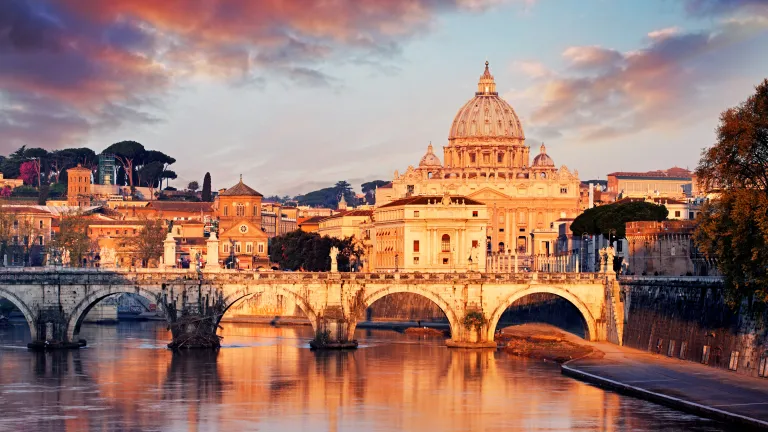
The global influence of the Roman Catholic Church, more than a billion strong, presents a number of challenges to students of the BibleThe books (Greek, "biblia" ) that are acknowledged as canonical (authoritative) by the early Christian Church. It includes both the books of the ancient Hebrew prophets and those of the apostolic witnesses to Jesus Christ..
The Good News regularly discusses popular religious beliefs maintained throughout Christendom that aren't found in the pages of the BibleThe books (Greek, "biblia" ) that are acknowledged as canonical (authoritative) by the early Christian Church. It includes both the books of the ancient Hebrew prophets and those of the apostolic witnesses to Jesus Christ. and that contradict its teachings. Further, the question may be asked: How does the Roman Catholic leadership view itself in relation to the BibleThe books (Greek, "biblia" ) that are acknowledged as canonical (authoritative) by the early Christian Church. It includes both the books of the ancient Hebrew prophets and those of the apostolic witnesses to Jesus Christ.?
Pope Leo XIII, in an encyclical letter dated June 20, 1894, stated: "We hold upon this earth the place of God Almighty."
A Catholic newspaper, The Catholic National, similarly stated in July 1895: "The Pope is not only the representative of Jesus Christ but he is Jesus Christ himself hidden under the veil of flesh."
Accordingly, the leadership of the Catholic Church has assumed the right to change biblical teaching where it sees fit. Notice this admission from the Saint Catherine Catholic Church Sentinel, May 21, 1995:
"Perhaps the boldest thing, the most revolutionary change the Church ever did, happened in the first century. The holy day, the Sabbath, was changed from Saturday to Sunday. 'The Day of the Lord' (dies domini) was chosen, not from any direction noted in the ScripturesThe divinely inspired writings of both the Old and New Testaments. The term Scripture is used in the New Testament to refer to both the Hebrew Bible (Luke 24:44-45) and the new apostolic writings accepted as inspired (2 Peter 3:16; 1 Timothy 5:18)., but from the Church's sense of its own power . . . People who think that the ScripturesThe divinely inspired writings of both the Old and New Testaments. The term Scripture is used in the New Testament to refer to both the Hebrew Bible (Luke 24:44-45) and the new apostolic writings accepted as inspired (2 Peter 3:16; 1 Timothy 5:18). should be the sole authority, should logically . . . keep Saturday holy."
Note also the words of Peter Tramer, editor of The Catholic Extension Magazine, replying to a question addressed to Pope Pius XI, May 22, 1934: "We Catholics do not accept the BibleThe books (Greek, "biblia" ) that are acknowledged as canonical (authoritative) by the early Christian Church. It includes both the books of the ancient Hebrew prophets and those of the apostolic witnesses to Jesus Christ. as the only rule of faith. Besides the BibleThe books (Greek, "biblia" ) that are acknowledged as canonical (authoritative) by the early Christian Church. It includes both the books of the ancient Hebrew prophets and those of the apostolic witnesses to Jesus Christ. we have the living Church, the authority of the Church, as a rule to guide us. We say this Church, instituted by Christ to teach and guide man through life, has the right to change the ceremonial laws of the Old TestamentThose books that make up the Hebrew Bible generally accepted by Christians, Jews and to some extent Muslims. It contains a threefold division: the Law (the five books of Moses), the Prophets and the Writings.; and hence, we accept her change of the Sabbath to Sunday.
"We frankly say, 'Yes, the Church made this change, made this law, as she made many other laws, for instance the Friday abstinence, the un-married priesthood, the laws concerning mixed marriages, the regulations of Catholic marriages, and a thousand other laws."
In addition listen to the official view of James Gibbons, cardinal and archbishop of Baltimore: "You may read the BibleThe books (Greek, "biblia" ) that are acknowledged as canonical (authoritative) by the early Christian Church. It includes both the books of the ancient Hebrew prophets and those of the apostolic witnesses to Jesus Christ. from Genesis to RevelationThe disclosure of God's Word and plan to mankind. In the Bible this refers to making obscure things clear; bringing hidden matters to light; causing especially called individuals to see, hear, perceive, know and understand the things of God; the unveiling of biblical mysteries (Romans 16:25)., and you will not find a single line authorizing the sanctification of Sunday. The ScripturesThe divinely inspired writings of both the Old and New Testaments. The term Scripture is used in the New Testament to refer to both the Hebrew Bible (Luke 24:44-45) and the new apostolic writings accepted as inspired (2 Peter 3:16; 1 Timothy 5:18). enforce the religious observance of Saturday, a day which we [Roman Catholics] never sanctify" ( Faith of Our Fathers, p. 111).
This teaching, like many others, was carried over from the Catholic Church into Protestant churches after the Protestant Reformation. As the Catholic Church readily admits, this change has no basis in the BibleThe books (Greek, "biblia" ) that are acknowledged as canonical (authoritative) by the early Christian Church. It includes both the books of the ancient Hebrew prophets and those of the apostolic witnesses to Jesus Christ..
The BibleThe books (Greek, "biblia" ) that are acknowledged as canonical (authoritative) by the early Christian Church. It includes both the books of the ancient Hebrew prophets and those of the apostolic witnesses to Jesus Christ. talks about another Church that Jesus Christ described as a "little flock" (Luke 12:32Fear not, little flock; for it is your Father's good pleasure to give you the kingdom.
See All...). The Church that Jesus built is so different that, as He warned, its members would be persecuted by the world because of their beliefs rather than gaining wide acceptance (John 15:19-20 [19] If ye were of the world, the world would love his own: but because ye are not of the world, but I have chosen you out of the world, therefore the world hateth you.
[20] Remember the word that I said unto you, The servant is not greater than his lord. If they have persecuted me, they will also persecute you; if they have kept my saying, they will keep yours also.
See All...).
After the death of the apostles in the first century, their teachings were soon replaced by unbiblical doctrines that would better appeal to the broad majority of mankind.
Yet Christ and the apostles made it very clear that God's Word is the basis of all true doctrinal teaching. Jesus said, "Your word is truth" (John 17:17Sanctify them through thy truth: thy word is truth.
See All...). That is, God's Word is truth, and it is found in both the Old and New Testaments of the BibleThe books (Greek, "biblia" ) that are acknowledged as canonical (authoritative) by the early Christian Church. It includes both the books of the ancient Hebrew prophets and those of the apostolic witnesses to Jesus Christ..
The apostle Paul wrote that "all ScriptureThe divinely inspired writings of both the Old and New Testaments. The term Scripture is used in the New Testament to refer to both the Hebrew Bible (Luke 24:44-45) and the new apostolic writings accepted as inspired (2 Peter 3:16; 1 Timothy 5:18). is given by inspiration of God, and is profitable for doctrine, for reproof, for correction, for instruction in righteousness, that the man [or woman] of God may be complete, thoroughly equipped for every good work" (2 Timothy 3:16-17 [16] All scripture is given by inspiration of God, and is profitable for doctrine, for reproof, for correction, for instruction in righteousness:
[17] That the man of God may be perfect, throughly furnished unto all good works.
See All...).
The apostle Peter told converts to "desire the pure milk of the word, that you may grow thereby" (1 Peter 2:2As newborn babes, desire the sincere milk of the word, that ye may grow thereby:
See All...). True Christians must reject any teaching proved contrary to the Word of GodThe books (Greek, "biblia" ) that are acknowledged as canonical (authoritative) by the early Christian Church. It includes both the books of the ancient Hebrew prophets and those of the apostolic witnesses to Jesus Christ..
To understand more, please request or download the free booklets The Church Jesus Built and Sunset to Sunset: God's Sabbath Rest .
Nobody has commented yet. Be the first to kick off the discussion!