The Coming European Superpower
With the collapse of the Soviet Union, there appeared to be only one superpower left in the world. After the tearing down of the Berlin Wall, the United States became the undisputed military, economic and political heavyweight. But is another superpower forming that will challenge the United States as the leader of the Western world?
Many citizens of the United States are complacent with a sense of invulnerability. The end of the Cold War has created a sort of emotional isolationism. The average person is more concerned with his or her job, the price of gas and local school board activities than events unfolding on the world scene.
Television news reflects people's interests and lack of worldview, dedicating little time to covering happenings in Europe, Africa or the Far East. But the world is on the verge of major changes.
In fact, another superpower is forming on the European continent that is already challenging the United States both economically and politically.
The dream of a united Europe is an old one. The ancient Roman Empire created a network of roads, postal delivery and economic cooperation, merging cultures and religions across a vast area. For centuries the concept of Pax Romana—a peaceful, united empire enforced by Roman law—fired the imagination of many Europeans.
The Romans found that the strain of maintaining an empire stretching from Central Europe to North Africa, and from Britain to the Middle East, eventually proved unmanageable. Rome slowly fell into political, social and economic decay and was conquered by Germanic invaders. In A.D. 476 the Western Empire seemed to suffer a mortal wound, but the dream never completely died.
History has witnessed a number of attempts to reunite Europe's sundry peoples into one empire, several times by force of arms. Charlemagne, Napoleon and, in more recent times, Adolf Hitler have tried to resurrect a united Europe.
From the destruction and death of World War II arose the dream of a peaceful European unity, in spite of the division of the continent with the eastern half under Soviet domination behind the iron curtain.
A new Europe rises from the ashes
In 1945, after two world wars in 30 years, Europe was in shambles. Many venerable cities had been bombed into rubble. The dead were counted in the tens of millions. Old institutions and organizations ceased to exist.
What happened next, fueled by U.S. dollars supplied under the Marshall Plan, was an economic miracle. Western Europe rebuilt and retooled its industry.
Modernized from the ground up, in the 1950s and 60s many of defeated Germany's factories began to outclass the factories of its national benefactor, the United States. The old dream of a peaceful European union led to an organization known as the European Common Market.
In the last half of the 20th century the Common Market gave way to the European Union, a powerful alliance with old enemies France and Germany at the center. The amount of international integration achieved under the European Union is staggering.
By the turn of the century Time magazine's European edition was able to report: " Europe has a single market, a single currency, a central bank. No member country can build an airport, decide on how much milk can be produced by national cows or call something chocolate without consulting Brussels or conforming to the Commission's guidelines. No important merger or acquisition can proceed unless [the] E.C. competition commissioner . . . has nodded his head."
Seeking a bigger role
The European Union is now the world's greatest economic power, accounting for more than a third of the globe's total gross domestic product. It is the largest exporter in the world. The euro, the EU's common currency, has increased in value almost 50 percent against the U.S. dollar since its introduction in 2002.
Some EU leaders believe that the union isn't developing fast enough or flexing enough muscle on the world scene. There has even been discussion of forming a coalition within the European Union, led by France and Germany, that would speed up political unity.
Some European leaders aren't just working for political unity, but hope to create a military force. This military might won't be just for defense, but to exert EU influence into far-flung areas of the world.
Not all Europeans are greeting the concept of an EU military force with open arms. The joint U.S.-European incursion into Kosovo in the late 1990s revealed the general reluctance of many European states to play a part in using military force. The combined EU members sent only 50,000 troops to the Balkans, when they have almost 2 million men under arms.
Meanwhile the United States, with major military commitments in Iraq and Afghanistan and other forces scattered worldwide in the war on terror, is showing considerable weariness in acting as the world's policeman.
Europe's prophesied future
The events in Europe are following a historical pattern—an attempt to unite the Spanish and Italians, Germans and Slavs, French and Scandinavians into one empire.
The prophet Daniel was given divine inspiration to reveal the meaning of a prophetic dream. In Daniel 2 the prophet tells of four successive empires, including one that will be ruling at the time of the coming of the Messiah to establish God's Kingdom on earth. Comparing history with other prophecies, we see that these four kingdoms were, in order, the Babylonian, Medo-Persian, Greco-Macedonian and Roman empires.
Speaking of the fourth and final kingdom, Daniel said it would be "strong as iron, inasmuch as iron breaks in pieces and shatters everything; and like iron that crushes, that kingdom will break in pieces and crush all the others" (verse 40). The Roman Empire indeed proved to be more dominant than the previous three, swallowing up their remnants in a reign that lasted for centuries.
Daniel also revealed fascinating prophetic details of this final kingdom. He said the legs and feet of the image in Nebuchadnezzar's dream represented a kingdom, later shown to be the Roman Empire. The image had feet and toes composed "partly of potter's clay and partly of iron" (verse 41). This indicated that "the kingdom shall be divided" and "partly strong and partly fragile" (verses 41-42). Further, "just as iron does not mix with clay," the components of this kingdom would not firmly hold together for long (verse 43).
Then, describing the return of Jesus Christ and His overthrow of all human kingdoms and governments, Daniel says that "in the days of these kings the God of heaven will set up a kingdom which shall never be destroyed . . . ; it shall break in pieces and consume all these kingdoms, and it shall stand forever" (verse 44).
Specifically, "these kings" here are a group of 10 leaders united in an end-time union or alliance. Daniel's prophecy indicates that, because of different cultures and languages, this final superpower will not be one tightly integrated group of states, such as the United States, but divergent entities united for a common purpose. Some will no doubt be much stronger than others.
In the book of Revelation we find more details of this end-time alliance of nations: "The ten horns which you saw are ten kings who have received no kingdom as yet, but they receive authority for one hour as kings with the beast. These are of one mind, and they will give their power and authority to the beast. These will make war with the Lamb, and the Lamb will overcome them, for He is Lord of lords and King of kings; and those who are with Him are called, chosen, and faithful" (Revelation 17:12-14).
The current moves to expand and solidify the European Union appear to be setting the stage for the emergence of this prophesied end-time power. In light of what Bible prophecy reveals, it's fascinating to note the roots of the movement to unify Europe.
The Jan. 29, 1996, issue of Newsweek reported: "In January 1957, six nations signed a treaty on the site of the ancient Roman Capitol, and brought into being the European Economic Community . . . An aide to Paul-Henri Spaak, the then Belgian foreign minister, remembers that his boss said, ‘Do you think that we have laid the first stone of a new Roman Empire?' Recalls the aide, ‘We felt very strongly we were Romans that day.'"
The idea of founding a renewed Roman Empire was certainly on the minds of those whose efforts have led to the current organization of European nations. That union has continued to strengthen with greater cooperation and integration in economic and political affairs.
The final fall
The dreams of Julius Caesar, Justinian, Charlemagne, Napoleon and Mussolini have never died. They will resurge once more—yet will end in utter disaster. In Revelation 19 we find out who destroys this final empire. Here the apostle John writes about a vision he received concerning the future:
"Now I saw heaven opened, and behold, a white horse. And He who sat on him was called Faithful and True, and in righteousness He judges and makes war. His eyes were like a flame of fire, and on His head were many crowns. He had a name written that no one knew except Himself. He was clothed with a robe dipped in blood, and His name is called The Word of God" (verses 11-13). This is the One we know
as Jesus Christ.
Continuing: "And the armies in heaven, clothed in fine linen, white and clean, followed Him on white horses. Now out of His mouth goes a sharp sword, that with it He should strike the nations. And He Himself will rule them with a rod of iron. He Himself treads the winepress of the fierceness and wrath of Almighty God. And He has on His robe and on His thigh a name written: King of kings and lord of lords" (verses 14-16; see also verses 17-21).
The final empire of men described in Bible prophecy will be replaced by yet another empire—the Kingdom of God, led by Jesus Christ, which will rule the entire world. Prophecy was given by God to guide us through changing world conditions, strengthen our faith and give us hope for the future. Our faith must be in Him and our lives must be dedicated to doing His will so we might ultimately be a part of that Kingdom. GN

An Article from:
Good News Magazine: January - February 2008
Course Content
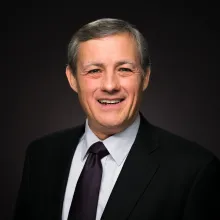
Gary Petty
Gary Petty is a 1978 graduate of Ambassador College with a BS in mass communications. He worked for six years in radio in Pennsylvania and Texas. He was ordained a minister in 1984 and has served congregations in Longview and Houston Texas; Rockford, Illinois; Janesville and Beloit, Wisconsin; and San Antonio, Austin and Waco, Texas. He presently pastors United Church of God congregations in Nashville, Murfreesboro and Jackson, Tennessee.
Gary says he's "excited to be a part of preaching the good news of God's Kingdom over the airwaves," and "trusts the material presented will make a helpful difference in people's lives, bringing them closer to a relationship with their heavenly Father."


