For the first time in its history, Israel finds itself without a single dependable friend in the Middle East. For decades, it maintained a cold peace with Egypt and a warm one with Turkey, but both have evaporated recently. What do the major changes occurring in the Middle East mean for the future?

Israel today finds itself more alone than ever, particularly in its regional neighborhood. As Public Radio International's The World explains: "For nearly all of its 63-year history, the Jewish state could count on decent relations with at least one of the major powers in the Middle East. That's what makes the political reality facing Israel today so grim.
"It's the lowest point diplomatically we ever had in the region. Ever,' said Alon Liel. Liel spent more than 30 years with Israel's Ministry of Foreign Affairs. He served as ambassador to both Turkey and South Africa. He said Israel is facing unprecedented isolation.
"We always had a strategic partner, sometimes two,' Liel said. 'Don't forget we had Iran for 20 years. Then we had Turkey for many years. Sometimes, we had Iran and Turkey together. And then we had Egypt and Turkey together. These are important countries in the region. And we are a Jewish state and they are big, important, Muslim states. And we worked it out. Now, we don't have any of the three as an ally, even not as a friend'" ("Israel's Growing Isolation in the Middle East," Sept. 16, 2011).
In addition to the deteriorating relationships with its closest allies, the instability of other uprisings rocking Muslim Arab states will likely lead to continually worsening relationships with Israel's neighbors. The Arab Spring is creating new realities in the Middle East that can no longer be addressed solely by diplomatic means. Even if these uprisings in places like Egypt and Libya do not result in new regimes heavily influenced by Muslim radicalism, the general public's dislike of Israel will likely push emerging leaders to be more hostile toward Israel than in the past. Where is all of this leading?
After enjoying warm military and commercial ties with Turkey since the 1990s, relations have taken a major turn for the worse.
In May 2010, Israel protected its naval blockade of Gaza—intended to keep out weapons and more terrorists that would harm Israelis—against a flotilla billed as a humanitarian mission but intent on breaking the Israeli blockade. Israeli forces boarded a Turkish vessel, the Mavi Marmara, and in the conflict that ensued, nine Turkish activists died.
Turkey demanded an apology, but the Israeli government refused. Even a review by the United Nations, typically ill-disposed toward Israel, found that Israel acted appropriately. Nevertheless, Turkey retaliated by kicking Israel's ambassador out of its capital and downgraded the diplomatic relationship. It halted military commercial relations and considered stepping up its military presence in the Eastern Mediterranean.
"Liel said the episode reflects a shift in Israeli diplomacy under the current government. There's been a move away from traditional partners in the region like Turkey, Egypt and Jordan, toward new partners, including Greece, Cyprus and Romania. Which he called ridiculous. 'Because for many, many years, one of the main leading arguments of the Arabs was, "you don't belong here."' Liel said Israel spent years cultivating relationships with its regional neighbors to disprove that" (ibid.).
The same article later gives what international relations professor Mark Heller of Tel Aviv University sees as the cause of Israel's diplomatic losses. "Particularly the rise of Islamist political forces,' Heller said. 'The loss of Iran as a partner was not the result of anything that happened in the bilateral relationship between Israel and Iran. It was the Islamic revolution. And similarly the same could be said about Israel and Turkey. It's the rise to power of a cautious or pragmatic Islamist power there.'"
He points to Turkish aims at a given time as determinative. "Whenever they were focused primarily on orienting Turkey towards the west and integrating Turkey with the western world, then relations with Israel were pretty good,' Heller said. 'And whenever there was some flirtation or attempt to re-orient in another direction, then one of the casualties of that was the Turkish-Israeli relationship'" (ibid.).
Heller believes that for the foreseeable future Turkey is lost diplomatically. As American influence wanes in the region, Turkey is less focused on relations with the west and is seeking to fill the growing void in the region caused by the Arab Spring.
On the heels of the souring relationship with Turkey came trouble with Egypt.
There is a growing display of deep antipathy towards Israel on the Egyptian street. Israel's embassy in Cairo, the premier symbol of the relations between the two countries, was overrun by hundreds of Egyptian demonstrators, tarnishing a symbol of the two nations' 32-year-old peace. Among the signs waved were displays of swastikas and a message that translates into English as, "The gas chambers are ready" (Memri TV, Aug. 21, 2011, memritv.org/clip/en/3083.htm).
This came in the wake of an incident along the Israeli-Egyptian border in the Sinai. Terrorists crossed into Israel, killed Israeli civilians and headed back into Sinai. Israeli troops pursued them, and, with gunfire exchanged at the border, several Egyptian police there were killed in the crossfire.
This inflamed the growing anti-Israeli feelings. Some political parties now want to close the Suez Canal to the Israeli navy and block the sale of natural gas to Israel. The new Freedom and Justice Party, an offshoot of the Muslim Brotherhood, says the 1979 treaty should be "revised." Opinion polls suggest Egyptians want peace with Israel but not necessarily under the terms of the 1979 treaty.
The interim ruling military government says policy towards Israel should be left to an elected government. Parliamentary elections have been scheduled for November, and presidential elections are expected to be held in March or April 2012. Still, the embassy incident serves as a warning to Israel that a democratically elected Egyptian government may be a lot less friendly.
The former head of Israel's Shin Bet Intelligence Service recently expressed deep concerns in an Israeli radio interview: "This should be very disturbing to us…there is a question about our place in the Middle East…The Egypt that was the bedrock on which we founded our strategy has disappeared" (quoted by Joshua Mitnick, "Israel Reels Over Rifts With Allies," The Wall Street Journal, Sept. 12, 2011).
Not only have relations with Egypt and Turkey deteriorated over the last several months, but so have relations next door with the Palestinians. All nations have ideological divisions, but the Palestinians are divided over the fundamental question of their national identity.
Fatah, the party that has continued to exercise control among the 2.5 million Arabs of the West Bank despite popular support for rival Hamas, sees itself as part of a secular Arab world that is on the defensive. Hamas, strong in the West Bank and ruling over the 1.5 million Arabs of the Gaza Strip, envisions the Palestinian nation as an Islamic state forming in the context of a region-wide Islamist rising. Neither is in a position to speak authoritatively for the Palestinian people, and the issues that divide them cut to the heart of their peoples.
While the two parties came to a reconciliation agreement last spring, they have yet to work out their differences. Things came to a standstill after they failed to agree on a prime minister who would lead a unified government. They did agree to new parliamentary elections, but as of this writing presidential and parliamentary elections are yet to be scheduled.
Both groups have different views on a future relationship with Israel, as George Friedman of Stratfor (Strategic Forecasting, Inc.) explains: "Fatah has accepted, in practice, the idea of Israel's permanence as a state and the need of the Palestinians to accommodate themselves to the reality. Hamas has rejected it" ("Israeli-Arab Crisis Approaching," Stratfor.com, Aug. 22, 2011).
How Egypt's new government forms will also have an impact on both Hamas and Fatah. If Islamist forces like the Muslim Brotherhood (of which Hamas is a wing, according to its charter) come to power in Egypt, it could favor Hamas. But Friedman doesn't think this is likely. He states:
"Egypt's military has retained a remarkable degree of control, its opposition groups are divided between secular and religious elements, and the religious elements are further divided among themselves—as well as penetrated by an Egyptian security apparatus that has made war on them for years. As it stands, Egypt is not likely to evolve in a direction favorable to Hamas…
"There is a broad sense of unhappiness in Egypt over Egypt's treaty with Israel, an issue that comes to the fore when Israel and the Palestinians are fighting. As in other Arab countries, passions surge in Egypt when the Palestinians are fighting the Israelis.
"Faced with this dynamic, it will be difficult for Fatah to maintain its relationship with Israel. Indeed, Fatah could be forced to initiate an intifada (uprising), something it would greatly prefer to avoid, as this would undermine what economic development the West Bank has experienced. Israel therefore conceivably could face conflict in Gaza, a conflict along the Lebanese border and a rising in the West Bank, something it clearly knows" (ibid.).
And Israel's own Arab minority is emerging as a potential problem as well. The country's landscape is increasingly dominated by minarets and veiled women. And leaders among this minority, identifying with their Palestinian cousins outside, are vociferously calling for Israel to shed its character as a Jewish state and give Arab citizens collective minority rights and perhaps some form of autonomy.
In the midst of the Palestinian division, Mahmoud Abbas, Fatah's leader, formally submitted to the United Nations a bid for the recognition of an independent Palestinian state. This reversal of strategy came after two decades of on-again, off-again direct negotiations failed to establish such a state. It's not clear how long it will take the Security Council to act on it.
Many observers feel that the Palestinian unilateral effort at the United Nations is a clear rejection by the Palestinians of direct negotiations with Israel.
Former British Prime Minister Tony Blair is negotiating for the Quartet on the Middle East—made up of the United Nations, the United States, the European Union and Russia—in an effort to establish a two-state solution through direct peace talks. He condemned the unilateral move at the UN, according to a recent article in Britain's Daily Mail ("Blair Attacks Palestinian Bid for State Recognition as 'Deeply Confrontational,'" Sept. 24, 2011).
In an apparent retaliation for the Palestinian Authority's bid for statehood, the U.S. Congress has frozen $200 million in humanitarian aid. But the Arab League has already promised that Arab nations will make up for the aid shortfall.
For now, America's position is reportedly to veto the recognition of Palestinian statehood when it comes before the Security Council. Yet an American veto or rejection could spawn waves of Palestinian violence. It would also likely harden the stances of Turkey, Egypt and Saudi Arabia. At least one Saudi leader has threatened to end the current form of his country's long-standing cooperation with the United States if there is a veto. And the country with the most to lose from such weakening of the U.S.-Saudi relationship would be Israel.
As the move at the UN was in the offing, the German magazine Der Spiegel explained the European Union's position: "If the Palestinians even just seek recognition in the General Assembly, Israel could lose the support of the European Union. EU High Representative for Foreign Affairs Catherine Ashton is feverishly working to reach a compromise with the Palestinians that would give them a status as a non-member observer state [at the UN], somewhat analogous to the one enjoyed by the Vatican. The arrangement would also require the Palestinians to waive their right to bring Israeli politicians before the International Criminal Court. The majority of EU member states would most likely back this kind of solution. But there is still no deal in sight" ("Palestinian Statehood? A Litany of Diplomatic Failures in US and Europe," Sept. 20, 2011).
With or without a U.S. veto, this "Vatican option" is a plausible outcome. From Israel's point of view, it would still be rather disturbing. But this observer-state option is the emerging consensus among the Europeans.
What this all adds up to is a shifting dynamic in the Middle East that has not been seen in a generation. The state of Israel finds itself in the worst isolation in its history. As surrounding enemies become more hostile, Israel will eventually be encircled by armies, as Jesus Christ and other prophets foretold.
The EU's independent proposal reflects a growing effort to more directly influence the Israeli-Palestinian peace process. Eventually, Europe will play an even more central role. Bible prophecy reveals that Europe will evolve into a final resurrection of the ancient Roman Empire. A powerful, persuasive leader will emerge in Europe who will bring about a false sense of peace. Manipulative and crafty, he will also be empowered by evil spiritual forces that can sway world governments and institutions (see Revelation 13:2-8 [2] And the beast which I saw was like unto a leopard, and his feet were as the feet of a bear, and his mouth as the mouth of a lion: and the dragon gave him his power, and his seat, and great authority.
[3] And I saw one of his heads as it were wounded to death; and his deadly wound was healed: and all the world wondered after the beast.
[4] And they worshipped the dragon which gave power unto the beast: and they worshipped the beast, saying, Who is like unto the beast? who is able to make war with him?
[5] And there was given unto him a mouth speaking great things and blasphemies; and power was given unto him to continue forty and two months.
[6] And he opened his mouth in blasphemy against God, to blaspheme his name, and his tabernacle, and them that dwell in heaven.
[7] And it was given unto him to make war with the saints, and to overcome them: and power was given him over all kindreds, and tongues, and nations.
[8] And all that dwell upon the earth shall worship him, whose names are not written in the book of life of the Lamb slain from the foundation of the world.
See All...; Daniel 8:23-25 [23] And in the latter time of their kingdom, when the transgressors are come to the full, a king of fierce countenance, and understanding dark sentences, shall stand up.
[24] And his power shall be mighty, but not by his own power: and he shall destroy wonderfully, and shall prosper, and practise, and shall destroy the mighty and the holy people.
[25] And through his policy also he shall cause craft to prosper in his hand; and he shall magnify himself in his heart, and by peace shall destroy many: he shall also stand up against the Prince of princes; but he shall be broken without hand.
See All...; Matthew 4:8-9 [8] Again, the devil taketh him up into an exceeding high mountain, and sheweth him all the kingdoms of the world, and the glory of them;
[9] And saith unto him, All these things will I give thee, if thou wilt fall down and worship me.
See All...; 2 Corinthians 4:4In whom the god of this world hath blinded the minds of them which believe not, lest the light of the glorious gospel of Christ, who is the image of God, should shine unto them.
See All...).
Jerusalem will eventually be divided again, violently traumatized, with at least part of it falling under the rule of gentile (non-Israelite) forces. "But when you see Jerusalem surrounded by armies, then know that its desolation is near…For there will be great distress in the land and wrath upon this people. And they will fall by the edge of the sword, and be led away captive into all nations. And Jerusalem will be trampled by Gentiles until the times of the Gentiles are fulfilled" (Luke 21:20-24 [20] And when ye shall see Jerusalem compassed with armies, then know that the desolation thereof is nigh.
[21] Then let them which are in Judaea flee to the mountains; and let them which are in the midst of it depart out; and let not them that are in the countries enter thereinto.
[22] For these be the days of vengeance, that all things which are written may be fulfilled.
[23] But woe unto them that are with child, and to them that give suck, in those days! for there shall be great distress in the land, and wrath upon this people.
[24] And they shall fall by the edge of the sword, and shall be led away captive into all nations: and Jerusalem shall be trodden down of the Gentiles, until the times of the Gentiles be fulfilled.
See All..., emphasis added).
The prophet Zechariah quoted God in referring to the same time. "For I will gather all nations against Jerusalem to battle; and the city shall be taken, and the houses rifled, and the women ravished; and half of the city shall go forth into captivity, and the residue of the people shall not be cut off from the city" (Zechariah 14:2For I will gather all nations against Jerusalem to battle; and the city shall be taken, and the houses rifled, and the women ravished; and half of the city shall go forth into captivity, and the residue of the people shall not be cut off from the city.
See All...; see also Zechariah 12:2-3 [2] Behold, I will make Jerusalem a cup of trembling unto all the people round about, when they shall be in the siege both against Judah and against Jerusalem.
[3] And in that day will I make Jerusalem a burdensome stone for all people: all that burden themselves with it shall be cut in pieces, though all the people of the earth be gathered together against it.
See All...; Revelation 11:1-2 [1] And there was given me a reed like unto a rod: and the angel stood, saying, Rise, and measure the temple of God, and the altar, and them that worship therein.
[2] But the court which is without the temple leave out, and measure it not; for it is given unto the Gentiles: and the holy city shall they tread under foot forty and two months.
See All...).
Traumatic times lie ahead for Israel, as these and other prophecies reveal. But the good news is the Jewish people and other Israelites will be reestablished in the Promised Land as Jesus Christ starts His glorious reign from Jerusalem (Hosea 1:10-11 [10] Yet the number of the children of Israel shall be as the sand of the sea, which cannot be measured nor numbered; and it shall come to pass, that in the place where it was said unto them, Ye are not my people, there it shall be said unto them, Ye are the sons of the living God.
[11] Then shall the children of Judah and the children of Israel be gathered together, and appoint themselves one head, and they shall come up out of the land: for great shall be the day of Jezreel.
See All...).
Sadly, man's efforts to bring peace to the Middle East and the world have proven a complete failure—as will be even more evident in the years to come. But Jesus Christ will not fail. As the prophet Isaiah foretold, "Lord, You will establish peace for us" (Isaiah 26:12LORD, thou wilt ordain peace for us: for thou also hast wrought all our works in us.
See All...).
He will do this by first powerfully assuming control over all opposing forces. Then He will lead the world into the way of righteousness and peace, giving people everywhere a change of heart through His Spirit (Isaiah 2:2-4 [2] And it shall come to pass in the last days, that the mountain of the LORD's house shall be established in the top of the mountains, and shall be exalted above the hills; and all nations shall flow unto it.
[3] And many people shall go and say, Come ye, and let us go up to the mountain of the LORD, to the house of the God of Jacob; and he will teach us of his ways, and we will walk in his paths: for out of Zion shall go forth the law, and the word of the LORD from Jerusalem.
[4] And he shall judge among the nations, and shall rebuke many people: and they shall beat their swords into plowshares, and their spears into pruninghooks: nation shall not lift up sword against nation, neither shall they learn war any more.
See All...; Joel 2:28And it shall come to pass afterward, that I will pour out my spirit upon all flesh; and your sons and your daughters shall prophesy, your old men shall dream dreams, your young men shall see visions:
See All...). This transformation after Jesus' return will commence with the Jews at Jerusalem (Zechariah 12:10And I will pour upon the house of David, and upon the inhabitants of Jerusalem, the spirit of grace and of supplications: and they shall look upon me whom they have pierced, and they shall mourn for him, as one mourneth for his only son, and shall be in bitterness for him, as one that is in bitterness for his firstborn.
See All...).
For a more complete perspective of the events prophesied to come in the Middle East and more of the history behind them, be sure to send for or download our free booklet The Middle East in Bible Prophecy.
I believe you are right Robert!
I have been following world news in the light of Bible prophecy for over 45 years and I have never seen this much change occurring all around the world at the same time. Many key shifts appear to be reshaping our world in order for the final major geopolitical power blocks to arise.
When the world undergoes a major realignment like we see today, conflicts between nations and regions becomes more likely.
Here are some other key regional shifts to be watching:
Reshaping of Europe:
The sovereign debt crises rocking the region may eventually force EU countries and the euro zone to breakup into blocs of less than the current 27 and 17 nations respectively. Bible prophecy indicates a group of 10 kings or nations will coalesce around a ruthless animal like leader which the book of Revelations calls the beast (Revelation 17:12-13).
Daniel refers to this system and leader as the King of the North. There will be major battles between this group of nations and the King of the South. Then disturbing news from the north and east (of Jerusalem) troubles the King of the North. This sparks a major war between the King of the Norththe Beast and nations to the east of Jerusalem and the Euphrates River. “But news from the east and the north shall trouble him; therefore he shall go out with great fury to destroy and annihilate many” (Daniel 11:44).
Asia on the rise:
These actions by the King of the North appear to be connected with what the book of Revelation describes as the “fifth trumpet” or “first woe” (Revelation 9:1-11). This engagement by the King of the North against those that trouble him east of the Euphrates River result in an army of 200 million coming from the east (verses 13-16).
A full-scale international conflagration will erupt. The sounding of the sixth trumpet produces major battles that results in a third of mankind dying (Revelation 9:13-18). In the language of his day John appears to be trying to describe the use of modern implements of war. Notice, it is not the horses and riders that do the killing. “By these three plagues a third of mankind was killed—by the fire and the smoke and the brimstone which came out of their mouths” (verse 18). Could this be John’s best effort to describe the use of nuclear, biological or chemical weapons?
East of Jerusalem and the Euphrates River lies India and China and other large populations. Whether by itself or in a league with other large population nations of Asia, it seems probable that China will be involved in fielding this incredible army and major weapons capable of killing so many people.
China, is pursuing an enormous military buildup both on land and at sea. For example, The Diplomat reports on China’s massive sea power build up. “There has been much discussion and speculation in recent commentary over China’s rapid maritime rise and strategy for dominating large swaths of the Pacific . . . China’s naval buildup will soon give Beijing the means to use military force to back up its expansive territorial claims to essentially the entire Yellow Sea, East China Sea and South China Sea” (“Ensuring China’s Peaceful Rise,” November 18, 2011).In Christ’s service.
Rod Hall
Writer / Reporter
Good News magazine
Beyond Today television
Vatican pushing for world economic system
The Vatican recently renewed its call for creation of a “world political authority” and the creation of a “central world bank” that would regulate the flow of monetary exchanges.
The 41-page document was prepared by the Pontifical Council for Justice and Peace. It says a “supranational authority” was needed to place the common good at the center of international economic activity (“Vatican Issues Major Document on Global Financial Reform,” October 24, 2011; Catholic News Service).
The document cited the teachings of popes over the last 40 years on the need for a universal public authority that would transcend national interests.
Here are some of the other suggests: taxation on financial transactions; a “world reserve fund;” recapitalization of banks with public funds; reward “virtuous” behavior; broad management over countries and “shadow markets;” gradual, transfer of a part of each nation’s powers to a world authority and to regional authorities” (Ibid.).
A centralize system with worldwide control of the economy like the one the Vatican suggest will be set up to by a great end time religious leader called the False Prophet in Revelation 19:20. Could this document act as its blue print?
This false prophet is referred to as another beast in Revelation 13. “Then I saw another beast coming up out of the earth, and he had two horns like a lamb and spoke like a dragon. And he exercises all the authority of the first beast in his presence” (verses 11-12).
“He causes all, both small and great, rich and poor, free and slave, to receive a mark (Amplified says: stamp, mark, inscription) on their right hand or on their foreheads, and that no one may buy or sell except one who has the mark or the name of the beast, or the number of his name” (verse 16).
Just as the Vatican recommends this centrally controlled economic system will have worldwide scope and "universal jurisdiction." It will siphon from nations some national authority for itself.
It will reward “virtuous” behavior. And also severely punish those who try to do business in any “shadow markets.” He will force everyone to join this system and carry its identification to be able to buy or sell.
In Christ’s service.
Rod Hall
Writer / Reporter
Good News magazine
Beyond Today television
America in decline:
The US appears to be undergoing a terminal decline that could lead to the prophesied time of Jacob’s trouble predicted for the modern descendants of the ancient nation of Israel or Jacob (Jeremiah 30:7). The English speaking nations, especially Britain and America, have dominated the world for the past two centuries. USs current trajectory projects an end of this era is closing in fast.
The 70 years of remarkable economic growth of the US ended a decade ago. The past decade was the worst for the U.S. economy in modern times, marked by high unemployment and stagnant wages. Germany will soon pass the US to become the 2nd largest exporter behind China. China is poised to pass the US as the world’s leading superpower in the next decade or so.
The Economist magazine recently reported “The World Bank sees a relentless decline in various indicators of American governance” (“American Idiocracy, The civil war in Washington, DC is damaging American business,” August 13, 2011).
The article goes on to show the sliding rankings the US as compared to the rest of the world. The World Economic Forum’s annual global competitiveness ranking downgraded America from second place in 2009 to fourth place in 2010. For the quality of its institutions America is ranked a lowly 40th, for trust in its politicians 54th, for government waste 68th and a dismal 87th for its macroeconomic environment.
About a year ago The Nation magazine carried an article by history professor Alfred McCoy titled “The Decline & Fall of the American Empire.” He predicts this will happen by 2025. “The question is not whether the U.S. will lose its unchallenged global power, but just how precipitous and wrenching the decline will be...” (December 6, 2010).
In Christ’s service.
Rod Hall
Writer / Reporter
Good News magazine
Beyond Today television
Arab Spring:
The Arab Spring brings the prospects for democratic development, but also the very real risk of Islamic ascension, political chaos, and humanitarian disaster. The performance of the Islamist party Ennahda in the October 23 Tunisian elections, in which it won 41.5 percent of the seats, has some concerned a similar Islamist victory may occur in Egypt.
Foreign Affairs magazine explains: “Some analysts have minimized the Muslim Brotherhood's prospects for success by pointing to polls suggesting that the group -- the largest and best organized in Egypt -- hovers between 15 to 30 percent approval” (“How Egypt's Muslim Brotherhood will win,” November 3, 2011).
Yet, The Telegraph indicates the Islamic influence could add up to a higher percentage during the three month election season that started November 28th. “Opinion polls suggest that the Muslim Brotherhood and its Islamist allies will win more than 40 per cent of the vote, far more than any of its secular rivals . . .” (“Egypt: Muslim Brotherhood facing growing backlash from protesters,” November 24, 2011).
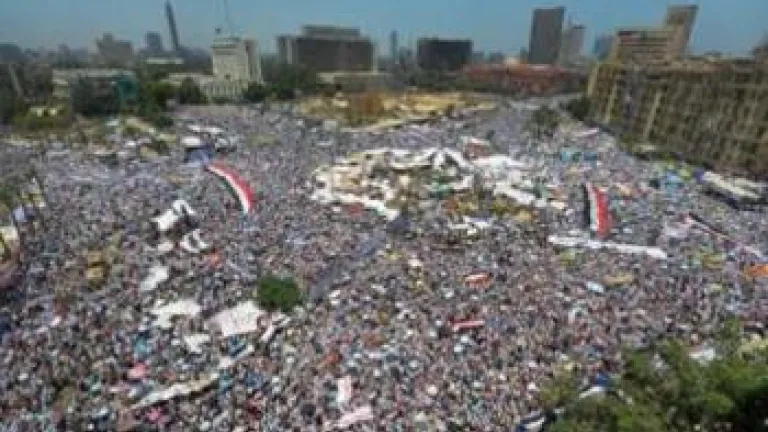
Protests were renewed in Tahrir Square in Egypt demanding the army immediately hand over executive powers to a civilian cabinet. Instead the generals, who have ruled Egypt since the former president was toppled, moved up the date for the transition to July 2012.
“Fearing they have been outflanked by the Brotherhood and the army – Egypt's two most powerful forces – many protesters called for secular politicians to unite and give the people of Tahrir Square one voice powerful enough to challenge two rivals they see as holding undemocratic values” (Ibid.).
Filling the power vacuum:
Even if the Islamists do not dominate the emerging governments one thing is sure─ the Arab world is undergoing seismic and irreversible change. As more and more of the strong dictatorial leaders fall and the masses rise up so do the chances for internal and external conflicts. The deep seated hostility toward Israel is growing in openness and intensity making the prospects for peace in the Middle East dim.
With America pulling out of Iraq by the end of the year, Turkey, Iran and Saudi Arabia are all pushing to fill the vacuum and become the dominate player in the Middle East.
Iran & Saudi Arabia push for dominance
Foreign Affairs magazine documents the rekindled struggle for dominance between Iran and Saudi Arabia as they aggressively seek to reshape the new Middle East to preserve and expand their power.
“As a result, Iran sees Saudi Arabia as a wealthy, ambitious proxy of the United States and Saudi Arabia views Iran as a major source of instability in the region, believing that it seeks to establish a so-called Shia Crescent to dominate Arab Sunnis. The rivalry has shaped both countries' policies as they have attempted to contain and combat each other’s influence. They have accused each other of blatant interference in their internal affairs, including indirect support for acts of terrorism against each other” (“Iran and Saudi Arabia Square Off, The Growing Rivalry Between Tehran and Riyadh, October 11, 2011).
If Iran dominates the region it is likely they will provide even more funding, weapons, training, and sanctuary to the numerous terrorist groups they support. These are most notably involved in Iraq, Afghanistan, and Lebanon, posing a security concern to the international community.
Arab unity has long been elusive, but a common purpose is emerging around the desire to destroy the nation of Israel. These changes through the Arab Spring will allow many who see themselves as Islamist’s first and national citizens second to push for closer Islamic unity.
This could lead to the rise of what Daniel the prophet calls the King of the South (Daniel 11:40). This king will attack the King of the North (10 nation beast power in Europe) causing a major counter attack that eventually brings the entire world into the final world war before Christ returns.
In Christ’s service.
Rod Hall
Writer / Reporter
Good News magazine
Beyond Today television
Iranian Nukes:
The International Atomic Energy Agency recently issued a condemning report on Iran's nuclear program. It found that Iran appeared to have worked on designing a nuclear weapon and may be continuing research relevant to that end.
The window of opportunity for stopping Iran from attaining a nuclear weapon is closing fast. Western intelligence sources believe that Iran now has enough highly enriched uranium to build, should it choose to do so, at least one nuclear weapon within a year and that this could be rapidly followed by several more. Some say they could have a weapon as early as April 2012. Once the bombs are complete a military strike would generate a dangerous level of radioactive contamination across the Gulf region, the main source of the world's energy.
And it would be likely that Iran would respond to any kind of attack on their 15 nuclear facilities with missile attacks on Israel. Also, its well armed proxy forces, Hezbollah in Lebanon and Hamas in Gaza, would likely be stirred to attack. They have both been rearmed with missiles and war materials. This could plunge the region into another hot conflict.
No Israeli─ Palestinian peace talks:
For the first time in its history Israel finds itself without a single friendly neighbor. Turkey’s warm relationship was broken off when they pulled their ambassador out of Israel, because Israel refused to apologize for the deaths of Turkish citizens on a boat flotilla to the Gaza Strip. The cold peace with Egypt appears in jeopardy in spite of a pronouncement they will honor the long standing peace treaty. Relations have deteriorated to the point that an Egyptian mob recently attacked Israel’s Embassy, setting it on fire and holding several Israeli’s captive for days.
In addition to Israel’s growing isolation, the prospects for renewing direct peace talks with the Palestinians remain dim. The Council on Foreign Relations had an insightful interview with Daniel Levy, Senior Research Fellow, American Strategy Program and Co-Director, Middle East Task Force, New America Foundation. He summarized it this way: “You have an Israeli-Palestinian reality, which is looking increasingly irresolvable and increasingly questioning the very possibility of a two-state solution" (November 15, 2011).
In Christ’s service.
Rod Hall
Writer / Reporter
Good News magazine
Beyond Today television