

Frank Dunkle
This transcript was generated by AI and may contain errors. It is provided to assist those who may not be able to listen to the message.
I knew that there was an announcement that I had forgotten it. It's about me. And that is that we'll be gone for a while. Susan and I are going to be headed back to Ohio on Thursday. And we are looking forward to that. We're going to be taking some vacation time and be going back to visit Susan's family, who lives just south of Lake Erie in the beautiful, beautiful state of Ohio.
And Susan would want you to know that. And it looks like the rest of the Midwest, other than it is a little, little greener. But we're going to be looking forward to that. We're going to be back there Thursday. We have all three of our adult daughters that are going to be going to see their grandparents. And what a blessing that the grandparents are alive, that our daughters are well, that we can all be together.
We're going to have four generations because Cameron, our fourth granddaughter out of five, will be there with us as well. So that's going to be neat. And maybe you'll remember, I wrote an article several years ago called, A World for Cameron. Well, that's the one that's going to be back there with us. That's our oldest daughter's daughter. And so we're going to have a wonderful, wonderful time of visiting the folks and walking down some nice farm country roads at nighttime.
And it starts cooling down and the crickets start coming up. You know, some of those that are from the Midwest know how that is like. And Susan's going to be coming back after about a week. I'm going to stay for a couple days. I'm kind of being limbo. That's a Catholic term that kind of describes what will be happening because she'll be coming back.
But the council meetings will not have begun, so I'm going to go down to Indianapolis for a day and to be speaking there in two weeks from now. Have an opportunity to view the McNee-Lees and help prepare for the Council of Elders meetings. And we'll be in the Council of Elders meetings for about five days, including committee meetings on Sunday. So I would really appreciate your prayers.
These are going to be very, very important meetings. They are certainly going to be setting a direction for the church in the months and the years ahead. We certainly do need God's wisdom and God's direction, God's humility. And us, because of them by ourselves, we do not have it as men, so we would certainly appreciate your prayers. And while we are gone, you are going to be taken care of by a very fine, ordained family here.
They are always in touch with me, and I am in touch with them. And I'll be in touch with some of you. As you know, oftentimes when I'm stuck in an airport, I'm dangerous because I have my cell phone. So I'll just start calling. Sometimes we talk more on my cell phone from an airport than we do at church.
But just to let you know that I'm alive and thinking about you. Have you ever wondered why God called you? Have you ever scratched your head? And if you haven't scratched your head, I'm sure that you've scratched your heart a little bit on that. Because you look around at everybody else and kind of figure out why God called them. And that God certainly didn't make any mistakes when it came to so-and-so. Either the person in front of you, or if there's nobody in front of you, then you might want to turn around. So that you can be in agreement, or the person behind you, the person next to you, your mate, whoever.
You can certainly see that God had a reason for calling them. But why did God call me? What do I have to offer? What do I have to offer God? What do I have to offer other individuals? Well, when we do that, we break a cardinal rule of Scripture. And when we break the rules of Scripture, you've just got to know that there are no good results that are going to be built upon them. Because if the foundation is bad, then the thoughts are going to be basically a house of cards.
You can just jot down if you want to, 2 Corinthians 10 and verse 12, because you can go back there later. I don't want to focus on that right now, but that's the principle where the Bible just basically puts it right out there in front of us. Don't compare yourselves amongst yourselves. The Scripture basically winds up by saying it's not too smart. Now, I'm paraphrasing, but that's the Scripture. Now, why is that Scripture in the Bible? Because I'll tell you why.
Because you know and I know that all of us, each and every one of us, compare ourselves amongst ourselves. And God says it's not smart. It's foolishness. And it's a folly. Well, today I want to share a story with you about a man who's mentioned in Scripture. Somebody just like you and me that was called of God, flesh and blood, human being. We're not going to pull him out of a museum. He's just like you and me.
Yeah, he's not pickled. He was not hatched. He drew breath at one time. He was a person of like passion, just like you and me. And the reason why we're going to talk about him is to help us to appreciate what God is doing with you and with me. And to dispel this folly of comparing ourselves amongst ourselves. And also to help us develop a very important key to spiritual growth.
And I'd like to share it with you, please. It's just one word. Maybe you've never thought about it. Maybe you have. Maybe you've written it out at one time or another. And it's just a very simple word that begins with the letter A. It's called acceptance. Acceptance. I love to read literature. I love to read philosophy. I've read many, many books from many, many wise people. And the greatest wisdom of all that is passed down by many religions, many philosophies, and many people down through the ages is that the key to life is acceptance.
But that's what we fight against so often. Today, what I want to do in this brief sermon, so I'm going to give you a hint. This is going to be brief.
Maybe. You heard the prayer. There was inspiration. We'll find out. But today I want to discuss the story of a man that is mentioned only 12 times in the Gospels. Only 12 times in the big four books in the front of the New Testament. And he's only mentioned once in the book of Acts.
So he's mentioned 13 times in the Bible. That's it. And beyond that, get this, four of those times he's mentioned in a list with others. So his name alone is not on the marquee. And beyond that, his recorded words are less than 12 words. I want you to think about that for a moment. You know this guy. You know him. And I hope that by the end of this message you're going to get to know him a little bit better. And why God called him. And if God called him, what he's doing with his work inside of you.
Now when you think that he's only mentioned 12 times, 13 times with the book of Acts, and he only speaks 12 words, and this gentleman never even wrote a book of the Bible, I have a question for you. Do you think that Peter, and or Paul, or John would have liked to have traded places with him?
Oh, you can have my space in the Bible. You can have my stories in the Bible. Well, some of them you'd like some of those stories of Peter to go. But you kind of begin to think about it. And what we're going to kind of begin to understand is that it's not how much you're doing, but what you are doing. It's not how much you say, or how many words that come out of your mouth, but the words that are expressed, and what they do, and what is their effect.
Who are we talking about? Andrew, one of the 12 disciples later called apostles. Andrew! Now, there's a lot of Andrews that are running around today on this earth. Andrew is given for a purpose to a young boy for a name. Andrew is a strong sounding name. It's a real male name. Macho, macho. Two syllable macho. What's your son's name? My son's name is Andrew. Andrew is a man's name. Real male. Very important. Given to solidify a young boy as he grows up. It also means courageous. But what about this man that is only mentioned 13 times in the Bible?
Four times in a list with others. 12 words recorded of what he said. What can we learn about him? And as we learn about Andrew, what can we learn about ourselves? Join me, if you would, in John 1, the Gospel of John, John 1 and verse 37. This is the very beginning of Jesus' ministry. And it's interesting what is recorded here. This is the famous story where Jesus comes down to the river Jordan.
He comes into contact with his cousin John the Baptist. John the Baptist, under the inspiration of God, says, Behold the Lamb of God. So something's happening here. Now that's John the Baptist. That's Jesus entering into the Jordan Valley. And then we notice here in verse 37, others are introduced. And it says, actually in verse 35, again the next day, John stood with two of his disciples. And looking at Jesus as he walked, he said, Behold the Lamb of God. And the two disciples, verse 37, heard him speak, and they followed Jesus. And then Jesus turned and, seeing them, followed, said to them, What do you seek?
And they said to him, teacher or rabbi, Where are you staying?
And he said to them, Come and see.
And they came, and they saw where he was staying, and remained with him that day. Now it was about the tenth hour, so they were spending a good amount of time.
And one of the two who heard John speak and followed him was Andrew, Simon Peter's brother.
And after having that contact with Jesus Christ, notice what happens. Verse 41, and maybe we've read over this before, never really centered what was going on.
He first found his own brother Simon, known to us as Peter, and said to them, We have found the Messiah, which is translated to Christ. And then notice verse 42.
And he brought him, that is Peter, to Jesus. And now when Jesus looked at him, he said, You are Simon the son of Jonah, and you shall be called Cephas, which is translated as stone.
Now what we begin to discover through this set of scriptures, friends, is simply this. To our knowledge, as we allow the scriptures to unfold, and you can take the time and study to go into the other gospels, it is Andrew that is the first to be called.
He is the first to follow.
And he is the first of the disciples to connect another disciple with Jesus Christ.
Interesting.
Let's build a story a little fuller about this gentleman named Andrew. Matthew 4.
Matthew 4, verse 18.
Jesus was beginning his earthly ministry. He was talking about the kingdom of heaven, that it was at hand. And then we pick up the story in verse 18. And Jesus, walking by the sea of Galilee, saw two brothers, Simon, called Peter, and Andrew, his brother, casting that into the sea.
For they were fishermen.
Then notice verse 19. Then he said to them, Follow me, and I will make you fishers of men.
That's an interesting phrase, and a whole sermon in itself, friends, that when you recognize the introduction of Christ in our lives, and his ongoing story to us, it's always two words.
Follow me.
That's how it starts, and that's how it will end.
That's how we move into this journey. And even when the journey gets long and tiring, and even when we near its end in this human tent, there's only two words that Christ will always say. Simply this. Follow me.
But notice then what they did.
Verse 20. And they, who's they? Peter, Andrew, immediately left their nets, following him.
Now, as we put just these two scriptures together, and we're just not a lot of words, but let's put it together and begin to build a profile of Andrew.
And more than that, a profile of Jesus Christ.
To understand that Jesus Christ knows who he is calling, when he is calling somebody, and why he is calling them.
We notice here that the reason of why he called, we come to understand that Andrew had a keen perception that when he began to hear the word of God or see the word of God, he began to perceive something. We also secondarily see something else. He pursued this knowledge. He went after Jesus Christ. He didn't just say, Ooh, look at that. Ooh, just went by. No, it says that he and the other disciple took off. So it's not only what he perceived. Are you with me?
But then he pursued Jesus Christ. And not only that, let's take it a step further, till he got the understanding.
It begins to show us that Andrew was one of strong conviction and that he was accepting what he was receiving.
And then, his greatest gift, and this is where I want to really pin it on you, he was a connector.
He connected other individuals with Jesus Christ. Now, I want you to think about this for a moment. What a gift!
What an incredible ability. And you know what? He didn't have to go to Harvard. You know why? Because it didn't exist then.
That was 1,600 years down the line.
Harvard wasn't founded till 1638, if I'm not mistaken. So he didn't go to Harvard.
He didn't go to technical school for this.
He didn't have a degree.
He did not have to have listened to 200 of Mr. Weber's sermons.
He had to do nothing like that.
He had to take that which God had given him as a unique gift. Not Peter's gift, not John's gift, not Paul's gift.
Nobody else's gift.
He took his gift and used it, and encouraged others to meet Christ and connected an individual with Jesus Christ. Now, I've got to ask you a question, friends, please.
Can there be any more exciting gift or ability that an individual has than to introduce somebody to the Savior of all mankind?
And lastly, if you were taking notes, let's jot this one down.
And he did it in a spirit of humility.
All the rest can be.
But we're going to show you something here in a moment, how he did it in the spirit of humility.
It's quite a man. Andrew.
The name means courageous.
Good, strong name. Join me if you would in John 6 and verse 9. Let's look at another example.
John 6 verse 9.
We're going to build a profile.
This is the story of Jesus Christ feeding of the multitudes that had come to hear the Son of Man.
And boy, did he draw a crowd.
Would that not have been exciting to be there, to see the stories that the Messiah gave and how the people began to electrify the people. They'd never heard anything like that. And the crowds built and built and grew and grew and grew. And pretty soon there were 5,000 people out there. They've been there all so long. You know, crowds can get fickle, especially when their tummies get a little edgy.
If you had an edgy tummy when you haven't been eating.
And so Jesus Christ didn't simply want to feed them spiritually. He wanted to feed them physically. And now we pick up the story here in verse 5. Then Jesus lifted up his eyes and seeing a great multitude coming toward him. He said to Philip, Where shall we buy bread that all of these people it's not what your Bible says, but that's how it probably came out, that all these people might eat.
But this he did to test him, that is Philip, for he himself knew what he would do. This is a little insert by John to remind people that John was not just simply writing about a good man, but he was writing about the Son of God, God in the flesh. God knew what he was going to do. Christ knew where he was going. He just wanted to see if his lessons to the disciples were going to get them there as well. So he asked Philip. Why does he ask Philip? Because Philip's the local hometown boy. If anybody knows where the bakery is in town that's going to feed all these people, well, it's Philip. Philip's had been 200 denarii worth of bread, and it is not sufficient for them that every one of them might just have a little. Philip basically comes back and reports, frankly, it would cost a fortune. And number two, there probably aren't that many bakeries in town. He basically says this is impossible. Now, Philip was the first to be asked, but let's just kind of stretch our minds a little bit here for a second, please. That doesn't mean that that Andrew was not busy, because remember, Andrew was a connector. That was his gift.
And it doesn't mean that Andrew wasn't busy with the solution, but he was humble enough to wait and let the hometown boy go first. And then notice what happens. One of his disciples, Andrew, Simon Peter's brother, said to him, said to who? To Jesus Christ. There's a lad here who has five barley loaves and two small fish, but what are they among so many?
Well, Jesus answered that. And then Jesus said, make this people sit down.
And there's a lot of grass in this place. So they sat down, about 5,000 people, and we know the rest of the story. One of the greatest spiritual picnics that ever occurred in the Bible. Who connected the little boy with Jesus Christ?
Now, Christ could have just been up there and by himself drawn, the boy said, come, you know, come. But that's not what he did. And that's still not how Jesus Christ connects people with them. He allows the privilege of other individuals to draw others towards him, because they have accepted him. They do believe, they do have strong conviction, oh, they may not have a doctor's degree behind their name. And if you do, that's good.
Don't erase it. It's good. It's okay. I'm just using this as an example.
But they did with what they had. They didn't compare themselves amongst themselves. They didn't say, well, where's Peter? Where's John? Where's Judas when you need him? Probably out there counting the money. No, Andrew just took the gift. That God, very simple gift.
And that was to connect people to the source of life. And the rest is history.
Let's notice how this continues, please, for a moment. Let's go to Mark 13, 13. And then we'll draw some conclusions. Mark 13.
Do I want Mark 13, 13?
Excuse me a second.
Give me a second.
One second. We are in the Olivet prophecy. That's not what I want.
Hmm. This is called a timeout.
Well, you know, I had that story, but that's all right. I'll just explain it. Yes. 13.3. 13.3. Jan, you want to come up here? No, just here. Okay.
I don't get everybody looking up. Okay. What is it now?
No, that's not a one. That's all right. I'll explain the story.
You're going to have to believe me on this. There's a story of a number of Hellenic Jews that had questions for Christ.
They needed some explanations, but they were kind of at a stalemate.
So then again, there was Philip. Philip, by now, was kind of impressed probably with the abilities of Mark. So he turned it over to Mark, and it is again Mark that is the one that connects the—not Mark, but Andrew—that connect—I can't get Mark out of my mind—connects Andrew connects the Hellenic Jews with the big questions to the source of the big answers, and that is Jesus Christ. So that's the final story that I wanted to share with you, and I apologize that I wrote it down wrong. I was transferring some notes this morning.
Now, with all of that, with these three stories, the one of Peter, the one of the little boy with Brad, the one with the Hellenic Jews that we'll find after church before Romans study this afternoon, we have to ask ourselves a question. So what are we dealing with? Are we dealing with a goody two-shoes? No, we're not. Join me, if you would, in Matthew 26. I'm going to stay out of the Book of Mark, Matthew 26. No, Andrew was a human being, and Andrew had his problems.
And what we see here is that at the time when Jesus Christ needed him the most in that hour of trial in the Garden of Gethsemane, Andrew was no more, no less than the other disciples. Because it said that then, at the end of the Scripture, all the disciples forsook him and fled. It didn't say, except Andrew that was still trying to connect people with Jesus Christ. No, Andrew had issues, and Andrew was a human being. And Andrew had lessons to learn. Even people, here's the bottom line, friends, even people with gifts and even people that have connected other people with Jesus Christ still have some learning to do. Just like Mr. Beatty, I've got some good news for you, though.
Join me if you would in Acts 1 and verse 13. In Acts 1 and verse 13. Because, to use an old cowboy term, here we find Andrew back in the saddle again. And yes, he's in one of those lists that I mentioned about. Acts 1 verse 13. And when they had entered, they went up into the upper room where they were staying. Peter, James, John. And there it is, blazing in lights. And Andrew, Philip and Thomas, Bartholomew, Matthew, James, the son of Alphaeus, and Simon the Zealot, and Judas, the son of James.
There's one individual that's not mentioned in that list. He was invited in the Gospels, but he didn't make it into the book of Acts. And he was a man that was very able, and probably a lot of the other disciples wished they could have been like him. Because there was nobody that had a better grip on finances than a man named Judas Ascariot. Oh, he was able. He was an advisor.
He was the one that kept the books. He's the one that kept the show going while Christ was up on the hill preaching to the crowds.
But you know what? He wasn't in the book of Acts. He squandered his gift. But here we find Andrew.
Tradition tells us a little bit about Andrew, and I'll share that it is tradition.
But I think it's tradition that to a degree makes sense.
It's said that Andrew evangelized Asia Minor and parts of Cynthia, for those of you that know where that is. He basically, his mission was to evangelize around what today we call the Black Sea.
We say, well that's interesting, but how does that affect me? Let's put a couple thoughts together. They're just thoughts. Tradition and some thoughts. But it's interesting that in Scotland, in Scotland, that Andrew is the patron saint of Scotland. And by Scottish tradition, they believe that it is Andrew that evangelized and came and spoke to their ancestors.
You know, and I know, that we have a faith and a base that we believe that many of the houses of Israel at one time were established around the Black Sea. That the house of Israel is not lost, but migrated over a period of time. Is it possible? And I say, is it possible in the realm of possibility that Andrew did indeed talk to some of those ancestors long ago, that basically did migrate up to the British Isles and to recognize that even today, that in Scotland, it is the cross of St. Andrew that is on the Scottish emblems. Why is that?
Again, by tradition, and it's only tradition, that like 11 out of the 12, Andrew, the quiet man, the man with the fews and the few written down activities in the Gospels, like all the others, saved John was martyred. And the tradition is that he was martyred on a cross in the shape of an X. That which we know as what? St. Andrew's cross. And by tradition, guess what? Remember what his greatest gift was when you think of Andrew? He was a connector. He always wanted to move people towards Jesus Christ and introduce them. And by tradition, even when he was martyred and at the stake and on that cross shaped in an X, he was still giving testimony and evangelizing and telling people about Jesus Christ, even as he died. Isn't that interesting? One man, rarely mentioned. You know, the man that, you know, he not mentioned that he asked Christ to pull fire and lightning out of heaven. He's not mentioned about getting mad. He's not mentioned about wanting to be washed all over or walking on water. But every step of the way where he is mentioned, it is a mention of note that he was humble, that he was a connector, that his greatest goal was to connect people with the source of life. Join me, if you would, in Revelation 21, verse 14.
What happens when you don't compare yourselves amongst yourselves? What occurs when you accept and understand the individual gift that God has granted each and every one of us?
We find something written about Andrew as a group. Again, remember, at times he's the guy that's in the list, but this isn't a bad list to be on. Revelation 21 talks about the New Jerusalem.
And notice what it says in Revelation 20 and 14. Now, the wall of the city had 12 foundations, and on them were the names of the 12 apostles of the Lamb.
Andrew's name, while not recorded often in Scripture, has not been lost. Andrew's name is known by God, and Andrew's name is going to be emblazoned forever on one of those foundational elements of the New Jerusalem.
Next time you or I are caught in a moment and we're looking around and we're wondering what God is doing with us. We wonder why we are here.
Little old me. Why me, Lord? And why now?
Why can't I walk on water? Why can't I have this big challenging personality?
Why can't I do this? And why can't I do that? And why can't I do this? And you know what? That just leads us down a real slippery slope, doesn't it, with no results.
Next time that happens, I hope that God's Spirit will convict you and draw up again the name of who?
Andrew. And I understand that in his moment of time, he used the gift that God gave him.
And each and every one of us has that ability, has a gift inside of us that God can use.
What's his name? Andrew.
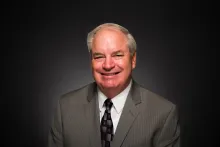
Robin Webber was born in Chicago, Illinois, in 1951, but has lived most of his life in California. He has been a part of the Church of God community since 1963. He attended Ambassador College in Pasadena from 1969-1973. He majored in theology and history.
Mr. Webber's interest remains in the study of history, socio-economics and literature. Over the years, he has offered his services to museums as a docent to share his enthusiasm and passions regarding these areas of expertise.
When time permits, he loves to go mountain biking on nearby ranch land and meet his wife as she hikes toward him.
