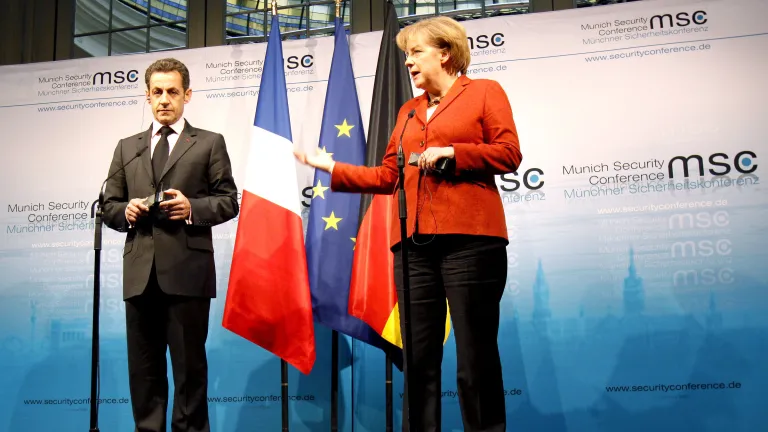
Current Event & Trends: Germany pushes on while France threatens the euro

Chancellor Angela Merkel of Germany continues to be the West's most successful political leader. John Peet, The Economist's European editor, reported that "in Europe it will be Germany that calls the tune" ("Wait for Angela," The World in 2013).
Some are referring to Merkel as the "Iron Chancellor"—recalling the architect of Germany's unification and imperial rise in the late 1800s. The designation is also meant to draw comparison with Britain's former prime minister Margaret Thatcher, the "Iron Lady." She famously said of herself, "The lady's not for turning"—and this expression is now likewise applied to Merkel. Several prominent journalists depict Merkel as the only leader who can save the euro and ultimately the European Union.
Jeremy Warner, who journeyed to Berlin for The Sunday Telegraph, had this to say: "Anyone who thinks Berlin is itself about to buckle under the pressure and bring monetary union to a rapid conclusion is sadly misinformed. The euro is Germany's currency now, but in the possessive rather than the collective sense. To all intents and purposes, the single currency has become Germany's new Deutschemark, and despite some concessions to fellow members, Berlin its undisputed capital. Nothing, least of all British obstructionism, will be allowed to stand in the way of saving the euro.
"But this is about more than simply defending the national currency. For many in Germany's political class, the [currency] crisis is the mechanism that allows the euro finally to fulfill its destiny as a dynamo of European reform and integration" ("The Euro Has Become Germany's New Deutschemark," Nov. 17, 2012).
Will the German chancellor become a key factor in paving the way for a European federal union, a United States of Europe? The Bible foretells a future union of 10 political entities centered in Central Europe that will ultimately be led by a charismatic dictator—a power that will dominate the world for a relatively short time (Revelation 13:3-9). This will happen not long before the second coming of Jesus Christ. (To learn more, read the Bible study aid Are We Living in the Time of the End?)
France's President François Hollande occupies the opposite end of the leadership spectrum from Mrs. Merkel. The Economist now considers France to be "The Time Bomb at the Heart of Europe"—as stated on the cover of its Nov. 17-23, 2012, edition. Some observers even suspect that bailouts are on the horizon for Paris and that France could be more of a threat to the euro than Greece, Italy, Spain and Portugal countries combined. Bearing the cover title, the magazine issue's lead editorial presented, as stated in the drophead, "why France could become the biggest danger to Europe's single currency."
The Paris bureau chief of The Economist, Sophie Peddor, writes in The World in 2013: "It will be a rude return to earth for France's President François Hollande in 2013. He was elected to 're-enchant the French dream.' He will now have to manage an economic nightmare—feeble growth, over 3m[illion] unemployed, factory closures, declining competitiveness and strained public finances."

An Article from:
Good News Magazine: January - February 2013
Course Content

John Ross Schroeder
John died on March 8, 2014, in Oxford, England, four days after suffering cardiac arrest while returning home from a press event in London. John was 77 and still going strong.
Some of John's work for The Good News appeared under his byline, but much didn't. He wrote more than a thousand articles over the years, but also wrote the Questions and Answers section of the magazine, compiled our Letters From Our Readers, and wrote many of the items in the Current Events and Trends section. He also contributed greatly to a number of our study guides and Bible Study Course lessons. His writing has touched the lives of literally millions of people over the years.
John traveled widely over the years as an accredited journalist, especially in Europe. His knowledge of European and Middle East history added a great deal to his articles on history and Bible prophecy.
In his later years he also pastored congregations in Northern Ireland and East Sussex, and that experience added another dimension to his writing. He and his wife Jan were an effective team in our British Isles office near their home.
John was a humble servant who dedicated his life to sharing the gospel—the good news—of Jesus Christ and the Kingdom of God to all the world, and his work was known to readers in nearly every country of the world.