God, Science and the Bible: Weighty evidence for the Bible's accuracy
What is a pim? That is what translators asked themselves when they were finishing the King James Version of the Bible back in the 17th century. They had never heard of the term outside of the Bible and had to guess as to its meaning—which turned out to be wrong.
What is a pim? That is what translators asked themselves when they were finishing the King James Version of the Bible back in the 17th century. They had never heard of the term outside of the Bible and had to guess as to its meaning—which turned out to be wrong.
In 1 Samuel 13:20-21, they translated the Hebrew term pim as "file." It seemed to make sense at the time. The text reads: "But all the Israelites went down to the Philistines, to sharpen every man his share, and his coulter, and his axe, and his mattock. Yet they had a file for the mattocks, and for the coulters, and for the forks, and for the axes, and to sharpen the goads."
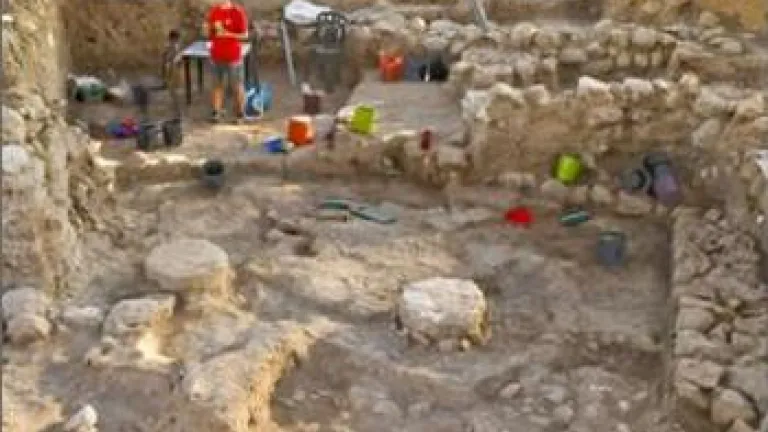
It was only when archaeology came to the rescue in the last century that the term was finally understood. Archaeologists digging at various sites in Israel—such as Gezer, Timnah, Ashdod and Ekron—found small stone weights inscribed with the word pim. They realized the word pim referred to a weight used in monetary transactions—about 8 grams of silver, or two thirds of a shekel.
The New King James Bible, utilizing the new discovery, corrected the verse in question. In this version 1 Samuel 13:21 reads, "and the charge for a sharpening was a pim for the plowshares, the mattocks, the forks, and the axes, and to set the points of the goads."
This discovery authenticated the Bible's historical validity, since these weights were only found in the strata from the ninth to the seventh centuries B.C., after which new sets of weights were adopted. It tells us that the account of 1 Samuel was written close to the time of the actual events, as the term pim fell out of use not long after that.
Archaeologist William Dever mentions the discovery of the pim weight as evidence of the historical accuracy of the Bible. "Archaeology still provides an invaluable service. Countless hitherto enigmatic passages have been clarified . . . The translation of 1 Samuel 13:19-21 was pure guesswork until archaeologists brought to light small stone balance weights inscribed in paleo-Hebrew with the word pim, which we now know designates a silver shekel fraction of about 7.8 grams (.28 ounces)" (Biblical Archaeology Review, May/June 1990, p. 55).
So thanks to archaeology, we again have confirmation of the accuracy of the Bible!

An Article from:
Good News Magazine: July - August 2005
Course Content

Tom Robinson
Tom is an elder in the United Church of God who works from his home near St. Louis, Missouri as managing editor and senior writer for Beyond Today magazine, church study guides and the UCG Bible Commentary. He is a visiting instructor at Ambassador Bible College. And he serves as chairman of the church's Prophecy Advisory Committee and a member of the Fundamental Beliefs Amendment Committee.
Tom began attending God's Church at the age of 16 in 1985 and was baptized a year later. He attended Ambassador College in both Texas and California and served for a year as a history teacher at the college's overseas project in Sri Lanka. He graduated from the Texas campus in 1992 with a Bachelor of Arts in theology along with minors in English and mass communications. Since 1994, he has been employed as an editor and writer for church publications and has served in local congregations through regular preaching of sermons.
Tom was ordained to the ministry in 2012 and attends the Columbia-Fulton, Missouri congregation with his wife Donna and their two teen children.

Mario Seiglie
Mr. Seiglie was born in Havana, Cuba, and came to the United States when he was a child. He found out about the Church when he was 17 from a Church member in high school. He went to Ambassador College in Big Sandy, Texas, and in Pasadena, California, graduating with degrees in theology and Spanish. He serves as the pastor of the Garden Grove, CA UCG congregation and serves in the Spanish speaking areas of South America. He also writes for the Beyond Today magazine and currently serves on the UCG Council of Elders. He and his wife, Caty, have four grown daughters, and grandchildren.

Scott Ashley
Scott Ashley was managing editor of Beyond Today magazine, United Church of God booklets and its printed Bible Study Course until his retirement in 2023. He also pastored three congregations in Colorado for 10 years from 2011-2021. He and his wife, Connie, live near Denver, Colorado.
Mr. Ashley attended Ambassador College in Big Sandy, Texas, graduating in 1976 with a theology major and minors in journalism and speech. It was there that he first became interested in publishing, an industry in which he worked for 50 years.
During his career, he has worked for several publishing companies in various capacities. He was employed by the United Church of God from 1995-2023, overseeing the planning, writing, editing, reviewing and production of Beyond Today magazine, several dozen booklets/study guides and a Bible study course covering major biblical teachings. His special interests are the Bible, archaeology, biblical culture, history and the Middle East.