God, Science and the Bible: First-century burial confirms Gospel details
For years scholars have puzzled over a curious detail mentioned in the Gospel of John concerning Jewish burial practices in the first century. In describing the entombments of Jesus Christ (John 20:7) and His friend Lazarus (John 11:44), John writes of both men having had their bodies wrapped with a linen cloth for burial, but with a separate, smaller cloth wrapped around their heads.
For years scholars have puzzled over a curious detail mentioned in the Gospel of John concerning Jewish burial practices in the first century. In describing the entombments of Jesus Christ (John 20:7) and His friend Lazarus (John 11:44), John writes of both men having had their bodies wrapped with a linen cloth for burial, but with a separate, smaller cloth wrapped around their heads.
While archaeology has confirmed many details of the Gospels, ancient fabrics are very fragile and decay completely within a few decades unless preserved under extraordinary circumstances. However, in the spring of 2000, a set of extraordinary circumstances led to a once-in-a-lifetime discovery for several archaeologists.
That morning Israeli archaeologist Shimon Gibson and Professor James Tabor of the University of North Carolina-Charlotte, with some of Dr. Tabor's archaeology students, happened on a first-century Jewish tomb in Jerusalem's Hinnom Valley that apparently had been plundered only the night before.
They immediately notified the Israeli Antiquities Authority (IAA) of the crime and, since Gibson worked for the IAA, they received permission to enter and examine the pillaged tomb.
Most tombs in the Jerusalem area, of which more than a thousand are known, were plundered long ago. A few, however, have remained intact over the centuries. This had been one of the few. Now it had been broken into and pillaged for artifacts that could perhaps be sold on the antiquities market.
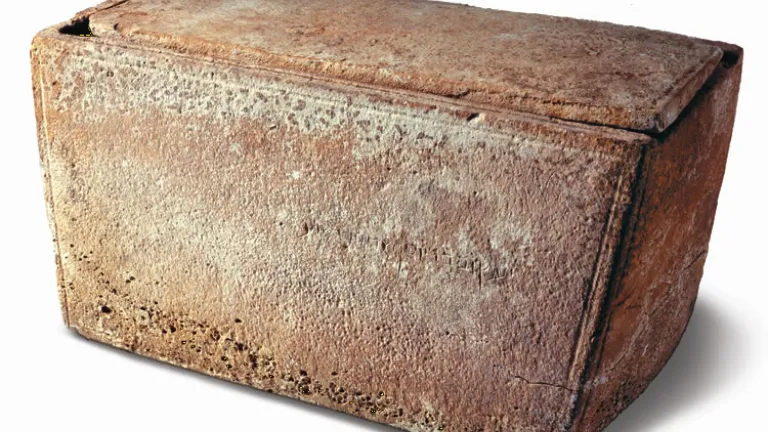
Inside the multilevel tomb the group found the remains of several ossuaries, small limestone boxes that had held the bones of Jewish men and women who had been entombed there. Regrettably, they had been shattered by the thieves, who then stole fragments that apparently bore the names of those whose bones had been contained in the ossuaries.
The most important find, however, remained undisturbed in one of the tomb's small chambers. "In the third level [of the tomb], which is the lowest level, we found . . . the skeleton of a person with a burial shroud still over his shoulders," reported Dr. Tabor. But even more remarkable, the man's body had been wrapped with two pieces of fabric—one around the body and a separate, smaller piece around the head, just as described in John's Gospel.
Small samples of the fabric were radiocarbon dated to the first century—the time during which Jesus lived. Clearly John had faithfully and accurately recorded this detail of Jewish burial practices from the first century.
Due to the find's importance, announcement of the discovery was postponed until scientific analysis could be completed and material prepared for publication.
How had the fabric been preserved all those centuries? Through a geological fluke, a crack in the limestone from which the tomb had been carved had drained ground moisture away from that one particular chamber, leaving it dry and protected—and leaving us evidence that the Gospels indeed are an accurate historical record of real first-century events. (Source: lecture by Professor James Tabor, International Symposium on Archaeology and the Bible, Jan. 14.)

An Article from:
Good News Magazine: March - April 2005
Course Content

Tom Robinson
Tom is an elder in the United Church of God who works from his home near St. Louis, Missouri as managing editor and senior writer for Beyond Today magazine, church study guides and the UCG Bible Commentary. He is a visiting instructor at Ambassador Bible College. And he serves as chairman of the church's Prophecy Advisory Committee and a member of the Fundamental Beliefs Amendment Committee.
Tom began attending God's Church at the age of 16 in 1985 and was baptized a year later. He attended Ambassador College in both Texas and California and served for a year as a history teacher at the college's overseas project in Sri Lanka. He graduated from the Texas campus in 1992 with a Bachelor of Arts in theology along with minors in English and mass communications. Since 1994, he has been employed as an editor and writer for church publications and has served in local congregations through regular preaching of sermons.
Tom was ordained to the ministry in 2012 and attends the Columbia-Fulton, Missouri congregation with his wife Donna and their two teen children.
Mario Seiglie
Mr. Seiglie was born in Havana, Cuba, and came to the United States when he was a child. He found out about the Church when he was 17 from a Church member in high school. He went to Ambassador College in Big Sandy, Texas, and in Pasadena, California, graduating with degrees in theology and Spanish. He serves as the pastor of the Garden Grove, CA UCG congregation and serves in the Spanish speaking areas of South America. He also writes for the Beyond Today magazine and currently serves on the UCG Council of Elders. He and his wife, Caty, have four grown daughters, and grandchildren.

Scott Ashley
Scott Ashley was managing editor of Beyond Today magazine, United Church of God booklets and its printed Bible Study Course until his retirement in 2023. He also pastored three congregations in Colorado for 10 years from 2011-2021. He and his wife, Connie, live near Denver, Colorado.
Mr. Ashley attended Ambassador College in Big Sandy, Texas, graduating in 1976 with a theology major and minors in journalism and speech. It was there that he first became interested in publishing, an industry in which he worked for 50 years.
During his career, he has worked for several publishing companies in various capacities. He was employed by the United Church of God from 1995-2023, overseeing the planning, writing, editing, reviewing and production of Beyond Today magazine, several dozen booklets/study guides and a Bible study course covering major biblical teachings. His special interests are the Bible, archaeology, biblical culture, history and the Middle East.