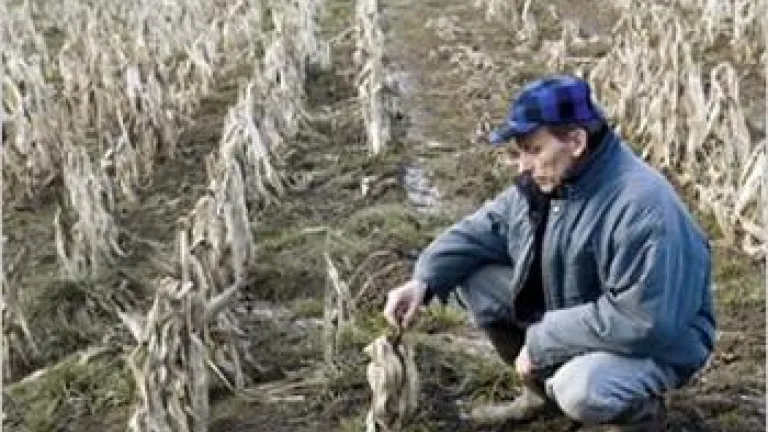
World News and Trends: Famine stalks the earth
Does the Bible reveal why famine has become a greater concern throughout the world?
Said a striking feature article in The Wall Street Journal: "Now and then across the centuries, powerful voices have warned that human activity would overwhelm the earth's resources. The Cassandras [i.e., prophets of doom] always proved wrong. Each time, there were new resources to discover, new technologies to propel growth. Today the old fears are back" (March 26, 2008, emphasis added throughout).
A UN agency projects that our planet's population will grow by 1.4 billion more people by 2025. Significantly more food and water is being consumed by the average individual. A middle class is growing rapidly in countries like China and India, resulting in increased demand for high-protein diets.
The article continued: "Demand for resources has soared. If supplies don't keep pace, prices are likely to climb. Further, economic growth in rich and poor nations alike could suffer, and some fear violent conflicts could occur."
Other mainstream magazines and newspapers are covering this major story. Time magazine stated: "Prices of rice, wheat and other basic foodstuffs are soaring beyond the reach of the world's poor, triggering riots, pleas for aid and fears of a deepening threat to security. Add this to the list of items that could threaten world peace: food" (March 17, 2008).
The Economist weighed in with these insightful comments: "High food prices do help poor farmers, but they also hurt the more numerous category of people (poor city dwellers as well as landless rural folk) who must buy food to survive . . . The World Food Programme (WFP), a UN agency, has just issued an urgent appeal for $500m, to cover higher food costs. America's Agency for International Development (USAID), a huge financer of food aid, is asking for $350m. The short term outlook seems grim" (March 29, 2008).
Josette Sheeran, executive director of the World Food Programme, stated: "We are seeing a new face of hunger. People who weren't in the urgent category now are" (ibid.).
Overall world food prices have risen by more than 75 percent since the year 2000, increasing by more than 20 percent in 2007 alone. For instance, London's Financial Times reported on March 28, 2008, "Rice prices jumped 30 percent to a record high yesterday, raising fears of fresh outbreaks of social unrest across Asia, where the grain is a staple food for more than 2.5 [billion] people." Rice also remains a staple foodstuff in Africa, and some smaller countries there have experienced riots and social unrest.
Richard Watchman offered this insight in The Observer: "Scratch beneath the surface of major social or political upheaval . . . and you will find that food shortages, brought about by crop failure, naval blockade or spiralling price, lie at the heart of the matter" (March 2, 2008).
Does the Bible provide any insight on our growing global food plight? In His lengthy prophecy of the end time, Jesus Christ spoke of a pattern of epochal events that would periodically trouble the earth from His time some 2,000 years ago, intensifying just before His second coming: "For nation will rise against nation, and kingdom against kingdom. And there will be famines, pestilences [disease epidemics], and earthquakes in various places. All these are the beginning of sorrows" (Matthew 24:7-8).
The book of Revelation primarily concerns itself with events that will happen prior to the end of this age of man. Paralleling the specific "sorrows" mentioned in Christ's prophecy, the Four Horsemen of the Apocalypse are featured in Revelation 6. The third rider, of the black horse, stands clearly identified as the specter of famine (verses 5-6)—to plague the earth just prior to Christ's return.
To understand the significance of these four horsemen, identified respectively as religious deception, war, famine and disease, request or download our free booklet The Book of Revelation Unveiled. (Sources: The Economist, Financial Times, The Observer [all London], Time, The Wall Street Journal.)

An Article from:
Good News Magazine: May - June 2008
Course Content
Jerold Aust
Jerold Aust has served in the ministry for 52 years, as a public speaker for 58 years, a published writer for 38 years, and is employed by UCG’s Media and Communications Services. He is a Senior Writer, interviewer, and editor for Beyond Today Magazine and has taught Speech Communication for UCG’s ministerial online program and the Book of Revelation for ABC.
Jerold holds a BA in theology from Ambassador College, Pasadena (1968), an MA in Communication from California State University, Fullerton (1995), a distance-learning Ph.D (2006), and a Famous Writers School diploma in non-fiction writing (1973). Additionally, he studied post-grad communication at University of Southern California (1995), radio, TV, voice-overs, and Public Relations at Fullerton College (1995-1996), and graduate communication at Wichita State University (1978). Jerold has taught communication at the University of South Alabama (7 years) and ABC (17 years). His published works include, Ronald Reagan’s Rhetoric: Metaphor as Persuasion and EZSpeakers: Public Speaking Made Easy in 7 Steps. Jerold's overarching goal is to share with humankind its incredible destiny!

John Ross Schroeder
John died on March 8, 2014, in Oxford, England, four days after suffering cardiac arrest while returning home from a press event in London. John was 77 and still going strong.
Some of John's work for The Good News appeared under his byline, but much didn't. He wrote more than a thousand articles over the years, but also wrote the Questions and Answers section of the magazine, compiled our Letters From Our Readers, and wrote many of the items in the Current Events and Trends section. He also contributed greatly to a number of our study guides and Bible Study Course lessons. His writing has touched the lives of literally millions of people over the years.
John traveled widely over the years as an accredited journalist, especially in Europe. His knowledge of European and Middle East history added a great deal to his articles on history and Bible prophecy.
In his later years he also pastored congregations in Northern Ireland and East Sussex, and that experience added another dimension to his writing. He and his wife Jan were an effective team in our British Isles office near their home.
John was a humble servant who dedicated his life to sharing the gospel—the good news—of Jesus Christ and the Kingdom of God to all the world, and his work was known to readers in nearly every country of the world.