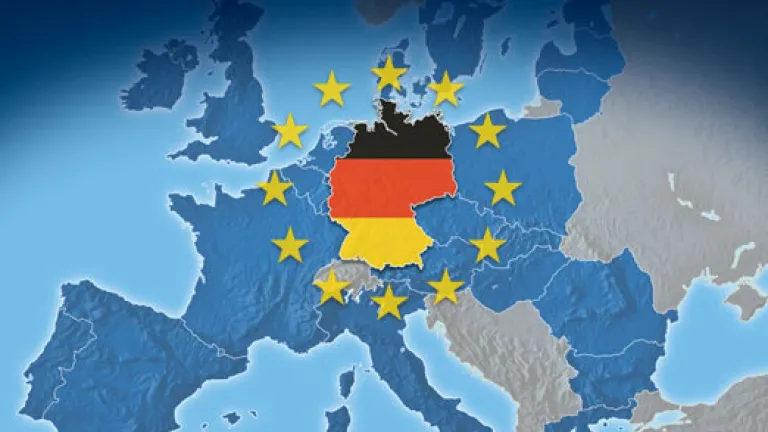
World News and Trends: The continuing German conundrum
Prior to the fall of the Berlin Wall, the former chancellor of West Germany, Helmut Schmidt, observed that the idea of a unified state of 75 million Germans arising one day in the middle of Europe was a cause of concern for many of the nation's European neighbors and partners
Nevertheless, a unified Germany has been a reality since late 1989. And now a people that brought two major wars to the European continent during the 20th century find themselves forging ahead economically, while most neighboring nations are struggling financially.
As Time magazine reported, while Germany's economy was in shambles 10 years ago, it's now an export machine: "While the Spanish, Irish and other Europeans were gorging on debt, building too many houses and giving themselves fat pay raises, Germans were busy fixing their economy" (Michael Schuman, "How Germany Became the China of Europe," March 7, 2011).
In November 2010, it was announced that German unemployment had dropped below 3 million for the first time since 1992. Clearly Europe's industrial engine is roaring again. But will Berlin take the lead on the European continent? Is the Fatherland going to take center stage in Europe?
The current leadership shows signs of reluctance. It sees Portugal, Ireland and Greece as posing painful economic problems for Germany and the European Union (EU). A March 12, 2011, Economist article asked the question: "Can Angela Merkel Hold Europe Together?"—meaning the EU. Germany remains somewhat uncomfortable with massive bailouts of the economically troubled member nations. Will Germany remain committed to the European dream through thick and thin?
Germany also remains conflicted about its military role. Last year the German military, long considered a postwar defensive and peacekeeping force, found itself actually fighting in Afghanistan. Still haunted by its Nazi past (Hitler's regime ending 66 years ago in 1945), Berlin remains reluctant to exercise a full military role in Europe, even as a part of NATO. Germany did not join America, Britain and France in its Libyan missile and air strikes.
So what is Germany's long-term destiny? Will Berlin eventually assume both military and political leadership of all Europe?
The Bible certainly indicates this will eventually happen. Who knows what kind of a leader may dominate Berlin in the future? To learn more, please read our free booklet Are We Living in the Time of the End? (Sources: The Economist [London], Time.)

An Article from:
Good News Magazine: May - June 2011
Course Content
Jerold Aust
Jerold Aust has served in the ministry for 52 years, as a public speaker for 58 years, a published writer for 38 years, and is employed by UCG’s Media and Communications Services. He is a Senior Writer, interviewer, and editor for Beyond Today Magazine and has taught Speech Communication for UCG’s ministerial online program and the Book of Revelation for ABC.
Jerold holds a BA in theology from Ambassador College, Pasadena (1968), an MA in Communication from California State University, Fullerton (1995), a distance-learning Ph.D (2006), and a Famous Writers School diploma in non-fiction writing (1973). Additionally, he studied post-grad communication at University of Southern California (1995), radio, TV, voice-overs, and Public Relations at Fullerton College (1995-1996), and graduate communication at Wichita State University (1978). Jerold has taught communication at the University of South Alabama (7 years) and ABC (17 years). His published works include, Ronald Reagan’s Rhetoric: Metaphor as Persuasion and EZSpeakers: Public Speaking Made Easy in 7 Steps. Jerold's overarching goal is to share with humankind its incredible destiny!

John Ross Schroeder
John died on March 8, 2014, in Oxford, England, four days after suffering cardiac arrest while returning home from a press event in London. John was 77 and still going strong.
Some of John's work for The Good News appeared under his byline, but much didn't. He wrote more than a thousand articles over the years, but also wrote the Questions and Answers section of the magazine, compiled our Letters From Our Readers, and wrote many of the items in the Current Events and Trends section. He also contributed greatly to a number of our study guides and Bible Study Course lessons. His writing has touched the lives of literally millions of people over the years.
John traveled widely over the years as an accredited journalist, especially in Europe. His knowledge of European and Middle East history added a great deal to his articles on history and Bible prophecy.
In his later years he also pastored congregations in Northern Ireland and East Sussex, and that experience added another dimension to his writing. He and his wife Jan were an effective team in our British Isles office near their home.
John was a humble servant who dedicated his life to sharing the gospel—the good news—of Jesus Christ and the Kingdom of God to all the world, and his work was known to readers in nearly every country of the world.