World News and Trends: Massive domestic and international challenges confront the next president
Richard Holbrooke, a former U.S. ambassador to the UN, observed that "the Presidency of the United States is the most extraordinary job ever devised"—with the one assuming this position "tested by pressures unimaginable to anyone who has not held the job" ("The Next President," Foreign Affairs, Sept.-Oct. 2008).
Richard Holbrooke, a former U.S. ambassador to the UN, observed that "the Presidency of the United States is the most extraordinary job ever devised"—with the one assuming this position "tested by pressures unimaginable to anyone who has not held the job" ("The Next President," Foreign Affairs, Sept.-Oct. 2008).
Although the new president will lead the world's most powerful single country, without question a superpower, he "will inherit a more difficult set of international problems than any of his predecessors have since at least the end of World War II . . . He will have to reshape policies on the widest imaginable range of challenges, domestic and international . . .
"He must revitalize a flagging economy; tame a budget awash in red ink; reduce energy dependence . . . tackle the growing problem of nuclear proliferation; improve the defenses of the homeland against global terrorists while putting more pressure on al Qaeda, especially in Pakistan; and, of course, manage two wars [in Iraq and Afghanistan] simultaneously" (ibid., emphasis added throughout).
That's a tall order! Insightful observers now discuss "the real new world order" ushered in by recent events in the country of Georgia and by madness in the financial markets on Wall Street and elsewhere. The state of the economy is probably the main challenge the next occupant of the Oval Office will face.
Veteran British journalist Simon Jenkins asked these penetrating questions in The Sunday Times: "You don't understand it either, do you? How could a clutch of dud mortgages somewhere in the American Midwest bring the mightiest financial centres on earth close to collapse? How could the esoteric practices of risk exchange [e.g., packaging, selling and reselling questionable mortgages] sabotage what was just six months ago, two smoothly performing capitalist economies? . . . Economics is still a mystery wrapped in an enigma" (Sept. 21, 2008).
Dan Atkinson, economics editor of The Mail on Sunday, explained that "the [financial] convulsions that began in August 2007 and have shaken us more violently since have been concentrated in the so-called Anglo-Saxon economies—chiefly Britain and the United States " (Sept. 21, 2008).
He further pointed out that "Britain, America and, to a lesser extent, Australia, New Zealand, Ireland and others have become addicted to debt. This addiction has been fed by a financial services industry bloated to many times its natural size, and itself, in need of huge amounts of borrowed money.
"[London] and Wall Street, having asset-stripped domestic industry, set about lending consumers the money to buy imported goods that we no longer make. In a final twist, the money is often borrowed from the same countries, such as China , that are selling us the goods . . . In return for their goods, China and other developing economies have taken vast amounts of [British pound] sterling and dollar-dominated paper—shares whose value they naturally wish to see preserved."
So far, the United States government has executed several major bailouts of very large, very prominent financial institutions whose projected demise threatened a major recession and possibly even a 1930s-style meltdown and depression. When the dust settles, it likely will constitute the biggest government takeover of private enterprise in American history. The scale and swiftness of government intervention is unprecedented since the 1930s.
These massive economic bailouts should provide some much-needed breathing space and hopefully restore confidence in the financial system. Yet they likely will not prevent a recession entailing perhaps many more job losses, further falls in house prices and a general economic slowdown in America and other Western countries.
Why are our Anglo-Saxon nations in such a quandary on so many fronts? Why does the leader of the United States face so many daunting challenges? One particular booklet explains important though little-understood biblical and historical background and tells us where the country is inevitably headed if it fails to institute major moral course corrections. Request or download our free booklet The United States and Britain in Bible Prophecy. (Sources: The Mail on Sunday, The Sunday Times [both London], Foreign Affairs.)

An Article from:
Good News Magazine: November - December 2008
Course Content
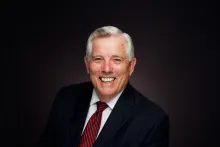
Jerold Aust
Jerold Aust has served in the ministry for 52 years, as a public speaker for 58 years, a published writer for 38 years, and is employed by UCG’s Media and Communications Services. He is a Senior Writer, interviewer, and editor for Beyond Today Magazine and has taught Speech Communication for UCG’s ministerial online program and the Book of Revelation for ABC.
Jerold holds a BA in theology from Ambassador College, Pasadena (1968), an MA in Communication from California State University, Fullerton (1995), a distance-learning Ph.D (2006), and a Famous Writers School diploma in non-fiction writing (1973). Additionally, he studied post-grad communication at University of Southern California (1995), radio, TV, voice-overs, and Public Relations at Fullerton College (1995-1996), and graduate communication at Wichita State University (1978). Jerold has taught communication at the University of South Alabama (7 years) and ABC (17 years). His published works include, Ronald Reagan’s Rhetoric: Metaphor as Persuasion and EZSpeakers: Public Speaking Made Easy in 7 Steps. Jerold's overarching goal is to share with humankind its incredible destiny!

John Ross Schroeder
John died on March 8, 2014, in Oxford, England, four days after suffering cardiac arrest while returning home from a press event in London. John was 77 and still going strong.
Some of John's work for The Good News appeared under his byline, but much didn't. He wrote more than a thousand articles over the years, but also wrote the Questions and Answers section of the magazine, compiled our Letters From Our Readers, and wrote many of the items in the Current Events and Trends section. He also contributed greatly to a number of our study guides and Bible Study Course lessons. His writing has touched the lives of literally millions of people over the years.
John traveled widely over the years as an accredited journalist, especially in Europe. His knowledge of European and Middle East history added a great deal to his articles on history and Bible prophecy.
In his later years he also pastored congregations in Northern Ireland and East Sussex, and that experience added another dimension to his writing. He and his wife Jan were an effective team in our British Isles office near their home.
John was a humble servant who dedicated his life to sharing the gospel—the good news—of Jesus Christ and the Kingdom of God to all the world, and his work was known to readers in nearly every country of the world.

