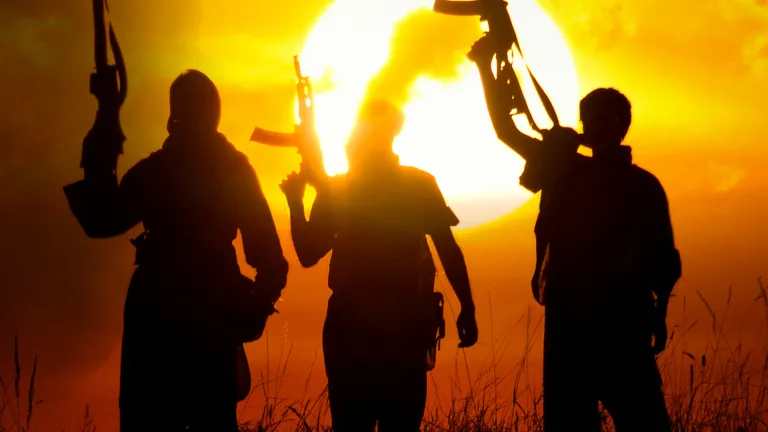
Current Events & Trends: Islamic State exploiting power vacuum
For 13 years now al-Qaeda has been the face of terror and Islamic extremism, both feared and hated in the West. But now their hold on the Middle East and the loyalty of Islamic militants may be slipping.
Despite the insistence of senior al-Qaeda leaders that there is nothing wrong in the organization, Reuters reports that "counter-terrorism experts say al Qaeda's aging leadership is struggling to compete for recruits with Islamic State" (Noah Browning, "Al Qaeda Denies Decline, Acknowledges 'Mistakes' by Its Branches," Sept. 14, 2014).
Browning's report quotes the U.S. State Department in saying that al-Qaeda's "ability to conduct attacks and direct its followers" has been limited (ibid.). The terrorist group has been dealt several severe blows over the last three years, beginning with the assassination of its figurehead and leader Osama bin Laden in 2011. Bin Laden was seen as al-Qaeda's spiritual leader as well as its geopolitical and organizational chief.
Several more key attacks and assassinations have repeatedly weakened al-Qaeda by eliminating high-ranking personnel. While al-Qaeda remains active in many regions across the Middle East and North Africa, the cumulative effect on the group has been undeniably debilitating.
Just a few months ago reports of the weakening of al-Qaeda would have been welcomed as good news. But the power vacuum being left by al-Qaeda and its affiliates has been quickly filled by the Islamic State or IS, a group making headlines through its declaration of a caliphate, extreme brutality and speedy expansion.
Headed by self-declared caliph Abu Bakr al-Baghdadi, the Islamic State's influence is being felt strongly as far west as Turkey, where officials have closed the border with Syria in response to an influx of Syrian and Kurdish refugees fleeing IS encroachment ("Turkey Clamps Down on Syria Border After Kurdish Unrest," BBC News, Sept. 22, 2014).
Why is it important to keep a close eye on the activities of the militant, extremist Islamic State? Besides the obvious reasons of staying informed about the world and potential impacts upon your personal life, the Bible gives us a lens through which we can understand the real storylines behind the world's events.
Daniel 11 describes historic wars between two geopolitical powers called the king of the North, located north of Jerusalem, and the king of the South, located to the south of Jerusalem. In verse 40 the perspective switches to a prophetic view of future events: "At the time of the end the king of the South shall attack him [the king of the North]; and the king of the North shall come against him like a whirlwind, with chariots, horsemen, and with many ships; and he shall enter the countries, overwhelm them, and pass through" (Daniel 11:40). (To learn more, see our free Bible study guide The Middle East in Bible Prophecy and "Islamic Caliphate Declared: What Does It Mean?" in the Sept.-Oct. 2014 issue of The Good News.)
With the Islamic State's aggressive stance and strategic pushes toward the West, this situation is one that biblically minded individuals will want to keep a close eye on. (Sources: Reuters, BBC.)

An Article from:
Good News Magazine: November - December 2014
Course Content

Rudolph Rangel III
Rudy Rangel attends the Cincinnati East, Ohio congregation along with his wife Judy and two children.

Darris McNeely
Darris McNeely is a retired elder in the United Church of God. He and his wife, Debbie, have served in the ministry for more than 53 years. They have two sons, who are both married, and four grandchildren. Darris continues teaching at Ambassador Bible Center and is a member of the Council of Elders. Darris and Debbie continue to travel and keep up with the many friends and relationships around the world.

Peter Eddington
Peter has retired as Operation Manager of Media and Communications Services.
He studied production engineering at the Swinburne Institute of Technology in Melbourne, Australia, and is a journeyman machinist. He moved to the United States to attend Ambassador College in 1980. He graduated from the Pasadena campus in 1983 with a Bachelor of Arts degree and married his college sweetheart, Terri. Peter was ordained an elder in 1992. He served as assistant pastor in the Los Angeles and San Luis Obispo, California, congregations from 1995 through 1998 and the Cincinnati, Ohio, congregations from 2010 through 2011.