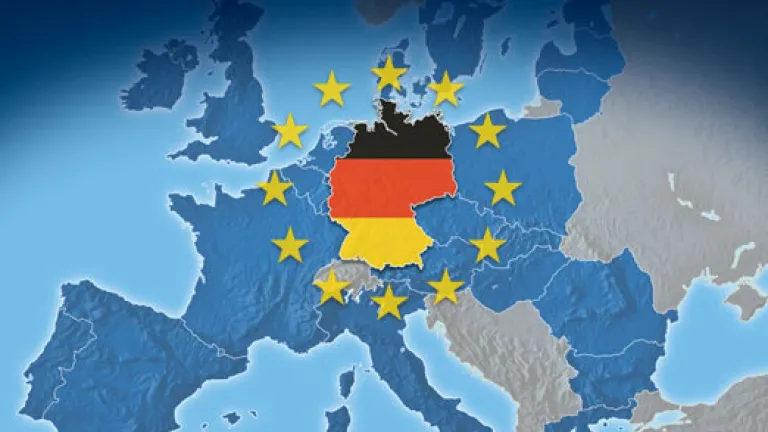
Current Events & Trends: Probabilities and prophecy: Is Europe heading for a crash?
From a human standpoint, accurately forecasting geopolitics often proves to be a risky venture. Particularly in today's age of the Internet and globalization, many varying forces pull nations and world leaders in contradictory directions - not to mention the generally unrealized influence of the unseen spirit world (Ephesians 2:1-3; 2 Corinthians 4:3-4).
Historian and political commentator Walter Laqueur states in World Affairs: "However, if there are no certainties in world politics, there remain probabilities that can be ignored only at great peril. In the case of the troubled European Union and the darkening Arab Spring, it is highly probable that, from the beginning, the optimism of even expert journalists, academics, and diplomats was misplaced, and that the odds against European progress toward a united and prosperous continent, and Arab progress toward liberty, peace, and democracy, were very heavy indeed" ("The Perils of Wishful Thinking: On Europe and the Middle East," March/April 2012, emphasis added throughout)
British author, editor and journalist Max Hastings would agree. His Daily Mail article of June 19, 2012, was titled: "Europe's on the Brink of Probably the Gravest and Most Frightening Tumult of Our Lifetime."
He speaks frankly of probabilities: "Greece, like Italy, espouses a historic culture of corruption and tax-evasion that may enable those countries to muddle along in splendid isolation, but disqualifies them as partners in an economic union with Northern Europe . . . Greece cannot and will not fulfill its financial obligations. Its new Government's only hope is that promises of future good behaviour persuade the Germans to pick up Greece's bills, keeping the game going for another round."
Hastings does not mince his words: "The truth is that the weaker brethren of the EU have got to go, for their own sake and everybody else's. There is absolutely no happy scenario at the end of the crisis—only a choice between variations of calamity. If the eurozone survives at all, it can only be as a German economic empire in which the subject peoples will sooner or later find colonial status intolerable."
In his concluding remarks, this veteran journalist boldly calls the European Union "a fantasy economic and political structure which is now collapsing about our ears."
Of course, Hastings may be mistaken. One can easily locate article titles like "Why It's Worth Keeping the European Dream Alive" (Financial Times, Nov. 1, 2011) and "Weber [i.e., former German central banker Axel Weber] Sees Euro Zone Surviving Crisis" (The Wall Street Journal, June 25, 2012). Nonetheless, the eurozone countries remain on the horns of a serious dilemma.
The Associated Press reported on Aug. 2, 2012: "The European Central Bank is preparing to unleash its financial might and buy government bonds to help drive down borrowing costs in debt-ridden countries like Spain and Italy, caught in the grip of what president Mario Draghi called a 'worsening crisis.' Draghi urged leaders of the 17 countries that use the euro to use their bailout fund to take the same action, sending a clear message: Europe's financial crisis requires more forceful remedies than leaders have so far been able to muster."
Your Bible reveals Europe's cultural differences today as it stumbles forward to form a final revival of the ancient Roman Empire. In interpreting a dream vision of future empires, the prophet Daniel explained:
"Whereas you saw the feet and toes, partly of potter's clay and partly of iron, the kingdom shall be divided; yet the strength of the iron shall be in it, just as you saw the iron mixed with ceramic clay. And as the toes of the feet were partly of iron and partly of clay, so the kingdom shall be partly strong and partly fragile. As you saw iron mixed with ceramic clay, they will mingle with the seed of men; but they will not adhere to one another, just as iron does not mix with clay" (Daniel 2:41-43).
Fundamentally, the social and cultural problems of the European Union are predictable, leading to financial difficulties for a time. And Bible prophecy concurs that transforming European diversities into any kind of cohesiveness will be a struggle. Yet it also shows that a measure of unification will eventually be imposed, but not until a strong leader comes to the fore.
Should there be an economic disaster in Europe, we should clearly recall that Adolf Hitler was only able to come to power in 1933 primarily because of unprecedented runaway inflation and economic hardship in Germany.
Bible prophecy deals in certainties, not probabilities. Whatever the causal circumstances, a world superpower headed by an end-time charismatic dictator will surely arise in Central Europe, its tentacles reaching all around the globe (Daniel 2; 7; Revelation 13; 17-18). To understand much more, read the Bible study aids You Can Understand Bible Prophecy and Are We Living in the Time of the End? (Sources: Associated Press, Daily Mail, Financial Times, The Wall Street Journal, World Affairs.)

An Article from:
Good News Magazine: September - October 2012
Course Content

Jerold Aust
Jerold Aust has served in the ministry for 52 years, as a public speaker for 58 years, a published writer for 38 years, and is employed by UCG’s Media and Communications Services. He is a Senior Writer, interviewer, and editor for Beyond Today Magazine and has taught Speech Communication for UCG’s ministerial online program and the Book of Revelation for ABC.
Jerold holds a BA in theology from Ambassador College, Pasadena (1968), an MA in Communication from California State University, Fullerton (1995), a distance-learning Ph.D (2006), and a Famous Writers School diploma in non-fiction writing (1973). Additionally, he studied post-grad communication at University of Southern California (1995), radio, TV, voice-overs, and Public Relations at Fullerton College (1995-1996), and graduate communication at Wichita State University (1978). Jerold has taught communication at the University of South Alabama (7 years) and ABC (17 years). His published works include, Ronald Reagan’s Rhetoric: Metaphor as Persuasion and EZSpeakers: Public Speaking Made Easy in 7 Steps. Jerold's overarching goal is to share with humankind its incredible destiny!

John Ross Schroeder
John died on March 8, 2014, in Oxford, England, four days after suffering cardiac arrest while returning home from a press event in London. John was 77 and still going strong.
Some of John's work for The Good News appeared under his byline, but much didn't. He wrote more than a thousand articles over the years, but also wrote the Questions and Answers section of the magazine, compiled our Letters From Our Readers, and wrote many of the items in the Current Events and Trends section. He also contributed greatly to a number of our study guides and Bible Study Course lessons. His writing has touched the lives of literally millions of people over the years.
John traveled widely over the years as an accredited journalist, especially in Europe. His knowledge of European and Middle East history added a great deal to his articles on history and Bible prophecy.
In his later years he also pastored congregations in Northern Ireland and East Sussex, and that experience added another dimension to his writing. He and his wife Jan were an effective team in our British Isles office near their home.
John was a humble servant who dedicated his life to sharing the gospel—the good news—of Jesus Christ and the Kingdom of God to all the world, and his work was known to readers in nearly every country of the world.