Current Events & Trends: Disappointment and disorder: the Middle East a prime example
End-time events continue to escalate. The trends of our time regress steadily from bad to worse. Yet another decade of pronounced world disorder seems inevitable.
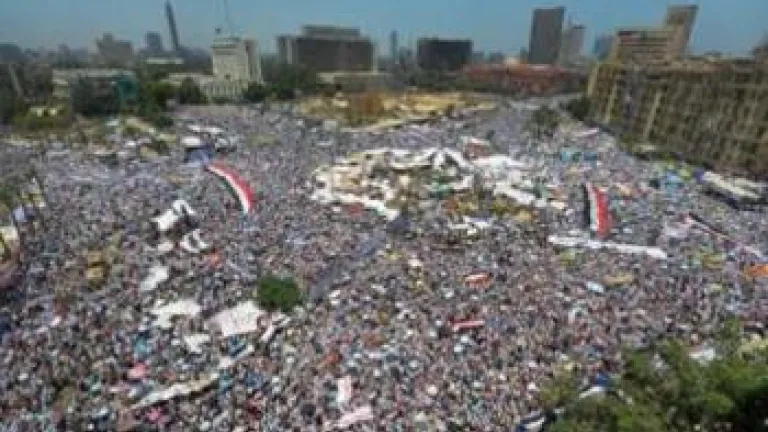
Massive protests are growing in numbers and intensity at crucial points around the world. They call it people power. On the whole things have not yet gotten completely out of control. But when world trends do get far worse, what do you think will happen in the streets?
The Middle East is a prime example of a region afflicted with administrative confusion and governmental disorder. In Egypt the Arab Spring did not lead to the free democratic visions of many in the West. Islamist President Mohamed Morsi's new administration soon began to return to dictatorial methods of government. The Egyptian military placed him under arrest, and new riots soon ensued with deadly violence in Cairo resulting in considerable loss of life.
While the military now holds the power, it should be remembered that Islamists took 75 percent of the vote in the 2011 parliamentary elections. In fact, some analysts believe the coup deposing Morsi will lead to more Islamist supporters becoming radicalized ("Egypt in Turmoil: Salafists Gain Strength Amid Political Chaos," Der Spiegel, July 16, 2013).
For those who think the military will put the march to Western-style democracy back on track, think again. As Caroline Glick writes in The Jerusalem Post: "The voices of liberal democracy in Egypt are so few and far between that they have no chance whatsoever of gaining power, today or for the foreseeable future" ("Israel's Reviled Strategic Wisdom," July 4).
Besides the high support for the Islamists, she goes on to say: "it is clear that their opponents are not liberal democrats. They are a mix of neo-Nasserist fascists, communists and other not particularly palatable groups. None of them share Western conceptions of freedom and limited government. None of them are particularly pro-American. None of them like Jews. And none of them support maintaining Egypt's cold peace with Israel."
Next door in Libya, Western liberation and Gaddafi's demise was soon followed by the country descending into armed chaos.
Turning to Syria, prospects of peace and stability seem very far off. Even if President Bashar al-Assad is turned out of office, a strong possibility persists that at best this will turn out to be the lesser of two evils. Keeping jihadists at bay may become very difficult. A retired general has warned the United States that military involvement will only be the thin end of the wedge. Events in Vietnam, Afghanistan and Iraq back him up.
Iraq continues to be plagued by terrorist bombings often with severe loss of life, still suffering from the age-old Sunni-Shia conflict. Both American and European political and diplomatic influence remains on the wane. Washington and Brussels have experienced frustration after frustration, as their advice has been regularly rebuffed in Mideast capitals. Two years ago U.S. President Barack Obama asked Assad to step aside. Yet he remains in office.
Now we are pinning our hopes on the agreed resumption of the on-again, off-again Israeli-Palestinian peace dialogue. Perhaps some fruit will yet emerge from Secretary of State John Kerry's considerable efforts, but only the second coming of Jesus Christ to His new world capital of Jerusalem will truly change the destiny of the Middle East. Until that time we seem to be moving steadily toward Armageddon. You may wish to download or request our free reprint article "Armageddon: The End of the World." (Sources: Der Spiegel, Financial Times, The Jerusalem Post, Time.)

An Article from:
Good News Magazine: September - October 2013
Course Content
Jerold Aust
Jerold Aust has served in the ministry for 52 years, as a public speaker for 58 years, a published writer for 38 years, and is employed by UCG’s Media and Communications Services. He is a Senior Writer, interviewer, and editor for Beyond Today Magazine and has taught Speech Communication for UCG’s ministerial online program and the Book of Revelation for ABC.
Jerold holds a BA in theology from Ambassador College, Pasadena (1968), an MA in Communication from California State University, Fullerton (1995), a distance-learning Ph.D (2006), and a Famous Writers School diploma in non-fiction writing (1973). Additionally, he studied post-grad communication at University of Southern California (1995), radio, TV, voice-overs, and Public Relations at Fullerton College (1995-1996), and graduate communication at Wichita State University (1978). Jerold has taught communication at the University of South Alabama (7 years) and ABC (17 years). His published works include, Ronald Reagan’s Rhetoric: Metaphor as Persuasion and EZSpeakers: Public Speaking Made Easy in 7 Steps. Jerold's overarching goal is to share with humankind its incredible destiny!

John Ross Schroeder
John died on March 8, 2014, in Oxford, England, four days after suffering cardiac arrest while returning home from a press event in London. John was 77 and still going strong.
Some of John's work for The Good News appeared under his byline, but much didn't. He wrote more than a thousand articles over the years, but also wrote the Questions and Answers section of the magazine, compiled our Letters From Our Readers, and wrote many of the items in the Current Events and Trends section. He also contributed greatly to a number of our study guides and Bible Study Course lessons. His writing has touched the lives of literally millions of people over the years.
John traveled widely over the years as an accredited journalist, especially in Europe. His knowledge of European and Middle East history added a great deal to his articles on history and Bible prophecy.
In his later years he also pastored congregations in Northern Ireland and East Sussex, and that experience added another dimension to his writing. He and his wife Jan were an effective team in our British Isles office near their home.
John was a humble servant who dedicated his life to sharing the gospel—the good news—of Jesus Christ and the Kingdom of God to all the world, and his work was known to readers in nearly every country of the world.