Current Events & Trends: German opinions changing about refugee influx

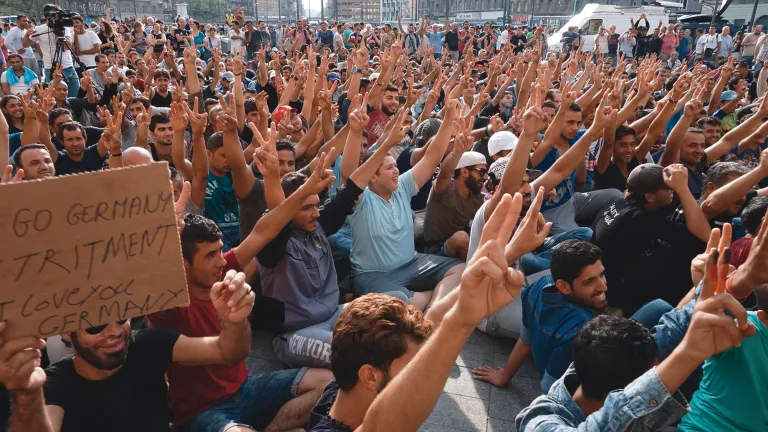
In September 2015 more than 200,000 mostly Muslim refugees entered Germany—some fleeing from war-torn areas in their homelands, but many simply seeking a better economic future.
German Chancellor Angela Merkel surprised her nation and those watching worldwide by claiming there was “no upper limit” to helping those seeking asylum in their peaceful country.
Many of the refugees are fleeing Syria, where the civil war has been blazing since 2011. Chemical weapons were even used at one point, raising the international community’s ire. Syria is dealing with fighting on many fronts. There is an uprising against President Bashar al-Assad, and there are those who are fighting against ISIS.
After seeing the masses arrive, German public opinion about Merkel’s decision is changing. A big concern for Germans is how the new refugees will assimilate into their nation. The Economist recently reported, “Germans worry whether Muslim refugees will accept German norms of sexual equality, secularism and Germany’s special responsibility towards Israel and Jews” (“Merkel at Her Limit,” Oct. 10, 2015).
The Nov. 13 terrorist attacks in Paris have put the nation on high alert because of the influx of refugees already accepted. TheWall Street Journal reports, “The Paris attacks have jolted Germany into considering greater military involvement in the fight against Islamic State, despite public opposition to abandoning its largely pacifist foreign policy” (Anton Troianovski, “Germany Reconsiders Military Intervention in Wake of Paris Attacks,” Nov. 16, 2015).
The cultural differences between the incoming refugees and a modern nation like Germany will have an impact on many aspects of the European nation. Germany has been one of the most financially sound members of the EU. How will the influx of hundreds of thousands of refugees impact the nation that has bailed out other nations? How will the culture of progressive Germans and fundamentalist Muslims clash?
We see in Daniel 11 that there will be a push by the king of the South against the king of the North at some point. Could what’s happening now be setting the stage for animosities between the regions of Europe and the Middle East? (See “Europe at a Crossroads: What Lies Ahead?” beginning on page 20.)
We look to God and His coming Kingdom for a time of peace. When all peoples of the world come to worship God and His Son Jesus Christ in spirit and truth, there will be peace and restoration of all things. (Sources:The Economist, The Wall Street Journal.)

An Article from:
Beyond Today Magazine: January–February 2016
Course Content

Rudolph Rangel III
Rudy Rangel attends the Cincinnati East, Ohio congregation along with his wife Judy and two children.

Tom Robinson
Tom is an elder in the United Church of God who works from his home near St. Louis, Missouri as managing editor and senior writer for Beyond Today magazine, church study guides and the UCG Bible Commentary. He is a visiting instructor at Ambassador Bible College. And he serves as chairman of the church's Prophecy Advisory Committee and a member of the Fundamental Beliefs Amendment Committee.
Tom began attending God's Church at the age of 16 in 1985 and was baptized a year later. He attended Ambassador College in both Texas and California and served for a year as a history teacher at the college's overseas project in Sri Lanka. He graduated from the Texas campus in 1992 with a Bachelor of Arts in theology along with minors in English and mass communications. Since 1994, he has been employed as an editor and writer for church publications and has served in local congregations through regular preaching of sermons.
Tom was ordained to the ministry in 2012 and attends the Columbia-Fulton, Missouri congregation with his wife Donna and their two teen children.
Stay up to date
Get new articles every week in your inbox and quarterly print issues in the mail.
Subscribe for freeor log in