God, Science & the Bible: Our Wondrous Cosmic-Web Universe

New discoveries about the ordered arrangement of the universe point to the One who put it all there and did so for a purpose.
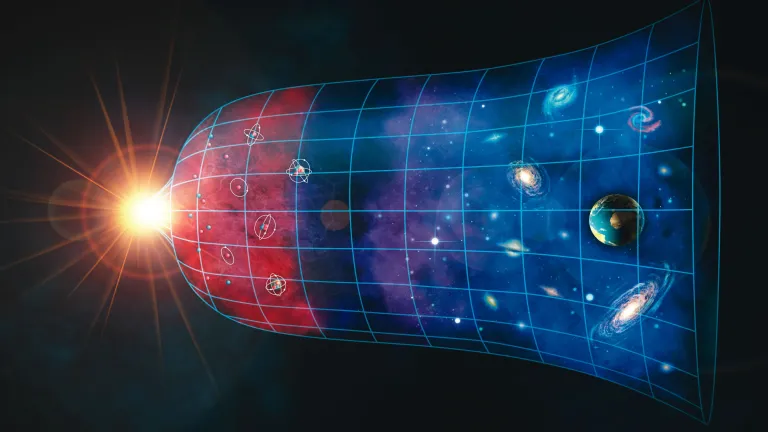
Did you know the galaxies of the universe are not distributed through the cosmic expanse in a random way? Amazingly, new astronomical findings show that they are actually situated along crisscrossing filaments of enormous scale like a vast spiderweb.
It calls to mind Isaiah 40:22, which says that God “stretches out the heavens like a curtain, and spreads them out like a tent to dwell in”—speaking in terms of structure.
This should help us see even more what King David saw in Psalm 19:1: “How clearly the sky reveals God’s glory! How plainly it shows what he has done!” (Good News Translation).
The cosmic web
Astronomy magazine presented findings of the Max Planck Institute in Germany in these terms: “The Universe is constructed like an oversized spider web. All visible material is arranged along the filamentary structure of the dark matter. On its threads and knots, this web holds gigantic chunks of . . . [subatomic] matter” (“A Cosmic Spider Web Is Unraveled,” Astronomy.com, updated May 19, 2023, emphasis added throughout).
Recently, some confirmation of the cosmic web was provided through powerful telescopes. As reported at the Daily Galaxy site:
“In an extraordinary leap forward for astrophysics, astronomers have achieved a momentous breakthrough with the first direct image of the cosmic web, a vast and largely invisible structure that plays a central role in the formation of galaxies and the expansion of the universe. This cosmic web, often described as the ‘skeleton’ of the universe, connects galaxies through thin filaments of gas and dark matter, yet until now, these filaments had existed only as theoretical models and simulations. Thanks to cutting-edge observational technology, scientists have captured a real image of one such filament, solidifying decades of scientific hypotheses” (Lydia Amazouz, “Astronomers Capture the Universe’s Hidden Highways Connecting Galaxies: First-Ever Image of the ‘Cosmic Web’ Revealed!” June 30, 2025).
The universe a cradle for life
This remarkable finding helps us better understand how an orderly universe is like a cradle where life can exist. Astrophysics research professor Paul Sutter writes in Nautilus magazine: “Galaxies are not scattered about randomly in our universe. Instead, they exist in a pattern, dubbed the cosmic web. The cosmic web holds the vast majority of the contents of the cosmos—roughly 5 percent matter (such as gasses and solids), 27 percent dark matter, and 68 percent dark energy. And it spans the entire universe, traversing otherwise relatively empty cosmic voids. It serves as the scaffold responsible for carrying the plasma lifeblood of our universe. It is the reason we exist at all” (“The Cosmic Web and the Fate of the Universe,” Dec. 11, 2023).
The vast order required for fragile life to exist adds to the ever-mounting evidence that the universe is a product of purpose and design.
When interviewed about the order in the universe, twin French physicists Igor and Grichka Bogdanov were right in pointing out: “This is a fundamental question. The most striking feature of the universe is that order began from the very start—at its initial stage. According to some physicists, everything occurs as if mankind was born in a universe ‘created for them,’ in effect, intentionally designed for human beings. It is similar to preparing a bedroom before the birth of a baby” (“The Universe Was Not Born From Chance,” Le Point, June 10, 1991).
God framed the universe
This order clearly resonates with what Scripture reveals about a purposeful Creator. The Bible tells us in Hebrews 11:3, “By faith we understand that the worlds were framed by the word of God, so that the things which are seen were not made of things which are visible.” Indeed, scientists have discovered that much of the universe is made up of invisible forces hidden to the eyes.
Scripture also says God is not the author of confusion but of order, a characteristic He desires we emulate (see 1 Corinthians 14:33, 40). He set up the universe to function in a stable and harmonious way. Jeremiah 33:25 states, “But I, the Lord, have a covenant with day and night, and I have made the laws that control earth and sky” (GNT). These laws of physics are carefully fine-tuned in relation to one another. With the discovery of the cosmic web, we can better grasp how the universe maintains equilibrium, dynamism and stability while expanding outward.
Mysterious “dark matter” and “dark energy”
Besides the effect of gravity and other forces on perceptible matter, many scientists are convinced of the existence of “dark matter” and “dark energy.” The word “dark” in this context refers to not being directly observable and scientists admitting they don’t really know what these are. But these are accepted on the basis of the measurable effect they are seen as having on observable matter and energy—with what’s observable constituting only a small part of the whole.
Professor Sutter goes on to state about recent findings: “The cosmic web fills up the volume of the universe and contains up to 2 trillion galaxies . . . Pulling from new data gathered by the James Webb Space Telescope, an international team of researchers discovered a baby filament containing just 10 galaxies that likely formed a mere 830 million years after the Big Bang, confirming that these filaments were important structures right from the earliest days of the universe. In addition to the gravitational pull of normal matter, there are of course, the forces of dark matter and dark energy at work, shaping the cosmic web. Combined, dark matter and dark energy make up 95 percent of all the energy contents of the universe—there’s no way that the web won’t be influenced by them.”
The balance of the universe’s forces is so exact that astrophysicist Hugh Ross gives the following analogy: “Picture a huge vehicle—something much bigger than a car. Maybe the U.S. Navy’s aircraft carrier the USS John C. Stennis. Now imagine a tiny fleck of paint from that ship, so small against your hand you can barely see it. If such a vehicle were compared to the universe in its earliest moments, removing that speck or adding an extra drop of paint to it would be enough to alter the vehicle’s mass so much as to make it completely useless for transporting passengers.
“In reality, the delicacy of that ratio is far more extreme than the ship analogy reveals. For the reasons noted above, and if no other density factors influence the expansion of the universe, at certain early epochs in cosmic history, its mass densitymust have been as finely tuned as one part in 1060 [1 followed by 60 zeros] to allow for the possible existence of physical life at any time or place within the entirety of the universe. This degree of fine-tuning is so great that it’s as if right after the universe’s beginning, someone could have destroyed the possibility of life within it by subtracting a single dime’s mass from the whole of the observable universe or adding a single dime’s mass to it” (Why the Universe Is the Way It Is, 2008, p. 35).
A cosmic superhighway system
Another analogy cosmologists use to explain the design of the cosmic web is an intricate highway system that guides the stars and galaxies through the universe and helps establish its equilibrium.
A recent book on the topic states: “The cosmic web itself, is essentially a network of dark matter halos that are connected by filaments of gas. These filaments act as highways through which matter can flow, and they are the primary means by which galaxies and galaxy clusters are distributed across the universe. Without dark matter, the cosmic web would not exist in the same way, and the structure of the universe would be vastly different” (Michael Scott, The Cosmic Web and Large-Scale Structures, 2024, p. 64). So nothing is left to chance!
An article from an astronomical team at the University of Kansas said that team member Gregory Rudnick “sees the universe crisscrossed by something like an interstellar superhighway system. Filaments—the strands of aggregated matter that stretch millions of light years across the universe to connect galaxy clusters—are the freeways. ‘Galaxies will flow along filaments from less dense parts of the universe to more dense parts of the universe, kind of like cars flowing down a highway to the big city. In this case, they are going toward big clusters, being pulled by the gravity of those large concentrations of matter,’ he said” (“New Research Looks at How ‘Cosmic Web’ of Filaments Alters Star Formation in Galaxies,” Phys.org, Nov. 1, 2017).
Such intricacy not a matter of chance
The precision and complexity involved in all this is mind-boggling. Dr. Sutter compares the formation of the cosmic web itself to the difficult paper art of origami folding: “From what we do understand of the cosmic web, much of its shape can be explained by the mathematics of origami folding. If you take a sheet of paper and start folding it, you will find a series of nodes and filaments. The filaments are the simple creases, and the nodes are the places where the creases intersect. Mathematicians have studied the relationships of the creases and folds of origami structures . . . and astronomers have taken that language and applied it to the cosmic web.”
Of course, it should be considered that origami requires an artist. Sadly, most scientists today will not honestly assess the question of who made the cosmic web. Many would say no one made it since it’s just the product of random aspects of matter and energy—that we just got lucky.
On the other hand, if you asked them how a spiderweb came to be and for what purpose, they would readily answer that a spider made it to catch insects to eat. Doesn’t it stand to reason that the vastly more complex structure of the cosmic web—described in such building terms as the scaffolding or architecture of the universe—was also made? To say that it just happened, with no intelligence or foresight involved, is denying reality (see Psalm 14:1; Romans 1:20-21).
Made by a God who cares about us
Far more sensible than believing the intricacy of the universe is a result of blind chance is to understand that an all-powerful Creator designed the universe for the purpose of sustaining life.
As we saw in Hebrews 11:3, God made the universe from what is invisible to the human senses. Further, He made it and sustains it through Jesus Christ. Hebrews 1:2-3 says: “God created the universe by his Son . . . God’s Son has all the brightness of God’s own glory and is like Him in every way. By his own mighty word, he holds the universe together” (Contemporary English Version).
And He does so for us—as small as we may seem in the cosmic expanse. Christ once described God caring so much for us that He has the very hairs on our head counted (Matthew 10:30). He is also able to count all the stars of the universe and direct them as an orderly army throughout space, even giving each one a name (Isaiah 40:26, GNT). Similarly, He is now in the process of preparing the universe for Christ’s coming “to bring many children to share his glory” (Hebrews 2:10, GNT).
Scripture declares our potential of one day reigning under Christ as coheirs of the universe. As Romans 8:16-17 states, God’s Holy Spirit “bears witness with our spirit that we are children of God, and if children, then heirs—heirs of God and joint heirs with Christ, if indeed we suffer with Him, that we may also be glorified together.”
What a grand purpose! And what a marvelous universe we live in—being carefully designed as a home for mankind. Let us give God the glory and so live our lives in such a way that the incredible potential He has planned for us will one day be realized in us. As 1 Corinthians 2:9 says, “Eye has not seen, nor ear heard, nor have entered into the heart of man the things which God has prepared for those who love him.”
Dive Deeper
The more we discover about our amazing universe, the more evidence we have that it was the product of an all-powerful and all-wise Creator. Prove this for yourself. Be sure to request or download a copy of our free study guide Life’s Ultimate Question: Does God Exist?

An Article from:
Beyond Today Magazine: January–February 2026
Course Content

Mario Seiglie
Mr. Seiglie was born in Havana, Cuba, and came to the United States when he was a child. He found out about the Church when he was 17 from a Church member in high school. He went to Ambassador College in Big Sandy, Texas, and in Pasadena, California, graduating with degrees in theology and Spanish. He serves as the pastor of the Garden Grove, CA UCG congregation and serves in the Spanish speaking areas of South America. He also writes for the Beyond Today magazine and currently serves on the UCG Council of Elders. He and his wife, Caty, have four grown daughters, and grandchildren.
Stay up to date
Get new articles every week in your inbox and quarterly print issues in the mail.
Subscribe for freeor log in