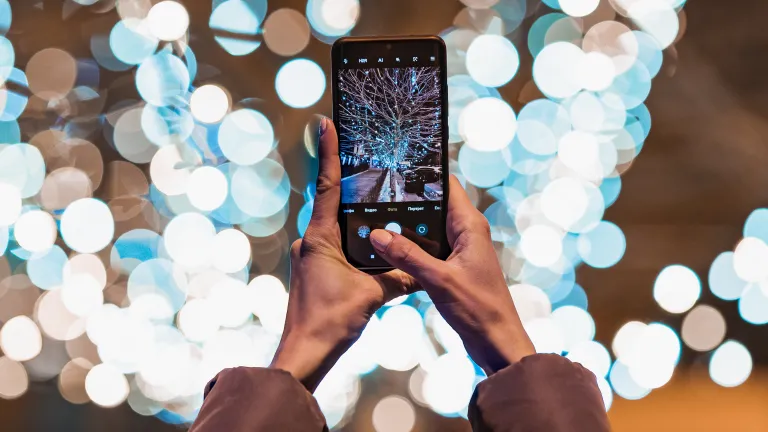
How to Put Down Your Phone and Pick Up the Bible

Is your smartphone’s unending supply for information and entertainment drawing you away from God?
It’s been getting harder for me to read the Bible. It’s not that I don’t want to or don’t see the need. I just find it difficult to stay focused on the words and actually absorb them. My brain feels like slush when I try. It takes several minutes of rereading the same passage before I finally settle into “Bible mode.”
I blame it on my smartphone—or, more specifically, my smartphone habits.
These days, there’s a lot of noise in my head. When I wake up, I check my phone to see what happened overnight—texts, Facebook, Google News, Pinterest, my workout app, Instagram.
Instantly, my mind is flooded with information, ideas and those all-too-powerful images of other people’s lives—both the good and the bad. A flick of my thumb, and each interesting morsel is replaced by the next. I don’t know that I truly process much of what I see before I succumb to the urge to scroll on to whatever’s next. It’s like a hunger—hunger for more entertainment, information or validation.
This app-checking routine can repeat itself multiple times a day. It feels satisfying and even important, but it’s a problem. When I pray and study, I find it difficult to stop all of this “checking.” It’s hard to focus on God’s Word without my hand seemingly unconsciously unlocking my phone again! It’s embarrassing to write this, but I suspect I’m not the only one struggling.
Here is my theory: My mind has grown dependent on the constant influx of new information. When there’s a dull moment—or a Bible passage that challenges me—I instinctively reach for distraction. That’s uncomfortable to acknowledge. Is this really how God wants me to live?
The physical vs. the spiritual
In Psalm 19:14, King David writes, “May the words of my mouth and the meditation of my heart be pleasing in your sight, O Lord, my Rock and my Redeemer” (Majority Standard Bible). The “meditation of our hearts” is simply what we think about throughout the day. If God desires purity in our thoughts, how does constant social media scrolling affect that?
For me, social media tends to pull my thoughts toward the physical instead of the spiritual. Seeing other people’s accomplishments—outfits, vacations, workouts, political opinions, food, families and activities—draws my attention to the material side of life.
Social media can have value. It can help us check on sick friends or stay close to distant family. But when I spend hours immersed in the physical, there’s little room left for the spiritual. “The meditation of my heart” becomes a futile exercise in worldliness.
The problem may be that it’s simply easier to look at photos and read quick posts than to sit down, focus and study the Bible. Reading the Bible requires us to calm and quiet our minds. It takes effort to think, reflect, and pray for understanding. If the constant flow of digital distractions has totally shot your attention span, it’s no wonder Bible study feels harder.
Psalm 46:10 says, “Be still, and know that I am God.” That stillness—the quietness of mind—is being stolen by our phones. There is no time for reflection, no peace and no space for the Holy Spirit to guide us.
I want to change that. It’s sobering to realize that focusing on God’s Word has become a struggle.
So what can I do?
I want to balance my life so that my thoughts are pleasing to God, my mind isn’t constantly distracted, and I can still use social media for its good aspects. Here are a few steps I’ve tried:
1. Keep first things first. I bought a regular alarm clock so I can put my phone away at night. I’ve tried not to check it in the morning until after I’ve prayed and read my Bible. I’ve struggled with consistency on this, but when I have succeeded I have experienced the benefits of a more peaceful, purposeful morning routine.
2. Delete apps. There is no need for me to have instant access to some apps. I can check Facebook or Pinterest on my computer, for example. It’s okay for people to not be able to reach me instantaneously. My connection with God is much more important!
3. Use a timer. I have installed apps that limit time allowed on social media. When the timer runs out, I’m logged out. The time limit can help you focus on what’s actually important and move on. I hope this works for you, and it has sometimes worked for me. The difficulty in relying on apps to fight apps, however, is that timers focus on our surface-level behavior rather than the impulse behind it. It can be easy to bypass the timer and “forget” to turn it back on.
4. Take some time off. I’ve scheduled “screen-free days” from time to time. I may still need to check my phone occasionally, but I want to spend my free time being outdoors, reading, or simply thinking instead of scrolling.
5. Ask God for help! I had to admit to God that I’d effectively turned my smartphone into an idol. Even now I often succumb to the temptation.
In Matthew 4:4 Jesus said, “Man shall not live by bread alone, but by every word that proceeds from the mouth of God.” We can’t subsist on the daily distractions of the Internet. They may contain some good, but they’ll never satisfy our true hunger for God’s Word. We need to make room in our minds—a quiet place where we can feed on His Word so He can work in our lives.
(Discover more about prayer, Bible study, meditation and other vital means to building our relationship with God in our free study guide Tools for Spiritual Growth.)
If you must be on your device
If you find it hard to put down your phone, use it for spiritual study. Read the Bible through an app, share Scripture with friends, or explore study tools on our website ucg.org, which offers mobile-friendly articles, study guides, sermons and Beyond Today videos. Above all, read the Bible itself. If we use technology with purpose and prayer, it can help guide us closer to God instead of pulling us away.
It takes wisdom and discipline to stay focused, especially in the digital realm. If you set goals for yourself and miss them, don’t despair. Most of these apps are designed to addict you. Sometimes we simply need to take a break from them.
Dive Deeper
(Discover more about prayer, Bible study, meditation and other vital means to building our relationship with God in our free study guide Tools for Spiritual Growth.)

An Article from:
Beyond Today Magazine: January–February 2026
Course Content

Joy Porter
Joy has been blessed to be married to Clint for 20 years. They have a busy household with two boys and two girls. Joy loves writing, long distance running, and chocolate. She also is a 2004 graduate of the University of Tennessee with Bachelor of Science in Early Childhood Education.
Stay up to date
Get new articles every week in your inbox and quarterly print issues in the mail.
Subscribe for freeor log in