Mother of Exiles

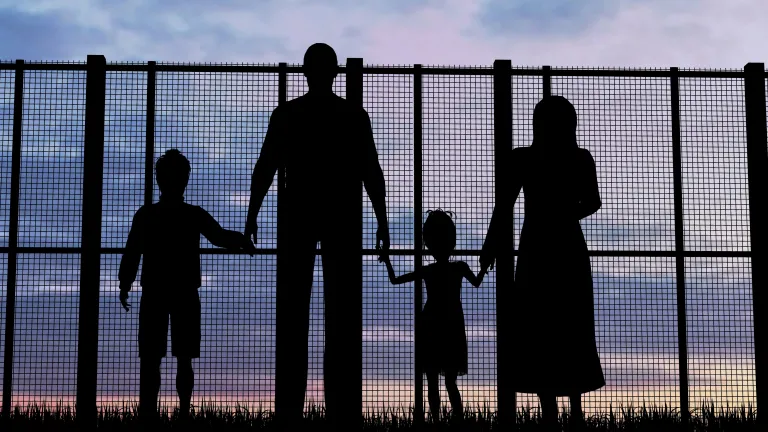
Most Christians today have not lived beyond the borders of their homeland, struggled with language barriers or felt the quiet exhaustion of being a different nationality from those they live among. Yet Scripture describes God’s people as strangers, foreigners and pilgrims. To understand why, we may first need to step outside the comfort of feeling at home.
As the United States of America approached its 100th anniversary in 1876, the people of France were preparing an unprecedented gift for their American cousins. The French political thinker Edouard Rene de Laboulaye and sculptor Frederic Auguste Bartholdi had conceived a colossal statue they named Liberty Enlightening the World. Upon its completion, it would be the tallest structure in Manhattan, towering over New York Harbor as a symbol of the political ideals they believed America embodied.
Private donations in France funded the statue; Americans were to fund the construction of the pedestal. But donations on both sides of the Atlantic lagged behind targets, and by the early 1880s, the project was stalled.
Fundraising efforts in the United States included the tediously named “Art Loan Fund Exhibition in Aid of the Bartholdi Pedestal Fund”in 1883. The exhibition catalog opened with a sonnet by Emma Lazarus that would, in time, alter the symbolic meaning of the statue. The most famous lines of “The New Colossus”—the poem now engraved on a plaque within the pedestal—invite the tired, poor, huddled masses of the Old World to take refuge in the New.
Lazarus was herself a descendant of Jewish immigrants. In 1882, after learning of waves of anti-Jewish violence in the Russian empire, she became deeply involved in aiding the Jewish refugees flooding into the United States. Their plight “gradually absorbed more & more of my mind & heart,” she wrote in a letter to a friend. “It has about driven out of my thought all other subjects.”
Her passion for their plight and some persuasion from a friend compelled her to contribute her writing talents to the fundraising effort. In lesser-known lines of “The New Colossus,” she gave the statue a name that likely reflected her concern for those refugees: Mother of Exiles. Conscious of it or not, the sentiment of the poem taps into the Bible’s recurring imagery of a displaced people searching for a homeland.
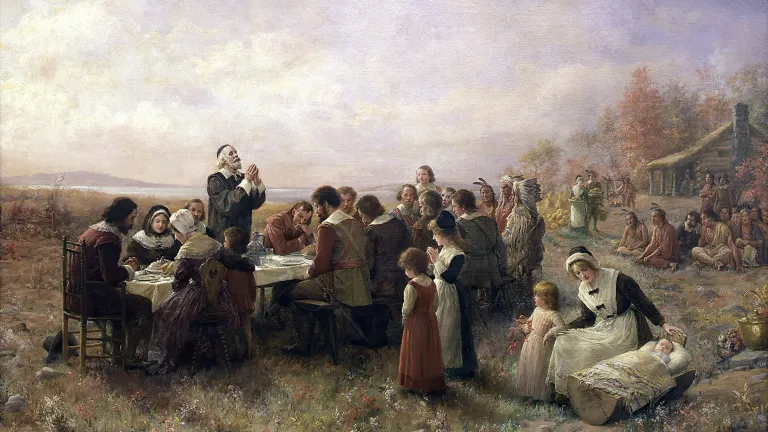
Long before the Statue of Liberty was conceived, or before the United States was a country, settlers in the New World borrowed heavily from the pilgrim, sojourner and exile imagery of the Bible. Writing in the mid-1600s of the early Massachusetts settlers, Governor William Bradford describes a people who “left that goodly and pleasant city . . . but they knew they were pilgrims, and looked not much on those things, but lift up their eyes to the heavens, their dearest country . . .”
His words echo Hebrews 11:13-16, which describes the biblical heroes of faith—our spiritual forefathers who “confessed that they were strangers and pilgrims on the earth . . . [Having not] called to mind that country from which they had come out . . . they desire a better, that is, a heavenly country.”
By the early 1800s, it became common to refer to the early waves of immigrants in biblical terms.
In 1821, John Quincy Adams described them as “willing exiles from a country dearer to them than life . . . exiles of liberty and of conscience.”
In 1830, Daniel Webster described the “Pilgrim Fathers” who had landed at Plymouth Rock 200 years prior as those who “sought to enjoy a higher degree of religious freedom.” Today, Americans are more likely to associate pilgrims with early Colonial times than biblical ones.
But those early pilgrims were not the first or last Christians to see the biblical pilgrim and sojourner themes in their own stories. Exiled Christians have long found companions in the book of Hebrews. Even in less extreme circumstances, Christians in unfamiliar places identify with these heroes and the longing that motivated them.
Modern sojourners
Most of us spend our whole lives as residents of the country where we were born. When the Bible speaks of strangers and foreigners, our first thoughts are probably of others—immigrants to our homeland. By contrast, Christians who emigrate to other lands understand this imagery firsthand.
Nicole Roig Espinoza immigrated to the United States from Chile in 2017, shortly before marrying her husband, Garrett Fenchel. The two met in Chile in 2010 and reconnected while serving together on a United Youth Corps project in Guatemala in 2015. After living in the United States for several years, Nicole’s father was diagnosed with a rare degenerative neurological disorder, and they moved to Chile to be near him in his final months.
They stayed in Chile for five years before returning to the United States.
Living as immigrants in each other’s homelands gave Garrett and Nicole a shared understanding of life as strangers and pilgrims.
“Part of your identity is the fact that you’re an immigrant,” Garrett reflected. “Coming home, you expect it to feel a lot better than it ends up feeling. You think it should be elation or relaxation, and I ended up feeling a lot more conflicted.”
Nicole echoed similar sentiment.
“When I went back to Chile, it was like I lost something,” she said.
This mindset of identifying as strangers and foreigners is one God has tried to cultivate in His people for thousands of years.
God’s first recorded words to Abraham in the book of Genesis are, “Get out of your country” (Genesis 12:1). He showed Abraham that his descendants would be “strangers in a land that is not theirs” (Genesis 15:13). And they were. First as nomads, but eventually as slaves of the ancient Egyptians. Their identity as foreigners was brutally driven home before God miraculously rescued them.
As they traveled toward their Promised Land, God gave them laws on the treatment of foreigners that were unparalleled in ancient cultures. “You shall neither mistreat a stranger nor oppress him, for you were strangers in the land of Egypt” (Exodus 22:21). He called to mind their ancestral identity as a motivator.
When you embrace your identity as a stranger in this world, the notion of home becomes a bit elusive.
“After you’ve lived outside [your native country] long enough, if you go back and forth, what is your true home?” Garrett asked.
Nicole said that, for her, home isn’t a place at all.
“You’re in between,” she said. “I don’t feel that my home is in Chile. I don’t feel my home is here. My home is with my family.”
No home to return to
The Fenchel Roig family’s back-and-forth is labeled by some agencies as “return migration,” which reflects the freedom of movement that some migrants have. But for others, the movement is one way.
Natallia Teague immigrated to the United States from Belarus by way of Barbados. She grew up in the Soviet Union in an atheist society where she was taught that believers were uneducated. It was not fertile ground for Christian efforts, but Natallia was drawn to Christianity despite the general absence of religion.
“I didn’t go looking—God took me,” she said.
She learned of God’s festivals (listed in Leviticus 23) and met with a small group in Estonia for the Feast of Tabernacles.
“There was a different spirit there. You may get used to it if you’re around it every week, but the first time you experience it, it is extraordinarily different,” she said. “People were so polite, kind to each other. They would take toys to children in need and visit people in homes. You could see in their eyes that they care. They were like . . . people not from this earth.”
After moving to Barbados, life took some unexpected turns. She wanted to leave, but there was no going back to Belarus for the simple reason that there was no church there. She volunteered for the United Church of God, helping edit literature in Russian. The church invited her to work from its home office in Ohio in 2010. She met her husband David within weeks of arriving, and they were married a year and a half later.
In recounting all this, Natallia provided a virtual tour of the city in Belarus where she spent much of her life as a young adult, pointing out the museums and the theater near the home she lived in.
“It’s a beautiful city,” she reminisced. “I miss it, but it is not mine.”
In her way, she joins those who, “if they had been thinking of the land that they had left . . . would have had opportunity to return” (Hebrews 11:15, New English Translation). Instead, she chose her spiritual family over what had once been familiar. Hebrews goes on to describe God as a Father who is “not ashamed to be called their God, for He has prepared a city for them” (Hebrews 11:16, NET).
God’s mercy on the foreigner
Short of living as foreigners, most of us have some firsthand experiences of feeling out of place—whether moving to a new city, starting at a new school or simply visiting an unfamiliar location. Those moments provide a glimpse of the discomfort of strangeness that God wants us to be able to tap into—in both thinking of ourselves as Christians and guiding our interactions with others.
Werner Solorzano was born and raised in Guatemala City, immigrating to the United States in 2024 to work for the United Church of God’s media team. He is no stranger to this discomfort.
“Living as a foreigner, you feel uncomfortable. There’s a constant feeling of not belonging, of not being part of the society in which you live,” he said. Looking to his wife, Stephanie, he asked, “Was it uncomfortable for you in Guatemala?”
Stephanie Rorem grew up in Pacifica, California. Her dad spoke Spanish fluently, and the Rorem family traveled to Central and South America regularly to serve congregations there. Stephanie met Werner on one of those trips. The two were married in 2018, living in Guatemala City for six years before moving to the United States.
“Uncomfortable? A little bit. I obviously stick out,” she laughed. Sandy-haired and pale, she was an uncommon sight in Guatemala City.
“That [discomfort] was more of a personal thing than any treatment I was receiving,” she said. Even apart from how others treated them, both experienced a quiet uneasiness in these respective places simply knowing they were different.
“There’s a scripture that says not to oppress the foreigner, because you know the heart of a foreigner,” Werner said, recalling Exodus 23:9. Like generations of Israelites that did not know slavery or wandering, modern Christians who never live as foreigners must cultivate a foreigner’s heart.
We have to recall our own discomfort from whatever firsthand experiences we may have. Without it, we’re missing opportunities to connect.
“I don’t think I ever hear much about what it’s like to feel like a foreigner,” Werner said of modern Christian messaging. “Some people just can’t relate.”
When you’re able to tap into your own experience as a stranger, you understand the needs of those who live on the margins in some way, who depend on the kindness of the majority—and whom God Himself looks after.
“The Lord your God is God of gods and Lord of lords, the great God, mighty and awesome, who shows no partiality nor takes a bribe. He administers justice for the fatherless and the widow, and loves the stranger, giving him food and clothing” (Deuteronomy 10:17-18).
The Old Testament often speaks of the stranger in the same breath as other powerless and marginalized individuals, noting that God takes special interest in them.
Jesus Christ used similar depictions of the powerless to illustrate the care He expected His disciples to show.
“For I was hungry and you gave Me food; I was thirsty and you gave Me drink; I was a stranger and you took Me in” (Matthew 25:35). Christians who understand their identity as strangers and pilgrims turn that discomfort into care for others.
Garrett and Nicole experienced this on their return to the United States. While waiting to pick up their children from school, parents of one of their daughter’s classmates approached them.
“They came out of nowhere and [the mom] says, ‘Hey, I know it’s a hard time for you to be here. And I just wanted to let you know that I’m thinking about you,’” Nicole said. “It makes a huge impact. It was like fresh air.”
When we can tap into our own experience as foreigners, strangeness becomes common ground.
“Maybe that’s the connection,” Werner said, “where they can look past your foreignness and just see another guy who lives here.”
Living as strangers
Embracing our Christian identity as strangers and pilgrims does more than just connect us to the people around us. It connects us with God Himself.
The apostle John describes Jesus as One who “became flesh and took up residence among us” (John 1:14, NET). He lived as a stranger and a pilgrim in a hostile world. He wasn’t aligned with the movements or governments of His time, but with the purpose of the One who sent Him. He lived among passionate Jewish nationalists, Roman conquerors and religious zealots—not as one of them, but as the other, a true alien.
Jesus isn’t asking anything of His disciples that He hasn’t lived. This is a great comfort to Nicole.
“I can see that God is seeing what I’m going through,” Nicole said. “I feel like there’s someone up there who understands me.”
To live as Christians is to recognize how alien we are to the governments and systems erected around us and to live as representatives of a different Kingdom, just as Jesus did.
Like the heroes of Hebrews 11, Christians today seek a homeland. Paul reminded the church in Philippi that “our citizenship is in heaven” (Philippians 3:20). That doesn’t mean we have no earthly citizenship or responsibilities, but they are subject to this greater reality.
Paul repeats this theme of where our citizenship lies by defining the limits of our strangeness: “You are no longer strangers and foreigners, but fellow citizens with the saints and members of the household of God” (Ephesians 2:19). He combines the ideas of citizenship and family into a complete vision of belonging.
This isn’t flowery language. There is a real Kingdom that Christians already belong to—a government that will be established on earth that will have no end.
It’s just not here yet.
It is found in the “city which has foundations, whose builder and maker is God” (Hebrews 11:10), the “city of the living God, the heavenly Jerusalem” (verse 22), the same city that John describes as “the holy city, New Jerusalem, coming down out of heaven” (Revelation 21:2) to a new earth. It is more than a hopeful monument, a beacon of liberty or a symbolic Mother of Exiles, but “the mother of us all” (Galatians 4:26).
For the Christian, it is home.
Dive Deeper
To learn more about being a sojourner traveling to the Kingdom of God as a part of His people today, request or download our free study guide The Church Jesus Built.

An Article from:
Beyond Today Magazine: July–September 2026
Course Content
Scott Delamater
Scott Delamater is a longtime member and elder in the United Church of God with a deep commitment to the mission of preaching the gospel and preparing a people. He is the Operations Manager of Media and Communications Services for the United Church of God. He has served as the National Music Coordinator for UCG Feast sites across North America and has volunteered for many years at United Youth Camps in a variety of roles, including Assistant Camp Director and Bible Instruction Lead. In addition to his service in the Church, Scott is also active in his local community, mentoring high school students as a programming coach in a robotics program.
Professionally, Scott has over 25 years of experience in software development, product strategy, and team leadership, having worked in both large organizations and startup environments. He is known for his thoughtful, data-informed approach to problem solving, his ability to communicate clearly across disciplines, and his desire to build systems—and teams—that serve people well. Scott and his family live in the Cincinnati area.
Stay up to date
Get new articles every week in your inbox and quarterly print issues in the mail.
Subscribe for freeor log in