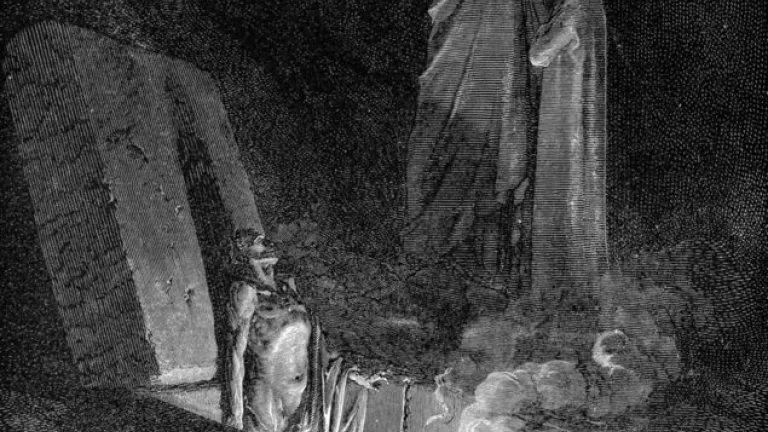
Eternal Hellfire: The Question That Will Not Die

A shift of some among the evangelical Christian community away from the traditional view of hell to belief in the total destruction of the wicked is causing a stir. What does the Bible actually teach?
What is the fate of those who in the end ultimately reject God and refuse to repent of their sins? The traditional view of mainstream Christianity is that they will burn in unquenchable hellfire for all eternity. Many who are uncomfortable with that idea, who see it as inconsistent with God’s love and mercy, have embraced other ideas. Some think burning in hell is just figurative language for suffering in this life. Others have taken a position of universal salvation—that ultimately all will be saved, with none lost. Yet that’s not what the Bible says. Of course, what the Bible says is what we need to know and understand.
It’s generally recognized among Christian believers that God will judge the living and the dead, that every person will give account before Jesus Christ, and that rejecting God has devastating consequences. The fact is, hellfire is presented in Scripture as a serious warning, not a metaphor to be dismissed. Indeed, there certainly will be judgment. The question before us is how Scripture describes the final outcome of that judgment.
In recent months, renewed attention has been drawn to this subject following published video from famous actor and now evangelical teacher Kirk Cameron, in which he raises a question many believers quietly wrestle with but rarely voice: “Are We Wrong About Hell?”As he further asks, what does the Bible actually say happens to the wicked in the end? Are they preserved forever in conscious torment, or does Scripture describe a different conclusion—one that culminates in a final destruction the Bible calls “the second death”?
Cameron surprised many evangelical teachers by coming down on the side of what is often termed conditional immortality or conditionalism (counter to the immortal soul, believing eternal life is given only to the saved) and annihilationism—belief in the utter destruction of the unrepentant.
The strong reactions to Cameron’s comments and to people being receptive to them reveal how deeply assumptions about hell are woven into mainstream religious thought. Some welcomed the discussion; others feared that questioning traditional formulations threatens core doctrine, especially as the teaching of conditionalism is gaining some ground among evangelicals. Yet the question itself is not new, nor is it frivolous. It is a question about what the Bible actually says on this matter—and more broadly about the nature of God.
Eternal life vs. death through fiery destruction
The Bible consistently presents eternal life as something granted, not assumed. Paul writes plainly, “The wages of sin is death, but the gift of God is eternal life in Christ Jesus our Lord” (Romans 6:23). Two outcomes are contrasted—death and life—not two different forms of immortal existence.
Ezekiel records God’s declaration, “The soul who sins shall die” (Ezekiel 18:4). Jesus warned that God is able to “destroy both soul and body in Gehenna” (Matthew 10:28, New American Bible)—the term here, sometimes translated “hell,” denoting the Valley of Hinnom outside Jerusalem as a place of burning refuse. Ultimate destruction of both body and soul (or conscious existence) is not the language of unending anguish; it is the language of final loss.
Throughout the Old Testament, the fate of the wicked is described with striking consistency. “The wicked will perish,” King David wrote, adding that “they vanish—like smoke they vanish away” (Psalm 37:20, English Standard Version, emphasis added throughout). Malachi foretold a day when the wicked would be burned up like chaff, leaving them “neither root nor branch,” becoming “ashes under the soles of your feet” (Malachi 4:1-3).
What Scripture repeatedly emphasizes is not unending conscious existence under judgment, but irreversible destruction—incineration into smoke and ashes.
At the same time, we need to take seriously Jesus’ warnings of “unquenchable fire,” “outer darkness” and “weeping and gnashing of teeth.” These were not figurative of just peacefully going to sleep and never waking up. Jesus intended His words to shock, warn and awaken—of the terrible end awaiting those who ultimately refuse to follow Him.
The question, however, is the nature of this ending. Would it end in destruction, or would it go on forever? Realize that “unquenchable fire” does not mean a fire that burns forever. It means a fire that can’t be extinguished before it finishes its work (Mark 9:43)—burning until there is nothing left to consume. The chaff burned in Matthew 3:12 is destroyed by unquenchable fire; it does not burn forever.
Biblical imagery of ultimate punishment often conveys certainty and severity rather than duration. Fire consumes, darkness excludes from the light of life, and destruction ends what existed before. These images communicate the seriousness and finality of judgment without requiring perpetual conscious existence of those being punished.
Those who finally reject God await the judgment of “fiery indignation which will devour the adversaries” (Hebrews 10:27)—that is, completely consume them.
Now, Jesus did say the wicked would go away into “everlasting punishment,” while the righteous enter “eternal life” (Matthew 25:46). The parallel is often taken to mean identical duration of conscious experience. Yet Scripture frequently uses “eternal” to describe results, not ongoing processes. It is not everlasting punishing, but everlasting punishment—a final result from which there is no coming back.
Similarly, Hebrews speaks of “eternal judgment” (Hebrews 6:2), though judgment is not an action that continues forever. It is a verdict with permanent effect. Likewise, “eternal redemption” (Hebrews 9:12) does not mean Christ is eternally redeeming us, but that the redemption accomplished by Him never expires.
Paul’s phrase “everlasting destruction” (2 Thessalonians 1:9) reinforces this understanding. Destruction that lasts forever does not require an eternally ongoing act of destroying; it requires that what is destroyed is never restored.
Divine justice and human reasoning
God gave the Israelites the justice principle of an eye for an eye—meaning not merely that punishment should fit the crime but that punishment should not exceed the crime. Indeed, our very sense of justice in such regards comes from God—the true arbiter of justice. Consider, then: Those committing a mere human lifetime of sin will burn forever and ever? As Cameron questions in his video, “After a billion years, you’re not one second closer to the end?”
Many defenses of eternal conscious torment rely on philosophical reasoning rather than direct biblical statements. One of the most common arguments asserts that in God’s perfect justice, all sins, finite though they may, are committed against an infinite God and thus require infinite punishment.
But that’s just an idea dreamt up without proof. Nowhere does the Bible explicitly say that sins are punished eternally because God is infinite. And the idea is in fact illogical. For it would mean that divine justice can never be satisfied—not ever. Yes, it would be satisfied through Christ’s death for those who receive it. But since some will not, there is never an end point for those that will satisfy justice. God, in this picture, is “forced” by His own justice to keep people in the torment of hell without end—even though it does not satisfy that justice!
And after a billion, a trillion, a quadrillion years of burning there, those suffering would be no closer to relief—for relief will never, ever come.
Does this make sense? Does it make sense that God created people knowing that He would have to send many of them into eternal torture? Meanwhile God and the redeemed will be rejoicing through that same eternity.
Does this not seem a very dark picture of God? If you are disturbed by this, you are right to be! Again, our whole concept of proper justice comes from God. Moreover, the Bible tells us that God is love (1 John 4:8, 16)—outflowing concern for others. And it further tells us that His “mercy triumphs over judgment” (James 2:13). Yes, that would apply to Christ bearing judgment on our behalf. But is there not even the mercy of final death for the others? Again, the Bible declares death, not conscious torment, to be the wages of sin.
Wrong assumptions about an immortal soul
The problem here for theologians defending eternal torment, who may well be motivated by a sincere desire to uphold God’s holiness and justice, is a misunderstanding of the nature of man—thinking God made us with immortal souls that cannot die. Once immortality is assumed, eternal torment must be accommodated for those who don’t repent. Yet Scripture teaches something quite different.
Paul states explicitly that God “alone has immortality” (1 Timothy 6:16). Immortality is not an inherent human trait; it belongs to God. Believers are told they will “put on immortality” at the resurrection (1 Corinthians 15:53). You don’t put on something you’re already wearing.
Eternal life is consistently presented as a gift. Jesus said that whoever believes in Him “should not perish but have everlasting life” (John 3:16). The word perish means to be utterly destroyed or annihilated—not continuing to live in another form. If the wicked live forever, even in misery, then perishing loses its meaning.
On this point, Cameron’s observation aligns closely with Scripture. He noted that when immortality is assumed rather than demonstrated from the Bible, conclusions about hell are crafted more by philosophy than by biblical teaching. This concern was explored in depth by another Christian teacher Cameron referenced, Edward Fudge, who argued in his book The Fire That Consumes that immortality is conditional—granted only through Christ—and that the Bible never teaches the eternal existence of the wicked.
A common emotional objection is that conditional immortality is “watering down hell” and that it lets sinners “off the hook.” There is no “watering down” in simply conveying what the Bible actually says! And in what it says, sinners who ultimately refuse to repent do not get a pass. The permanent loss of life—the irreversible erasure of existence, relationship and future—is not leniency. It is the most absolute judgment Scripture can describe. Nothing could be more final!
As conditionalist researcher Joseph Dear argues at his website RethinkingHell.com, annihilation results in infinite loss—the loss of eternal life itself. The punishment is not light; it is total.
If anything, the final loss of life underscores the urgency of the need for repentance. What is at stake is not merely comfort or condition, but existence itself—life that can only be received through Jesus Christ.
Scripture also affirms degrees of punishment. Jesus said it would be “more tolerable” for some than others in the day of judgment (Matthew 11:22; compare Luke 12:47-48). Conditional immortality fully allows for proportional judgment prior to a final destruction.
And what very few engaged in this debate understand is that there is far more to this last judgment period than immediate sentencing. God wants all people to receive the opportunity for redemption and salvation (2 Peter 3:9; 1 Timothy 2:4). Yet all have not had that opportunity in this life. What happens to them?
Tradition, sincerity and the need for reexamination
Many sincere believers have assumed interpretive frameworks about hell and the afterlife without realizing their unbiblical origins. This is not an accusation of bad faith. Throughout church history, sincere people have held differing views while seeking to honor Scripture. The question is not whether tradition is worthless, but whether it must always be reexamined in light of Scripture. The Bereans were praised for testing what they were taught against God’s Word (Acts 17:11).
This article is not denying fiery judgment as the ultimate punishment or the seriousness of sin. It is not teaching universal salvation, temporary judgment or second chances beyond what Scripture describes. It is not minimizing Jesus’ warnings or God’s justice. What it is saying is that the Bible does not teach eternal conscious torment—that it teaches instead a final, irreversible destruction in a “lake of fire” called “the second death” (Revelation 2:11; 20:6, 14; 21:8), from which the saved are free.
Some would argue that rejecting the teaching of eternal conscious torment is just going with what feels more comfortable instead of what the Bible says. And there are some for whom that is probably true—especially those espousing universal salvation. But the Bible does not teach eternal conscious torment as assumed—just as it does not teach the automatic immortality of the soul. Moreover, there is a proper circumstance for considering whether we are comfortable with a teaching or not—and that is how well it accords with our understanding of the whole of Scripture and the nature of God as revealed in it.
It’s vital that we learn what the Bible truly says. Indeed, there is far more to this matter than what mainstream Christians and most conditionalists understand—the Bible revealing much more about the last judgment period. This is a big subject, and we invite our readers to request our free study guide Heaven and Hell: What Does the Bible Really Teach? It answers many issues that have been raised to support the traditional view and presents much more about what the Bible says about life after death.
Let it be said for now that the Bible does not teach that people will burn forever in eternal hellfire. The wicked will be burned up. But that is not a fate to desire—for it is indeed infinite loss. Receive instead the gift that God is offering—“eternal life in Christ Jesus our Lord.”
Dive Deeper
The idea that people will burn in agony forever is a myth that did not come from the Bible. To better see what Scripture teaches on this greatly misunderstood subject, be sure to request or download our free study guide Heaven & Hell: What Does the Bible Really Teach?

An Article from:
Beyond Today Magazine: March–April 2026
Course Content

Ken Loucks
Ken Loucks was ordained an elder in September 2021 and now serves as the Pastor of the Tacoma and Olympia Washington congregations. Ken and his wife Becca were baptized together in 1987 and married in 1988. They have three children and four grandchildren.
Stay up to date
Get new articles every week in your inbox and quarterly print issues in the mail.
Subscribe for freeor log in