Follow Me: “I Know That My Redeemer Liveth”

Far more than a musical refrain, these words from Handel’s Messiah assure us of God’s abiding care and rescue through His Son, helping us to endure suffering and death with hope and faith for the future.
A story has it that when the noted conductor Reichel was guiding musicians through rehearsal of Handel’s inspiring oratorio Messiah, a soprano soloist sang with flawless technique the famous refrain “I know that My Redeemer liveth.” Everyone expected an approving response, but the conductor motioned for silence, walked over and asked almost sorrowfully, “My daughter, you do not really know that your Redeemer lives, do you?” Embarrassed, she answered, “Yes, I think I do.” “Then sing it!” he cried. “Tell me so that I’ll know you have experienced the joy and power of it.” She repeated her part with fervency that testified to her belief in the risen Lord. Listeners wept, and the conductor with tears in his eyes proclaimed, “You do know, for this time you have told me!”
As disciples of Jesus Christ, what may we bring forward from this account into our lives as we embrace what it means to yield ourselves to His invitation of “Follow Me”? (See Mark 8:34, emphasis added throughout.) Are we reticent and shy like the soloist regarding our personal belief in Jesus and His resurrection? Do we realize the world is a stage we enter each day as life comes at us and plays out in ways we never expected, testing us in this regard?
Beyond just knowing about Christ
Do we grasp that genuine discipleship is more than knowing the right words and moving our lips, but centering and solidifying hearts that are moved upward toward One who lived, died, was resurrected to life, ascended to heaven, and is forever exalted at the right hand of our Heavenly Father? Beyond knowing about Christ, we must come to truly know Him—and grow in Him. That’s not simply a mental attribute. It involves deep-seated spiritual roots that prepare us for not just today, but forever by God’s grace. It means knowingly embracing our human end—“It is appointed for men once to die” (Hebrews 9:27)—as but the beginning of God’s ultimate reality for each of us.
Note how Jesus raises our awareness level through what He told the original disciples on the last evening of His humanity: “Don’t let your hearts be troubled. Trust in God, and trust also in Me. There is more than enough room in My Father’s home. If this were not so, would I have told you that I am going to prepare a place for you? When everything is ready, I will come and get you, so that you will always be with me where I am. And you know the way where I am going” (John 14:1-4, New Living Translation).
His disciple Thomas was blunt in his response. “‘No, we don’t know, Lord,’ Thomas said. ‘We have no idea where you are going, so how can we know the way?’ Jesus told him, “‘I am the way, the truth, and the life. No one can come to the Father except through me” (verses 5-6, NLT). And He further said that to really know Him was to know the Father (verse 7).
Thinking of Thomas, who was on the main stage of that Passover evening with Jesus, shows us that even being close is not enough. It must go deeper! Jesus would gently be straightforward with Thomas then and later (John 20:24-29), as He is with us now—helping us to allow the living Redeemer to grow in us.
The ageless echo that comes to us
But where does this famous phrase “I know that my Redeemer liveth” (in the King James Version) come from? The Gospels? Perhaps Paul’s epistles? No, it comes from the Old Testament—from the middle of the book of Job. Satan was sorely testing this follower of the one true God before Israel became a nation. He suffered the loss of nearly everything in terms of his family, property and health. God allowed it for a purpose beyond mere human endurance, as this saga extends for 42 chapters.
Early on, when unbelievable tragedy struck, Job’s words revealed that what lodged in his heart was bigger than the storms of life: “Then Job arose, tore his robe, and shaved his head; and he fell to the ground and worshiped. And he said: ‘Naked I came from my mother’s womb, and naked shall I return there. The Lord gave, and the Lord has taken away; blessed be the name of the Lord.’ In all this Job did not sin nor charge God with wrong” (Job 1:20-22).
As matters escalated with Job covered in painful boils, Mrs. Job had enough and laid down the gauntlet: “‘Do you still hold fast to your integrity? Curse God and die!’ But he said to her, ‘You speak as one of the foolish women speaks. Shall we indeed accept good from God, and shall we not accept adversity?’ In all this Job did not sin with his lips” (Job 2:9-10).
What held Job together at human wits’ end from knowing God to 40 chapters later further growing in God when he uttered, “I have heard of you by the hearing of the ear, but now my eye sees You”? (Job 42:5). The tight knot binding the bow and keeping God’s wrapping on Him is discovered in Job 19: “Oh, that my words were written! Oh, that they were inscribed in a book! [Little did he know!] That they were engraved on a rock with an iron pen and lead, forever! For I know that my Redeemer lives, and He shall stand at last on the earth” (verses 23-25). And he further declared his deep yearning to see God (verses 26-27), having earlier stated that he knew he would be resurrected after his death (Job 14:10-15).
How can we better understand the role of a redeemer? In ancient Israel, a redeemer was someone who bought a slave’s way to freedom or an attentive near relative who stepped in to restore and secure family interests amid difficulties, such as happened in the book of Ruth when Boaz restored the property of the widowed Naomi and married her daughter-in-law to continue the family line of Naomi’s former husband and her deceased son (in line with rules in Deuteronomy 25:5-10). The redeemer embodied hope for those in despair over inability to create a future on their own. Rescue had to come from elsewhere! The patriarch Jacob spoke of being divinely redeemed in Genesis 48:16.
This aspect of God’s work was later crystallized in the apostle Paul’s identifying words about the Redeemer in Titus 2:13-14: “Looking for the blessed hope and glorious appearing of our great God and Savior Jesus Christ [our Elder Brother, Hebrews 2:11-12], who gave Himself for us, that He might redeem us from every lawless deed and purify for Himself His own special people, zealous for good works.”
The Redeemer’s touch
As we conclude, let us consider another apostle’s words. John outlived all of his colleagues, but he too would ultimately die. Yet not long before that, Christ came to Him through a vision recorded for us: “And when I saw Him, I fell at His feet as dead. But He laid His right hand on me, saying to me, ‘Do not be afraid; I am the First and the Last. I am He who lives, and was dead, and behold, I am alive forevermore. Amen. And I have the keys of Hades [the grave] and of Death’” (Revelation 1:17-18).
Our Heavenly Father and His Christ understood that John needed to fully know that His Redeemer lived—that he needed this “hands-on” moment from the Risen One as the humanly challenging roll-out of God’s future plan to bring redemption to the world was revealed.
Perhaps for such a time as now (compare Esther 4:14) you are reading this column, and like the soloist of long ago you have needed a time-out on the stage of life to be refreshed, encouraged and emboldened. So then, “Sing it!” Live it! And feel the touch of our Redeemer on your heart.
Dive Deeper
Jesus Christ came as our Redeemer to die for our sins. But He lives to continue His saving work in us. To better understand, request or download our free study guides Forgiveness Is Possible and Jesus Christ: Saved by His Life.

An Article from:
Beyond Today Magazine: March–April 2026
Course Content
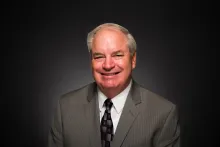
Robin S Webber
Robin Webber was born in Chicago, Illinois, in 1951, but has lived most of his life in California. He has been a part of the Church of God community since 1963. He attended Ambassador College in Pasadena from 1969-1973. He majored in theology and history.
Mr. Webber's interest remains in the study of history, socio-economics and literature. Over the years, he has offered his services to museums as a docent to share his enthusiasm and passions regarding these areas of expertise.
When time permits, he loves to go mountain biking on nearby ranch land and meet his wife as she hikes toward him.
Stay up to date
Get new articles every week in your inbox and quarterly print issues in the mail.
Subscribe for freeor log in