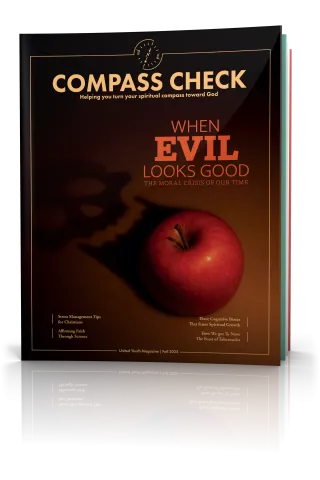
When Evil Looks Good

As the “prince of the power of the air,” Satan has cleverly engineered the world we live in (Ephesians 2:2), and unknowingly, the whole world is under his sway.
Satan is the greatest enemy of God and man, and he hates us passionately. This may seem like a no-brainer, and in the past, it was a well-known fact. However, in recent years, the waters have been muddied, and the general perception of evil has drastically changed. We are truly living in a world that eagerly embraces evil. In our modern world, it is more important than ever for youth and young adults to be able to accurately distinguish between good and evil.
Portrayals of Good and Evil
The portrayals of good and evil and how they interact were generally consistent throughout most of human history. The “good” characters were depicted as embodying admirable qualities such as courage, tenacity and humility. Evil was represented as selfish, cruel and absolutely irredeemable. Ultimately, good always won in the end, emphatically endorsing said admirable qualities.
These concepts are clearly seen in numerous narratives dating back to the Bible itself. One of the most famous secular examples is Bram Stoker’s Dracula (1897). This most famous iteration of a vampire is that of a vicious, terrifying creature of the night that hunts and stalks its innocent victims. There could be no doubt that the titular character, Dracula, was pure evil and completely incorrigible. The flip side is also true. For example, characters such as Ward Cleaver from Leave it to Beaver and Jim Anderson from Father Knows Best were once celebrated as paragons of manhood—wise, strong and loving fathers who were the heads of their households. A clear line in the sand could be discerned between the forces of good and evil. These ideas have been turned on their heads in recent years.
The Rise of the Antihero
In modern, mainstream media, the viewer is frequently introduced to a relatively new archetype of protagonist: one who does not live in the light or the darkness but dances in shades of grey. This new morally ambiguous character type is portrayed as incredibly complex and misunderstood—blurring the long-established lines which clearly separated good from evil. Enter the antihero. As Merriam-Webster’s Dictionary puts it, the antihero is “a protagonist or notable figure who is conspicuously lacking in heroic qualities.”
Let’s fast forward approximately 110 years from Bram Stoker’s Dracula to the early 2000s. The new millennium brought with it an influx of supernatural-themed shows which depicted a very different kind of vampire. This new type of vampire was a far cry from the cruel and outright villainous creature portrayed in the past. Instead of being viewed as an awful villain, vampires now became protagonists which perfectly manifested the popular antihero archetypes. They even became romanticized as legitimate love interests for other main characters—often involving a sensational love triangle. This popular storyline can be seen in movies and TV series such as the Twilight series and The Vampire Diaries, among numerous other examples.
The same phenomenon can be seen in mainstream media’s depiction of men—particularly fathers—as bumbling, often unemployed oafs who can do nothing right and who pale in comparison to their illustrious breadwinning wives. Today, the characteristics of the ideal father are derided and mocked as “toxic masculinity.”
Compromised Morals
What is the effect of being bombarded with this message? A conscience that becomes desensitized to evil, and a mindset that evil is not always bad. The subtle implication is that things which have been characteristically viewed as evil throughout man’s history have simply been misunderstood—“evil” things aren’t really evil at all, but actually have redeemable aspects and qualities.
We can clearly see the pervasiveness of this inability to distinguish good from evil in society as more people “call evil good, and good evil; who put darkness for light, and light for darkness” (Isaiah 5:20). The searing of the conscience results in an inability to recognize evil or distinguish it from good, yet this ability is essential for spiritual growth! As the author of Hebrews explains, Christians mature spiritually as they train their senses “by reason of use . . . to discern both good and evil” (Hebrews 5:14).
Do Not Be Deceived!
Is there harm in consuming this type of entertainment? We might scoff at this notion, believing we are fully aware that these are fictional accounts. But the Bible warns us that we should not be deceived into thinking we can regularly be exposed to evil and not be influenced by it. On His last night on earth, Jesus prayed that His disciples would be “in the world” but “not of the world” (John 17:11, 14-16). He understood that it was entirely possible for His true disciples to be influenced by the world around them, and the Scriptures have many examples of this for our admonition. One powerful example is the story of Abraham’s nephew, Lot, in Genesis 19.
Lot and his family were so desensitized to and familiar with the evil around them in Sodom that they had to be forcibly prompted by angels to leave Sodom in order to escape its pending destruction. Earlier, Lot had gone so far as to offer his daughters to the violent mob—an indication of just how far his morals had been compromised by constant exposure to evil. And although God regarded Lot as a righteous man who was greatly distressed by all the evil around him (2 Peter 2:6-8), the lesson for us is clear: “Do not be deceived: ‘Evil company corrupts good habits’” (1 Corinthians 15:33). This principle doesn’t only apply to the company of people in real life, but also to the books we read, the video games we play and the TV and movies we choose to watch.
The Prince of the Power of the Air
As the “prince of the power of the air,” Satan has cleverly engineered the world we live in (Ephesians 2:2), and unknowingly, the whole world is under his sway. Because he knows about mankind’s incredible potential to become sons and daughters of God—because he knows that human beings who take on the nature of the Father and Son will one day be literally born into the family of God and will even “judge angels” (1 Corinthians 6:3)—Satan’s ultimate goal and desire is that each individual will reject God’s love and mercy and will be destroyed (1 Peter 5:8, Ephesians 6:11-13).
Being aware of the consequences of his actions and knowing he only has a “short time” remaining, Satan hopes to destroy as many relationships as he possibly can between humanity and their Creator (Revelation 12:9-12, Revelation 20:7-10). One of the subtle ways he does this is by gradually desensitizing us to evil so that we don’t recognize or view him as evil (Genesis 3:1). In the same way that modern entertainment portrays villains in a new light, Satan’s goal is to portray himself as the misunderstood antihero in the Bible’s narrative so God’s reputation will be slandered and His character called into question.
What Should We Do?
So, what should we do to avoid being influenced by evil and having our morality compromised? Let’s look at four actions God prescribes to resist the influence of evil. This is by no means an exhaustive list, but it is a fundamental starting point.
1. Ask God for Discernment
The first thing we should do is pray and ask God to teach and help us develop our senses to discern good and evil. Solomon, the wisest man who ever lived, set this example by requesting wisdom above all else (1 Kings 3:5-12). This advice is found throughout the Bible, and God tells us that wisdom should be sought after diligently (Proverbs 4:7). Fortunately, James was inspired to assert that God will grant us wisdom if we ask Him for it (James 1:5).
2. Study the Bible
After asking for wisdom and discernment, the next step is to study the Bible and seek God’s response. In the Scriptures, God makes clear distinctions between good and evil using a variety of techniques, including direct commands, instructional stories and even poetry. Prayer is how we talk to God, and God talks to us through the Bible—His inspired, written Word—to teach us how to interact with others and how to be more like Him. Paul reminded the young pastor, Timothy, of this in 2 Timothy 3:16-17, saying: “All Scripture is given by inspiration of God, and is profitable for doctrine, for reproof, for correction, for instruction in righteousness, that the man of God may be complete, thoroughly equipped for every good work.”
3. Reject Every Form of Evil
Once we have asked God to grant us discernment and have pored over the Scriptures for the insights we seek, we have to put knowledge and understanding into practice. Jesus emphasized this point frequently throughout His earthly ministry, at one point saying that “everyone who hears these sayings of Mine, and does not do them, will be like a foolish man who built his house on the sand,” (Matthew 7:26).
How do we apply what we learn in the Scriptures to avoid exposure to evil? We need to make informed decisions regarding what media we consume. For example, the prophet Isaiah teaches us that a righteous man is one “who stops his ears from hearing of bloodshed, and shuts his eyes from seeing evil” (Isaiah 33:15). Applying this bit of wisdom immediately rules out all movies and TV shows in the horror and action genres with excessive violence.
Ingesting violent media results in a desensitization to torture and brutal killing. When we learn of such horrific events in the news, we are unbothered by the loss of life, yet life is sacred and a gift from God. This kind of callousness has the potential to harden our hearts to the point that we may even consider murder as a justifiable solution to dealing with a troublesome individual, and there have been many cases of civilian shootings inspired by violent video games.
4. Cultivate Good Habits
One of the powerful lessons we learn during the Feast of Unleavened Bread is that the most effective way to stop a bad habit is to replace it with a good habit. Many people who try stopping bad habits but do not replace them with good habits find themselves with a lot more free time and consequently, more opportunities to relapse. How they use their free time is the deciding factor in whether the individual will backslide again.
What should sinful forms of entertainment be replaced with? They should be replaced with “whatever things are true, whatever things are noble, whatever things are just, whatever things are pure, whatever things are lovely, whatever things are of good report, if there is any virtue and if there is anything praiseworthy” (Philippians 4:8). Paul summarizes this statement, saying a Christian should “meditate on these things.” Some suggestions include reading good books, working out, playing board games with friends and family, or taking a cooking or dancing class.
Knowing that God “commands all men everywhere to repent, because He has appointed a day on which He will judge the world in righteousness” (Acts 17:30-31), let’s be sure to be found “redeeming the time, because the days are evil” (Ephesians 5:16).
Remember that there is no overlap between good and evil. We live in a “post-truth” society that has blurred the line separating the two. We are greatly influenced by the world around us. For this reason, it is essential that we pray to God and study the Bible to be thoroughly equipped to accurately differentiate between good and evil. These practices will make it easier to recognize and eliminate the most subtle of negative and evil influences in our lives. The time is short and humanity is racing toward the end of this age. Make the choice to be on the right side of history; choose life!
Lance Hobson