(Re)Reading Moses’ Second Law

Standing at a crossroads in life? Discover how Moses’ final words in Deuteronomy reveal a powerful path forward—helping you move past regrets, make confident choices, and build a future with purpose.
When time’s running out, you say what really matters. You don’t mince words or fret about trifles. You speak the truth.
Before Moses died, he spoke to the Israelites as they went to enter the Promised Land. Having just completed four decades of immaturity, wilderness wandering, and heavenly provision, Israel was ready to grow into an established nation.
These final speeches of Moses make up the book of Deuteronomy, the conclusion of the Pentateuch—the five books of the Torah, the Law—and transition Israel’s story into the historical books: Joshua, Judges, Samuel and Kings. Deuteronomy marks a physical and spiritual crossroads for God’s People.
You might find your own life at a crossroads. Where should I live when I grow up? Should I go to college, trade school, or take a job? Do I want to keep going to church and assembling for the Holy Days?
Let’s examine Moses’ instruction to Israel for insight into handling these jumping-off points. By closely reading and rereading Deuteronomy, we can learn God’s instructions for our lives: past, present and future.
Remembering Your Past
At the beginning of Deuteronomy, Moses devotes plenty of space to recounting Israel’s history in the wilderness. God was with Israel every step of the way in its wanderings.
When Israel encountered adversarial kings like Sihon and Og in the wilderness, God gave Israel the victory:
“Sihon king of Heshbon and Og king of Bashan came out against us to battle, and we conquered them. We took their land and gave it as an inheritance” (Deuteronomy 29:7-8; 2:24-3:11).
Israel could not have defeated these mighty giants on its own, but was dependent on the Lord for deliverance.
Likewise, you need to remember your story. Think about the times that God gave you victory, or saw you through a difficult time, whether it was at school, work or in your family life. I think of times I felt anxious or worried; I remember and now see how God worked through the situation to bring a result I cherish, in spite of my nerves! You could also reflect thankfully on what blessings you’ve received, taking nothing for granted, like unexpected moments of praise.
Forty years earlier, Israel was told to enter Canaan: “Nevertheless you would not go up,” Moses said, “but rebelled against the command of the Lord your God; and you complained in your tents” (1:26-27). Because of this refusal to enter the Promised Land, Israel wandered around the desert for those forty years.
When you think about your past, there will always be things you are not proud of. Things you regret. Things you wish you could take back and do over.
While we cannot change the past, we can put those deeds behind us. God says, “return to Me, and I will return to you” (Zechariah 1:3, compare Deuteronomy 30:2). We must humbly live in light of the victories God gives us, including over our shortcomings and wrongdoings. It is the lessons we learn from difficult times that drive us to further demonstrate trust and loyalty in Him.
Ten Words for Today
The Hebrew name for the book of Deuteronomy is Devarim, or simply, “the words,” from the book’s opening line:
“These are the words which Moses spoke to all Israel” (1:1).
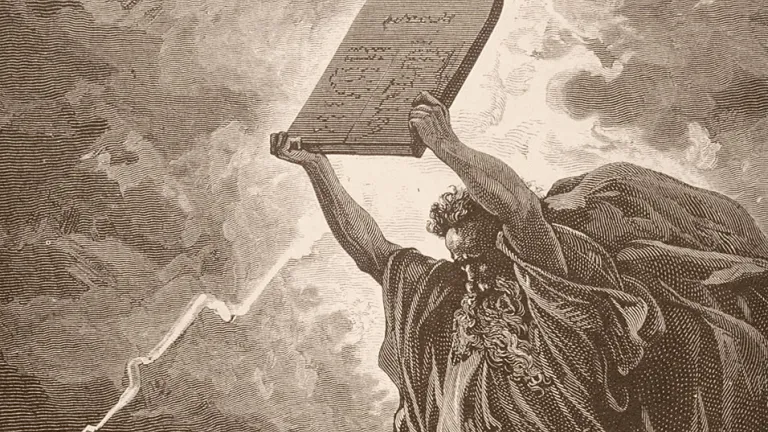
Of special emphasis are the Ten Words, or as they’re conventionally translated, the Ten Commandments (4:13).
This section of Deuteronomy is introduced in 4:44,
“Now this is the law which Moses set before the children of Israel.”
Moses calls the people to hear, learn, and carefully obey this instruction, first by reminding them that the Lord made a covenant with Israel at Horeb (5:2).
A covenant is a committed, personal relationship which formally binds parties to specific obligations and benefits, with penalties for failing to maintain it. However, Moses emphasizes
“the Lord did not make this covenant with our fathers, but with us, those who are here today, all of us who are alive” (5:3, emphasis added throughout).
This generation was not alive during the Exodus, and nearly all of those alive back then had died in the wilderness (1:34-38). Yet, the wilderness generation was just as accountable to God for this law and covenant, as if they were present with God and Moses at Horeb themselves. Each Israelite was to think of themselves as having come out of Egypt and having heard God’s voice from the mountain.
The Sabbath commandment accentuates this point. While Exodus 20:11 connects the Sabbath to creation, Deuteronomy underscores the Exodus.
“Remember that you were a slave in the land of Egypt, and the Lord your God brought you out from there by a mighty hand and by an outstretched arm; therefore the Lord your God commanded you to keep the Sabbath day” (5:15).
We remember God not only as our Creator but also as our Redeemer from Egypt on the Sabbath day.
We ought to obey God today with the same closeness and thankfulness as that generation, owing Him allegiance over all others, and being attentive to His Word. This is true whether we are hearing God’s truth for the first time or if we have heard it our whole childhood, as second-, third- and fourth-generation Christians. Whether you have a dramatic, walking-through-waters calling, or one that simply sustains you through the wilderness, it is no less a gracious miracle and a provision of God. And the same response is owed to both: faithfulness.
While the word “Deuteronomy” means “second law,” it’s more than just a static copy of what’s already been said. Here, Moses “began to explain this law” (1:5).
The bulk of Deuteronomy’s content and structure is Moses’ exposition of the Ten Commandments in order (6:1-26:19, see table). One good exercise is to read through Deuteronomy and see how this outline makes sense, or if any parts surprise you. Perhaps you’ve heard that Proverbs is 31 chapters long, so it can be read in a month at one chapter per day. Deuteronomy is about the same!
Covenant Keeper
One of Moses’ last exhortations to Israel was to enter into and remember its covenant relationship with God (chapters 27-30). Like Israel, God calls His people today into a relationship with Him in the New Covenant. This call is initiated by God and formalized by repentant baptism and the laying on of hands. Whatever decisions you make in life, God is calling you to this baptism.
Despite instruction and encouragement, in his final hours, Moses knew Israel would not be faithful, but utterly faithless. Rather than success in the covenant, the people would fail.
“They will turn to other gods and serve them . . . they will provoke Me and break My covenant” (31:20, compare 4:25-28).
They did not have hearts to hear and obey God (29:4; 5:29). Thus, they fell under the curse:
“Cursed is the one who does not confirm all the words of this law by observing them” (27:26).
When Jesus of Nazareth was crucified and died, He addressed the cursing that the covenant required.
“Christ has redeemed us from the curse of the law, having become a curse for us” (Galatians 3:13).
Jesus died the death we deserved, so we could walk in newness of life: the good works of righteousness He prepared for us (Romans 6:4; Ephesians 2:10). Where we broke and failed to remember the covenant, Jesus succeeded, and He set an example that we might follow.
Moses promised the Lord would raise up another “Prophet like me.” Rather than disloyalty and rebellion, the outcome with this Man would be different: “Him you shall hear” (Deuteronomy 18:15). By changing the hearts of the people—of us—we are enabled to heed God’s commands (30:6; 10:16).
These and more are the abundant blessings we have in Jesus Christ. We receive the New Covenant, deliverance from death, and empowerment by the Spirit to faithful obedience. And indeed, we anticipate a future when “there shall be no more curse” (Revelation 22:3).
God asks you to walk with Him—to choose life—with your whole life: your past, your present and your future (Deuteronomy 30:11-20). I don’t know your plans for tomorrow, but I know that the words He taught , those thousands of years ago in the desert, continue to be a wellspring of life for me and for His faithful servants around the world.
Do you struggle with self-confidence? Remember and give thanks to God, the Giver of all good gifts, who redeemed you and gave you victories.
Do you deal with regret? Take courage and comfort in the Lord who heals the whole person and qualifies us to walk in new paths.
Do you seek knowledge and understanding? Read the words of this book, meditate on them, and do all you can to live by them. Then read them again (31:10-11; 17:19).
Do you feel alone? Jesus has not left you behind but is saving a people out of Egypt,
“I will not leave you orphans; I will come to you” (John 14:18).
Do you fear what God will cost you, what you’ll have to give up if you really follow Him? Realize your possessions and accomplishments in this world are temporary, and He has covenanted to give you a Promised Land—with a vocation, blessings and family—which will never pass away. For we “shall inherit all things” (Revelation 21:7).
So, at the crossroads, go forward in faith and in courage.
“The Lord your God” is your life and “the One who goes with you” (Deuteronomy 31:6).
COMMANDMENT6 | EXPOSITION IN DEUTERONOMY |
I: The Lord is God | 6:1–11:32 |
II: Idolatry | 12:1–13:18 |
III: Bearing God’s Name | 14:1–29 |
IV: Sabbath Observance | 15:1–16:17 |
V: Honor Father and Mother | 16:18–18:22 |
VI: Murder | 19:1–22:8 |
VII: Adultery | 22:9–23:14 |
VIII: Theft | 23:15–24:7 |
IX: Lying | 24:8–25:4 |
X: Coveting | 25:5–26:19 |

An Article from:
Compass Check: Winter 2025
Course Content

Kevin Greer
Kevin Greer attends the United Church of God in the Kalamazoo, Michigan congregation. Kevin currently works as a project management engineer at DENSO Manufacturing Michigan, Inc., an automotive thermal systems production facility in Battle Creek, Michigan, where he has worked for over ten years. Kevin graduated from Western Michigan University with a Bachelor of Science in Mechanical Engineering in December 2018. Some of his hobbies include music, movies, mathematics, reading, writing, and spending time with family and friends. Kevin has served with United Youth Camps on staff at Camp Cotubic (2015-2016, 2018) and Winter Camp (2014-2016) and has been writing with the United Church of God since January 2014. He lives with his wife, Sarah, and pet dog, Josie (15), in Richland, Michigan.