Care About the Caregivers

Caregiving is often very difficult. How can we support those who serve in this role?
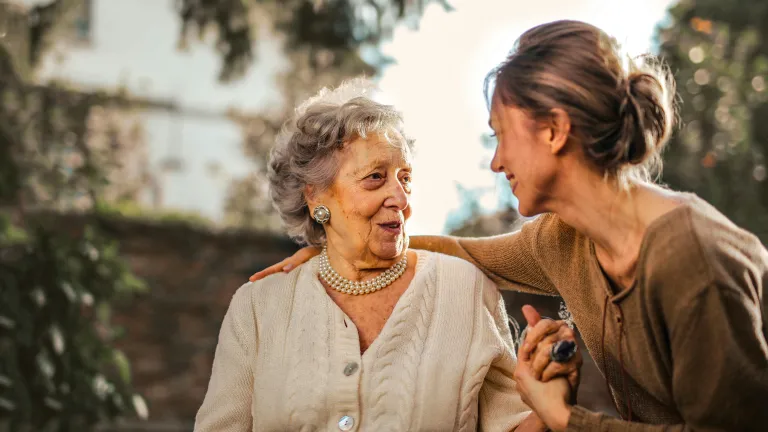
Caregivers are “unsung heroes” in our Church and everywhere, but seldom do they receive the recognition, appreciation and prayers that they deserve. Most of us hear or read many prayer requests, often by email. Let’s remember that almost everyone with a serious health problem is being helped by one or more caregivers.
James 5:16 tells us to “pray for one another, that you may be healed. The effective, fervent prayer of a righteous man avails much.” God’s people generally take that to heart and pray for the person announced in the prayer request.
Thank you for all those prayers! In addition, let’s try to think of and pray for the caregivers as well as the care-receivers. Caregivers often have a very heavy load on their shoulders, a load which might last for a short time or for a long time, sometimes years! Even when we don’t know the names of the caregivers, we can still pray for them.
In America and elsewhere, the availability of professional caregivers is a wonderful blessing when they are needed, whether occasionally or regularly. This article is about the non-professional caregivers who usually are family members or close friends. Family and friends who serve as caregivers generally sacrifice their time and energy, some of their own personal needs and desires, and sometimes money to give whatever care and help is needed to a loved one who has a serious health problem or disability.
Learning more about caregiving has been very enlightening and sobering to me. One study estimates that a fourth of all adult children are providing personal care or financial assistance to a parent!
Many thanks to all the caregivers!
Thank you, thank you to all the self-sacrificing caregivers—past, present and future! Thank you for all that you have done, are doing, and/or will be doing to help take care of the needs of a family member or friend!
The word “care” has several definitions. “Caregiving” is usually about giving physical assistance. Let’s also remember that most personal caregivers sincerely care about the patient with loving compassion. Jesus gave us the parable of the good Samaritan, speaking of a Samaritan who “had compassion” for an injured stranger and “took care of him” (Luke 10:30-37).
Sometimes the need is for a short time, such as when someone is injured or having surgery, and sometimes it is for a very long time. Sometimes the caregiving is needed for the remainder of the patient’s life, such as when there is a major disability, dementia or the weaknesses of old age. Sometimes it is in cooperation with hospice care.
Family caregivers are usually grown children, husbands, wives and parents. Sometimes more than one relative shares in the caregiving.
The fifth of the Ten Commandments is “honor your father and your mother” (Exodus 20:12). Even after we are adults, we must continue to honor our parents. Think of the continual loving care that they provided for you as you were growing up! A major way to honor parents is to help them when they need help, as much as we are able. At the same time, the son or daughter must exercise humility, patience and wisdom to avoid showing any disrespect for one’s parent.
The spirit of that commandment implies that we should also help other family members when they need help as we are able. Every Christian should try to “provide for his own” (1 Timothy 5:8).
After the initial “promise and covenant” in our Church wedding ceremony are these words: “In sickness and in health, in both good times and difficult times, I will honor you, protect you, love you, and cherish you for the rest of our lives.” When a married person needs daily assistance, the husband or wife should try to live up to the promise made at their wedding!
Remember and pray for caregivers!
The caregiving role is often very difficult, especially when it is needed day after day, and sometimes night after night! And caregivers generally have to manage other essential responsibilities at the same time. The caregivers need our prayers and encouragement! And when you personally know a caregiver, you can inquire as to how you might be of assistance to them!
The stress of serving as a long-term caregiver is often overwhelming physically and mentally, and some caregivers experience burn-out! We plan to publish a follow-up article that explains how caregivers must take good care of themselves if they are to survive with good physical, mental and spiritual health.
Caregivers are inspiring examples of what Jesus taught in John 15:12-13—“This is My commandment, that you love one another as I have loved you. Greater love has no one than this, than to lay down one's life for his friends.” A long-term caregiver is laying down his or her life—laying down time, energy, other responsibilities, and sometimes their own health.
A caregiver is his or her “brother’s keeper.” Caregivers understand Ecclesiastes 4:9-10, which says, “Two are better than one, because they have a good reward for their labor. For if they fall, one will lift up his companion. But woe to him who is alone when he falls, for he has no one to help him up.”
This reminds me of the popular Boys Town poster showing a boy carrying a small boy on his back. The boy says, “He ain’t heavy—he’s my brother..”
Many Variations in Caregiving
Caregiving is a big subject that includes many types of care, the amount of care and the duration of that care. Following are common examples.
As a person loses strength and clarity of mind, their caregiver must learn their daily needs and desires. The caregiver must provide help with medications, legal documents, appointments, etc.
A caregiver must make the home as safe as possible. That responsibility can include installing safety grab bars and providing a shower stool, a toilet armrest, and a raised toilet seat. It may include removing throw rugs that might be a tripping hazard. It might include procuring a cane, a walker and/or a wheelchair. It can include chores that the patient formerly did including meal planning, shopping, running errands, cooking, cleaning and yard work. It can include helping the patient with getting in and out of bed, getting dressed and undressed, and getting in and out of chairs. It can include bathing the patient and helping the patient to use the toilet.
Many patients need stimulating and uplifting experiences, such as the caregiver reading to him, playing music, playing games, reminiscing, taking the patient outdoors and to interesting places.
Sadly, when a person doesn’t feel well, it is easy for him or her to become depressed and then take out their negative feelings on the only person present—the caregiver. Caregivers often hear many more criticisms and complaints than thanks. This can greatly increase the caregiver’s stress and discouragement.
When we show love, we feel more love
I’ve wanted to write on this subject ever since my wife, Elsie, died in August 2020. I was increasingly her caregiver as her health declined during the last couple of years of her life. There’s an encouraging point I want to share with you. We were married for 54 years and I always loved her very much, but the more I gave her the help that was needed, the more I grew in my love for her. Good action often leads to good feelings. My increased labor of love led me to increased feelings of love.
This illustrates how love usually grows more by giving than by receiving. This reminds me that in Acts 20:35, Jesus is quoted as saying, “It is more blessed to give than to receive.”
Be prepared!
Someone’s need for daily assistance can start quickly, like right after someone has had a bad injury. Or it can escalate gradually, such as when a person’s disease is getting worse or there are more and more handicaps because of old age.
Consider that most caregivers never received any prior education for that role! It is wise to begin learning about and preparing for that responsibility long before we are plunged into it! For example, if a parent reaches a ripe old age, he or she will very likely need some family assistance.
Today, many helpful books and websites on caregiving are available. One is cleverly titled “Parenting Your Parents.”
Thank you!
To all the caregivers—past, present and future—thank you for your caring heart and your caring service! We realize that with many of you, your service goes on and on, day after day, hour after hour. Thank you for your genuine love which motivates, sustains and inspires you.
And words cannot adequately convey the gratitude that we should have and express to our all-loving Creator, Provider and Sustainer who loves and cares for all human beings as His sons and daughters—our perfect and all-loving Caregiver!
If you have found this article helpful, be sure to check out the next article in this series: Family Caregivers, Please Take Good Care of Yourselves!
Course Content

Donald Hooser
Don Hooser is a minister for the United Church of God. He lives in McKinney, Texas, a suburb of Dallas. He and his wife Elsie had three children, and she died in August 2020. Don married Judy in January 2022. Mr. Hooser graduated in 1963 from Southern Methodist University with a degree in mechanical engineering, and graduated in 1966 from Ambassador College, Big Sandy, Texas. For most of the time since then, he served as the pastor of churches in Ohio, Nebraska, Oklahoma, Texas, and Washington. From 2011 until his retirement in 2021, his primary responsibility was answering the many letters written to the Church.