Gospels Part 048

Do you recognize this particular photograph? Do you know the story behind it? You need to understand its significance!
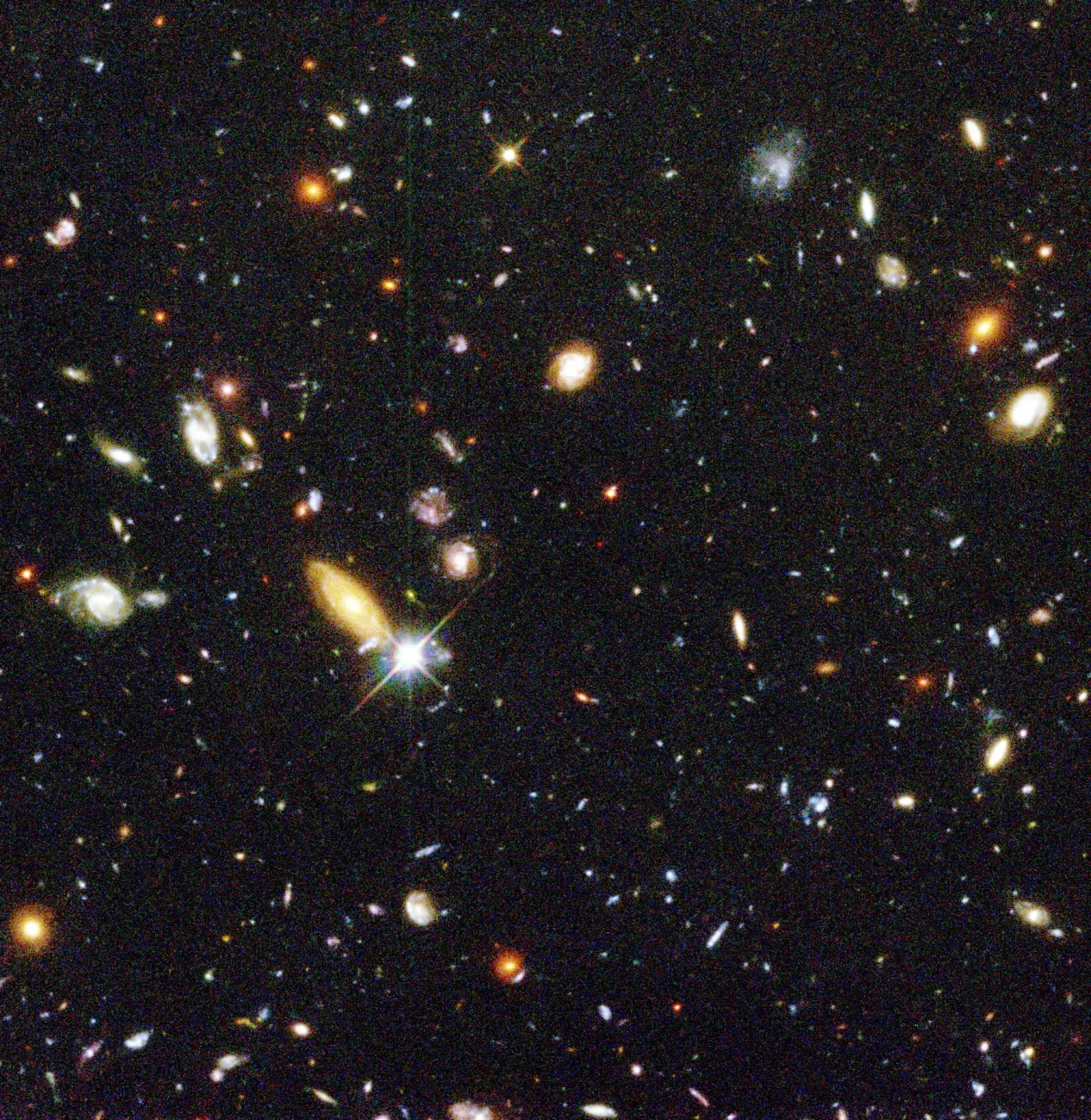
This is one of the most famous photographs taken by the Hubble Space Telescope. Actually, it is one of the most famous photographs taken in history.
In December 1995, astronomers pointed the school-bus-sized Hubble Space Telescope at the darkest region of sky they could find, which happened to be near the Big Dipper constellation. They wanted a dark patch of sky with no stars or galaxies to obstruct the view as they used the telescope to do something that had never been done before—to record light from the farthest reaches of the universe, 4 billion times fainter than what can be detected by the human eye.
For the first time in human history, scientists had the technology to do what had previously been impossible—to attempt to see back in time, to glimpse the beginnings of origin of the universe. Hubble’s massive state-of-the-art telescope, floating in orbit more than 300 miles above earth to avoid atmospheric distortion, would allow them to see things no human eye had ever seen before.
Imagine for a moment holding a grain of sand between your fingers at arm’s length. This is about the size of the angle that they were viewing through the telescope.
The astronomers kept the Hubble Telescope focused on that one tiny spot for 10 days while they took 342 exposures with the telescope’s technologically advanced digital cameras, exposures that averaged 15 to 40 minutes each. This was the only way to record light so infinitesimally faint.
The astronomers were hoping to find answers to fundamental questions about the universe. How large is it? How far might humankind be able to see in searching for galaxies billions of light-years away? Could they find clues to the origin of the universe and our own Milky Way galaxy? How far back in time could they see?
It took days to combine and process the 342 separate digital images into one photograph. When they were finished, the astronomers were awestruck. The tiny speck of sky was this photograph! Looking through a “tube” of sky as small as a grain of sand at arm’s length, they counted more than 1,500 galaxies of various shapes, sizes and colors. They concluded that the faintest galaxies they had recorded were more than 10 billion light-years away. This was the farthest back in time humankind had ever been able to see.
Let us consider that for a moment. In the darkest part of the sky, in a spot so incredibly tiny, they were able to see more than one and a half thousand galaxies. They extrapolated that to the total visible sky, 360 degrees in every direction, and concluded that the universe contains far more galaxies than we can imagine—at least 100 billion and possibly much more!
How big are these numbers? To put them into perspective, if you counted galaxies at the rate of one per second for 24 hours, it would take almost 32 years to reach 1 billion. You would spend almost 3,200 years to reach 100 billion, and again that is only the estimated number of galaxies in the universe. When we consider the number of individual stars and planets making up all these galaxies, we simply cannot begin to imagine numbers that enormous. The average galaxy the size of our own Milky Way is thought to contain 200 billion stars and an untold number of planets. Multiply the 200 billion stars in our galaxy by 100 billion other galaxies and try to comprehend that number!
But the story does not end there. Not long ago, a group of astronomers recalculated new data gathered with even better technology since this photo was taken, and they concluded that the universe contains not 100 billion galaxies, but two to three trillion galaxies! This is 20 to 30 times as many as previously thought! The little speck of sky examined by the Hubble telescope did not contain 1,500 galaxies; it contained about 40,000! Hold out your hand and visualize a grain of sand between your fingers again and try to imagine 40,000 galaxies in that tiny spot of light!
Why are we starting this next series of studies in the Gospels with this astronomy lesson on the size, greatness and magnitude of the universe? The simple answer is that in the Gospels we are going to be studying the Being who created all of that—who created those billions and trillions of galaxies and countless suns and planets and worlds. That same Being who created all of this came to earth as a human being so we could know and have a relationship with Him and God the Father. Not only that but, He has provided a way for us to inherit all of this as part of Their family!
In tomorrow’s lesson, we’ll begin the astounding journey of discovery into that story!
© 2026 Scott Ashley. All rights reserved. Used with permission.
UYA Team | uya@ucg.org
United Young Adults (UYA) primarily serves the 18–32-year age group for the United Church of God. There are three main areas of contribution to the lives of the young adults: Promoting Spiritual Growth, Developing Meaningful Relationships and Making the Most of Your Talents. The Know Your Sword series is a daily expository message introducing God’s Word from a trusted perspective.

Course Content

Scott Ashley
Scott Ashley was managing editor of Beyond Today magazine, United Church of God booklets and its printed Bible Study Course until his retirement in 2023. He also pastored three congregations in Colorado for 10 years from 2011-2021. He and his wife, Connie, live near Denver, Colorado.
Mr. Ashley attended Ambassador College in Big Sandy, Texas, graduating in 1976 with a theology major and minors in journalism and speech. It was there that he first became interested in publishing, an industry in which he worked for 50 years.
During his career, he has worked for several publishing companies in various capacities. He was employed by the United Church of God from 1995-2023, overseeing the planning, writing, editing, reviewing and production of Beyond Today magazine, several dozen booklets/study guides and a Bible study course covering major biblical teachings. His special interests are the Bible, archaeology, biblical culture, history and the Middle East.