Gospels Part 071

As we conclude our overview of Matthew’s genealogy, we’ll see that he employs another common Jewish communication method to convey a deeper message regarding Jesus Christ, one that is not immediately evident on the surface.
Let’s notice again how Matthew introduces the subject of his Gospel in Matthew 1:1:
“This is the record of the genealogy of Jesus Christ, the son of David, the son of Abraham” (New English Translation [NET]).
We’ll focus on the significance of the phrase, “the record of the genealogy of . . .” It may not sound familiar to us today, but it would have sounded familiar to Matthew’s readers of the first century, because it’s the direct quote of a phrase that appears early and significantly in the “Bible” most often used by the Jews of the first century.
This Bible, a Greek translation of the Hebrew Scriptures known as the Septuagint, was commonly used by Jews in the first century, frequently quoted by Matthew and the apostle Paul. It was popular at the time because Greek was the most common language throughout the Roman Empire, and many Jews no longer knew how to read or write Hebrew due to their centuries-long exile by the Babylonian Empire in the sixth century B.C.
When Matthew opens his Gospel with the phrase, “This is the record of the genealogy of ...,” the literal translation in Greek is: “The book of the genesis of Jesus Christ . . .”
The words he wrote in Greek are the exact same words that appear in the Septuagint in the opening of these two key passages in Genesis, quoted from the Septuagint:
Genesis 2:4:
“This is the book of the genesis of heaven and earth.”
Genesis 5:1:
“This is the book of the genesis of mankind.”
Understand that in Greek the word “genesis” means “origin” or “beginning” or, when applied to people, “generation(s).”
So, what is Matthew telling both the readers of his day and his readers of today?
In our last lesson, we discussed the popular first-century Jewish teaching that means “allusion,” “echo,” “look back,” or “hint,” commonly known as remez in Hebrew. We saw earlier that John begins his Gospel with a remez to Genesis, “In the beginning . . .” (Genesis 1:1). Matthew also begins his Gospel with a remez in his opening words: “The book of the genesis of Jesus Christ,” telling his readers to look back at Genesis 2:4 and Genesis 5:1.
And what do we see in those two verses? Two great cosmic turning points in God’s great plan—first, the creation of heaven and earth, and then the creation of the first human beings, Adam and Eve.
God began His great plan by creating the universe and the earth as a habitation for human beings.
Then God began the next step of His great plan by creating human beings who could ultimately become a part of His divine family as His children.
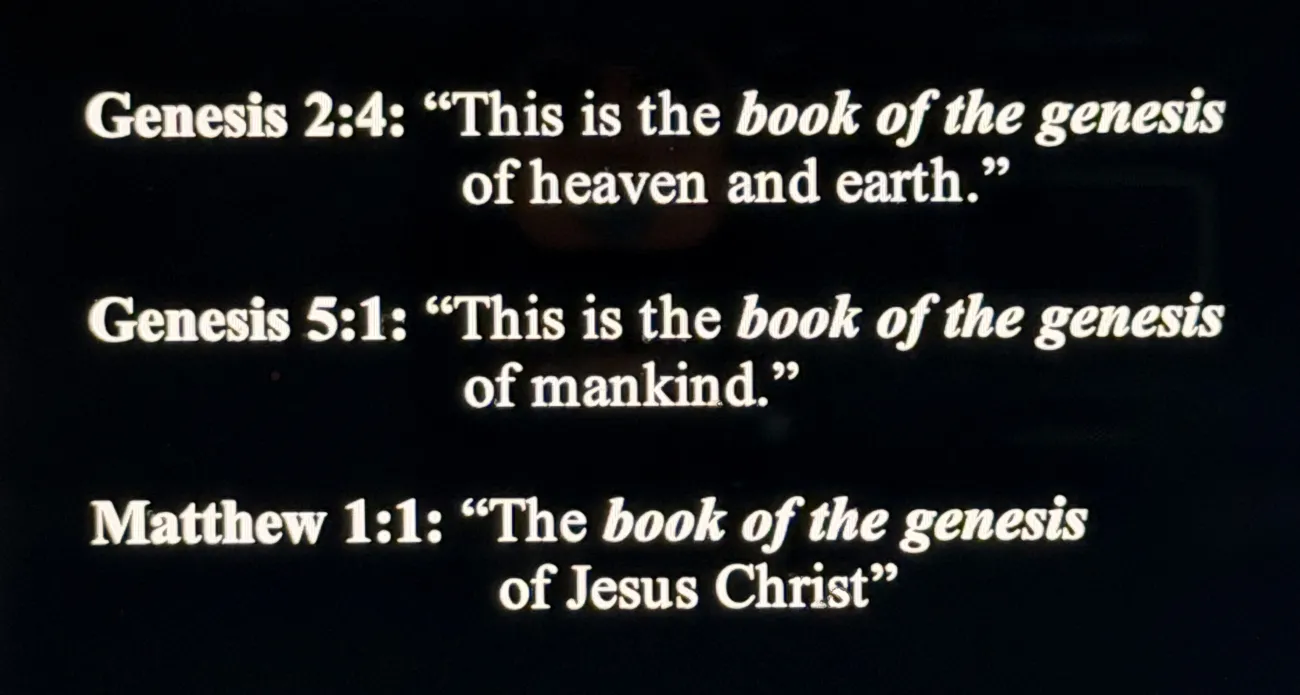
Matthew tells us that God has begun the third great step of His plan, which is Jesus coming as God in the flesh to provide the pathway for us mortal human beings to ultimately become spirit beings in God’s immortal family! Matthew, like his fellow Gospel writer John, tells us about the origins, teachings, life, death and resurrection of God’s Son that makes God’s plan possible!
Matthew’s use of the word genesis/origins/generations also points his readers to other places where this word appears in the book of Genesis, including the following (quoted from the Septuagint):
Genesis 6:9:
“These are the generations of Noah”
Genesis 10:1:
“These are the generations of the sons of Noah”
Genesis 11:10:
“These are the generations of Shem”
Genesis 11:27:
“These are the generations of Terah”
Genesis 25:12:
“These are the generations of Ishmael”
Genesis 25:19:
“These are the generations of Isaac”
Genesis 36:1:
“These are the generations of Esau”
Genesis 37:2:
“These are the generations of Jacob”
Matthew is pointing his Jewish readers back to these other lists of genealogies. This phrase, “the generations of,” he’s picking up directly from the Septuagint, which has been in common use among the Jews of Judea and Galilee for about a century and a half leading up to the time he wrote his Gospel.
What’s the point Matthew is making? He doesn’t specifically tell us; he expects us to know the story well enough to figure it out on our own. So, let’s ask a few questions:
What is the book of Genesis? Genesis means “beginnings.” It’s a book of beginnings. It’s a book of God working out His plan in and through the lives of each of these individuals listed above—very significant biblical figures such as the patriarchs Noah, Isaac, and Jacob.
What is the book of Matthew? It’s a book about another new beginning. A new creation. A second Adam. A new spiritual family and nation. A new Israel. A new revelation of how God will work with people. A new pathway to God.
It’s all a part of God’s continuing story. God worked in and through the lives of these people, and now Matthew begins his story of how God is going to work mightily in the life of another major individual, Jesus Christ. It’s the next chapter of the story of God working through mankind to bring to pass His great plan!
The beginning of Matthew’s Gospel is very much a parallel with how and why John begins his Gospel with a remez—a hint or look back—to Genesis 1:1 to tell the story of how God came to earth as a human being. Matthew is now going to tell the next chapter of the story that began back in Genesis. But again, if we’re not intimately familiar with the Scriptures, we miss the remez, and we miss the point!
This is why it’s important to read the Gospels—and the entire Bible, for that matter—in the context of the Gospel writers’ day and what they intended for their audiences. If we don’t, we miss important parts of the story—God’s story—for us!
© 2026 Scott Ashley. All rights reserved. Used with permission.
UYA Team | uya@ucg.org
United Young Adults (UYA) primarily serves the 18–32-year age group for the United Church of God. There are three main areas of contribution to the lives of the young adults: Promoting Spiritual Growth, Developing Meaningful Relationships and Making the Most of Your Talents. The Know Your Sword series is a daily expository message introducing God’s Word from a trusted perspective.
Course Content

Scott Ashley
Scott Ashley was managing editor of Beyond Today magazine, United Church of God booklets and its printed Bible Study Course until his retirement in 2023. He also pastored three congregations in Colorado for 10 years from 2011-2021. He and his wife, Connie, live near Denver, Colorado.
Mr. Ashley attended Ambassador College in Big Sandy, Texas, graduating in 1976 with a theology major and minors in journalism and speech. It was there that he first became interested in publishing, an industry in which he worked for 50 years.
During his career, he has worked for several publishing companies in various capacities. He was employed by the United Church of God from 1995-2023, overseeing the planning, writing, editing, reviewing and production of Beyond Today magazine, several dozen booklets/study guides and a Bible study course covering major biblical teachings. His special interests are the Bible, archaeology, biblical culture, history and the Middle East.

