Revelation Part 06

As we study the image of the powerful Alpha and Omega, we see strength and learn that the hope of Revelation is not only that Christ reigns, but that we will bear His image and reign with Him.
As we continue to look at the image of God and the glorified Christ in Revelation, we see that God is described as being seated on “a throne set in heaven, and One sat on the throne” (Revelation 4:2). The concept of a "throne" itself originates from the Greek word thronos, which means an “elevated seat or chair” and was passed into English through Latin and Old French. Historically, the throne has come to represent more than just a physical seat—it stands for monarchy, power and divine rule. Initially associated with the gods in ancient cultures, the throne quickly became a symbol of authority and status among human rulers. Eventually monarchs and religious leaders adopted increasingly elaborate thrones to visually separate themselves from commoners and to represent their elevated status. The idea of a ruler’s feet being lifted off the ground, never touching the earth, was a deliberate act to signify transcendence, power and divine-like authority.
Humanity has long attempted to imitate the divine, creating counterfeits of God's glory. One example of this can be found in the coronation rituals of the Chinese imperial court. In a translated account from the 1820 coronation of the Dougong Emperor, we read of a highly ritualized process where all ranks knelt and bowed multiple times before the emperor, who sat on the majestic Dragon Throne. The throne itself was a grand structure made of white marble and jade, richly sculpted with dragons—the mythical symbols of imperial power in Chinese culture. The throne was designed to awe and elevate the emperor above all others, reinforcing his divine right to rule.
Modern thrones continue to carry deep symbolism. The Coronation Chair in Westminster Abbey, used in 38 British coronations, remains a symbol of monarchical continuity and sacred kingship. Likewise, St. Peter’s Throne in the Vatican’s Basilica, symbolizing the authority of the papacy, is rich in tradition. These thrones are not merely seats but are meant to show the power that the person who sits in them has.
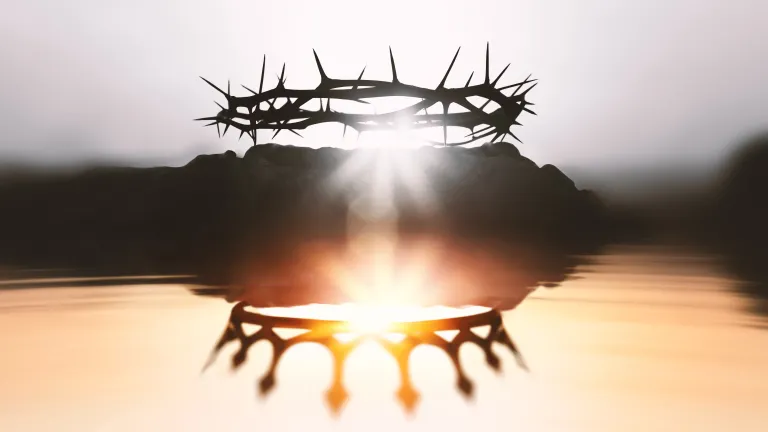
In Revelation, however, Christ’s throne is unique—not a man-made imitation, but the genuine seat of divine authority. This throne is not empty. It is occupied by the resurrected, glorified Christ, who reigns eternally. His throne is not built on mythology, tradition or politics but on truth, righteousness and justice. The symbol of burnished bronze, often seen in Revelation and connected to the ancient city of Thyatira, reflects God’s presence and judgment. The process of burnishing bronze (refining it to glow with warmth and durability) adds character and uniqueness, just as Christ’s presence brings refining fire and unmatched holiness. No two burnished pieces are exactly alike, emphasizing the personal, intentional nature of God’s rule.
As Ephesians 1:22 declares, God “put all things under His feet, and gave Him to be head over all things to the church.” This exalted position of Christ is not symbolic alone—it reflects His actual authority over all creation, and it points forward to the Judgment Seat of Christ, where justice will be administered. In Revelation, the throne of Christ is the center of worship, justice and ultimate victory.
“His voice as the sound of many waters” (Revelation 1:15, Ezekiel 43:2) illustrates divine power and authority. In Mark 4:39, Christ calmed the sea with His voice. In Matthew 17:5, God declares, “This is My beloved Son . . . Hear Him!” When Christ speaks, creation responds. There is much symbolism in the description of Christ. He holds seven stars in His right hand, symbolizing power and authority over angels and the churches. His right hand is the position of control and leadership as He is Head of the Church (Ephesians 4:15).
From His mouth comes a sharp two-edged sword, the Word of God (Hebrews 4:12). Isaiah 11:4 and Revelation 19:15 show that Christ will rule and judge with His Word. We are constantly reminded of how important His Word is, as Matthew 4:4 states,
“Man shall not live by bread alone, but by every word that proceeds from the mouth of God.”
He is not just one of our buddies or a genie to grant wishes, He is the Messiah, returning in power, justice and judgment. Revelation reveals not only who Jesus is but what He is doing: judging, refining, leading and preparing His people.
This vision of Christ profoundly impacted John, who fell at Christ’s feet in awe. Yet, Christ’s words are reassuring,
“Do not be afraid; I am the First and the Last. I am He who lives, and was dead, and behold, I am alive forevermore. I have the keys of Hades [the grave] and of death” (Revelation 1:17–18).
He alone has power over life and death. As 1 Corinthians 15:26 proclaims, “The last enemy that will be destroyed is death.”
This image of God demands a response. For John, it was to write. For us, it is to live, teach and reflect Christ. We are the salt of the earth (Matthew 5:13), light of the world (verse 14), and ambassadors of Christ (2 Corinthians 5:20). 1 Corinthians 15:49 reminds us,
“As we have borne the image of the man of dust, we shall also bear the image of the heavenly Man.”
1 John 3:2–3 also gives us hope,
“We shall be like Him, for we shall see Him as He is.”
This vision of the glorified Christ in Revelation reveals the God we worship: eternal, holy, powerful and soon returning. This is the great hope that propels us forward, the promise of transformation, victory and eternal life in the presence of the glorified Christ.
UYA Team | uya@ucg.org
United Young Adults (UYA) primarily serves the 18–32-year age group for the United Church of God. There are three main areas of contribution to the lives of the young adults: Promoting Spiritual Growth, Developing Meaningful Relationships and Making the Most of Your Talents. The Know Your Sword series is a daily expository message introducing God’s Word from a trusted perspective.