Revelation Part 24

The first four seals—the “Four Horsemen of the Apocalypse”—paint a sobering picture of deception leading to war, war breeding famine, famine breeding disease and the cycle ending in death.
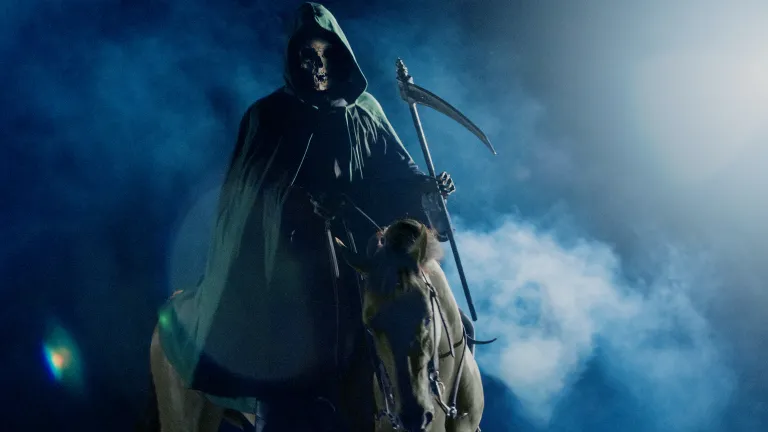
When the fourth seal is opened in Revelation 6:7-8, John describes a pale horse. We can imagine it as a sickly, greenish shade of a corpse. Its rider is called Death, and behind him follows Hades—the grave itself. This symbolizes the grim outcome of the world’s corruption under Satan’s rule. While the earlier seals brought deception, war and famine, this fourth judgment is the culmination of those three: mass death on a global scale.
The rider is given authority over a fourth of the earth—an enormous portion of the world’s population. Today, with over 8 billion people alive, that would mean as many as 2 billion deaths. We are told that this destruction comes by four means: the sword (warfare and violence), hunger (starvation brought on by famine and disrupted supply chains), death (plagues, pestilence and disease), and beasts of the earth (which may refer not only to wild animal attacks but also to diseases carried by animals—viruses, germs, and what we might today call “germ warfare”).
These descriptions resonate with modern global realities. War continues to evolve with increasingly destructive weapons: from traditional battlefields to drones, cyberwarfare and nuclear threats. Hunger remains a worldwide crisis with conflicts and climate disruptions cutting off or limiting food supplies, shipping channels being blocked (such as the Suez Canal), and inflation making even basic staples unaffordable in many nations. The COVID-19 pandemic provided a glimpse of how quickly the global supply chain can be impacted. And the “beasts of the earth” may also remind us of zoonotic diseases—plagues like Ebola and avian flu that jump from animals to humans, bringing widespread death. Revelation’s picture of Death and Hades feels strikingly relevant in a world where war, famine, and pestilence often combine into cycles of suffering.
Yet these things are not presented as random misfortunes. They are allowed under God’s sovereignty as part of His judgment. Prophets like Jeremiah (14:11–12) spoke of these same plagues of sword, famine, and pestilence as God’s instruments of judgment against unrepentant peoples. While these judgments sound terrifying, the Bible reminds us that God’s justice is not the same as human cruelty. In 1 Chronicles 21:9–19, David preferred to fall into God’s hands rather than men’s, knowing that the Lord is merciful even in discipline.
This seal reveals a sobering truth: humanity cannot solve its problems while under Satan’s dominion. The first four seals—the so-called “Four Horsemen of the Apocalypse”—paint a sobering picture of deception leading to war, war breeds famine, famine breeds disease, and the cycle ends in death. Only the Lamb, who alone is worthy to open the scroll, can bring history to its rightful conclusion. These judgments are not meant to destroy blindly but to purify the earth, bringing mankind to the point of realizing its need for God. If God intervened too early, people could think they didn’t really need His help. If He waited too long, chaos would consume everything (tohu and bohu—formless and void, Genesis 1:2).
The wisdom of Ecclesiastes 8:11 speaks here: because God’s judgment is not immediate, people grow bolder in their evil. But the fourth seal is a reminder that judgment will not be delayed forever. For those who fear God, there is hope: “It will be well with those who fear God” (verse 12). Even in devastation, His people can rest in His promises.
UYA Team | uya@ucg.org
United Young Adults (UYA) primarily serves the 18–32-year age group for the United Church of God. There are three main areas of contribution to the lives of the young adults: Promoting Spiritual Growth, Developing Meaningful Relationships and Making the Most of Your Talents. The Know Your Sword series is a daily expository message introducing God’s Word from a trusted perspective.