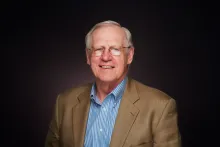

Jerold Aust
This sermon was given at the Steamboat Springs, Colorado 2012 Feast site.
This transcript was generated by AI and may contain errors. It is provided to assist those who may not be able to listen to the message.
To begin my sermon, I'm going to do something which the Bible does command. It says in Proverbs 3, 27, to give honor to whom honor is due. It says in Romans 13, 7, to render therefore honor to whom honor. A few weeks before the feast, the home office emailed me, Victor Kubik did, and requested that I do what I'm going to do, and that is to give honor to Mr. Wilberg and his wife Sue. Now, we really have a remarkable man here in the audience. He was born in Michigan in 1926. His father died when he was seven. He spent most of his youth after that in New Hampshire, where he began to play jazz, piano professionally by age 14. He was playing professionally by age 14. As a young man, he played with many members of major orchestras of the Big Band era. So if you like Big Band music, you might want to talk to Mr. Bergh. He served in the U.S. Navy during World War II. How many of us were not even born then? He graduated from Colorado College in 1953, went on to Yale University to pursue a master's degree in music. He is an accomplished jazz pianist. He managed his own band in order to support himself in college. He was introduced to the Plain Truth magazine in the early 1950s.
And by reading it and by studying the Bible, this became a life-changing experience for him. And God brought him to the knowledge of the truth at a point in his life when he was looking for absolutes. He wanted to find something that was true and unchangeable, and indeed he found it in the Bible. He also realized that by reading the Bible, he was breaking God's laws and that to continue a professional career in the music field would cause ongoing conflicts with Sabbath observance, Friday evening concerts and so forth.
So, he made the faithful decision to leave Yale where he was studying music composition. He says that learning and choosing to live God's way of life was the best decision of his life. He came to Pasadena in 1955, was baptized by Norman Smith in 1955, and started working for the church in 1958, began attending Ambassador College in 1958, and graduated around 1961. He's been employed by God's Church since 1958, a 54-year employment period. He's also been an ordained minister for 51 years. His work with the church can be divided roughly into two 25-year segments, the first spent working in and around Pasadena.
During this time, he was in many personal meetings with Mr. Herbert Armstrong. He assisted in the letter-answering department under Dr. Clint Zimmerman. He worked in the Special Services department, the Conscientious Objector Department for the young men in the church, and he probably corresponded with me in 1966. He would have to double-check that, but I was involved with the Conscientious becoming a Conscientious Objector at that particular time in my life. He also served as an administrative assistant to the head of Ministerial Services, and he was asked to pastor congregations in Hawaii for one year.
So this time, I'd like to ask them if they'd start coming forward. We have some flowers here we'd like to present to them, so they could start coming forward at this particular time. So he and Mr. Al Dennis co-pastored two extremely large congregations in Long Beach, California for about 10 years. The second 25 years of his ministerial career began during the 1980s when he was sent to Idaho to pastor churches in Twin Falls and Blackfoot, Idaho, as well as Jackson, Wyoming.
He has four children and seven grandchildren. We've learned that he is an avid outdoorsman who still enjoys fly fishing, hunting, backpacking, and skiing. Mr. Berg has remained faithful to God's way, even as he is known, hardship, suffering, and lost. He lost his second oldest son in 1998, and he lost his first wife of 50 years, four years later. He married Sue Blumell in 2003, and they both work as a team in their function of serving God's people. He now pastors the Idaho Falls in Idaho and the Du Bois Wyoming congregations.
He and his wife actively host the Challenger Teton Camps hauling equipment in their trailer. He has done this since inception, and now they host 22 staff and participants of the Challenger program in their Du Bois home. In other words, their home in Du Bois Wyoming is the base camp for the Challenger programs.
Here are a couple of important things that he has recounted to me. Please do remember these. In recounting his many blessings, he said this to me. God will provide when you seek the kingdom first. And regarding his blessings, he says, I don't deserve them. Finally, an overall summary statement of his conversion experience, because the conversion and holding fast, that is the heart of the matter. He says, I have found that God is love, and that his purpose is to make us as he is, which is love.
Dear brethren, we were privileged to hear him speak the opening night of the feast. We were privileged to hear him as the Feast of Tabernacles closed yesterday. In that period of time, he put together not everything, because you can't do it in a couple of hours worth of speaking, but as much as he possibly could of his understanding and relationship to God, to Jesus Christ, to the Bible.
It's a wonderful instruction in not only the kingdom of God, but of his own personal conversion journey. I feel privileged to be able to honor them at this time and to present them on behalf of all of us, a small token of our deep appreciation for these people leading the way, showing the way, showing the example for the rest of us. Thank you so much for your service. I'd just like to add a few words that I don't feel worthy of any special honor.
The honor should go to Jesus Christ. He's the one who is worthy. Never forget that. Yes, indeed, the honor does go to Christ. Our part is in yielding to him. Our part is in yielding to God, our Heavenly Father, and our Lord and Savior, Jesus Christ. Today is the eighth day of October. Today is the eighth day of the feast. A bit of a coincidence there. As I said, I think on the opening day that although the staff here consider this the Priest Creek Ballroom, we really know that it's the King and Priest Training Room.
We've been given a lot of training during these past seven and now into the eighth day. Let's open the sermon today, first of all, by turning to Leviticus 23. Leviticus 23 and verse 33, Then the Lord spoke to Moses, saying, Speak to the children of Israel, saying, The fifteenth day of this seventh month shall be the Feast of Tabernacles for seven days to the Lord. On the first day there shall be a holy convocation. You shall do no customary work on it.
For seven days you shall offer an offering made by fire to the Lord. On the eighth day you shall have a holy convocation. You shall offer an offering made by fire to the Lord. Sometimes our life experience is an offering to God and trial by fire, is it not? It is a sacred assembly and you shall do no customary work in it. These are the Feasts of the Lord as a summary statement in verse 37. We need to know, we need to take note of the fact that although these Feasts run together, there's a seventh day, then there's the eighth day, they do run together, but they're also separate as well.
And the specific command to dwell in temporary dwellings or in booths is for seven days. And look at verse 42. Verse 42, you shall dwell in booths for seven days. Just keep that in mind. For seven days there is a distinction between the Feast of Tabernacles and the eighth day of the Feast. So my purpose today is to encourage all of us and to remind all of us that at this final day of the Feast, that there is a coming time of a final ultimate fulfillment of joy. There is going to come unspeakable joy as God's plan unfolds.
As joyful as the Millennium will be, what this day pictures will be, absolutely, just unbelievably wonderful. This will be the time period of the Great White Throne. This last day of the Feast, this eighth day, pictures the greatest time of joy ever that we could ever even begin to imagine. Now, before we get to there, we have to deal with here. You know, we're here. We want to get there, but we're here. And so let's talk a little bit briefly about the here.
About a year ago, in October of 2011, the world reached a milestone, absolute milestone. And I'd been following that particular story in the summer of 2011, because population watchers, people that count and calculate and estimate the population, they were debating and calculating where and when would the world's 7 billionth person be born. Now, they knew there would come a time, I believe it was October 31st, they figured that out, that October 31st, 2011, the world's 7 billionth person was going to be born. Now, of course, they didn't know who exactly that 7 billionth person was going to be, but they knew that this person would be born either in India or the Philippines or in Asia, somewhere in Asia.
And sure enough, October 31st, in Manila, Philippines, little Danica May Camacho was born. And world population counters and demographers and population people, they said, yep, that's as good as we can get it. We're going to proclaim her to be the world's 7 billionth person in Manila, Philippines. They gave her a cake. It had, looks like chocolate frosting. It had 7B, you know, Manila. That was the lettering on the cake.
They gave her a gift certificate for a pair of shoes. She was born in a very poor country, impoverished country. And she may become more and more famous as she grows older.
And I Googled her name this morning, and I didn't see any update on her, so I'm assuming she's still alive and going to celebrate her first birthday. And there will probably be some information on that as well. But brethren, let's think a little bit about 7 billion people. Who will feed them?
Who will nourish them? We heard in Mr. Swagarty's message that some people, or not some, billions live on $2. $2. You know, fame and drought is very much a part of the world of 2012.
You can look up the statistics, and they say that anywhere between $925 million to about a billion, people are hungry and go hungry every day. About a billion people go hungry every day. And I, it saddens me. I've been feasting during the feast and noticing that my clothes usually shrink during the feast. I used to blame it on the rain. Maybe the rain was shrinking in my clothes, but it's not been raining here. So I can't blame it on the rain. But I'm enjoying the feast, I'm enjoying life, and yet there are at least a billion people really suffering. Now, on the other hand, the leaders of this world are believing and predicting that all will go well for the world if we vote for them. As long as you vote for this person, you know, this candidate, everything's fine. I'm not here to take a political stance.
You know, I'm not of either political party. But I do want to read a little bit from a commencement address to a high school group of students given by Joseph Biden, Joe Biden back in, I think it was end of May or early June, in Florida. I think we have some Floridians here. And this is Weston, Florida. I'm not sure where Weston, Florida is.
But this is from a speech he gave about what the future holds. Is he right? Is he wrong?
This is my simple advice to you today. Biden said, imagine the progress you will see and achieve in your lifetime. Imagine the breakthroughs that are on the horizon and just beyond. And then he predicts, I think, a doable prediction that by the time these young people can buy their first home, maybe it won't be quite that fast. But the idea would be to put on a complete roof of solar shingles. The whole roof will be solar shingles so that you'll be able to power your home, heating, cooling, running appliances at a fraction of the cost that your parents pay today. So I think that's possible. That's doable. Imagine a day in your lifetime when doctors can and will engineer your white blood cells to attack cancer cells and leave healthy cells untouched, allowing cancer patients to live out of full life without undergoing the difficulties. Some of you observe painful chemotherapy and radiation procedures. So he feels that's a doable situation.
And then he goes on saying that there'll come a time, again, in these teenagers' lifetime, when doctors will be able to regenerate entire body parts and limbs. They'll be able to do that and restore the thousands of amputees, military amputees, and so on. He's thinking that's going to happen. Now here's one that is a bit of a stretch. I'll check with Mr. Swaggerty afterwards.
He's our agricultural man. Imagine a world in which hunger is vanquished by crops that don't depend on the soil, water, or fertilizer. Well, I've heard of hydroponics with hydro. That means water, doesn't it? Well, crops that don't depend on soil, water, or fertilizer or pesticides to thrive. That's just around the corner. Okay. Imagine famine being a memory and was at the end of so much war and conflict that plagued so many parts of the world. Then he went on to say, imagine a time when nations no longer depend on nuclear weapons for their defense and lightweight materials, cleaner fuels, advanced engines, so on, so on. Even engines that make our air cleaner. So he went on with those things. Then he said, what we imagine today, he said, you will build tomorrow. Now, much, I can't say all, but much of what Joe Biden says will indeed come to pass, but not by the hands of man. Not by the might and not by the brains of man. But again, we heard we had read to us Isaiah 35, where the desert will blossom as the rose and so on. But you know, man has a dream and this universal dream of prosperity and of all sorrow and of all suffering. Mankind has this dream and indeed this dream will be fulfilled, but it will not be again by the hands of humanity. It will become, it will be by the hands of man. Let's turn to Revelation 21 and there's going to be a phrase, as I've said, I want to encourage us all in this sermon to look forward to. That we should look forward to the ultimate time of joy that is coming. The ultimate time of joy that is coming. And in Revelation 21 and verse 4, and God will wipe away every tear from their eyes. This is the ultimate, brethren. This is the ultimate. This is the goal of God and Jesus Christ. God will wipe away every tear from their eyes. There shall be no more death, nor sorrow, nor crying, and there shall be no more pain, for the former things have passed away. The day is coming when this prophecy will actually take place. Not only during the millennium, not only during the new heavens and the new earth, but also during the great white throne period of time as well. Let's move to Isaiah 25 and verse 6, and take a look at the same theme. If you want to kind of summarize my sermon in a few, just a few words, it's simply this. God will wipe away all tears. That's it. That's going to be my message. God will wipe away all tears. That's my message. In Isaiah 25 and we'll go to verse 6.
Isaiah 25 and verse 6, And in this mountain the Lord of hosts will make for all people a feast of choiced pieces, a feast of wines on the leaves, of fat things full of marrow, of well-refined wines on the leaves, and he will destroy on this mountain the surface of the covering cast over all people, and the veil, verse 7, and the veil that has spread over all nations. And that veil, brethren, is the spiritual blindness of this world. The spiritual blindness, the false religion, the spiritual blindness of this world. He will swallow up death forever. God is here and his plan is to swallow up death forever. And the Lord God will wipe away tears from all faces.
God shall wipe away all tears. The rebuke of his people, he will take away the shame, the rebuke, the punishment, the whatever. He will take away from all the earth, for the Lord has spoken.
God has spoken. In verse 9, we're going to hear this as well. Isaiah 25 and verse 9, one more verse here. It will be said in that day, Behold, this is our God. We have waited for him. He will save us. This is the Lord we have waited for him. We will be glad and rejoice in his salvation. That day is coming and that day is going to be fulfilled by the meaning of the eighth day of the feast. Let's go back to Revelation chapter 7. Revelation chapter 7, God puts this promise in so many places in the Bible that he is coming to wipe away every tear. Revelation 7, and this is talking about not only the sealing of the 144,000, but also, John saw and envisioned the great innumerable multitude. In verse 14, it says that they came out of the tribulation. It says that in verse 14, the robes were washed and made them white by the blood of the Lamb. But here in verse 15, therefore they, the culmination of what God is doing with the 144,000, with the great innumerable multitude, they are before the throne of God and serve Him. This is their future. This is what they're going to be doing for eternity and serve Him day and night in His temple. And He who sits on the throne will dwell among them.
God and Jesus Christ ultimately will dwell amongst us. God is not some far-off God, away, too busy, too occupied. No, that's not God. God, His plan is to dwell among His people.
They shall neither hunger anymore nor thirst anymore. The Son shall not strike them, nor any heat. For the Lamb who is in the midst of the throne will shepherd them and leave them, and lead them to living fountains of waters. And God will wipe away every tear from their eyes. God shall wipe away all tears. Now let's go to Isaiah 65 and verse 17. Isaiah 65 and verse 17.
For behold, I create new heavens and a new earth. Ultimately, we're going to go past the millennium, past the last great day, past the great white throne judgment, and we're going to see the new heavens and the new earth. And verse 17 again of Isaiah 65 and verse 17. And the former shall not be remembered or come into mind. I've really wondered about what that means. The former shall not be remembered. Does that mean in the kingdom we will be spiritual amnesiacs, not remembering anything? So I fly over to Mr. Suckling, being Arthur Suckling, and I say, hello, what's your name? He says, I don't know. And he says, what's your name to me? I say, I don't know. I don't think it's not going to be that. I won't turn to Hosea 217, but in Hosea 217, it does say that the names of the bales, the Baal gods, will no longer be remembered. The names of the Baal gods will no longer be remembered. I won't turn to Zechariah 13 too, but it says the names of the idols will no longer be remembered. People will have washed from their minds. God will wash from their minds the former false pagan religious teachings that they suffered with, that they had to endure and suffer. But be glad and rejoice forever, not for just a little time, not just for an wonderful eight-day festival that God has blessed us with. But be glad and rejoice forever in what I create, for behold, I create Jerusalem as rejoicing and her people a joy. The feast is a feast of joy. The millennium is a millennium of joy. The great white throne will be a time of joy.
And I will rejoice in Jerusalem and joy in my people. The voice of weeping shall no longer be heard in her, nor the voice of crying. God will wipe away all tears. Now verse 20, no more shall there be an infant from there live but a few days.
No more of that type of thing ever to happen ever again. Nor an old man who is not fulfilled his days, for the child shall die 100 years old, but the sinner being 100 years old shall be accursed. And so the church has taught for decades, as long as I've been around, that possibly we believe that the great white throne period will be a period of 100 years.
People will be resurrected at that time and they will be given 100 years to make up their minds.
Do they want to enjoy God and live with God forever and ever? Or do they want to go back to the devil and reinvent what the devil was doing? They're going to have about 100 years. Apparently, it appears to be that way. A sufficient period of time to make up their minds. Which way is the best?
Now they're going to have 6,000 years of man's miserable history and they're going to be able to compare it with 1,000 years of Christ's rule. I'm assuming the answer is, you know, their decision will be an easy one to make. We'll have to see. But at least for right now, the world does remain in total ignorance of what God's plan is all about.
Now, right now I'm going to compare and contrast very briefly three different views of God's plan. Three different views from man. Well, let me back to the first two are from man, the third one is from God, about God's plan for humanity. I'm going to talk about the traditional Christian view. Then I'm going to talk about the Jewish view of God's plan. And then I'm going to talk about the correct understanding. The understanding that we have been given in advance.
Now, I was raised in a church, and many of you were probably raised in a similar church.
You know, the traditional so-called, you know, Christian view that this is your time of judgment.
And if you mess up and you die, in my case, if I were to die with just one mortal sin on my soul, that I would go to hell forever and ever and ever. And it would be the most hot, burning, torturous, awful, forever type torment. I mean, forever and ever and ever.
When I learned this, when I was a little feller, about four or five years of age, it terrified me.
And I come from the farm, and we were always burning brush, you know, brush piles burning. And the heat. And I mean, oh boy! You know, I know what heat is. We always, you know, we always touch, you know, hot stove. But it was explained to me, and it was explained to so many of you, whether you were Protestant or Catholic, that there's this ever-burning hellfire. And you would be tortured forever and ever and ever. And that is the, again, the traditional view.
This misconception was also taught by Jonathan Edwards. Jonathan Edwards was a very famous 18th-century preacher in the United States, and he's widely acknowledged to be America's most important and original philosophical theologian. Maybe that's the problem. Philosophical theologian. That could be the problem. He's also known to be one of America's greatest intellectuals. And you can go online and you can Google this sermon of his, Sinners in the Hands of an Angry God. And he preached it July the 8th, 1741.
I'm just going to read. It's a very long message. I won't read the obvious all of it, but just a few excerpts here. It would be dreadful to suffer this fierceness and wrath of Almighty God one moment, but you must suffer it to all eternity. There will be no end to this exquisite, horrible misery.
And you will absolutely despair of ever having any deliverance, any end, any mitigation, any rest at all. You will certainly know that you must wear out long ages, millions of millions of ages in rustling and conflicting with this almighty, merciless vengeance, so that your punishment will indeed be infinite. Yikes! He preached that, and apparently more than once, too.
Now, he even stated in his sermon, or he referred to the Old Testament Israelites. I thought this was an interesting referral. He talked about the Old Testament Israelites. Apparently, he didn't read the Old Testament. But of them, he says, they are now the objects of that very same anger and wrath of God that is expressed in the torments of hell. How about that? Old Testament Israel, according to him, are right now in the torments of hell. God is very angry with them. Now, what being was inspiring this man? It wasn't God. It was not God. God is very angry with them, as he is with many miserable creatures now tormented in hell. And there they feel and bear the fierceness of his wrath, sinners in the hands of an angry God. Now, there were reports during his sermon that people swooned or fainted. They groaned, outcries, convulsions at his message.
Ooh, kind of gruesome. I have to wonder, brethren, how many millions and perhaps billions of people have gone to their graves quite convinced that they would meet this wrathful God and God would cast them into the kind of hell that Jonathan Edwards was talking about. Of course, he was wrong, very wrong. We know, first of all, sinners do not face an angry God the moment they die. They go to their graves. We're aware of Ecclesiastes 9 and 10. There is no work or device or knowledge in the grave where you are going. Psalm 6, 5, for in death there is no remembrance of you in the grave who will give you thanks. How could this bright, smart, intelligent, philosophical theologian miss these verses? And we heard earlier in the sermon that what Jesus said, most assuredly, Christ said, most assuredly I say to you, the hour is coming and now is when the dead will hear the voice of the Son of God and those who hear will live. They're in their graves, said Jesus Christ in another similar passage, and from their graves they will hear the voice of God.
So the traditional Christian view is not biblical. Again, I was raised in that, and I believed that up until I was about age 18. And I was so relieved to read the scriptures that talked about what happened when we die and what happened was about the coming resurrection. Now, let's take a look at the Jewish interpretation of God's plan of salvation. I'm not going to claim to know an awful lot about it because I don't, but it is, I will say, contrary to mainstream Christianity.
And they talked that God's plan was going to include, or did include, the Gentiles.
Now, we have a study paper on our study page, a website called The Last Great Day, and it's not a long paper. You might want to pick it up and read it to go online. And, of course, it says, you know, the Feast of Tabernacles represents the Millennial reign of Jesus Christ, and the Eighth Day, of course, represents the Great White Throne Judgment. Now, I had studied this paper before, but I was reviewing it in preparation for the sermon. And it caught my eye something I had either missed or forgot the first couple of times through, and that is that the Jews have a much better grasp of God's mercy than the so-called theologians of today.
That they do look at God, you know, their Old Testament God, as a God of mercy, whose plan is to include the Gentiles. Not to exclude the Gentiles, but to include the Gentiles.
And they get this conclusion from the Scriptures. Let's turn to Psalm 117.
Psalm 117 and verse 1.
The Jews simply read, O praise the Lord, all you Gentiles. So they made the conclusion. God wants the Gentiles in his family, in his kingdom as well. Loud him all, you people, for his merciful kindness is great towards us. His merciful kindness is great towards us. And the truth of the Lord endures forever. Now, the Jews just simply believe the Bible. They just believe what it says. Let's look at that word again, that phrase, you know, his merciful kindness and compare it to Jonathan Edwards' almighty merciless vengeance. Now, who's right and who's wrong? You know, the Jews are correct in their understanding of the Word of God. Another Scripture that the Jews turn to, to believe that salvation would be offered to the Gentiles is here in Zechariah 14. Zechariah the 14th chapter in verse 18. Zechariah 14 and verse 18. And they put a positive view of this Scripture.
If the family of Egypt will not come up and enter in, they will have no reign. And they shall receive the plague. Or another translation says, this will be the plague with which the Lord strikes the nations who do not come up to keep the Feast of Tabernacles. Their idea is, you know, the Jews feel that indeed the people of Egypt will learn and will keep the Feast of Tabernacles and will, you know, worship God at the Feast of Tabernacles. I'm not going to turn to the Scripture that says, I believe it's Psalm 68, but I'm not sure, where the Jews again read it. Ethiopia shall soon stretch forth her hands to God. So instead of this nonsense from Jonathan Edwards, they understand correctly that they believe salvation is to be offered to the Gentiles as well.
Now, the understanding that they did not have is that they thought that the seventh day of the feast pictured this. That was their misunderstanding. They observed the eighth day, but they do not have the understanding that God has blessed His church with. So that's one of the major differences there. So in brief, we've looked briefly at what mainstream Christianity has taught.
How God is this terribly merciless, vengeful person. We've looked at what the Jews correctly understand that God is merciful and He is kind. Now let's review the truth, the truth that God has given to us. Let's turn to Ezekiel 37. This is a Scripture that we all deeply, deeply love and appreciate. Ezekiel 37. I know years ago when so many people were coming into the church, and we had an ongoing visiting program to visit new people. The man that was training me as I was his ministerial assistant, he would sit down and every time he would go over the second resurrection with these new people. And then when I began, after I was ordained and began visiting on my own, I would always take these new people, well, through a whole lot of Scriptures, but also Ezekiel 37 as well. The hand of the Lord came upon me and brought me out in the spirit of the Lord and sent me down in the midst of the valley, and it was full of bones. So how about that? Ezekiel goes to this huge graveyard full of bones, and he caused me to pass by them all around, and behold, there were very many in the open valley, and indeed they were very dry. And he said to me, Son of man, can these bones live? And so instead of saying, I don't know, he said, O Lord God, you know. And he said to me, prophesied of these bones and said to them, O dry bones, hear the word of the Lord.
Thus says the Lord God to these bones, Surely I will cause breath to enter into you, and you shall live. I will put sinews on you and bring flesh upon you and cover you with skin, and put breath in you, and you shall live. Then, then, future, you will know that I am the Lord.
And so Ezekiel, instead of saying, Lord, me, talking to bones, do I have to do this?
True prophets of God just did what God told them to do. So I prophesied as I was commanded.
And as I prophesied, there was a noise, and suddenly a rattling, and the bones came together, bone to bone. Now, in the whole office, there's this fabulous painting. One of our church members, I don't remember the name, has been, I mean, it's huge. It's, I mean, it's bigger than this and bigger than that. It's just a huge painting of this resurrection of people coming up out of the dust of the ground. It's so interesting, so detailed. I think there's hundreds of various people in various stages of coming up out of the grave. It's really an incredible painting.
So bones come together, bone to bone, verse 8, indeed, as I looked, the sinews and the flesh came upon them, and the skin covered them over, but there was no breath in them. They were still quite dead. And then he said to me, prophesy to the breath, prophesy, son of man, and say to the breath, Thus says the Lord God, Come from the four winds, O breath, and breathe on the slain that they may live. And so I prophesied as he commanded me, and breath came into them, and they lived and stood upon their feet, an exceedingly great army. How many? How many?
I wonder how many people there will be in this resurrection. There are seven billion plus people today, and I thought, well, in round numbers, I thought, well, maybe there'll be 70 billion people.
There are 70 nations there that are mentioned in the book of Genesis, so maybe there are 70 billion. But then I heard a sermon at last great day, last year in Galveston, where the minister said he read in the book, there'll be 120 billion, so we don't know. 70, 120, it'd be a lot.
A lot of billions of people, an exceedingly great army. And then he said to me, Son of Man, these bones are the whole house of Israel. Now, I'm including in my figures of 70 or 100 or 120, obviously the Gentiles as well, but specifically here, these are the house of Israel.
And they say, see, they're going to stand up, they're going to have breath in their lungs, they're going to look at this great white throne, and Jesus Christ is sitting on it, and they're going to say, our bones are dry, our hope is lost, we ourselves are cut off.
They're going to say, uh-oh, Jonathan Edwards says, next thing I know is hellfire.
My hope is cut off.
Many of these billions will have died committing a sin. And they'll say, uh-oh, judgment day, I've had it. We ourselves are cut off. And then they're going to hear words that it's going to be hard for them to believe the words that they're going to hear. Therefore, prophesy and say to them, thus says the Lord God, behold, O my people, not you people, not you people, my people, I will open your graves and cause you to come up from your graves, and I will bring you into the land of Israel. Then, future, then you shall know that I am the Lord, when I have opened your graves, O my people, and brought you up from your graves.
The billions and billions of people that have died and gone to their graves have never known God.
Maybe they know Buddha, maybe they know Brahma, maybe they know Mohammed, but they don't know God.
But they will know God at this time when God opens their graves, and they come out of their graves.
Brethren, this holy day is for unconverted people.
Unconverted people are coming up in the resurrection, that evening of this day.
And then God says, verse 14, I will put my spirit in you, and you shall live, and I will place you in your own land. Then you shall know that I the Lord have spoken it and performed it, says the Lord. So God's going to give them an opportunity to repent and to be baptized, to be given God's Holy Spirit, and they're going to live and be placed in their own land. Now from here, let's go to a New Testament scripture that is actually a forerunner.
Or how can I say, a forerunner of what is yet to come regarding this prophecy. You have the prophecy, then you have a New Testament forerunner of it, and then we're going to have the fulfillment on down the road. And that's in John chapter 7, verses 37, 38, 39, and on into John chapter 8. And so we see in John 7, 37, on the last day, that great day of the feast, Jesus stood and cried out, saying, If anyone thirsts, let them come to me and drink. Now from the Jews' point of view, they looked at the seventh day as the last great day, because they thought that's going to be the last chance for Gentiles to climb on board. And you might want to do some research into that. You can look at our study paper, you can look at the chapter in our Holy Day booklet, God's Holy Day Plan, and look at the chapter on the eighth day. It's just a short chapter. Some of you are probably online as I speak, and you can multitask, and you can go over to ucg.org, just ucg.org, pull up the Holy Day booklet, click on the eighth day, and it's just a page there.
And the indication is that this was the seventh day of the feast, maybe towards evening, and maybe rolling on into the eighth day. Let me just read my book. My wife doesn't like me to read because it's boring, so I will try to keep it short when I read my boring reading here. But this is from David Stern, the Jewish New Testament commentary quoted in our study paper. We can have little difficulty in determining at what part of the service of the last calm of the last great day of the feast, Jesus stood and cried.
If anyone thirsts, let them come to me and drink. It must have been a special reference to the ceremony of the outpouring of the water. Every day they would bring water and they poured on the altar. They would have water pouring every day of the feast. They were praying for rain, but they were also praying for the Holy Spirit. Maybe they knew it, maybe they didn't know it, but that was the fulfillment of that. The water pouring was the central part of the service.
By pouring the water was the chanting of the Hallel, which means that we heard this in a sermon by Mr. Suckling, the songs of praise, Psalm 113 through 118. They sang them on their way to Jerusalem, apparently each of the three holy days, the season, spring, early summer, and fall. They would be singing the praise Psalms. But after that, there must have been a short pause to prepare for the festive sacrifices. It was then immediately after the water pouring and after the people that responded by repeating these lines from Psalm 118, that there rose so loud as to be heard throughout the temple, the voice of Jesus. He did not interrupt the services, he interpreted and fulfilled them. So it is likely, brethren, that this took place toward the end of the seventh day and rolling on into the eighth day of the feast. Afternoon, twilight, sundown evening, now you're into the eighth day of the feast. Thus he spoke concerning the Spirit, whom those believing in him would receive. For the Holy Spirit was not yet given because Jesus was not yet glorified.
Well, it goes on. And Christ gave, I'm sure, a lengthy sermon here. Back in those days, they had long sermons. Go to Ezra and Nehemiah. They would read the Bible from early in the morning till noon and then all afternoon. I mean, they would have all day, I mean, really all-day services. And they would stand up when the Word of God was read to them. So, anyway, they were used to long services. And I'm sure Jesus, I feel sure Jesus spoke a long time and very likely into the eighth day after sundown into the eighth day. And then verse 53, let's just catch verse 53 here.
And everyone went to his own house. That doesn't say they went back to their booths.
See, they were commanded to stay in their booths seven days. We just read that, didn't we?
So now they go back to their house. Now, the Jews have a rather complicated way of fulfilling all of that. I don't want to go into all of that, but it's just interesting. Everyone went to his own house. But Jesus went to the Mount of Olives, chapter 8, verse 2, but early in the morning, very strong indication. This is the morning of the last great day, early, earlier than it is now here, much earlier, the eighth day of the feast.
So early in the morning of the eighth day, he came again into the temple, and all the people came to him. And in rabbi fashion, he sits down and teaches. That's what rabbis did in those days. They would sit down and teach. The Sermon on the Mount. Christ went to the mountain, sat down. People came to him. Rabbis would sit down and teach. So he is just about to give a sermon on the eighth day of the feast. And all of a sudden, the object lesson of the eighth day of the feast is brought to him. The object lesson, the whole point of it, the forerunner of what is yet to come about the mercy that is going to be given on the eighth day or the great white throne period. So he's teaching them an interruption, verse 3. The scribes and the Pharisees brought to him a woman caught in adultery. And when they had sat her in the midst, verse 3, she's in the same situation as the Israelites of Ezekiel 37. Caught in sin. Our hope is lost. We are cut off.
We're doomed. We've had it. Was she crying? Probably. Was she trembling? Probably.
Was she thinking about stones coming at her? I'm sure. They brought her to the ultimate judge. I mean, God is the ultimate judge. We know that. But Christ sitting on the great white throne.
Teacher, this woman was caught in adultery in the very act. Now Moses in the law commands us that such should be stoned. What do you say? And this they said, testing him that they might have something of which to accuse him. But Jesus stooped down and wrote on the ground with his finger as though he did not hear. Very interesting. He writes on the ground with his finger. And if you want to learn more about this, you'll have to come to the afternoon sermon. You'll hear more about this in the afternoon sermon. So when they continued asking him, he raised himself up and said, He who was without stone among you, let him throw a stone at her first. And he again stooped down and wrote on the ground. And then those who heard it being convicted by their conscience went out one by one, beginning with the oldest, even to the last. And Jesus was left alone and the woman standing in the midst. And then Jesus says, he raised himself up and he saw no one but the woman. But this actually was the sermon that he was giving on this eighth day. This was the sermon.
Woman, where are those accusers of yours? Has no one condemned you? And she said, No one, Lord. And Jesus said to her these immortal words, Neither do I condemn you. Go and sin no more. Go and sin no more. He's not doing away with God's law. He's just saying, Don't sin anymore.
I'm giving you mercy. Go and sin no more. Just like the prophecy of Ezekiel 37.
They're raised thinking, well, our hope is lost. We're doomed. We're done for. God says, Oh, no, I'm going to give breath to you and then I'm going to give you the real breath of life. I'm going to give you the Holy Spirit. I'm going to give you a period of time to prove whether or not you are going to sin no more. This is actually just leads right into, or I should say refers back to Ezekiel 37. Instead of being given a place in ever burning hell fire, they will be given mercy. The Jews understood God's, remember we read that, merciful kindness.
This is a day of mercy. This is not a day of doing away with God's law. This is a day where billions and billions of people will be given something they never understood, God's mercy.
An opportunity where Jesus Christ will say to billions and billions and billions of people, I'm not condemning you. Go and sin no more. So God and Christ, they have planned this day from time immemorial and they're going to offer mercy to billions of humanity. And thankfully, not just the Jews, of course, or the Israelites, but the Gentiles obviously are going to be included in God's great plan of mercy. And I'm so thankful for that because it's not just the Jews and the Israelites, but it's for Polish people too. God's mercy is for Polish people too. I was so fascinated by Mr. Leif Anderson's Bible study on Friday night and he had all these, you know, the subject was, and neither shall they learn war anymore, Micah 4.3. And he broke down, you know, war and the elimination of war by God and the power of Jesus Christ. And one of the things he talked about was he had this graph of the Napoleon's army. I don't remember, it was at 455,000 that left France and they headed for Moscow and they tramped all over Poland again, you know. And anyway, they came to Moscow and by that time they had burned the city and the Russians had it and left. And then they started starving to death in the Russian winter, so they limped on the way back and just a few thousand made it back to Paris. But my family, I don't know if it's family history or family legend, one or the other, I'll find out. But apparently my family, part of my family, came from the Saint Cyr region of France long, long ago. And there was a soldier in there and he was coming back and he was in the army and came back to South Poland on the way back and says, I'm tired of war. So this farmer took him in to protect him and to, you know, feed him and clothe him. And of course he met and married the farmer's daughter. And according to the family history or legend, that would have been my grandfather's, probably great-great-grandfather. So at any rate, the point I'm saying is those 455,000 French troops, they will come up in the resurrection. Along with Polish people, Chinese people, Japanese, Koreans, Native Americans, Africans, Australians, they're all going to come up in the great white throne judgment. Matthew 12 and verse 41. The men of Nineveh will rise in the judgment with this generation and condemn it because they repented at the preaching of Jonah and indeed a greater than Jonah is here. Christ marveled that the Gentiles got the picture quicker than the Israelites. They responded to the reluctant prophet Jonah. The queen of the South will rise up in the judgment with this generation, meaning these Gentiles will come up in the resurrection of Ezekiel 37, but they will be standing next to Simon the Pharisee.
And they'll say, Simon, why didn't you wash Jesus' feet when you had him over for dinner that night? And why did you condemn him when he forgave the woman? They'll look at Simon the Pharisee and think, well, why didn't you get it? The men of Nineveh got it. The queen of the South understood it.
She came up from the ends of the earth to hear the wisdom of Solomon. Indeed, a greater than Solomon is here. Let's turn to Matthew 11.21.
Matthew 11.21, Woe to you, Corazon, and woe to you, Bethsaida, Jewish cities. For if the mighty works which were done in you had been done in these Gentile cities of Tyre and Sidon, they would have repented long ago in sackcloth and ashes. But I say to you, it would be more tolerable for Tyre and Sidon in the day of judgment than for you. These men and women of Tyre and Sidon are coming up in the resurrection, and God will give them mercy. He will give them mercy and extend mercy to them. Same way with Sodom. Verse 23. Let's turn also to Matthew 10 and verse 14. We'll just go to verse 15, save time.
Assuredly I say to you what would be more tolerable for the land of Sodom and Gomorrah in the day of judgment than for that city. Genesis 13.13 says that the men of Sodom were exceeding sinners and terribly wicked and awful people. They're going to be offered mercy. They are going to be offered mercy as well. There probably will be tears at that time, but there will be tears of gladness. Not tears of sorrow, but tears of gladness. I know at our individual level each one of us has our own story of a friend, a family member that we're waiting for to come up in the great white throne. We just can't wait for that day. I know a lot of people I love to can't wait for. But what one person in particular was this man in Detroit, Michigan when I was serving. My wife and I were serving there many years ago. I visited a man who was coming out of the confusion of religion. I would point out false doctrine to him and then I would tell him what the truth was. I'd read the Bible to him. He was amazed and amazed. The man was also struggling with cancer at the time. One time I visited him in the hospital and we talked about prayer.
And he exclaimed something to me that I'll never forget. He said, I'm so confused about religion right now. I don't know whether I'm praying to God or to the devil. He was that confused.
He really didn't know who the true God was. Well, he died shortly thereafter.
Brother, I'm really looking forward to meeting him again. I've forgotten his name, but I'll remember him. I can't wait to embrace him and welcome him to the Great White Throne period. Let's turn to John 3, verse 16. Let's see if I know it by heart. For God so loved the world that he gave his only begotten son, that whoever would believe on him would not perish but have everlasting life. I was going to admonish all the teenagers to make sure they memorized that verse, but I had to get it right first before I told them anyway. But, young people, you should really have this, for God so loved the world, you should have this verse memorized. God so loves the world, not just the church, but the whole world. He's going to give the whole world the opportunity to understand his mercy, his grace. They're going to be taught the Sabbath. They're going to be taught the holy days. They're going to be given their first chance for salvation. That's what this day pictures. This day pictures the first chance of salvation for billions and billions of people. I want to turn to Hebrews 10. And while we turn to Hebrews 10, I want to go back to Danica Meikomacho, the world's seven-billionth child. And wouldn't it be wonderful? And it's possible if her family were called into God's truth that they would remain faithful to the end, that they would be in the first resurrection. That's very, very possible. Wouldn't it be wonderful that happened? But if it doesn't happen, that family, Danica Meikomacho and others, and multiple, multiple billions of people will come up in the second resurrection. So I want to finish here by turning to Hebrews 10 and verse 23. And boy, it's good news. And you're going to hear a lot more good news about the eighth day this afternoon. But we must never forget our mission that we have to do, that we must do. Let us hold fast the confession of our hope.
Hebrews 10.23. Our hope has been confessed and professed to us in the sermons and sermonettes and seminars and Bible studies that we've heard this feast.
You know, the confession of our hope has been explained to us. God tells us, Hold fast without wavering, for he who promised is faithful.
If he knows the sparrows that follow the ground, he knows every human being that's in the grave.
Let us consider one another in order to stir up love and good work. Let's work with each other and build on the unity that we are enjoying here. Not forsaking the assembling of ourselves together. You know, when I come to church, God's people energize me. They just stir me up.
Just being around God's people energizes me. Not forsaking the assembling of ourselves together, as is the manner of some, but exhorting and encouraging one another. And so much more as you see the day approaching. Rather than we have to realize that the journey ahead is going to be tough. It's not going to be an easy journey. We're in for a tough journey ahead. And some may fall. I hope not. I hope nobody else falls, but some may fall. Some may falter. Some may give up. I sure pray not. I sure hope not. But we have to remember that the journey is going to be tough, and we're going to have to stay close to God. We're going to have to remain yielded to God as we see this day approaching so that on the Great White Throne period, in that period of time, we're going to be able to be there assisting Jesus Christ in wiping away the tears of the world.
