
Gary Petty
This transcript was generated by AI and may contain errors. It is provided to assist those who may not be able to listen to the message.
Brethren, I did use the Bible Knowledge commentary as well as the expositor's Bible commentary in preparing the message for today. Last Sabbath we began a series going through the book of Micah. I want to give a little bit of background just to refresh our memory. We have a few here today that weren't here last week. Micah is a very relevant book for our day and age. Micah was a very unusual prophet in the sense that Micah prophesied not just to Israel or Judah, but he prophesied to both. There weren't too many prophets who did that. The biggest reason I decided to go through the book of Micah is because Micah was prophesying at the very end of the years of the nation of Israel. They went into national captivity while he was alive, while he was prophesying. It may well be the case, brethren, where you and I are living at the very end of the American Empire. Prophecy, as we know, is dual. There are a lot of things Micah says to the Israel of his day that really strikes a chord with us in our nation today. Let me give you a little bit of background that I covered last week. Micah was contemporary with Isaiah and Amos. Unlike Isaiah, Isaiah had ties to the royal court. We believe that maybe his first cousin was in the royal court, and Isaiah had the ability to go in and be a part of the royal surroundings at the court. Micah was quite different. Micah was just a common man. He was not a royal in any way, sense, or form, and he certainly didn't have those kinds of connections like Isaiah did. But Micah, like Isaiah, prophesied at a time when Israel had risen to some of the greatest economic and military heights they had ever experienced. Obviously, during the days of Solomon, it was when Israel and Judah both were at the zenith of their power and their influence. But when Micah was prophesying, they were still pretty close to that level. It was a society that was well-to-do, a society that was militarily strong and so forth. But despite the fact that they were strong economically, strong militarily, they were weak morally. They were corrupt morally. And one of the things that Micah takes Israel and Judah to task is their leadership. That their leaders were not leading them in the way that the nation should go. Obviously, rather, in our nation, even though it was founded by people who believed in the Bible, we've long since walked away from that. And I'm not talking about Republican or Democrat or Independent. I'm talking about whoever has been in the White House. We simply are not a nation that's been following God the way God would have us be followed. We're not a Sabbath-keeping nation. We're not a nation who observes God's Holy Days and so forth. And as time goes along, we've become more and more secular. That's exactly what was happening to Israel. They had religion, but they had false religion.
Micah picks a bone with the false prophets as well. So here we're seeing Israel coming to the very end of their days. Micah, in the first three chapters, talks about the sins of the people. Now, last Sabbath, we went through the first portion of the book. Micah is divided into three portions, called three oracles, or three prophecies. Last week, we covered the first prophecy, which was chapters 1 and 2. In chapters 1 and 2, Micah emphasized the people sins, and especially the leaders' sins. Leaders politically, leaders religiously, leaders economically, leaders in every sense of the word. The leaders set the pace for the rest of society, and all of society was running afoul of God's ways.
Now, we want to get into what's called the second prophecy, or the second oracle, today. That would be chapters 3, 4, and 5. I doubt I'll get through chapter 5.
I didn't this morning in Ann Arbor. So I'll probably just get through chapters 3 and 4. They're relatively short chapters, but they are packed with information. In chapter 3, again, we see this discussion about the sins of the leaders. But then in chapter 4 and 5, we see a totally different dynamic, a tremendous contrast, because in Micah chapter 4 and Micah chapter 5, for the most part, we see some of the best prophecies about the coming kingdom of God.
So Micah in the first three chapters shows just how, you know, the doom and gloom. Doom and gloom. Lots of doom and gloom. Then chapters 4 and 5, hey! There's some light at the end of this very dark tunnel. And so we can appreciate that. Now, why do we have prophecy? Why do I even bother with this?
Sometimes I think some people think that prophecy is a way for us to have an edge. We know what's happening before other people know. No, that's not why we understand prophecy. I may mention Last Sabbath, and I'll make mention here again, that the days we're looking at are very dark days, when this nation is dismantled as a nation. Dismantled. I made the comment about people standing in long lines waiting to board a ship, and they're not taking a Carnival cruise. They're going to get out of ship, and they're going to leave America, never to come back again. Wouldn't it be a shame if you or I were in some of those lines at the end of the age, where we knew about what was going to take place?
But spiritually speaking, we didn't do what we should have done. We had a lot of knowledge. We knew about the Sabbath. We knew about the Holy Days. We knew about all of God's plan, but we didn't have a relationship with God like we should have had. And we find ourselves, if we still are alive, we find ourselves in one of those long lines waiting to be boarded as slave labor to be going to who knows where in the world, as America is dismantled.
The purpose for prophecy is to motivate you and I to change our lives. That's why we study prophecy. It's not so we have some sort of edge. It's not so we have a knowledge, well, what comes next? Well, what comes next should be a closer walk with our God. That's what should come next. And if we only think about prophecy, about what the next event in prophecy is going to be, we miss the whole point of what prophecy is all about. Prophecy, God gives it to motivate His people to change, to become more like God.
Okay, that is background. Let's go to chapter 3 now of Micah, verse 1. And I said, Here now, O heads of Jacob, you know, Jacob changed the name to Israel. So here we're talking about the leadership of Israel. Here now, O heads of Jacob, and you rulers of the house of Israel. Is it not for you to know justice? Brethren, is there justice in... you know, let's look at this from the dual perspective, from the modern perspective. Is there justice in our land today? How many times do you and I listen to a news report and hear about some scoundrel who has done, you know, some horrible thing?
And some judge says, well, you know, according to the law, I've got to kind of, you know, we don't have all the facts. Well, a lot of things aren't permissible. They may be true, but in the way we've structured, the way man with his faulty laws, a structured law, some things can't even be looked at. They can't be brought into evidence. And sometimes we let some very heinous criminals go. You have seen that over the years. I've seen that over the years. How about our leaders, political leaders, religious leaders, leaders in every strip of society, leaders on Wall Street? Have we ever been lied to as a politician?
Never lied to us? Please. We know better than that. We know better than that. And again, I don't care what side of the aisle a politician sits on. I don't care if you're Republican, Democrat, independent, whatever. Third party, you name it. So God is taking to task the leadership of the nation. Verse 2, You who hate good and love evil, who strip the skin from my people and the flesh from their bones, who also eat the flesh of my people, flay their skin from them, break their bones, chop them into pieces like meat for a pot, like flesh in the cauldron.
So Micah here is not talking literally, he's talking figuratively. He says the language, he wants to use some very harsh language to describe the treatment that the leadership, that the wealthy, treat the poor with. That those in power treat those who are not in power with. Do we see any of that in our society today? Of course we do.
And it's just, it's signaling for God when he sees his people and the way we're living, the way we've decided to live. Verse 4, Then they will cry to the Lord, but he will not hear them. He will even hide his face from them at that time, because they have been evil in their deeds. Brethren, let me ask a question. Is God honor bound to hear everybody's prayer? No. God is not honor bound to hear everybody's prayer. God is merciful. There are times that human beings have no right to think God will hear them, and yet because of God being loving as he is, and merciful as he is, there are times God will hear the cries of the sinner.
But God's not honor bound to do that. We know that God heard our cries when we were sinners because God was working to bring us into the church. That's a different situation. But let's take a look, put a marker here. Let's go over to Isaiah chapter 59. Isaiah chapter 59. And the question I asked is answered right here. Is God honor bound to hear everybody's prayer? No. Isaiah chapter 59 verse 1. Behold, the Lord's hand is not shortened that it cannot save, nor is ear heavy that it cannot hear.
But your iniquities have separated you from God, and your sins have hidden his face from you. It's scriptural. I'm not making this up. I was like, oh. Adam and Eve made a choice. And the choice they made in the garden of Eve, they were going to turn their back on God. God said, well, okay, you want to make that choice? That's your choice to make. If you're going to make that choice, then we're going to perform a little bit of an experiment here.
Now, this experiment, on the heels of our sermon today, which went very well. Thanks. Thank you. God said, I'm going to give you 6,000 years. God again, I'm just following a few seconds, as we heard earlier today. I'm going to give you 6,000 years of me kind of stepping back. I'm going to step back, and I'm going to allow you to have your own devices and see what happens. And we know how that's working out. Verse 3, for your hands are defiled with blood, your fingers with iniquity, your lips have spoken lies, your tongue has muttered perversity.
Basically, everything that comes out of human being can be perverse, perverted. No one calls for justice nor does any plea for truth. They trust in empty words. They speak lies. They conceive evil and bring forth iniquity. And on and on this chapter can go. I'm not going to read more of it. But, you know, God is not honor bound to hear people. So we go back to Micah chapter 3, verse 4. You've got these people who are just entrenched in sin.
They really are not repentant. They're not looking to get closer to God. They view God as a superstition. If they have any idea who the true God is, they view God as a superstition. So it says, they will cry to the Lord, but God will not hear them. And it's not because God is in loving. Our God is a loving, merciful God who is long suffering and patient.
But there comes a point where even God's patience comes to an end. That happened during Noah's day, didn't it? And it's going to happen in our day to day where God says, you know, enough is enough. Enough is enough. Okay, so verses 1 through 4, basically God is taking the task, the leadership of the countries, Israel and Judah. Now he's going to start in verse 5, through verse 8, taking the ministry to task. You know, won't be it to any minister who thinks they're speaking for God, and God has not called them. Won't be it to that person. You know, James talks about that, about, you know, better not to say anything at all than to say you're talking for God, when God has not called you to talk for Him.
Verse 5, thus says the Lord, concerning the prophets who make my people stray. They're not preaching the truth. They're making His people stray. Who chant peace while they chew with their teeth. The Hebrew here is much clearer than we have in English. Basically, the whole thought is that these false prophets are going to, they're going to preach a health and wealth gospel. They're going to preach things that really aren't that, they're not going to step on people's toes.
They're going to say things people want to hear. And because they're saying things people want to hear, they'll be, money will come into their coffers. People will say, that's, He's a good minister. You know, He's not making me uncomfortable here in my seat where I'm sitting. So they are able to chew with their teeth.
They're able to eat off of their ministry. But who prepare war against whom who puts nothing into their mouths? Oh, if you don't give me some money, if you don't put something in that offering plate, I'm going to work with you. And so we see that these particular ministers were in it for the gain. They were in it for the money. They weren't in it because they had a love of God and a love for the people of God and wanted to show the people their sins. Verse 6 and 7, Therefore you shall have night without vision, you shall have darkness without divination, the sun shall go down on the prophets, and that they shall be dark for them.
Well, people right now, and I know a number of people, I go out and I visit new people all the time. And a common question is, well, Mr. De La Sandro, what you preach and what my preacher preaches on Sunday are quite different.
How am I supposed to know? And I say, well, let's get out our Bible and I'll go through the Bible with you and I'll show you why we believe what we believe. You're going to ask your minister to come over and you're going to ask him why he believes what he believes. And it's up to you to make a decision. But through all of that, there's coming a time with the return of Jesus Christ where one side is going to be shown to be totally wrong.
And that's what we're seeing right here. There comes a point where there's no more debate, there's no more discussion. Christ is coming, and Christ is going to be very angry with people who thought they were good Christians. Can we keep Sunday and Easter and sunrise services and all those little things? They had the Easter egg hunt and all that stuff.
Well, there's coming a day where God says, you know, those things were an abomination to me. Verse 7, So the seer shall be ashamed and the diviners abashed, and ye shall all cover their lips, for there is no answer from God. What our peoples are being put on those ships and being sent off the foreign lands, our peoples, your next-door neighbors, your relatives, mine, never to come back home again, because whether they're white, black, yellow, red, whatever nationality they are, they're going away as human slaves. They've got no rights anymore. That's when these seers, these men who thought they were ministers of God, that's when they are going to be ashamed.
But notice now the contrast. In two chapters we're going to go through here, we're going to notice where Micah makes some really good contrast. First, he's going to talk about a true minister of God, like himself. Verse 8, But truly I am full of power by the Holy Spirit of the Lord, and of justice and might, to declare to Jacob his transgression and to Israel his sin.
You know, we made a comment at the very outset when you look at chapter 1, verse 1. Look at how Micah starts the book, the Word of the Eternal that came to Micah. He makes it very clear he's not speaking on his own, he's not just pontificating his own thoughts.
He wants people to know up front, right at the very beginning, the Word of the Lord that came to Micah. And, brethren, that's something that we as a work need to do. I may mention, again, I'm sure this gets on some of your nerves, but there are times when maybe I need to get on nerves.
That's my lot in life as a church pastor. People say, we want to have a strong work, we want to get a strong message. But see, where I find there's going to be a difficulty, maybe already is, is there are coming days when we are going to have to take the task, our leaders, even more publicly than we hardly do it at all now. But there's coming a time when I don't care who the current president is, or the next president, or the president after that person, I don't care if they're Republican, Democrat, Independent, I don't care if they're white, black, yellow, red.
There's coming a time when we have to speak the truth. And what concerns me as a pastor is I see how more of our people are becoming more and more politically oriented. When we speak the truth our leaders need to hear, are you going to be upset? Are you going to mentally walk out on the sermon because, or the literature because we dare tell this nation what they need to hear?
Brethren, please hear what I'm saying. Because when we take a look at the the church of God at the end of the age when Jesus Christ returns, we see a lay of the sea and spirit. We see Christ Himself saying, when I come, will I really will I really find the faith? We find people betraying one another and so forth.
For some people, now other people will be very strong. Other people will be just like the Hebrews 11 picture. But some of us will get so caught up with society and we feel, well, you know, American can be saved if we can get our guy in the office. Well, no, America is not going to be saved. And I don't care what guy you get in office. That's not going to happen. So I just throw that out to you as a loving brother to my brothers and sisters. This truly troubles me and concerns me. That we feel that we can somehow prop up this country and somehow everything is going to be okay. Well, the only way we prop up the country is we tell them the truth of God. And if they accept it, then we're happy to help them. We're happy to help them understand. We'll be with them night and day, going through the scriptures with them. But politically, that's not where God's church is supposed to be. Verse 9 and 10. Micah goes after some other corrupt officials. You know, you're going after the kings, going after the prophets. Now he's going to talk about princes and other people. Lesser people, but still people in rulership, you know, judges, people like that.
Verse 9. Now hear this, you heads of the house of Jacob and rulers of the house of Israel, who abhor justice, abhor it. I mean, when you see what some of the laws are anymore in this country, you know, you've got to shake your head. The Supreme Court is to rule this session by the end of June about same-sex marriage. I don't know what the court is going to do with that one. If they do a Roe v. Wade type of decision, that means this country will be embroiled in all sorts of difficulty for years and years to come. But that's what the Supreme Court is supposed to do.
I think I mentioned last week that in one school district in Wisconsin, they had a gender-bender day. And the little boys were told to come to school dressed as little girls, and the little girls were dressed to come as little boys. And the sad thing was, the little kids didn't really do that. You know who did that? It was the teachers. The leaders. Teachers are leaders. They live by the example where they... I tell you, brethren, we need to make sure we're praying people. This society is just... Today, we had a very fine sermon. I really enjoyed Steve's message today. But over in Ann Arbor, we had another fine message. Alex Henderson gave a message about our music. I should ask Alex to come over here and give that. You know, we're an older crowd here. I don't know.
I'm not too... I don't think anybody here much listens to heavy metal, that sort of thing.
But, you know, there's just an awful lot of music out there where some of the leading lights, some of the bands, they literally have tattooed on themselves, demonic names and things of that nature. When you read the lyrics and get into the lyrics, you know, sometimes you think, why does it kind of like the song has a beat? But if you're listening to the words of some of these songs, they are very satanic in nature. And the artists, they don't try to hide it.
And, you know, our kids have got those earphones in, and they're just drinking this stuff in all the time. And it's amazing what's happening to our society. Satan is having a field day with our society. He's having a field day with our society. So these are all things. You know, people abhor the right, they abhor justice, they pervert all equities as they're at the verse, and at verse 9, you know, all things that are good and beautiful, they make it like a shabby...
You know, there was a sermon I gave a number of years ago when we had more teenagers in the church, and I said, dare I use the V word here in church and talk about virginity?
I didn't know. Because in some circles, that's going to say, oh, a virgin? Who's a virgin anymore?
It's just a shame when this happened to our society, and we as a people are going to pay the price.
First, then, who build up Zion with bloodshed and Jerusalem with iniquity? So, obviously, the other perversion here. Verse 11, her heads judge for a bribe.
So, here we're talking about the judicial. And I've almost given up on our judicial system, the various things I see happening in courts. And the way that we are... God's laws are beautiful. Man's laws are just awful.
Here in our military, we've got 26,000 people in the military whose lives have been sexually compromised. 26,000. 14,000 of them were men. 14,000 of them were men. And I was listening to one report, and one woman was talking about... And, of course, now, there's all different kinds of angles there, but the woman said, you know, it's an awful thing for a person to have to salute somebody who's raped them. This is the kind of society that we have, and yet some of our judges, because of the way the laws are written, they have to be really goosy with their renderings. The priests teach for pay. The prophets divine for money. Yet, they lean on the Lord and say, is it not the Lord among us? No harm can come to us. Is the Lord among groups like that? No.
Therefore, because of you, Zion shall be plowed like a field. Israel will be plowed like a field.
Jerusalem shall become heaps of ruins. And the mountain of the temple, like the bare hills of the forest. See, they thought in Judah, well, you know, we've had some good kings, we've had some revivals from time to time, we've got the temple in Judah. God says, yeah, I could appreciate that temple, but what's better, what's more important to me, is what's in your heart and mind. Not a building. What's in your heart and mind. And your heart and mind are corrupt before God. Okay, so chapters one, two, and three. Doom, gloom, beat and bust them. That's our custom, as I used to say in high school with the cheerleader chants. But now we have this tremendous, this contrast here in chapter four and five. And as we read the first verses here of chapter four, remember that Micah is a contemporary with Isaiah. They may have met somewhere around and maybe exchanged letters for all we know. Because when you're reading of chapter four of Micah, it sounds an awful lot, almost word to word, like Isaiah chapter two. Micah chapter four, verse one. Now shall come to pass in the latter days. So here we've got a date stamp, talking about the end of the age, that the mountain of the Lord's house, talking about God's government, a mountain is symbolic of a government, a large government. So God's government shall be established on the top of the mountains. God's government will be established on the top of other national governments and shall be exalted above the hills, hills representing smaller governments, smaller countries. And people shall flow to it. People shall flow to it.
We're looking at a time now, in chapters one, two, and three, we see Satan alive, well, and manhandling human beings, spiritually speaking. But in chapter four, we enter the age where Satan is bound. The demons are bound. And there is some, there is thought that false ministers will not be allowed to live into the time we call the millennium.
Amos, I'm not going to turn here, but Amos chapter five has a prophecy. And if we understand that prophecy, and again, this is contrasting and comparing, but if we understand the prophecy of Amos chapter five and verse three, it appears that only 10 percent of human beings who are alive at the start of the great tribulation, and they, and that you've got that great tribulation of the day of the Lord, the last three and a half years prior to the return of Christ, in that time period, that last three and a half years prior to Christ's return, 90 percent that everybody living on this planet is going to die. 90 percent. And so it could well be that God's going to allow all these false ministers to perish. So, you know, if we're not going to have Satan in the millennium, why should we have false ministers? Oh, God will resurrect them later. God will give them an opportunity for salvation later. God loves them, too. So it's not because they're going into the lake of fire, it's because God's going to let them sleep for a thousand years. Verse 2, Many nations shall come and say, Come, let us go up to the mountain of the Lord, to the house of the God of Jacob. He will teach us his ways, and we shall walk in his paths, for out of Zion the law shall go forth, and the word of the Lord from Jerusalem. And the very reason this nation is going to go into the troubles it's going to go into the time of Jacob's trouble is because this nation doesn't want to teach God's ways. It doesn't want to teach the Ten Commandments. It doesn't even know there are holy days of God. It has no clue about the things of God.
You've got theologians today who will say, you know, it's a mystery to us.
We see that in the Old Testament, God's people kept the holy days. We see in the world tomorrow that if you don't come up to Jerusalem to keep the feast, you don't get rain.
So the holy days are kept in the world tomorrow. But for some reason, I think that Jesus Christ came to abolish them during a New Testament time, which is simply not the case. It's not the case.
And so people are going to say, come, let us go to the mountain of the Lord. Why? Because they will see that God's laws, as it says in the book of Romans, chapter 7, God's laws are holy, just, and good. God's laws are spiritual. God's laws give life. God's law will allow for a millennial atmosphere, and not an atmosphere like people had come out of where 90% of the people died.
Verse 3, He shall judge between many peoples and rebuke strong nations afar off.
They shall beat their swords into plowshares, their spirits into pruning hooks. Nations shall not live upsword against nation, neither shall they learn war anymore. Brethren, think of what this country can do. If we were to take all the money we apply to our military, I don't think this nation would have any poor people in it. And of course, our poor, it's a relative term to call American poor. A poor American lives like a king compared to the rest of the world. But all the billions of dollars we pour into weapons of war, it says, neither shall they learn war. There'll be no more West Point. There'll be no more Annapolis. There's no need for those kind of teaching schools that teach those kinds of things. And so we have, you know, Christ, Christ running the government. We've got a beautiful society here. Verse 4, everyone will sit under his vine and under a spake tree. So here we see where God says, I want you to have ownership. And the reason Micah brings us out is in his day. People, their land was taken from them.
Now, do we have that happening today at all? Do we have something called eminent domain?
If the nation thinks that, you know, they need your land well, I don't think it is simply come and take your land. And because it's in the public interest, but everyone will have their vine and their victory. No one will make them afraid. Well, Micah's day, everyone was afraid who didn't have money, who couldn't bribe. That's the way the rulers were. For the mouth of the Lord has spoken this. For the people shall walk in the name of his God, but we will walk in the name of the Lord forever and ever. Now, we're not Hebrew scholars, but in verse 5 in the Hebrew, that last phrase or last word is forever. And that's like an exclamation point. It means, gives strong emphasis to the fact that God has now taken rulership and it's a done deal. It is forever. God wants to make a very emphatic point by saying that. Verse 6, in that day says, the Lord, I will assemble the lame. I will gather the outcast and those whom I've afflicted.
So, verse 6 is talking about a very positive thing. You know, all that discussion about our people going on to ships and going over other lands. Now, God is going to reverse that.
After three and a half years, God says, you know, I'm establishing my kingdom. I'm going to bring my people back. I will assemble the lame, those who were lame because of the oppression. I will gather the outcast, those who have been scattered among the nations and those whom I've afflicted because, you know, this nation goes into captivity. I will make the lame man a remnant and the outcast a strong nation. So, God is going to rebuild the nation of Israel, the nation of Judah, and the world tomorrow would simply be called Israel. And the Lord will reign over them in Mount Zion, from now on, even forever. And again, that word forever is at the end of the phrase in Hebrew. Again, showing God being very dramatic and very emphatic about this.
Verse 8, in you, O tower of the flock, the stronghold of the daughter of Zion, to you it shall come, even the form of dominion shall come, the kingdom of the daughter of Jerusalem.
So, your former glory is going to come back to you.
Now, verse 9 and 10, we've got a little bit of a flashback. You know, we're talking about all these lovely things that are happening in the world tomorrow. Verse 9 and 10, we've got a bit of a flashback and in contrast, why do you cry aloud? Is there no king in your midst?
Has your counselor perished? For pangs have seized you like a woman in labor. Be in pain and labor to bring forth, O daughter of Zion, like a woman in birth pangs. For now you shall go forth from the city. You shall dwell on the field, and Babylon, and to Babylon you shall go. There you shall be delivered. There the Lord will redeem you from the hand of your enemies. Now, Babylon here is symbolic for the suppressors of Israel.
You can use the word Assyria. It doesn't necessarily mean the Assyrian people or the Babylonian people, but it means it's a symbolic language here. At the end of the age, what does God call the power that is going to take this nation down? Oh, Revelation chapter 17, Revelation 18, God calls that power Babylon. So here we see it again. Verse 9 and 10 is a flashback to what was going to happen to their nation, but it also shows what's going to happen to our nation in the future. We'll spend a little more time here in verse 11.
Now also many nations have gathered against you who say, Let her be defiled, let her look upon Zion. Short verse, but this verse has a lot going to it. Put a marker here. Let's go to Revelation chapter 16.
Who are these nations that gather around Jerusalem at the end of the age, at the return of Jesus Christ? And they're certainly not gathering because they love God. They're gathering to fight Jesus Christ. It may well be that the Antichrist tells these nations that the power that's coming from on high, the Antichrist will tell people, That is the Antichrist. The Antichrist will lie and say, When Christ comes, when Christ is the Antichrist. Revelation chapter 16 verse 12.
Then a six angel poured out his bowl on the great river Euphrates, and its water was dried up so that the way of the kings from the east might be prepared. God says, You want war? I will give you your Philippit. God says, You want to come to Jerusalem? You want to bring your armies? I'll make it easy for you. I'll take away one of the barriers. This great river Euphrates, I'm going to dry that thing up so you have a way to cross with your armies and your machinery and so forth. I'll just open the door for you. You want to come after me? Fine. You come after me. Verse 13. And I saw three unclean spirits like frogs coming out of the mouth of the dragon. So here we see in verse 13, demonism rife.
Brethren, we are living today in biblical times. We tend to think of biblical times as when Christ walked the earth. We are living at the end of the age. A lot of these prophecies deal with us today. And in that sense, we are living in biblical times. In the New Testament, we saw plenty of evidence of demon activity. Here we see it big time. You've got one demon coming out of Satan's mouth.
We've got another demon coming out of the mouth of the beast. The beast is a strong political ruler.
He runs a combination of nations that are a great world power. And we see yet another demon coming out of the mouth of the false prophet. A person of great religious stature in the world. This person we call the man of sin. This person will claim to be God himself. And people will believe that because of the demonic influence. Verse 14, for they have the spirits of demons performing signs. People want signs. You better watch that when you ask for signs.
Janice and Janberries for Pharaoh perform signs in front of Moses. They weren't of God. For they are spirits of demons performing signs which go out to the kings of the earth and to the whole world to gather them together to the battle of the great day of God almighty.
People mistakenly refer to this end time battle around Jerusalem as Armageddon. That's not correct. We'll get to that in a moment. But the actual name for the battle is the battle of the great day of God almighty. Verse 15, Behold, I am coming as a thief. In other words, Christ is not coming secretly. There's no secret rapture. But Christ is coming at a time when people aren't expecting.
Just like a thief would come to your house. You're not expecting a thief. But the thief comes unexpectedly. Christ is going to come unexpectedly. But everyone's the Bible says every eye will see him. Behold, I'm coming as a thief. Blessed is he who watches and keeps his garments.
In the midst of this prophecy, notice what Christ in my Bible says is red lettering. Blessed is he who watches, not just watches world events, but watches, you know, you and I watching our spiritual relationship with God. Blessed is he who watches and maintains and looks at their relationship with God. I know some people, I won't name names the one I'm building, I know some people who are such good examples of Christianity. They read the Bible and almost to their hurt, they're always trying, well, how does this apply to me? And there are times when they bend over back, they want to be merciful to people, they bend over backwards, where other people actually almost take advantage of them. And yet they're trying so hard to be a good Christian and to do everything according to God's word. I love seeing people like that. And then there are other people who just kind of walk around, huh? What? You know, just kind of in a daze, spiritually speaking. But here it says, blessed is he who watches and keeps his garments. There are things for us to do, not only watching, but making sure our garments are white and spotless, because we're walking in God's ways. Now, when we fall and slip and stain those garments, we've got the sacrifice of Jesus Christ to call upon. As it says there in 1 John 1, 9, we will wash and we'll be white as snow.
But notice verse 16. And they gather them together to the place called in the Hebrew, Armageddon.
So Armageddon is not where this battle is going to take place. Armageddon is a location 55 miles north of Jerusalem. 55 miles north of Jerusalem. Armageddon is simply where the armies, these great armies, it may be more than a million people, where they are the armies, the machines, all the equipment. That's all. It's a staging area. It's a staging area. Now, where is the battle going to take place? Let's go to... I'm going to look at a number of prophecies here.
Go back to the Old Testament, the book of Joel. You know, the minor prophets, you've got the book of Hosea. The next book in is Joel. Daniel, Hosea, and Joel. Joel chapter 3.
Joel chapter 3. All these prophecies now are going to converge together. And we want to make sure we understand that these are all like prophecies. Joel chapter 3 verse 1. For behold, in those days, and at that time, when I bring back the captives of Judah and Jerusalem...
So here we've got a date stamp. We realize this is the end of the age. Our peoples have gone into national slavery, but prior to the millennium, God begins to bring these people back.
Verse 2. I will gather all nations and bring them down to the Valley of Jehoshaphat.
Now this Valley of Jehoshaphat is where the battle is going to take place.
And just where is the Valley of Jehoshaphat? The Valley of Jehoshaphat is between Jerusalem and the Mount of Olives. So the battle at the end of the age will not be in Armageddon, but it will be in the Valley of Jehoshaphat. In other words, it's going to be right there at Jerusalem. Right there at Jerusalem, for all intents and purposes.
Continue on to verse 2. And I will enter into judgment with them there on account of my people, my heritage Israel, whom they've scattered among the nations.
So notice where Israel is at the time of Christ's return. They're scattered among the nations.
They also have divided up my land.
We drop down to verse 9 in the same chapter, Joel chapter 3 verse 9.
Proclaim this among the nations. Prepare for war.
God says, look, you know, you want to fight me? You know, kind of like the actor. Do you say something to me?
God says, okay, okay, you want to be spanked. You come here. We're going to give you a good spanking. Proclaim this among the nations. Prepare for war. Wake up the mighty men. Let all the men of war draw near. Let them come.
So it's like high noon. And God says, you want to fight me? Okay.
Notice verse 10. Beat your plowshares into swords.
That's a reversal of those nice millennial scriptures, isn't it?
Beat your, you know, take those spire implements. You make war, more influence out of those. Beat your plowshares into swords.
Your pruning hooks into spears. Let the weak say, I'm strong. Assemble and come, all of you nations. Gather together all around. Cause your mighty ones to go down their award.
Let the nations be awake that they become to the valley of Jehoshaphat. For they, I will sit to judge all the surrounding nations.
God throws down the gauntlet. He says, you want, you want to come at me. You want, you want to do all these things to me and my people? Verse 13. God says, I'm going to be there. I'll, you know, you want to meet me there in the middle of the street in the high noon? I'm going to be there.
Verse 15. Put in the sickle, for the harvest is ripe. Come, go down, for the wine press is full, the baths overflow, for the wickedness is great. Multitudes, multitudes, and the valley of decision, for the day of the Lord is near, and the valley of decision. Now, you know, I'm not going to turn there, but you know in the book of Revelation, it talks about the Christ and the angels returning and the angels putting in this sigh, the sickle into mankind, symbolically showing that when God comes, there's going to be a lot of bloodshed, Christ comes, to the horse's bridle, for a fairly lengthy period of, like the length of time, length of space.
So we see all these prophecies now converging, where the nations are going to get exactly what they want. They want war with God. God says, okay, I'm going to be there for you. I will get into war with you. And God does that because ultimately He's going to be victorious. He's going to take a lot of their lives.
But God is also the God who will resurrect them. God is the ones, just like with Pharaoh's army that he drowned in the Red Sea, God says, now, what did that prove? When you came up against me, when you came up against my people, what did you learn? What did you prove? You died. I could have left you dead in your grave, but I resurrected you. And that's going to be a truly... people are going to really take note. Hey, I was dead. I knew I was dying. And now I'm alive. I've got to listen to this one who's saying he's God, because he's got really some awesome power.
Go to the book of Zachariah toward the end of the Old Testament. Zachariah chapter 14. That's just before the book of Malachi. Zachariah chapter 14. Verse 1, Behold, the day of the Lord is coming, and your spoil will be divided in your midst, for I will gather all the nations that battle against Jerusalem. The city shall be taken, the house is rifled, the women ravished, half the city shall go into captivity, but the remnant of the people shall not be cut off from the city.
Verse 3, Then the Lord will go forth and fight against those nations as he fights in the day of battle. Yet God is going to reign supreme. He's got to work with people. He's got to fight people. We drop on down to verse 12, And this shall be the plague with which the Lord will strike all the people who fought against Jerusalem.
Their flesh shall dissolve while they stand on their feet. Their eyes shall dissolve in their sockets. Their tongues shall dissolve in their mouths. Every time I read that section, as I may mention earlier today in Ann Arbor, every time I read that section, I think about the Indiana Jones movie.
And they opened the Ark of the Covenant, and they just started melting down. If you've seen that movie, you know what I'm talking about. This is what I see. And this is what's going to happen to mankind. They think they can take on God. How arrogant! God's going to show them the error of their way. Verse 13, If you're going to pass on that day that a great panic from the Lord will be among them, everyone will seize the hand of his neighbor and raise the hand against his neighbor's hand.
Jude will also fight against Jerusalem, and the wealth of all the surrounding nations shall be gathered together, gold, silver, peril, and great abundance. Such also shall be the plague on the horse and the mule, the camel and donkey. In other words, whatever these people are bringing to the fight, on our day it won't be camels and horses and mules, you know, your mechanized machinery, your atomic weaponry, all your gizmos, those things are just going to be God's.
It's going to touch those things, and they're just going to melt. They're not going to do any good for these people. One last place to go, Revelation chapter 19. Revelation chapter 19. All these prophecies talking about the same thing now.
Revelation chapter 19 verse 11. Now I saw heaven open to behold a white horse, and he was out of him was called faithful and true, and in righteousness he judges and makes war.
You know, God doesn't make war because he's upset, because he's got a bad attitude.
God makes war because the people have sinned. They are deserving of death.
And God has to, you know, get their attention, and in some cases he's got to kill them to get their attention, and then resurrect them. Verse 12.
Obviously, we're talking about Jesus Christ. We're looking at his shed blood. His name is called the Word of God. We know who this is. You can reference here John chapter 1. The Word was in the beginning. The Word was God. Verse 14.
Follow him on white horses. Now, this army would include a whole host of holy righteous angels.
Probably more than we could number.
But there's another element, in a few moments we're going to turn back to just the last two verses of Micah and finish with that. But when we go back to Micah, there's another element to who may be included in this army. We'll see when we get back to Micah in just a few moments.
So you see these armies in heaven, clothed with fine land and white and clean, followed him on white horses. Now, out of his mouth goes a sharp sword, that with it he should smite the nations, and himself will rule them with a rod of iron. He himself treads the winepress of the fierceness of the wrath of God Almighty. He is on his robe and on his thigh, name written, King of Kings and Lord of Lords. So again, we're talking about Jesus Christ, his assembled army, they're coming to take rulership of the earth, verse 17. Then I saw an angel standing in the sun, he cried with a loud voice, saying to all the birds that fly in the midst of heaven, come and gather together for the supper of the great God, that you may eat of the flesh of the kings, the flesh of the captains, the flesh of the mighty men, the flesh of the horses, you know, everybody. I saw the beast and the kings of the earth, and the armies gathered together to make war against him, who sat on the horse and against his army. Then the beast was captured, and within the false prophet, were signs in the presence by which he perceived those who mark the beast, those who worship his image. These were cast alive into the lake burning with fire. So Christ ultimately here is victorious over these armies that come to fight with him. I don't have time to, I won't take the time, we've gone through so many things, I don't want to keep going through all so much more.
It inundates you, but when you look at Revelation there are several places in Revelation that talk about how God wanted people to repent, how he gave them space to repent, and instead of the people repenting, they got, their hearts became harder and harder. And so God had to continue, said more and more plagues. All of these things that God does, he does because he wants people to repent, not because he's a hard, harsh God, not because he loves punishment. God loves mercy, but God also loves people enough, or just like, you know, when we raise our children and grandchildren realize there are times for us to have good children and grandchildren, they need to be disciplined. And human beings need to be disciplined, and human nature being what it is, sometimes it's discipline has to go to the very nth degree. Okay, let's go now, we'll quit early for today. I don't have time to really go through in kind of detail, I want to, chapter 5 of Micah. Let's go back to Micah chapter 4 and finish up over there. We'll conclude early, and we'll save chapter 5, 6, and 7 for next time. Micah chapter 4, verse 12.
But they do not know the thought of the Lord, nor do they understand his counsel, for he will gather them like sheaves to the threshing floor. So verse 12 is saying, people think that they've got a plan devised to fight God. God says, no, you don't have a plan devised. I've got a plan, and you're following my plan. I'm going to make that Euphrates River so that you can cross by easily. I'm going to bring all these armies together, I'm going to assemble all you good folks, and you know, you want to have that, fine, you'll have your chance, and then I will overcome you, and then we'll resurrect you later, and we'll start working with you in the millennium, or after the millennium. Excuse me. But notice verse 13. Now, verse 13, I'm going to give a little bit of a... what do you call it? Speculation. Verse 13.
Arise and thrash, O daughter of Zion, for I will make your horn iron, I will make your hooves with bronze, you shall be in peace with many peoples, I will consecrate their gain to the Lord, and their substance to the Lord of the whole earth. We have wondered if verse 13 isn't actually talking about the saints of God. We read in Revelation that Jesus Christ was coming with his army. We read about the holy righteous angels. But we also realize that God told the churches in Revelation 2 and 3 that they would rule the earth with a rod of iron. And so you see here, verse 13, for I will make your horn iron. It could well be that when Jesus Christ comes with his army, we know that we will meet Christ in the air. That's not a speculation. That is the fact. We will meet Christ in the air. We may well be a part of that army that comes with Jesus Christ with the holy righteous angels to put down this rebellion on earth. That may well be. That may be what this verse is talking about. Okay, like I said, we'll finish early. There's a lot happening in chapter 5. I don't want to try to give this in a lick of a promise, so we'll just keep this for next time.
As I said, next time you'll have Brian McGuire with you here next Sabbath, and I'll finish this in two weeks.
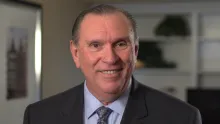
Randy D’Alessandro served as pastor for the United Church of God congregations in Chicago, Illinois, and Beloit, Wisconsin, from 2016-2021. Randy previously served in Raleigh, North Carolina (1984-1989); Cookeville, Tennessee (1989-1993); Parkersburg, West Virginia (1993-1997); Ann Arbor and Detroit, Michigan (1997-2016).
Randy first heard of the church when he was 15 years old and wanted to attend services immediately but was not allowed to by his parents. He quit the high school football and basketball teams in order to properly keep the Sabbath. From the time that Randy first learned of the Holy Days, he kept them at home until he was accepted to Ambassador College in Pasadena, California in 1970.
Randy and his wife, Mary, graduated from Ambassador College with BA degrees in Theology. Randy was ordained an elder in September 1979.
