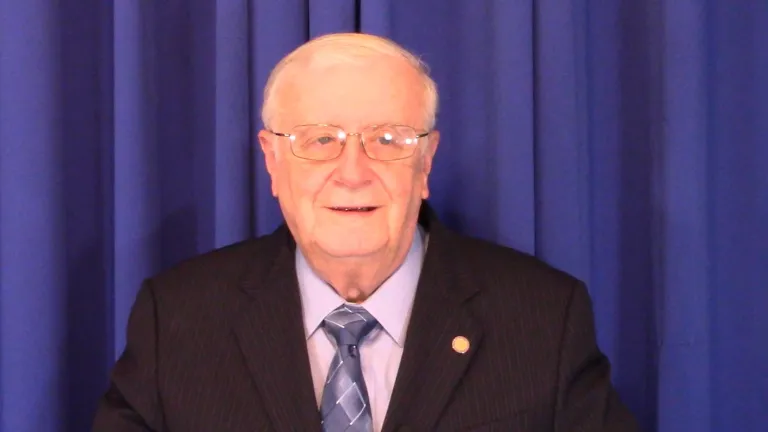

Frank McCrady
This transcript was generated by AI and may contain errors. It is provided to assist those who may not be able to listen to the message.
Can you change human nature? Is it possible for you to change in any sense? Well, I have good news and bad news. Bad news is you can't really change human nature. The good news is you can rule over it. We are going to talk about that today. First of all, let's look at the word change. Of course, so many words can be used as a transitive verb or an intransitive. As a transitive verb, you need an object for it, a direct object. Like, to put or take a thing in the place of something else, substitute for, replace, or transfer to another of a similar kind.
You might say, he changed gears. Gears is a direct object. To give and receive reciprocally, exchange. To change places, he changed places with John, and he swapped places. Intransitive does not require direct object. For example, the seasons change, the moon goes through various phases. There are synonyms for the word change. These synonyms denote becoming distinctly different and imply either a radical transmutation of character or replacement with something else. Believe it or not, I think we're going to see from Scripture today, in light of Scripture, you don't really change human nature.
But don't jump to conclusions. Let's explore it in light of Scripture. In fact, my purpose here today is to help each one of us understand more accurately what is meant in the spiritual sense by the conversion process. Once again, can you change flesh or human nature? Let's go now to 1 Corinthians 15, and we'll see when the big change comes for all of us. In 1 Corinthians 15, the resurrection chapter, when we are put on immortality, when we are changed from mortal to immortal, notice what it says here in 1 Corinthians 15 and verse 50.
Now this I say, brethren, that flesh and blood cannot inherit the kingdom of God, neither does corruption inherit incorruption. So much of what we talk about oftentimes refers to the physical, that is, the children of God who are in the kingdom, who are spirit-born in the kingdom. Flesh and blood cannot inherit the kingdom. They are kings and priests ruling over the kingdom. They are ruling over the human beings who have lived over into the millennium. He continues here, Behold, I show you a mystery.
We shall not all sleep, but we shall be changed. Now that change is a radical change because we're going to be changed from physical to spirit. Flesh and blood cannot inherit the kingdom of God. In a moment, in the twinkling of an eye, the last trump, for the trumpet shall sound and the dead shall be raised incorruptible, and we shall be changed. For this corruptible must put on incorruption, this mortal must put on immortality.
So when this corruptible shall be put on incorruption, and this mortal shall be put on immortality, then shall be brought past the saying that is written, death is swallowed up in victory. So we see clearly here that at the resurrection, when we are resurrected, when we are born into the family of God, we shall be changed. Changed from mortal, corruptible human beings into glorious, radiant spirit beings. Now there are some synonyms for change, and perhaps the meaning of the words change as we use it in the spiritual sense is perhaps best characterized by the conversion process.
However, even the definitions does not really describe what takes place when we talk about change or conversion in the spiritual sense. Now, definition once again in a broader sense, sort of a summary of what I said up front. What synonyms for the word change best captures the meaning of the word change as we use it in the spiritual sense. Once again, a making or becoming distinctly different, and implies either radical transmutation of character or replacement with something else.
We can change clothes, we can change places, we can change shoes, but can we change human nature? Now here is something I want you to really consider. I think that most people labor under the assumption that conversion means the old mind is made over. As we shall see, the old mind remains, but it can be ruled over by the new mind, which is a spiritual creation. Now, you need to get that. You need to write it down. You need to think about it. Once again, the old mind remains, but it can be ruled over by the new mind, and the new mind is a spiritual creation.
We talk about, oh, I'm developing character by not eating sugars, chocolate cake, or whatever it might be. But that is self-discipline. There are people who have starved themselves to death through self-discipline. There are people who have eaten themselves to death through gluttony. They didn't exercise self-discipline. I think that, once again, most people labor under the assumption that conversion means the old mind is made over. So now let's examine some words in the Bible that are used synonymously with the word change. Let's go to Psalm 19 and verse 7.
I said used synonymously with the word change. Psalm 19 and verse 7, in fact, we're going to close today with the last verse of Psalm 19. But now in Psalm 19 and verse 7, the law of the Lord is perfect converting the soul. One might look at that and say, changing the soul. Well, we know what soul is. At least I hope you know. Soul is life potential. Man became a living soul. He has life within him. He is an air-breathing creature. Soul is used for human beings and for animals.
Soul can be destroyed, but the soul is used sometimes to describe the innermost part, the inner seat of one's thinking and being. So once again, the law of the Lord is perfect converting or changing the soul. The testimony of the Lord is sure making wise the simple. So we see here the word convert used. Now let's go to Acts 3 and verse 19. Acts chapter 3 and verse 19, where Peter is speaking here, giving a sermon. After Christ ascended, the disciples were in and out of the temple area preaching and teaching until they were scattered abroad. In Acts 3 and verse 19, repent you therefore and be converted. Some might say, repent therefore and be changed. That your sins may be blotted out when the times of refreshing shall come from the presence of the Lord. Now this word convert here is the Greek word epi means above, epi-strafo. Strafo means to turn about. If you turn someone about. So we'll go to James 5 verse 19, where this same word is used with regard to you going to your brother when you see him doing something that he shouldn't be doing and you help turn him about. Help him to turn to change directions. This is James 5.19.
Brethren, if any of you do err from the truth in one epi-strafo, turn him about. Let him know that he which turns about the sinner from the air of his way shall save a soul from death and shall hide a multitude of sins. Look at that. A soul from death. Soul is life potential. Only God has a final prerogative of life potential. Those whose names are not written in the Lamb's Book of Life were put into the Lake of Fire, which is the second death from which there is no resurrection and life potential soul ends. The second death. Now we go to Romans 12.1. We'll read into this from Romans 12.1. I hope we'll be able to follow these things, to think deeply on them, to get a better grasp of what we're really dealing with and what we're really dealing with ourselves. Not so long ago, I don't know how long ago it was, in my lifetime I gave a sermon on overcoming the three S's, Satan, self, and society. And actually, self is probably the greatest obstacle that stands between us and the kingdom of God. Some may say, well, it's Satan. Some may say, well, it's society. I believe it's self.
In Romans 12, verse 1, I beseech you therefore, brethren, by the mercies of God, that you present your bodies a living sacrifice, holy, acceptable unto God, which is your reasonable service. Reasonable service, I mean, this is just what would be expected to be a living sacrifice. Who would come to me, first of all, as to love God more than he does his own life? And be not conformed to this world, but be you transformed by the renewing of your mind that you may prove what is that good and acceptable and perfect will of God.
This transformed here means to change to another form. The Greek word here that is used is used for transfiguration. You remember when Peter, James, and John went up on the Mount and Christ was transfigured before their eyes, and they saw him partly in his glory. Then we see this renewing of the mind, which means renovation or change for the better. But none of these words means to change into something else. You still have that whatever you are, whatever that mind is, but you have trained that mind, you have developed that mind to go into a different direction. But the conversion process, as we shall see, gives you also a new mind. And none of these words, transform or renewal, literally means to change into something else. And what we call the conversion in changing really has to do with becoming a new creation. Critical point. Becoming a new creation. Notice the word creation. Do you ever think about the word creation? What does it mean? Becoming a new creation. Do you on your own become a new creation?
Can you discipline yourself to the point that you make yourself into a new creation? Of course, you have to participate, as we shall see, but let's look at 2 Corinthians 5 and verse 17. Now we begin to get into the nitty-gritty in 2 Corinthians 5 and verse 17. Therefore, if any man be in Christ, he is a new creation. All things are passed away. Behold, all things are become new, and all things are of God, who hath reconciled us to himself by Jesus Christ, and hath given to us a ministry of reconciliation. This verse states that we are in Christ, if we are in Christ, we are a new creation. This Greek word that's translated creation is chitsis, k-t-i-s-i-s, something like chitsis, k-t-i-s-i-s, meaning the act of creating. The act of creating, thus the new mind, is a new creation. It is a new thing. It's not the old mind made over. We need to understand that all of us who have been sanctified or called have the potential for obeying two different minds. We may choose to obey the mind of the flesh or the mind of the spirit.
So now let's discuss for a moment the amazing ability of the human mind to store information. I have here some of the latest research with regard to the human mind, of how powerful the human mind is. If you were to just draw a circle, and with that circle draw a line through the middle like a diameter, and above it say the conscious world, the world of awareness, and below it you would put the subconscious world, the world of which you're not aware.
Way back years ago, the doctor and physiologist, Penfield in Canada, Toronto area, hospital there, he stimulated various areas of the human brain, and people relived live and in color, events that were stored in their past. So this conscious stream of awareness is stored in our minds. Of course, to a large degree, we cannot retrieve it. We cannot get to it, as it were. The things that we can get to are the things that we use most often, and we exercise.
Let me read two or three paragraphs here. The most complex living structure in the universe is that of the human brain. The storage and processing power of the human brain and its memory varies in humans because of several internal and external factors. Acting as a central part of the central nervous system, this master organ, the brain, is the control center. This master organ is responsible for the collection and process and various types of sensory and other data. It also receives the source of intellect, it serves as the source of intellect, and a place for the storage of audio, visual, and other sorts of information. The human brain's memory capacity in the average adult can store trillions of bytes of information, according to a Stanford University study. It was reported that the cerebral cortex alone has 125 trillion synapses. The storage capacity in the cerebral cortex alone is 74 terabytes. You'd have to be in a computer lingo to understand what a terabyte is. To put this in perspective, the computer on board the first Apollo spacecraft that landed on the moon had an operating system with just 64 kilobytes of storage memory. The computer, in that example, could handle just over 64,000 bytes, which is just over 64,000 characters of information. Today, most digital toasters have more computing power than Apollo 11.
And your average smartphone is literally light years ahead of the computer that guided and controlled the spaceship Apollo 11. Now, one other paragraph here and then something else to separate these pages. The IRS's massive data warehouse keeps track of 300 million-plus Americans, and many more million businesses, has a capacity of 150 terabytes of memory. Yet Yahoo's 2.0 petabyte computational center, which can process 24 billion events a day, is a full 20% smaller than the capacity of a single human brain. The human brain is indeed a marvel. Now, it's, I'm reading here, it says, facts about the human brain and memory that you must know. One, the part of brain that has a link with a sense of smell and plays the part of the brain that has a direct link with a sense of smell and plays an important role in the information of new memories is called the hippocampus. You can look it up, H-I-P-P-O-C-A-M-P-U-S. A tiny little thing buried in the brain, the hippocampus. Caffeine is a central nervous system stimulus that is used to increase mental alertness, but it cannot maintain the memory performance. It can help people cram for a test and short-term enhancement.
It goes on to say, and remember this, facts about human brain you must know. You will be surprised to note that aging does not have a direct effect on memory. The loss of memory is simply because you use it less and less as years go by. That's why you see a lot of times I know that I have some relatives that they spend their downtime with crossword puzzles or with playing solitary on the cell phone to keep the mind active. Next fact, do you know a traumatic experience has the potential to reinvent, distort, aggravate, or create memory, which is known as false memory? Another fact, as in the case with any other organ in the body, this is one so important ties in to what I just said, the brain needs adequate exercise for the proper functioning of memory. For example, harder thinking will facilitate the permanent storage of information. It is because thinking helps in the creation of a stronger connection among the neurons. These synapses are when these neurons come together and form bridges. The more active you are, the more you use your mind, obviously the better it's going to be. It used to be that people would say, well, you can't exercise your brain. Well, that's nonsense. You can exercise your brain just as you can exercise anything else. Everything that comes through our conscious awareness is stored in what psychologists call the subconscious mind, and anything that is stored in the subconscious mind can be admitted into the conscious mind. That is the reason why a song you haven't heard in years might suddenly be emitted pop into your conscious mind.
This fact alone should tell us a lot about the biblical command to guard our minds. Yet with all its marvelous capacity and ability, the human mind is morally illiterate and remains illiterate until it is taught. Let's go to 1 Corinthians 2.9, and we'll see here that the contrast already is given here between two minds in 1 Corinthians 2 and verse 9.
We'll start there, and then we'll have to read into it. But as it is written, I have not seen or ear heard what has entered in the hearts of man the things which God has prepared for those that love him. But God had revealed them unto us by his Spirit. See there the ways that man can gain knowledge. He can gain knowledge, empirical knowledge, through experience, through human reasoning. But this, which the world denies for the most part, reveal knowledge, for the Spirit searches the things, yea, the deep things of God. For what man knows the things of man, except for the Spirit of man which is in him, even as the things of God knows no man but the Spirit of God?
So there you have the human mind apart from God with the Spirit of man and the animating force within the mind. And then you have the Spirit of God which leads you, guides you into a new mind and a new man.
Man has many standards depending upon the culture that he grew up in. Remember, the human mind, when we are born, I don't care what culture you are in, it's illiterate. It doesn't know that culture. And obviously you can adopt a child from any part on the face of the earth you want to name, rear him like your own in your culture. He will speak your language and embrace your way of life and be able to grasp your values. He may not stay with them, but it depends on the culture that we are reared in. We know in the final sense there are only two standards. There is God's standard and there is man's standard. Let's go to Proverbs 14, verse 12. Proverbs 14, verse 12. There is a way which seems right unto man, but the end thereof are the ways of death. So morally illiterate, unless taught. You have to be taught. This is the way. And God teaches us His way through His Word. Now we go to Deuteronomy 30, verse 19, the verse we often use in sermons. Deuteronomy 30, verse 19.
What do we call this book? It is the book of life. It is the book of life. It reveals the way to live life. But without that book, you're left to your own devices.
Now there is a so-called basic morality and integrity which can be taught and practiced apart from God's spiritual law. For example, there was a time in this country in which a man's word was his bond. Of course, there have always been liars, but we're talking in the general sense.
His word was his bond. It was as good as his life. You could count on it, even though he may not be religious at all. But shake hands, the deal was done, word was kept. God's law, God's word, is a reflection of his mind. It has his standard and his morality. But in days past, even though a person wasn't necessarily religious, you could basically count on most people doing what they said they would do, especially in the Bible Belt and those who grew up in what we would call a nominal Christian home. As we grow and develop, our minds are allowed freedom to think, to imagine, to reason, and make choices. In the first few hours, days, weeks of a person's life, they are totally egocentric. The whole world is them. Whether they're hungry, whether they are in pain, whether they need to go to the bathroom, their diaper changed, or whatever it is, the world is egocentric, the world revolves around them. They're not aware of the world at large at all. But then, as our brain grows and develops, we begin to think, imagine, reason, make choices. Your thoughts, your choices and experiences become a part of what makes you you.
As your mind grows and develops, and as you experience life, your database expands. You have this knowledge, this experience by which you can make decisions. Remember, anything stored in the subconscious mind can pop into your conscious mind at any time. And that's why, let's go to Proverbs 4 and verse 23 now, that's why the Bible gives this admonition. And time after time, I have pointed to this scripture and mentioned it in Proverbs 4 and verse 23.
Keep your heart with all diligence. The heart is used in the Old Testament for your very seat of the inner being of thought. Keep your heart with all diligence, for out of it flow the issues of life.
Good experiences, right learning, good parental discipline tend to develop a mind that is easier to teach and influence toward that which is in harmony with God's standard of morality. However, regardless of your previous experiences, whether you have led a life of the prodigal son, go out and live it up and waste all your inheritance, or the son who stayed at home, God eventually will allow you to see the carnal mind for what it really is. I wonder if we have all seen the carnal mind as it really is. I seem to see it more and more every day, how carnal my mind is.
You know, the Apostle Paul, he's an Apostle, he said, to set up sinners I am chief. And he wrote more about the carnal mind and the mind than anyone else directly in the whole Bible.
So what happened to Job? Job was tried to the point that finally he came to see his carnal mind, that regardless of what happens, you have to justify God and judge yourself. Second-generation Christians may think they have nothing to repent of. Others may think they are so wicked that God can't forgive them. And neither one is correct.
We all have sinned and come short of the glory of God. And is there a sin which if we repent of, it cannot be forgiven? If it is, I'd like to know what it is. So let's notice now in what Paul writes so much about in Romans 7 and verse 14. He leads into this with talking about the law of God, how it is right and just and holy.
In Romans 7 and 14, for we know that the law is spiritual. Now this is the apostle Paul writing. He's been struck down on the road to Damascus. He's gone through all kinds of things. He has the Holy Spirit. And he writes, I am carnal, sold under sin. For that which I do, I allow not. For what I would do, that do I not. But what I hate, that do I. And we're going to talk about what that means. Some people take that, well, because you're just that way, because that's human nature, that's okay. No, it's not okay. And Paul makes it clear. For then I do that which I would not. I consent under the law that it is good. The law is good. It tells you the right way to go. Now then, it is no more that I that do it but sin that dwells in me. Human nature is always there and will always be there. I know that in me that is in my flesh dwells no good thing. For to will is present with me, but how to perform that which is good I find not.
But that sounds so depressing. Well, I guess I just have to live a life of sin. That's not what he's saying. For the good that I would do not, for the good that I would I do not, but the evil which I would not that I do. Now, if I do that, I would not. It is no more I that do it but sin that dwells in me. I find then a law that when I would do good, evil is present with me. For I delight in the law of God after the inward man. But I see another law in my members warring against the law of my mind, bringing me into captivity to the law of sin which is in my members. That is human nature. Human nature is there and it's always warring against the right way to go. Now, some people have been taught to be honest, to be true, to work hard, to do the things that they need to do, apart from any religious training, and they become, quote, successes as man counts success. But what we're talking about here is to be coming as God is, to have the mind of God and Christ.
O wretched man that I am, who shall deliver me from the body of this death. The wages of sin is death, the gift of God is eternal life. If we are just left with this aspect, it's a rather hopeless kind of picture. But I thank God through Jesus Christ our Lord, so then with the mind I myself serve the law of God, but with the flesh the law of sin. Does that mean that the law of sin is excused if you do it? No, it doesn't, because we will get to that. And the first 14 verses here of Romans 8 tells us clearly what this means. That is, I thank God through Jesus Christ our Lord, so with the mind I myself serve the law of God, but with the flesh the law of sin. And now, to me perhaps the most encouraging verse in the whole Bible is Romans 8.1. Have you grasped Romans 8.1? There is therefore now no condemnation or judgment to them who are in Christ Jesus, who walk not after the flesh. See, they don't obey the mind of the flesh, who walk not after the flesh, but after the Spirit. For the law of the Spirit of life in Christ Jesus made me free from the law of sin and death. It can be ruled over. For what the law could not do in that it was weak through the flesh cannot perfectly keep the law of God apart from the Spirit of God. God sending his own Son in the likeness of sinful flesh and for sin judged sin in the flesh. How did he judge sin in the flesh?
By perfectly keeping the law while living in the flesh. He showed that it could be done. He had the Holy Spirit without measure. We have the Holy Spirit in us.
For what the law could not do in that it was weak through the flesh, God sending his own Son in the likeness of sinful flesh, and for sin condemned sin in the flesh, that the righteousness of the law might be fulfilled in us, who walk howl not after the flesh, but after the Spirit. See, Christ came living in the flesh. He condemned sin in the flesh, showing that you could perfectly obey it. Christ had the Spirit without measure. Of course, he was the incarnate Son of God in the flesh. For they that are after the flesh do mind the things of the flesh, but they that are after the Spirit do things of the spirit. For to be carnally minded is death, but to be spiritually minded is life and peace. Because the carnal mind is enmity against God, for it is not subject to the law of God, neither indeed can be. So then they that are in the flesh cannot please God. But you are not in the flesh, but in the Spirit. If so be that the Spirit of God dwell in you. Now if any man have not the Spirit of Christ, he is none of his. And if Christ be in you, the body is dead because of sin, but the Spirit is life because of righteousness. Now some people read verse 9 and say there are two different spirits, the Spirit of Christ. And then verse 11, if the Spirit of him that raised up Jesus from the dead, that's the Father. There is one Spirit. Ephesians chapter 4. The same Spirit that is in God is in Christ. But the Spirit of God and Christ both abide in us. We will both make our abode in him. That's John 14, 23.
Verse 11, but if the Spirit of him that raised up Jesus from the dead dwell in you, that's the Father. He that raised up Christ from the dead shall also make alive your mortal bodies by his Spirit that dwells in you. Therefore, brethren, we are debtors not to the flesh to live after the flesh. For if we live after the flesh, we shall die. But if we through the Spirit do mortify, see, mortify means to put to death the deeds of the body, you shall live. For as many as are led by the Spirit of God, they are the sons of God. Now, that is a great summary, but I want to go on with more and hopefully a deeper understanding or an enlightening then understanding. What mind are we listening to? What mind am I listening to? What mind are you listening to? Much of the anguish in life comes from believing the vain imaginations of our mind and what Satan can interject just as we should not believe our vain imaginations. We don't believe Satan. We should not believe our vain imaginations. Once again, much of the anguish in life. I talked to a person in recent times. A lot of the anguish is from vain imaginations. Thinking this, thinking the other.
So let's go now to 2 Corinthians 10, and it will give us the remedy for this. Of course, we just read the remedy there in Romans 7 and 8, but there's much more. We want to understand this so completely and get our minds wrapped around it.
2 Corinthians 10.
That's not what I want.
I'm using this Bible. This Bible my mother gave it to me way back. Yeah, it is. The way the chapters and pages are laid out, I'm used to the other one. That's my excuse, and I'm seeking to it. She gave me this Bible some 50-something years ago, and it's a Bible I use all through Ambassador College. So I want 2 Corinthians 10, verse 3. For though we walk in the flesh, we do not war after the flesh. I think much of our warfare we are warring after the flesh, not after the spirit.
For the weapons of a warfare are not carnal, but mighty through God to the pulling down of strongholds. What are the strongholds? The strongholds are those things that come into our minds, that grip our minds, that are enemies of faith, that are enemies of God in His truth. As we shall see here, casting down imaginations and every high thing that exalts itself against the knowledge of God, and bringing into captivity every thought to the obedience of Christ, and having in a readiness to revenge all disobedience when your obedience is fulfilled. In other words, maybe a word slips out of your mouth and you didn't intend to say it. So much of what happens is we just blurt something out without thinking. It's like it's an automatic reflex. So-and-so said something. When I was a child, the way I got a haircut was those old clippers that you did like this. And my head, I thought, was so, well, you pull a hair and it was like... It's just like you pulled a string and I'm mad. You had to hold me down to cut my hair. And so some people are, you say a certain word, you give a certain trigger, and they blurt out something that they really didn't mean. And many people are quick then to repent of that. And sometimes we do it when we are by ourselves, and we ask God quickly to forgive us. I shouldn't have said that. I shouldn't have thought that. It's a mistake to ever listen to the human mind when it comes to making moral decisions. And what do I mean by moral decisions? Those decisions that have to do with right and wrong, relating to God. How you view yourself. God says He'll never leave you nor forsake you, that He'll always be with you. In relating to others, do it as God says to do, not according to what you're mind. I would like to give Him a piece of my mind. And oftentimes we wish we had saved that piece of our mind. The direction and course of moral decisions in our lives has to do with what we think and what we believe. As we often say, thought is a precursor of action. Here's what your mind can do to you. It will allow you to be filled with the four great enemies of faith. Anxious care. Oh, I don't know if I'm going to make it. Fear. Afraid of what's going to happen. Doubt. Oh, is God really with me? Am I really, quote, on the road to eternal life? And then human reasoning, which feeds off all three of anxious care, fear, and doubt. Christ rebukes all of these states of mind by saying, O ye of little faith. The four great enemies of faith, anxious care, fear, doubt, human reasoning. And Christ, in every case, says, O ye of little faith. And we oftentimes, and a lot of people have fallen into this trap, people who were once in the church, no longer in the church. They make God over into their own image, and they think that God is like them, that He reasons the way that they do. Let's turn to Psalm 50. Psalm 50.
In verse 15, he says, Psalm 50. 15. Call upon me in the day of trouble. I will deliver you, and you shall glorify me.
But under the wicked, God says, What have you to do to declare my statues, or that you should take my covenant in your mouth, seeing you hate instruction and cast your words behind you? When you saw a thief, then you consented with him. You have been a partaker with adulterous. You gave your mouth to evil and your tongue framed to see. You sat and spoke against your brother. You slandered your own mother's son. These things have you done, and I kept silence. You thought that I was altogether such a one as yourself. But I will reprove you and set them in order before your eyes. Now consider this. You that forget God, lest I tear you in pieces, and there be none to deliver. Whosoever offers praise, glorifies me. And to him that orders his conduct right, will I show the salvation of God. God is not like us. So many make God over in their image to conform to their view of righteousness. Oh, you just need to be a good person. And that's all that's required. You don't have to do all those do's and don'ts. You don't have to keep the Sabbath. You don't have to keep the feast days. You don't have to tithe. You don't have to do this. You don't have to do that. Satan's fatal mistake was to rely on vain reasoning and vain imagination.
Go to Ezekiel 28. In Ezekiel 28, once again, Satan's fatal flaw was to rely on his reasoning, his vain imagination. In Ezekiel 28, verse 12, Son of man, take up a lamentation against the king of Tyreus, the king of Tyreus as a type of Satan. And say to him, Thus sayest the Lord, You seal up the psalm full of wisdom and perfect in beauty. Who made him that way? Who created Satan? God, through Jesus Christ, created Satan, or Lucifer, before he became Satan. You have been in Eden, the Garden of God, where every precious stone was your covering. The Sardis Topaz, not going to read all of those. Verse 14, You are the anointed carob that covers, and I have sent you so. You were upon the holy mountain of God, and you walked up and down in the midst of the stones. Notice that. You were the anointed carob that covers. Remember that in the mercy seat, there were the carobs that faced in each other, covering the mercy seat, representing the throne of God. You were perfect in your ways until the day that you were created, till lawlessness was found in you by the multitude of your merchandise. They have filled the mist of you with violence, and you have sinned. Therefore, I will cast you out as profane out of the mountain of God, and I will destroy, O covering cherub, from the mist of the stones of fire. I will destroy you. Now, the vain imaginations. Your heart was lifted up because of your beauty. Your heart, keep your heart with all diligence, were out of it, flowed the issues of life. You have corrupted your wisdom by reason of your brightness. See, I looked at myself, and I saw that I was so beautiful, and I was so wise, I was so intelligent. I was so when you fill in the brink. I will lay you before kings, that they may behold you. You have defiled your sanctuary by the multitude of your iniquities, by the iniquity of your traffic. Therefore, you're going to be brought down. See, notice what was involved in this. Thought, the precursor of action. Satan talked to himself, and reason, Look at me, aren't I beautiful? Aren't I wise? Can't I play beautiful music?
And on and on it went, Why should I take a back seat, even to God? The one who created him.
The advertising world, the world of endless commercials, is largely based on looking good. I guess you have noticed now that the commercials have doubled in length in almost every program that you watch. God has given us a mind, and it is the height, the vanity, to try to reason around God. If we fail to listen to God, the results are. And that's what the world has done. That's where the politics of the land lie. And we go to Romans 1.28, and we see what the result is. And it doesn't seem to matter which party is in power. It seems that all things continue, regardless of who is in power.
Not only are we slouching toward Sodom and Gomorrah, we are living in Sodom and Gomorrah. And, of course, having pleasure and unrighteousness. In Romans 1.28, and even as they did not like to retain God in their knowledge, God gave them over to a reprobate mind to do those things which are not convenient. And he lists several of those behaviors, including homosexuality and other behaviors. Now go to 2 Thessalonians 2, verse 10. See, time after time, I say, we're not just playing church. This is real. The Alan Jackson song. Now, here in the real world, a cowboy doesn't always get the girl. In 2 Thessalonians, chapter 2, in the real world, if you don't love the truth, it will be God who will send you grand delusion. In 2 Thessalonians 2, verse 10. And with all deceivableness of unrighteousness in them that perish, because they believe not the love of the truth, that they might be saved. And for this cause, God, God, shall send them strong delusion that they should believe THE lie, that they all might be damned, who believe not the truth, but had pleasure in unrighteousness. Oh, yes! They're having so much pleasure in unrighteousness. Of course, the anecdote is to turn to God with your whole heart. There are two aspects here now that I want to deal with. The understanding of what and why the mind of the flesh remains in us, and that the new mind must rule over the flesh. God did not create us perfect in all our ways. As we've already said when we were born, how were we born? Morally illiterate. Depending on the culture that we were reared in, that's what we embraced. He allowed us to be born morally illiterate, and through a process of growth and development, we developed a mind and a sense of morality, right and wrong. God allowed us to go the way of the flesh until we were either sanctified and given the opportunity to walk, either called or sanctified, to walk in God's marvelous light. Now, I use that either sanctified or called. I probably should just say called, and I don't want to get off into what it says with regard to children are sanctified whose parents are in the church. They're not cut off from access. And one of the things that United did when it first started, back in, I think it was in 96, this booklet probably came out, or paper on, God is calling children, and somebody wrote a song because the title, God is calling children. Now, before we were called and we repented, let's go to Ephesians 2 and get a description from the Bible of the way we were. In Ephesians 2, verse 1, And you hath he made alive, who were dead in trespasses and sins, wherein in times past you walked according to the course of this world, according to the prince of the power of the air, the spirit that now works in the children of disobedience. You better believe that there are spirits at work, among whom also we all had our conduct in times past, we all in times past, in the lust of our flesh, fulfilling the desires of the flesh and of the mind, and more by nature the children of wrath, even as others. But God, who is rich in mercy for his great love, wherewith he loved us, even when we were dead in trespasses and sins, he sent his son to free us. Then after repentance, faith, baptism, and the laying on of hands, were begotten by God's Spirit. God, in essence, is saying, I want you to crucify the old man, the old mind, for a new mind. I want you to walk in newness of life. Go to Romans 6, verse 4, the baptism chapter, Romans 6, verse 4.
When I'm doing baptismal counseling, I say, draw a wavy line across. Put a stick man under the line. This is what you're doing in baptism. You are burying the old man. Then put a stick man above the line, raised to newness of life. Then put a hand going down, trying to keep the old man under the water. Because the old man is always going to try to get up. And I don't care how long you've been in the church, or how, quote, converted you are. So we crucify the flesh by putting on the new man. At baptism, we enter into the covenant of sacrifice, and agree to sacrifice the old mind and accept God's mind. Now, perhaps the most graphic description. We've already read Romans 7-8, the carnal mind is enmity toward the law of God, not subject to it, neither indeed can be. But now we want to go to Jeremiah 17. Perhaps this description is even more graphic of the human mind apart from God. Not my words. Jeremiah 17-9. The heart is deceitful above all things, and desperately wicked. Who can know it? Deceitful above all things, desperately wicked. Who can know it? I, the Lord, search the heart. I try the reins, even to give every man according to his ways and according to the fruit of his doings. As we talked about recently, God's perfect spiritual mirror is His word, the Hebrews 4-12, cutting and dividing us under the very thoughts and intents of the heart. So why do God want us to crucify the old man? You remember that I said earlier, the human mind is morally and spiritually illiterate. And in baptism, we enter into this covenant of sacrifice and agree to sacrifice the old mind and accept God's new mind. In Galatians 2.20, you're there in Romans, you just go past Corinthians 1 and 2, and you land at Galatians. In Galatians 2.20, a lot of ministers quote this verse very often, and well they should. I am crucified with Christ, nevertheless I live, yet not I, but Christ lives in me. Now some go on to say that Christ is living his life all over again, and you. No, He's not. He's in you, but you're living your life, you're making decisions. Christ is not making decisions for you. Christ is making your decisions for you. Your life would be different. But Christ lives in me in the life which I now live in the flesh. I live by the faith in the Son of God, who loved me and gave Himself for me. He has given me access to His Spirit and His mind that I can rule over it, but He's not making the decisions for you, and we know that. You know, when you, most everybody in this room who's an adult has traded cars. When you trade cars, the dealer keeps the old car, and you get the new car. But with regard to repentance, faith, baptism, laying on of hands, receiving the new mind, God allows you to keep the old mind. Why? The old mind becomes the battleground, the test site, the White Sands, New Mexico, the test center for the project of the atomic bomb. God allows us to choose all the way. If the old mind were removed, there would be no opportunity for growing and overcoming. God wants us to voluntarily follow Him.
So the old mind is still there. When trial comes, both minds will battle for the right to make decisions, understanding that God allows trials to see if we will be directed by the new mind. So we go to James chapter 1. James is the meat of the Word. Some people talk about the general epistles being the milk of the Word. No. No. Paul is the milk of the Word in the sense of bringing you to conversion and the process thereof. James is going on to perfection. How many can say?
Verse 2, My brethren counted all joy when you fall into different trials. I'm just so glad to be having this trial. Knowing this, that the trying of your faith works patience.
But let patience have her perfect work, that you may be perfect and entire, wanting nothing. So what does that mean?
You know, in Ephesians 6, it talks about putting on the whole armor of God. Above all, taking the shield of faith, whereby you'll be able to quench all the fiery darts of Satan. See, when you are in the trial, when you know and you know that you know that God is going to deliver you, even if you die in the trial, you know you die in the faith. And patience has its perfect work, because you remain faithful through the whole trial.
Let patience have her perfect work. Why? That you may be perfect and entire, wanting nothing. Who can defeat you? God before you, who can be against you?
So will you allow the new mind to rule over you? What we tend to do is to compartmentalize, divide our mind into when, what, where, how, why, and who said it. When did they say that? What did they say? Where did they say that? How did they say that? Why? Do you listen to the new mind part of the time and conversely listen to the old mind part of the time? The great mediator is human reasoning. And so you have this data bank. You have this data bank here. You're a word of a hidden in my heart that I might not sin against you. That's Psalm 119 verse 11. Or you might say Psalm 119 verse 97. Oh, how love I your law. It is my meditation all the day. I have more wisdom than all my teachers because I meditate on your law. Or do you fall prey to anxious care for your doubt human reason? So will it be the mind of the flesh or the mind of the spirit? As we already mentioned, many of our actions are reflective. Reflexive, we like a reflex. You put a muscle on stretch, it contracts. We call it the myostatic reflex. It just automatically does it. Something comes toward our eye or our blinks. We don't have to think about it. And sometimes we speak without thinking.
Humans, especially children, talk to themselves a lot. And when we reach the age of accountability, God wants us to talk to Him. In fact, children should be taught to pray from the cradle to the grave.
God wants us to talk to Him. We read Psalm 15, verse 14. I pointed that out. In the day of trouble, call on me and I will deliver you. God wants us to look to Him with our whole heart. Let's notice now Matthew 11, verse 28.
I think we have now the picture of what God wants us to do. He wants us to live our life with the new mind.
In Matthew 11, verse 28, Come unto me, all you that labored are heavy laden, and I will give you rest.
Take my yoke upon you and learn of me, for I am meek and lowly in heart, and you shall find rest unto your souls. For my yoke is easy and my burden is light. Now quickly to Ephesians 4.
Ephesians 4 We're starting at 4.17. This I say, brethren, or this I say therefore, and testify in the Lord, that you henceforth walk not as other Gentiles walk in the vanity of their mind. Having their understanding darkened, being alienated from the life of God through the ignorance that is in them because of the blindness of their heart, and the past feeling, have given themselves over unto lasciviousness to work, all in cleanness with greediness, but you have not so learned Christ. If so be that you have heard and have been taught by Him, as the truth is in Jesus, that you put off concerning the former conduct the old man, which is corrupt according to the deceitful lusts, and be renewed in the spirit of your mind, and that you put on the new man, which after God is created in righteousness and true holiness. So, brethren, that's what I am encouraging us to do here today. We'll close with this final scripture, Psalm 19, verse 14. Way back, I've mentioned this before, it was way back in the olden days, in the sixties, when I was teaching school and coaching. I put on my desk this verse, and it seemed that after putting that verse on my desk and looking at it every day, that things just got better. Psalm 19, verse 14. Let the words of my mouth and the meditation of my heart be acceptable in your sight, O Lord, my strength and my redeemer.
Before his retirement in 2021, Dr. Donald Ward pastored churches in Texas and Louisiana, and taught at Ambassador Bible College in Cincinnati, Ohio. He has also served as chairman of the Council of Elders of the United Church of God. He holds a BS degree; a BA in theology; a MS degree; a doctor’s degree in education from East Texas State University; and has completed 18 hours of graduate theology from SMU.
