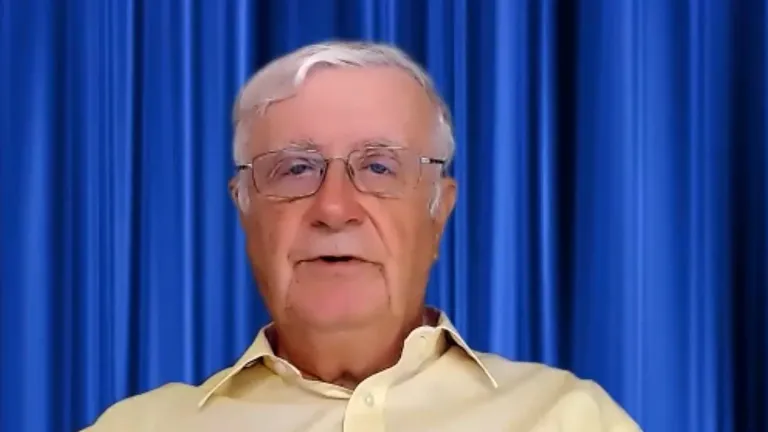

Jim Tuck
This transcript was generated by AI and may contain errors. It is provided to assist those who may not be able to listen to the message.
I wanted you to think about the fact about the God that we worship. It's interesting that Mr. Walden led this song, How Great God Is. During the cooler summer months—I don't do this in the summer in Phoenix—but during the cooler months—and that'll be after the feast, when it starts getting down to 95 outside, no, actually cooler than that. But I will go in the backyard, and we have an area, kind of a fire pit area, and I will sit in the fire pit and I'll look up at the sky and behold the stars. The grandkids, when they would go out there with me, sometimes we'd go in and get into a contest about who could count the most stars. And it was kind of interesting doing that. But it made me think, as I was reflecting back on that, that our God, now, He doesn't count the stars, He has a name for every one of them. He knows the name of every one of them. He knows how much hair you and I have on our heads. He knows all about us, this awesome God and He designed the world that we live in and everything that dwells in it. We know that the Father and Jesus Christ are creators, and they're absolutely brilliant. You know, I was telling our brother in the Phoenix area, in fact, last week, that we are in the hands of a Creator who does masterpieces. He doesn't make junk. What He creates and makes is valuable, very valuable, because of His brilliance, His mind, His capability. You know, what kind of being, though, that has that capacity to be able to do that, to know all of these things and design the human body that made all the intricacies of the insect world? You know, there are six million varieties of insects that God designed them all. What kind of a being, what must His mind be like? You know, it says in the book of Isaiah, God says, My thoughts, for My thoughts are not your thoughts. And He says, Nor are your ways My ways, for as the heavens are higher than the earth, so are My ways higher than your ways and My thoughts than your thoughts. You know, God is so brilliant, so beyond us, His mind is so great.
And yet, it's very interesting what Paul says over here in Philippians. I'd like you to turn to Philippians. You know, at best, our puny minds see only a tiny part, brethren, of God's mind. You know, we can only see a very small part of God's mind because we see only what God has revealed to us. And what our minds, our puny minds, could grasp, you know, even with God's spirit. We can't grasp at all. We can't understand at all. And again, we see a minuscule part of God. But Philippians chapter 2 here, let's notice here, "'Therefore, if there's any consolation in Christ, if any comfort of love, if any fellowship of the Spirit, if any affection and mercy, fulfill my joy by being like-minded, having the same mind being in one accord of one mind, let nothing,' he said," Paul says, "'be done through selfish ambition or conceit, but in lowliness of mind, let each esteem others better than himself, and let each of you look not only for his own interest, but also the interest of others." And then verse 5, really, if you think about God's mind again, in Christ's mind, it says, "'Let this mind be in you which was also in Christ Jesus.'" So here, this brilliant-minded God, and Jesus is again the Father, have the same mind, we're supposed to have the mind of Christ. That's the kind of mind we're shooting for here, which is certainly much higher than we can even remotely grasp. But what is the mind of Jesus Christ? What is his mind? And do you have it? Do you have the mind of Christ?
Now, obviously, we're not the brilliant-minded God of the Father or Jesus, but there are aspects of Christ and his mind that we're also supposed to develop and have. Barnes notes of the Bible says this about this particular passage, "'Let this mind be in you which was also in Christ Jesus.'" He said, "'The object of this reference to the example of the Savior is particularly to enforce the duty of humility.' You and I have a duty, a responsibility, to be humble, to be lowly." Christ said he was lowly, and that's his mind. This was the highest example, which could be furnished, Barnes says. And it would illustrate and confirm all the apostle has said of this virtue. The principle in the case is that we are to make the Lord Jesus our model. He's our model of what we ought to be in terms of our minds, and that we should be humble and are in all respects to frame our lives as far as possible in accordance with this great example. So that's what we're supposed to be doing, being like Christ. And the apostle Peter—I won't go to it, but in 2 Peter 3 verse 18—he says that we should grow. He commands us to grow in the grace and the knowledge of Christ, to learn what that mind is, that brilliant mind of Christ. And so we know one of the central things about Jesus that Paul mentions is humility, that we all ought to be very humble, humble of mind in our approach to life. Over in Romans chapter 12, Romans 12, verse 1—let's notice this one verse over here. I won't turn to all the Scriptures here for the sake of time, because I understand you have an hour and a half service, and I have about two minutes left. But giving a sermon to me is like getting up and telling you my name. So it's not going to be easy, but we're going to do it. Romans chapter 12 and verse 1, Paul says, I beseech you therefore, brethren, by the mercies of God, that you present your bodies a living sacrifice. So Christ was a humble of mind, and we know Christ was a sacrifice too. But Paul is going ahead here and saying, we have got to be living sacrifices, holy and acceptable God, which is your reasonable service. It's reasonable because of what Christ did, and we're going to talk a little bit more about that. Let's go back to Philippians chapter 2. Philippians chapter 2 over here, where Paul continues in discussing this thing about Christ in chapter 2 over here, about the way he was and where he says, again, let this mind be in you. Let this mind be in you. So Christ was humble. But in verse 6, talking about Christ and His willingness to sacrifice, who being in the form of God did not consider it robbery to be equal with God.
Jesus Christ was equal with the Father. But I want you to think about this because Christ was the one that actually created everything. It was by His voice, by His words, that these things were created because He was the Logos. He brought into being all the constellations, all of the stars. He created the six million varieties of insects I was telling you about. You know, He created us in our complexity as a human body. He created all. He thought it not robbery to be equal to God. But this being, brethren, Jesus Christ was so humble that He said this. He said, I will come. I will surrender. You know, my Godship, as it were, at least the power He had, and I will go in the form of a man. Again, He did not cease being God because He was a manual God with us, but He did relinquish a lot of His power that He did not use in the course of His ministry. But it goes on to say, but made Himself, He did this voluntarily. He made Himself of no reputation. And some translations say He emptied Himself. This is the Jesus you and I worship, brethren. And this is the mind that we're supposed to be thinking about it that we should have. The same kind of thinking that Jesus had. Not vauding Himself, but saying, Father, I'm willing to go and I'm willing to surrender everything for them, for their salvation. And it goes on to say that He made Himself of no reputation, taking the form of a bondservant and coming in the likeness of men. And so that's what Jesus Christ did, brethren. He was void of selfish ambition prior to coming in the flesh, and He, before that, was in the form of God. And, you know, we know that Jesus, before that, was the Word. And the very last prayer He prayed, remember, He said, Now, O Father, glorify Me together with Yourself with the glory which I had with You before the world was.
In other words, when He had completed His mission. You know, I have to marvel at how humble Christ was, what He gave up for us. And Jesus, again, was equal with God, but He, you know, wanted more than the position He had, brethren, He wanted to offer up an opportunity for you and me to actually be a part of the future. And we know that they were no doubt talking about the family of God. You know, He didn't, in fact, where, you know, it mentions about, He thought it not robbery, that He did not think it was something in holding on to the fact that He was equal with the Father to be grasped at or to cling to. And so He surrendered it, and He came in the form of a man. And John 1.1 tells us what He did. In verse 14, He came and He dwelt among us. He was that word that came and dwelt among us. Well, again, brethren, do you have this mind that Christ had, the way He thinks? This is what all of us are supposed to have, that we should not cling to our own opinions. We shouldn't cling to attitudes that vaunt ourselves, that elevate ourselves, but to be humble like Christ. Most in the world, brethren, cling to their station in the world with, whether it may be a high-paying job, and they won't give it up because they know that they're going to be looked down on by the people that may be on the job. You remember Mr. Armstrong's feeling about that and what happened to him when his wife discovered the Sabbath. His first thought was, what were my associates like? But, you know, God taught him a few lessons because He gave up on that, didn't He? But how about us? Do we hang on to things? Do we cling to our station in life? Some people cling to their friends, you know. I don't want to disappoint my friends, you know. Make them upset at me or turn away from me. And I've seen people that were afraid they were going to offend family members, and they would not obey God. They didn't come and follow God. You know, some do so for their mates, as you know.
They cling to their mate rather than obey God. Well, brethren, how about us? Is the mind of God in us? Is the mind of Christ in us? You know, the mind of Christ, if we're striving to have it, doesn't hold on to selfish ambition, but subjugates itself. We subjugate ourselves to fulfill whatever God's will is. We don't get offended when we don't get that recognition that maybe we even think we deserve. And we're happy when other people get elevated. We're happy. Happy that somebody else gets a blessing. That we're overjoyed by it. There's no jealousy there. He'll—vanity, jealousy, and greed make the world go around. That is not the mind of Christ. The mind or the attitude of Jesus Christ, brethren, is to lay aside all those things that we want, we desire, for the work of God, for the will of God, whatever it is.
Now look at it this way, brethren. Maybe if somebody else gets a promotion, it may be they're elevated, you know, in a job, or even if it's at the church, that somebody gets ordained or whatever else, maybe you don't need it. But God looks down from His throne and He said, you know, this person really needs this, to train them for what I have for them to do. But you may not need that. You may not need that. Now I've looked at things in the church, you know, why things are done the way they are. They've been done. Look back in the worldwide days. And, you know, some were promoted, and that is the way I've looked at it personally. Well, you know, maybe I don't need that. So God has not given it to me. And maybe I don't deserve it either, right? Maybe I don't deserve it. But, you know, we know God makes right decisions. But Jesus Christ, brethren, divested Himself of the glory He had with the Father. He took upon Himself the form of a servant. Is that our mind? Are we a servant? You think how magnanimous that was on the part of Jesus Christ. And think about the fact that Jesus, when He decided to do what He did, He came as a human being. He was an egg inside the womb, you know, of Mary. He developed into a baby within her womb. He was born as a man is born. As a child is born, He had to have somebody change his diaper. This being who created everything. Do you think He knew this was going to be what He would go through? And then as a child, He had to have somebody wipe the start of His face.
You know, He had, in other words, He had to go through all of the things that you and I go through. And He willingly did it for us. Except He went through things we've not gone through. And that is, He was beaten worse than any man has ever been beaten. And He bled and He died, and He's crucified for you and me. We haven't done that, have we? But that's the mind of the Lord that you worship. And that's the mind you and I are challenged to have. Let this mind be in you, in each of us, brethren.
You know, God really wants us, again, to have that tremendous mind. Let's go to verse 7 here. Verse 7, but it says, He made Himself of no reputation, taking the form of a bond-servant, and coming in the likeness of men. In verse 8 of Philippians 2, And being found in the appearance of a man, He humbled Himself, and became obedient to point of death, even the death of the cross. And so that's what Jesus Christ did, brethren. And we are not to ignore, certainly, our needs and our life, brethren, but we have to make room for other people.
And at times, we have to subjugate our needs to help another person. The Bible actually says that the strong should help the weak and not vice versa. In the world, it's the other way around, in the world, the weak are made to serve the strong. But in God's way, the stronger to help the weak. We ought to be helping each other up in our lives. We ought to be encouraging one another, buoying each other up in our lives as Christians. Now, again, we're not to ignore our own needs. I'm not saying that, brethren, but we need to think about the needs of another. Since Jesus willingly gave up His glory in heaven for our sake, we have an obligation to sacrifice our own lives to have His kind of mind. You can't have it unless you sacrifice. Unless you're willing to give up some of your glory, as it were, you will not receive the glory that God will give. Unless we can give up, brethren, what we maybe desire or want for the needs of another, we don't understand Christ's mind. We don't get it. We don't understand it.
But Jesus willingly gave up His glory for our sake, brethren, and we have an obligation, a responsibility to be people of sacrifice. Let's go to Hebrews chapter 2 over here, Hebrews chapter 2. I hope what I'm saying here is registering with you.
What kind of mind we ought to have in Hebrews chapter 2 and verse 9, let's notice this again, what it says about Jesus. But it says, we see in the Hebrews 2 verse 9, we see Jesus who was made a little lower than the angels. Now think about that. He created the angels. He was made a little lower than they were. Even though He was God with us, He was God in the flesh, He was lower, at least for His physical body. And it says, who was made a little lower than the angels, for the suffering of death, crowned with glory and honor, that He by the grace of God might be taste deaf for everyone. He did it for us, brethren. You know, imagine again that conversation when it happened between the Father and Christ of what He was going to have to go through, what He was going to go through. In verse 10, for it is fitting for Him for whom are all things, and by whom are all things, in bringing many sons to glory, to make the captive of their salvation perfect through sufferings. For both He who sanctifies and those who are being sanctified are all of one, for which reason He's not ashamed to call them brethren. Christ is not a shame brother to call us, His brothers and sisters. Relatives. Frankly, I don't know about you, but when I think about that, that Christ is my brother, I realize I'm a lousy brother, you know, and yet He still is not ashamed of me. I'm not but a very good brother, and I would have probably say, all of you, if you're seeing the truth, you probably would say you're not, you haven't been a very good brother either. I haven't had the mind of Christ all the time. I've tried to, but I know I've failed miserably so many times, but He is not ashamed of us, and He's going to proclaim that to the Father. He's going to proclaim it to the angels in heaven, how He's not ashamed of us. And, you know, I had five brothers, and I was proud of every one of them. And so I have a sense of understanding. I know Mr. Horjak has some brothers. I know his brothers and, you know, some of his family members through the years, but, and I know Jackie was telling me she has a brother, but we're proud of our brothers. Well, Christ is going to be proud of us and is proud of us, brother. But let's go down to verse 14.
He does not give aid to the angels. Now think about that, brethren. Christ doesn't give aid to the angels, but He does give aid to the seed of Abraham. He's a ready help to us. He's right there for us. You know, it always astounds me when I think about the fact that sitting in this room right now might be dozens and dozens of angels. Now, maybe they're in the empty chairs here.
And maybe some of them are sitting on the rafters and around here watching what's going on. Therefore, in all things, He had to be made like His brethren, that He might be a merciful and faithful high priest in things pertaining to God to make propitiation for the sins of the people. For in that He Himself has suffered, being tempted, He is able to aid those who are tempted. He's able to comfort them, able to help them. How many times have you knelt down and you prayed about yourself? Maybe some foible you have. And you say, Jesus, you understand, explain it to the Father, convey it to the Father. And we know the Spirit of God does the same thing. But Christ went through what we go through, and yet He never sent one time. He was absolutely perfect in every way and never sent one time. And He wasn't a big superman. He was, remember, a human being.
And He anguished. Remember the night before He was crucified, He anguished over what He was going to face? It wasn't easy for Him. But He said, nevertheless, He said, Father, You will be done. Not buying. Not what You want. What I want, necessarily. But if that's what You want, God, that's what I want, too. And that's what He did. He gave His life, brethren, for all of us, every one of us. It wasn't easy for Him to do what He did. We need to get that out of our minds. And we think, well, you know, He was the Logos. He was God. But remember, He ouchted when something hurt Him. Every lick of the beating endured. He felt that. He felt the pain and the suffering that was there. You know, there's so many things we could say, but brethren, do you have that mind? Do you have that mind of sacrificing? The mind that Jesus Christ had of sacrificing, of surrendering what maybe He would have liked it done for the benefit of others, in His case, the entire world. That He had that attitude. He had that approach. And that is the mind of Christ. Again, do you have the mind of Christ? I feel wonderful to be able to talk about Christ's mind and know about what He did.
And I would like to have. I would like to have His mind. But I will say this, brethren, we'll be working on that until the return of Christ, because we're a little hard-headed. No, no, you're not, though. I'm not you, me. I'm hard-headed. Nobody else here hard-headed. The reality is we are all sort of hard-headed and hard to get to.
You know, I think God had a hard time bringing us to where we are right now. It's a wonder we're still here. And, you know, when we pray, we are to pray, Father, lead me not into temptation and deliver me from evil. And, of course, that means the evil one. It can mean evil, too. But there are three things we have to battle against. We have to battle against the Satan, the devil. We have to battle against the world. And, you know, the number one thing we battle against? Number one. Ourselves. All of us battle against ourselves. And, you know, what? We're the greatest enemy that is out there. Satan never has done as much damage to us as we've done to ourselves. You know, think about that. Really think about that, brethren. I think God's given us a lot of protection. Let's go back over to Philippians then. Philippians, again, in chapter 5 and down to verse 9 here again. And so Jesus was humble, brethren. He sacrificed. He was obedient to God to the death. He did what God commanded him to do. But in verse 9 again, he says, Paul says he did all these things. Therefore, therefore, Paul said, and that's a pretty big word, therefore, it's the conclusion of his life. And, brethren, therefore will be the conclusion of your life, my life. Sometimes God is going to make the case for us, and then he's going to say, therefore. And then what comes after that? Well, when Christ had done what he did in his life, Paul says, therefore, my beloved, as you have always obeyed, not in my presence only. Oh, I'm sorry. I went too far down there. I mean, verse 9. There is another, therefore, in verse 12, though, by the way. But in verse 9, it says, therefore, God also has highly exalted him and given him the name which is above every name. He gave him that name above every name, that at the name of Jesus every knee shall bow of those in heaven and those on earth and those under the earth, and that every tongue shall confess that Jesus is Lord to the glory of God the Father. So, again, therefore, at the end of Christ's life is God highly exalted him. You know, you and I are called to be kings and priests in the world of moral. That's what God has called us for. And he wants us to live the life where we've had the mind of Christ so God can say, therefore, now I can induct you into your royal position and the kingdom in my family. Therefore, I'm going to give you a great reward for your life and what you've done because you didn't put yourself first, you put God first. You'll obey God first and God's will. So, brethren, you know, think about this. Let this mind be in you, which also is in Christ Jesus. Christ's mind involves what we've talked about here. We talk about humility. We talked about obedience, how Christ was obedient. And we talked about sacrifice. And so, brethren, if we do those things, if we have this mind of having the attitude of wanting to obey God and being humble and willing to sacrifice what we want, then therefore, we'll be receiving a great reward in the kingdom of God. So, do you possess the mind of Christ? We should be developing, brethren, this kind of mind. That's what we ought to be working on as God's people because, you know what, it is a key to sharing in the glory together with Christ when He is glorified and made the King of kings and the Lord of lords. And we know that that time is going to come when God's going to be handing out the kingships in the future. It's going to be based upon the mind of Jesus Christ. So, let's make sure we're, again, working on that mind.
But, you know, we're happy to be able to be up here with you. I understand we don't have a lot of time here after church because we're heading up to Reno, but hopefully we'll be able to save hide a few more of you before we leave. But good to be here.

Jim has been in the ministry over 40 years serving fifteen congregations. He and his wife, Joan, started their service to God's church in Pennsylvania in 1974. Both are graduates of Ambassador University. Over the years they served other churches in Alabama, Idaho, Oregon, Arizona, California, and currently serve the Phoenix congregations in Arizona, as well as the Hawaii Islands. He has had the opportunity to speak in a number of congregations in international areas of the world. They have traveled to Zambia and Malawi to conduct leadership seminars In addition, they enjoy working with the youth of the church and have served in youth camps for many years.
