

Jim Tuck
This transcript was generated by AI and may contain errors. It is provided to assist those who may not be able to listen to the message.
Well, happy Sabbath! Good to see all of you. I didn't know if this was my cue or not to stand up, but thank you very much to the choir, the children's choir, and Mrs. Delamiter for the job for that. And certainly want to comment a little bit on Mr.
Scriber's presentation. The last picture he showed was of two old dogs. And I'm not sure what that message is, but he told me that old dogs can't learn new tricks. But I think we can, though. I think we're going to be able to do that. Well, Joan and I are thrilled to be here with you. Of course, we were up in the Bay Area for 14 and a half years and serving up there. We love the brethren in the Bay Area. We're going to miss them a great deal. And like Mr. Scriber, when you try to say goodbye, you try to compose yourself.
But there are those moments that you just cannot do it. And I certainly understand that very much so. We, interestingly, came to be meeting in this facility back in 1992. When we arrived in 1992 in the Phoenix East area, the school we were meeting in, I went in and talked to the principal, and she said, We want you out. This is my introduction to Phoenix, you know, basically. We want you out. Makes you feel welcome, doesn't it, when somebody says, We want you out.
So I drove up rural road here, and I looked at this place. It is quite a bit changed now than it was back in those days. But I walked in to this particular door right here and looked over in the corner. There's a woman playing a piano. Or a daughter, I guess, was playing the piano and the woman was overseeing it, or the piano teacher, or whatever. And I said, Do you rent this facility?
And so she introduced me to the administrator, and that's how we came to meet here. The administrator loved us, and so much so, in fact, when I came, they wanted me even to use the rabbi's office. So I said, Well, I don't think we need to do that. But they gave us the run of the place, and we're really, really happy it's been able to serve the churches here for a long time. But we look forward to renewing old friendships and making new ones. We know many of you from the Northwest by face. Forgive me if I don't have the name that goes with it, but I am an old dog, you know.
But hopefully, after a while, we'll begin to familiarize ourselves with everybody and get to know everyone. We, of course, have appreciated the scribers for many years. We used to get together often up in the Idaho area, so we knew each other there. And when they were in Reno, we would get together from time to time. And there was another fellow, Harold Smith, and his wife, all of us had kids about the same age. So we combined our names, and we called it Smuck Meetings.
And lo and behold, I turned on Elliot up here, and Frank Schmutte is running for the Senate, interestingly. But anyway, we have known the scribers since the last century. In fact, many of you we've known since the last century. That sounds funny to say that, doesn't it?
Since the last century, we knew you. Well, I don't know if any of you have been watching the Olympics or did watch the Olympics. It's always exciting to see the Olympics. And there's always those inspiring moments. I like to see Usain Bolt run. You know, he was one of the fastest men on earth. But there's an individual that he's called the phenomenon. He's called the fish. You probably know who I'm talking about. Michael Phelps. You know, at this Olympics, is the most-medaled athlete in Olympic history. He has earned 28 medals at the Olympics over his career.
And interestingly, you know, of those 28, 23 of them are gold medals. It's astounding. He is like a fish in water. He beat Mark Spitz. Mark Spitz used to be, of course, the champion swimmer. But Phelps, of course, has far outclassed him now. But when Mark Spitz won his eight medals, that was an astounding feat on his part.
But, you know, again, Michael Phelps beat him hands down. In fact, Michael Phelps received eight gold medals in Beijing, if you remember the Olympics four years ago. But, you know, I want you to think about how that some of these people that accomplish something like this, it almost takes superhuman strength to be able to do it. You know, we couldn't even imagine. You know, I get in the pool and I dog paddle from one end to the other, and I'm exhausted by the time I get to the end.
But it takes superhuman strength to be able to do that, to pull off a stunt like that. And, of course, he will go down in history without question. But I want you to think about the fact, brethren, that in no lesser way it takes great effort to lead God's people. It's very difficult to lead God's people. I know not you, but other people can be that way.
You know, I believe the Church of God is not like anything on earth. It is a very special place. God's people are very special. We're playing for eternal stakes, aren't we, here, you know, in the Church. So it is very special in that way, in that manner. It takes unusual people to lead in the Church. God, though, takes ordinary people, you know, like some that seem to get in trouble all the time. You know, I didn't realize Mr. Stryber had been in trouble so often. I might not have associated with him, actually, if he'd have known that.
But God takes ordinary people, and He makes them do extraordinary things. And all of you, you know, have been examples of that, of how you have done yourself in your own life extraordinary things. And it's not that you're superhuman, but you've had some supernatural help to do it, to change, to be the way you are, to be able to last as long as you have in the Church of God, or to grow and to change as you may have in the last years of being in the Church of God.
So being in the ministry, brethren, of the Church is not easy. Being an elder in the Church is not easy. Being a pastor is even more difficult than it looks. I know, you know, that as Mr. Scriber was up here the, you know, the last 16 years, he probably made it pretty easy-looking. That's one of the things I like about Mr. Scriber. He makes what he does look easy. But I know that he spends a lot of time, I know that he and his wife spend a lot of time, trying to prepare to make it look easy. But it is not easy. And being a pastor can be very, very stressful. And I would say even being an elder's or a pastor's wife in many ways is even more stressful, you know, than being a pastor or an elder. It's quite difficult to be an elder or pastor's wife. You know, Mr. Armstrong used to say about his wife that she was over 50% of his ministry. That's how important his wife was to him. You know, I'd have to say my wife has been more than 50% for me. Sometimes I think that she's actually my brain, you know, so if I need to know something, I have to ask her about it. But elders and their wives, brethren, should be honored for the weighty responsibilities that they have, that they hold. The Bible, I think, is very, very clear about the worth of those who lead within the church as pastors and elders. Now, please don't get me wrong, brethren. The reason I'm saying some of these things today is for a very real purpose. This is a special day here. We're here to honor the scrybers. We certainly know that we should honor all within the church for their work and their labor and the things that they do. What you do is not easy either. They should be honored whether someone is ordained or not. And it is a collaborative effort, as Mr. Scryber mentioned when he pointed out the vision statement of the United Church of God. That's what we try to do in the church, to actually make what we're doing something that is a collaborative effort where everybody is involved. That's what it reads in Ephesians 4, doesn't it? That's the way it reads. And the ministry doesn't do it all, but the ministry does have a role, brethren, in doing what needs to be done with regard to a church. So it is not wrong to honor the elders and the pastors for their effort and their work. We're thankful for everything that everyone does within the church, but Christ has placed us all in the body as it pleases Him. And you know, we shouldn't we should be pleased, shouldn't we, about the decisions that the Father and Jesus Christ make. All of us should be happy with those decisions that God makes.
So let's, brethren, examine the subject of honor in regards to elders. Let's look at this particular topic. Now, again, not that elders and pastors should be and their wives be honored above, you know, over much, I would say, but because, you know, elders and those in the ministry are people of light passions. Is everybody here? You know, we all get old. I noticed that Mr. Judson moves a little slower, you know, here and coming up. And all of us do as we get older, we begin to move slower. We don't have as much stamina. It is amazing how much energy you have when you are in your 20s or your 30s and how it changes as you step into the the 60s category and you start getting those letters from AARP. Which I still, by the way, haven't signed up for AARP. Those letters come regularly and I hand them right to my wife. And to remind her of how old, you know, sometimes we forget that we're getting. But when you get old, you begin to have, again, problems. We don't, again, have the memory sometimes that we used to have. Yeah, I used to, frankly, I used to never carry a schedule book with me because I could remember everything I was going to do. Now I couldn't live without a schedule book. You know, I can write it down in about, you know, 10 minutes. I forget it. You know, what was I supposed to do today? But the memory tends to go. You know, there's an old man who said to his doctor, he said, Doc, he says, I've lost my memory. And the doctor says, when did this begin? And the old man replies, when did what begin?
Sometimes it seems that way, doesn't it? Your mind begins to go. You're going up the stairs, you forget why you were going up the stairs, or, and then you get down about midway and you forget whether you were going up or down. So the memory begins to go. Hopefully our memory is not that bad, but sometimes it can seem that way. But you know, one of the things that elders must learn to do is not take themselves too seriously. I've heard it said that blessed are those who can laugh at themselves, for they will never cease to be amused. And it seems like these days I'm more amused than ever about myself, because again, time tends to get away, but we can't take ourselves too seriously. But think about the fact, brethren, that Peter, who was an apostle, he was appointed by Jesus Christ.
He called himself an elder. Didn't call himself an apostle all the time, but he called himself an elder. You know, the Bible casts those who have a front-light role in preaching the gospel in a very special way. Go with me, if you will, to Romans chapter 10. Romans chapter 10. And over here, let's notice about this. Romans chapter 10 and verse 14.
How then it says, shall they call on him, in whom they have not believed? At some point along the way, all of us, of course, have come to believe. And that's to God's credit. If we've come to believe, we had our minds opened. God has shown us His way. But it says, and how shall they believe in him, in whom they have not heard?
And how shall they hear without a preacher? So, really, sometimes it almost seems foolish for us to have to get up and talk to one another. But there's a need for a preacher. There's a need for somebody to teach God's way of life. And I know that the scrybers have gone out, you know, across the country in different ways and manners as preachers of that truth.
And God sent them for that purpose, for that reason. And it says, and how shall they preach unless they are sent? Now, you have a lot of people today that want to go and preach that they weren't sent. They weren't given the responsibility, and a lot of times they don't even know what the truth is. They wouldn't know if they tripped over the truth. But it says, one should not preach unless they are sent. You know, you are not given—you don't volunteer to be an elder. I will tell you this, that when I came into the church, I began attending in 1968. And, you know, I walked into the front of the church and I looked over at the piano. And there was a man who was there, and he looked fairly well-to-do-looking individual, nice suit. And he was teaching somebody how to lead songs. And somehow, innately, since that was the pastor, and I walked in the door and I looked at him and I said, I never want to be one of those.
And God took out his book, and he wrote it down. No kidding. If you think, you know, God is up there on his throne, and you say you don't want to do something, you will end up doing it. God will whip out his book and say, well, let's see about that, you know? And so, you know, my life changed, of course, when I went into the ministry. I went in in 1974 out in the field, and my wife and I, you know, first assignment was up in the Harrisburg, Pennsylvania area, back in that time. Quite a challenge, to say the least, coming out of college. And I will say this, that in the ministry, you learn far more by going out and talking to people, visiting with people. It really puts the onus on you to study your Bible. Because, you know, you don't always have those concordances to say, now, where was that Scripture? You need to be able to tell people where it is. And in fact, the church always taught the pastors and elders, look, look, you go out and visit with somebody, don't take your own Bible. Use their Bible. Because it's much more impressive to show them in their Bible than in your Bible. I know I talked to a fellow at the church recently who ended up not staying in the church. He was a new fellow. And anyway, he said he knew all about the Bible. And we were sitting on the front row up in San Jose, California, the congregation. And he was asking me questions. He knew all about the Bible. But you know what? I found out he didn't know where anything was in the Bible. I had to show him where it was. And in the end, he didn't agree with what was taught, even though he, again, he didn't know where the Scriptures were. Frankly, he didn't even know what they said.
But again, a lot of people are that way. So going on here, let's notice those that had the responsibility to go out and begin to talk to people, how beautiful are the feet of those who preached the gospel of peace, who bring glad tidings of good things. And then Paul goes on to say, but they have not all obeyed the gospel, sadly. For Isaiah says, Lord, who has believed our report? So then faith comes by hearing and hearing by the word of God. But I say, had they not heard? Yes, indeed. Their sound has gone out to all the earth and their words to the ends of the world. The words are out there. And God has used his ministry to do that. And again, unordinary people to do extraordinary things.
And God has used people, and he will continue to do that in these training people. You know, up in the Bay Area, by the way, there were two individuals. I didn't realize it had been 11 years ago. They were ordained elders. And I left, and now they're pastoring the churches there. And I had the responsibility over Oakland, San Jose, Santa Rosa, Stockton, in Hawaii. You know, somebody's got to do it in Hawaii. And by the way, Hawaii is going to be connected to Phoenix. So we're going to continue to take care of Hawaii. I don't think anybody's hooked up right now, but we hope to hook them up, and we'll be able to wish them an aloha. Those up in the shalow, we want to wish you an aloha, I guess. I don't know what you say to you up there, but I hope you enjoy the mountains, the cool air up there. But anyway, so those that preach the gospel, brethren who carry the message, and they are there, have a special responsibility that God has clearly said here. Let's go to 1 Timothy, 1 Timothy, chapter 17.
Paul told Timothy a lot about what it was like and what it would need to be done to be an elder.
Again, there's a lot of learning to do. But 1 Timothy, chapter 5, and verse 17.
But notice here in verse 17, he says, Let the elders who rule well be counted worthy of double honor, especially those who labor in the word and in doctrine. I was talking to Mr. Scriber yesterday, and he mentioned that—I believe he mentioned this. You can correct me later about it, but I think he said he had given 1,500 sermons. Is that correct? I say that correctly. 1,500 sermons in the last 16 years. If it could be written at a volume, how many volumes of the books would it be, rather? Huge production of teaching and word and doctrine.
And it says, For the Scripture says, You shall not muzzle an ox which treads out the grain. And it says, The labor is worthy of his hire. The topic, the subject I want to talk about here, about elders and pastors, is double honor. Of course, that is much of the thrust of what we're talking about here today. For the effort and the labor and the work that has been offered by your pastor and his wife for the last 16 years. What does the Scripture say? What does it say here in verse 17? In the Old Testament time, an elder, by the way, meant somebody advanced in years. But in the New Testament, it means a mature man having seasoned judgment and experience.
It can be somebody young, because Timothy was a young minister. Remember, Paul told him, Don't let anybody despise your youth. Now, Mr. Stryber and I have been in that category in our ministry. I went out in 1974. I think it was 1973. I began in... I was 22. I began pastoring in Huntsville in 1976. So I was 25 when I began pastoring a church. And I think today I'd have to say that more people in 1975 call me Mr. Tuck then than now.
It's changed a lot, hasn't it? But people were very respectful in so many ways. And I do not mean to say that people are not respectful now, but it is different. Things are different. We were all young. But Timothy was told, Don't let anyone despise your youth. So somebody who's an elder can be young, but with a great deal of judgment and knowledge and wisdom about the truth. Interestingly, in the New Testament, if you look into the Greek, the same root word for elder that is in the Greek is translated ambassador over the Corinthians. So that an elder is an ambassador. In other words, he is an able representative to present the truth. That's what his representative is. Now, we're all to be ambassadors for Jesus Christ. No question about that. But an elder must be an ambassador of God's truth, of how to present it to people, how to introduce people. We're training new ministers, potential pastors in the church. And of course, that's something that needs to be learned. How do you present the truth so that it will be received when you're in the church? How do you present it so that it will be received when you tell them about the truth?
And that, of course, takes time to learn about that. But a pastor is like him to a shepherd. He's like a shepherd, and that gives his insight into what his job is. You know, he is to be a shepherd with tender, loving care and concern. He's to take care of them. Jesus Christ is called the chief shepherd. So we have, of course, within the church, the lesser shepherds, but Christ is the chief shepherd. Also, Christ is called the bishop. He's called a bishop. And the word bishop, by the way, means overseer. Someone who's an overseer. Another word that we might use, and that would be equal to that, would be a watchman. And a pastor stands watch over the flock to watch for trouble, impinging disaster that may be coming or difficulties that might come, because he's there to protect the flock. You know, that's something, by the way, that a pastor does many times over the course of the ministry. Some of you have been through some of the difficulties we've had in the church, and you've helped to sort of fight those battles. You've been involved with it, and everybody is very important, you know, in making sure that the church stays on the track. But the pastor's the watchman. And over in Ezekiel 33, it says that if we don't watch, and if we don't warn people, and we're not careful with people, you know, to protect them from the wolves that come, that God says he'll hold the watchman responsible. The watchman will be responsible. You know, in this congregation, of course, the pastor had that responsibility. And Mr. Scriber has been the watchman for the last 16 years in this area here before that. Of course, other pastors have been here as well, who have been watchmen protecting the flock, because the wolves, of course, are vicious and would like to divide the flock. But this is a sobering responsibility, brethren, to be an overseer or watchman. Christ is called the shepherd, the great shepherd, the chief shepherd, and the bishop of our souls. And to a lesser degree, a pastor has that role and responsibility as well. In other words, watch out after our well-being. You know, God, of course, is great. He's a great shepherd. God, of course, is going to hold the pastor and the elders for their responsibilities accountable for the salvation of others. Now, that's a mouthful, brethren, right there. Very, very heavy responsibility.
Well, when I came again into the church back in those days, that's why I did not want the job. I said, I never want to be one of those.
And I was probably like Mr. Stryber. You know, they told me they wanted me to go in the ministry down in Big Sandy, both when he and I went to the same college in Big Sandy.
And they announced I was going into the ministry at a forum.
Frankly, nobody asked me if I wanted to go in the ministry. And, you know, if I had known what the ministry was going to be like, I probably would have said no back in those days. But, you know, it was what everybody was doing. And, of course, as I got into the ministry, I realized how it was very important, of course, that God wanted me to do this. And, of course, if he didn't want me to do that, he could take me out. You know, he could cause me not to be in the ministry. But he has not done that. And we've been involved again in the work for many years as well.
And we also heard Garnet and Armstrong and Herbert Armstrong and all of them in the beginning. We learned about the truth in that way, in that manner. But it's a huge pressure that a pastor is under. And I'll tell you that the pastor's, I know Mr. Scriber, takes us very seriously. I've, of course, known he and his wife for many years, and they're very serious about their calling. Are all of us serious about our calling? Is that why we're here? That we're going to go to the gamut? That we're going to endure to the end to be saved?
I know the Scribers are very serious about it and very committed about it. You know, they've got to watch after those that have charge over, and they've got to stay on top of themselves, spiritually speaking as well. Let's go to Hebrews 13. Hebrews 13, verse 17 over here. Hebrews 13, verse 17.
A lot of times people ignore this verse over here, but let's present it in a way that we maybe can understand it a little better. Like I say, we do not look upon the pastors as no all do all. That's not the way we, of course, conduct things in the United States. Of course, conduct things in the United Church of God. But again, it does not diminish the role of responsibility that they have. Again, the role in responsibility of the elders is pretty heavy as well. But in Hebrews 13, verse 7, let's notice here, it says, Remember those who have the rule over you, who have spoken the word of God to you, whose faith follow considering the outcome of their conduct. So remember those who rule over you. Now, this word rule, of course, carries a wrong connotation, doesn't it, to us? Like somehow, you know, the pastor is a potentate. But you know, this word here, if you look in the Greek, has to do with leadership. Basically, you could put the word leader in there rather than rule.
Remember those who lead you, who have the leadership over you. Read it maybe in a better way. Remember them. Take note of them. In the international standard version, by the way, this is the way it renders it. Continue to follow and be submissive to your leaders, since they are watching over your souls. Like I said, brethren, you know, Jesus Christ is the bishop or the watchman over our souls. And to a lesser degree, the leaders of the church have that job of being watchers over the souls of God's people. And by that, we don't mean, you know, that you and I have this soul like the, you know, the traditional Christianity believes, but your whole being, as it were, you know, the entire life that we have in the spiritual sense, the pastor has that responsibility, the elders have that responsibility.
So they're watching over your souls as those who will have to give a word of explanation. They're going to have to explain themselves. You know, God is going to say, okay, why did you do this? No, God's not going to ask you, except those things you have responsibility over. But over a congregation, He's going to ask the pastor. And then it goes on to say, by doing this again in the international standard version, you will be letting them carry out their duties joyfully and not with grief, for that would be harmful for you. So, you know, I have to say, brethren, sometimes it's not always been joyful. I'm sure that Mr. Scriber could tell you that. Here in the last 16 years, there have been those moments that you just weren't having a lot of fun. Was it so easy?
And frankly, when the troubles came, very often the one that suffered was not the pastor in the in the fullest extent. It was the people, because of the fact they didn't listen. They didn't apply what they were being taught. And so the consequences for them could be not very good. They could lose out, in fact, in the kingdom of God, because they didn't listen. They didn't hear what was said and instruct it. So, brethren, what this means is that literally the pastor is to care for and is the protector of the guardian of the local church. He has that responsibility. He's the one that is out front leading and guiding. And of course, the elders have that responsibility as well, you know, in the local church and assisting, helping with what needs to be done.
You know, being brethren and elder or pastor is a gift.
It is a gift, a special gift. In fact, it's one of the gifts that is mentioned in Romans 12.
That if you've been given that gift, if you've been given that ability, you know, God says, lead, he said, and lead diligently. Diligently lead. In other words, be serious about what you're doing. Take the responsibility you've been, you know, given and take it very, very seriously.
Again, it is a gift. And over the years, I have seen in working with different people that some just do not have the gift. They don't have that ability to do what needs to be done.
Some have the gift, but they don't want to use the gift.
They have the ability, but they don't want to use those things that they've been given.
It has been amazing too, how you see, you can see people in the church be transformed, change so much. And I have seen people that have been so transformed. In fact, the very man I was telling you that the pastor was teaching to song lead. You know what? When I looked at him, I thought, you're going to teach this guy? Look, you know, song lead, he looks like he should do behind a tractor. You know, that man became an elder in the church in Arkansas, where I first started attending. And I had a great deal of respect for him. In fact, his son is in the ministry. So it is amazing, isn't it? God, you know, caused him through the power of the spirit to be transformed and to be changed in so many ways. You know, over in Titus 3 and verse 8, you know, Paul told Titus, because he had the responsibility of teaching both elders and members, he said that you need to teach them to maintain good works.
And, brethren, in the ministry, you've got to maintain the good works.
You know, you can't be somebody, you know, who maybe does well for a little while in terms of obedience to God. It means you've got to be dedicated to the calling. You really have to be dedicated to the calling. Now, I'm not saying that every minister is not, you know, has his ups and he has his downs, because, again, everybody's a physical, moral human being. But, like Mr. Scriber was talking about, you know, that we have to live the vision.
Somebody who is an elder or pastor has to live the vision. And, you know, the wives, you know, must do it as well. And that can't be done just by physical human effort. That takes God's spirit. Supernatural help to do that. And, of course, we can't, none of us can change without God's Holy Spirit.
But God wants us, brethren, to realize, too, that it's not by your physical might that you do anything. It's by God's spirit, as it says over in the book of Zechariah. It's by God's spirit that we're able to accomplish what we need to do. And when we're not tapping in to God's spirit through prayer and study and meditation, brethren, and keeping close to God, that's when we wane. That's when we make mistakes as God's people. You know, Paul had to warn the elders up there in Ephesus over in Acts chapter 20 and verse 28. He told them that they were to watch over or tend to the flock over which God had made them overseers. Then he went on and he warned them. He said, some of you are going to rise up and you're going to take others away out of the flock. You know, those that do that or those that again are not staying close to God, not letting God's spirit lead, because those that draw to Christ are the ones that are being used of God. Those are the ones that are, you know, having God's spirit lead them and guide them.
And any minister that accomplishes anything, any of us that accomplishes anything, whether a minister or not, is by God's spirit. It's by God's spirit that we can do it. It's by God's spirit that we can endure to the end, whatever our role, whatever our responsibility might be. Let's go over to James chapter 3. James chapter 3.
In James chapter 3 and verse 1, James says here, My brethren, let not many of you become teachers. I think in the King James it says, Masters, be you not many masters, knowing that we shall receive a stricter judgment. So, brethren, it's better not to take on a leadership role in teaching if it's not been given to you.
And, you know, since 1995, we've had a flood of people that have decided, you know, they're going to go off, break off, and they became self-ordained, basically. You had a lot of people that have done that over the years. I remember this particular verse. It's a warning to us to be careful about that mentality. The work of the spiritual leader is to lead, is to guide, and the shepherd, and to teach God's holy people to have a greater relationship with God. And those that are having that responsibility are going to have a heavy judgment on them for what they teach, for what they instruct. Brother, the scrybers have served in the ministry, as he mentioned, since 1972, 44 years. And that's quite an accomplishment to do anything for 44 years, only in the Church of God. Like I said, the Church is unlike any other organization. It is a special place on earth. And they should be thanked and honored for the role they've played. They're going to continue to play a role in the Church. They're going to continue to pastor over in Albuquerque. They're not going to stop serving in the Church. You know, in the Church, brethren, even if you do retire from the ministry, you don't stop. You don't retire, do you? On the job, you can retire from your job, say from a secular job, but in the ministry, you really don't ever retire. You keep on serving within the Church until, in fact, you cannot serve anymore.
You know, I thought I'd give you a little bit of history, you know, of the of the scrybers. He may have done that with his four-part series for you. But in 1972, the scrybers went out to Bakersfield to serve there and was an assistant pastor out there at Bakersfield and Fresno.
And they served until 1975. 1975 to 1977, they went up to Denver and served there. I think it was the associate pastor up in the Denver area.
And then in 1977 to 1979, they went to Kalispell, Montana.
Then from 1979 to 1986, they served in the Twin Falls of the Blackfoot, Idaho Church areas. You know, we were we were there, in fact, in Boise in 1985 when about a year afterwards they left. And then they went down to Reno and they pastored Reno and Battle Mountain from 1986 to 1994. And they came down here in 1994 and they pastored half the country out here.
Let me go through Phoenix, the east and northwest, of course. Northern Arizona, Huma, Albuquerque, Albuquerque, Sholo, Las Vegas. Am I leaving something out?
Yeah. And he's, of course, surveyed, well containing, served here on end of the future.
He served as a district coordinator. I know this, by the way, and I know he was the district coordinator of YOU. I know because he gave it to me when he left. You know, he has a habit of giving things to me. He served as a feast coordinator. Don't know when that was, but and he and his wife have traveled to churches in the United States and he's even done them, they've done them internationally, conducted sonars for marriage, helped people a great deal with that. Came up, I know, to the Bay Area and conducted, you know, sessions up there as well, and we really appreciate that. He served at youth camps. And, you know, to me, brethren, that's quite a legacy. It's quite a legacy that both of them have been active and involved in the church in a very big way these 44 years. Think about, brethren, if you look at the history of Mr. and Mrs. Kreiber, a lot of their lives are going to be remembered for the people they served, people will remember them. How do you want to be remembered in your life? See, how do you want to be remembered, brethren, in 30 years? I've often wondered how I wanted to be remembered in another 30 years. There were three old men talking about what they wanted their grandchildren to say about them in 30 years. The first man said, I want them to say that I was a successful businessman. The second one said, he said, well, 30 years from now, I want them to say he was a loyal family man. And the third one said, so, you know, the other two said, well, what do you want your grandchildren to say about you in 30 years? Me, the third man, replied, I want them all to say he certainly looks good for his age. So I know that the scrybers want that to be said about them, you know, that they look good and they do look good, you know, here at their young age, you know, that they're in. The scrybers are, you know, certainly are looking far beyond what they've done already. They're looking to things to do as well, to add to that legacy. And the most important legacy of all, brethren, they will have will be in God's kingdom. Of course, that's been the purpose of all of it. And as Mr. Scryber pointed up, God doesn't forget the works that we do, brethren. He really doesn't. Let's go to 1 Timothy chapter 5. 1 Timothy chapter 5, we already read this verse. 1 Timothy chapter 5.
In verse 17, it says, Let the elders who lead well, put it that way, that rule well, let those that lead well be counted worthy of double honor, especially those who labor in the word and doctrine. An elder who goes above and beyond what is normally done is worthy, the Bible says here. You notice it says worthy here. And that Greek word, by the way, means this, to deem entitled entitled or fit. The Scripture says he is worthy of double honor for serving if he goes above and beyond the call of duty. Now, the context of this in verse 18 is wages. Now, I wish I could say, you know, Mr. Scryber, when you come up here, we want to give you a check for one half million dollars. You know, like he told me when I left, by the way, the keys to Alexis, he was going to give me, you know, he joked about that in the gift they were going to give me Alexis, you know. But, you know, I wish we could do that because I think the elders, of course, that serve well certainly should be honored. I'm not saying half a million dollars, but of course, we are not in it for the money, are we? Not about the money.
But the context is, you know, that an elder should be paid well, certainly. But it says double honor here. It doesn't say just honor in that way. But, brethren, what it means is that we should respect them for what they've done. Not just that we should respect them, but we should really, you know, appreciate what they've done. And it's fitting, brethren, to show honor and proper respect. We're focusing in this sermon on elders, the work of elders, but again, it doesn't lessen the work that others do within the body. I don't mean to imply that in the very least bit. All that is done is vital, brethren, and needed and appreciated. But, you know, brethren, I'm not going to go to it, but in 1 Thessalonians 5, you can read verses 11 through 13. Speaking about those that lead there, it says, Hold them in the highest regard of love. It's just because of the work, because of the work. I know that Mr. and Mrs. Scriber has worked very hard here, and we talked to them yesterday. We see the work that they've done. We hope we can keep up the pace, you know, that they have said here.
But hold them in the highest regard of love because of the work.
I've been asked by the Home Office as a regional pastor to present a token of depreciation of the Home Office and Ministerial Services, by the way, to the Scribers. Following the last hymn and the prayer, I would like to come back up and make that presentation to them. And also, Mr. Mike Miller will follow me, and he has a presentation as well on behalf of the congregations. Right now, I'd like to ask Mr. Judson if you would come up, please, and leave one more hymn, and we will then have the presentation.
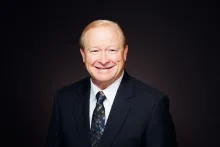
Jim has been in the ministry over 40 years serving fifteen congregations. He and his wife, Joan, started their service to God's church in Pennsylvania in 1974. Both are graduates of Ambassador University. Over the years they served other churches in Alabama, Idaho, Oregon, Arizona, California, and currently serve the Phoenix congregations in Arizona, as well as the Hawaii Islands. He has had the opportunity to speak in a number of congregations in international areas of the world. They have traveled to Zambia and Malawi to conduct leadership seminars In addition, they enjoy working with the youth of the church and have served in youth camps for many years.
