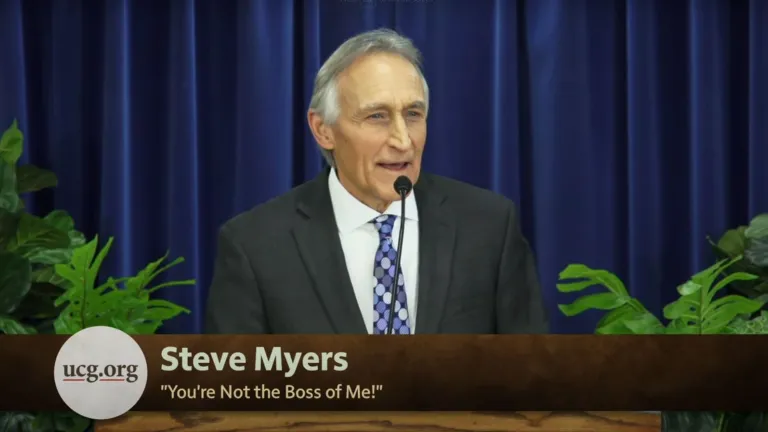

Steve Myers
Despite the division, hostility, and turmoil present in the world today, believers can find comfort and strength by looking to foundational scriptural truths. These essential truths include trusting that God is faithfully completing His spiritual work within us like a master potter, receiving His complete forgiveness and mercy through true repentance, and resting in the absolute sovereignty of God over human history and future prophecy.
This transcript was generated by AI and may contain errors. It is provided to assist those who may not be able to listen to the message.
Thank you, Mr. Moss.
Well, maybe I'll start in a very lazy way. Have you ever been encouraged by the news lately? Now, some of you are wondering, why is that lazy? I've been told it's lazy to start with a question. It's not my opinion. Have you been encouraged by the news lately? I appreciate the occasional funny video that comes across my feed. Dogs or cats? Recently, a whole compilation of dogs. Playing in the snow? Playing in different environments? I send it to my wife, because we love dogs. She responds back, I've seen this, but a lot of that's AI. I said, you know, I know. It's still cute nonetheless. But I'm talking about the real news, the things that are published out there for learning about what's going on around us. There's much that is published in the world that is quite discouraging. Wars? Strife? Conflict? A spirit of unrest? We see Europe seems to be protesting a lot lately. It's hitting the news a lot. A lot of unrest in different cities. And as we know, even our recent history, when mankind gets together and they kind of, what do you call it, protest stuff? There's always some in there that things can get out of hand. There's a spirit of unrest, destruction, and strife, and division. In the United States, we know division all too well. We're coming up on a political cycle again. Election is just around the corner. And it seems to be that Ohio is very important concerning what's going on in the elections. I seem to be getting every day a thick postcard for voting for this person or that person in the mail. Now, it's not addressed to me personally. They don't really know I exist there. It's usually addressed to the previous tenants. But usually, there are attack ads. You've seen these attack ads? Very discouraging. You know, a vote for so-and-so is a vote for killing puppies. That's our running joke. They won't say things exactly like that, but it'll be very unhinged and ridiculous. Always attacking allegations of corruptions, allegations that those who should be leading us and serving us are really taking advantage of us. And there's no doubt. I mean, when the wicked are in charge, when those who are cut off from God, those who don't see God's way, when they are in charge, the people groan and they mumble. Sin and flagrant transgression of God's law of love, as we heard a little bit in the sermonette, right? The true love, when there's sin and flagrant transgression of that law, that leaves the world in a crumbling state. Many decide for themselves what is good and what is evil. Mr. Pramar just talked about that. All of this brings diseases, destruction, and heartache. For us in the church, if we read these things, sometimes it can be very anxious, generating. Or generate a lot of anxiety, feelings of fear, or stress. What's one thing people need right now? Well, maybe we could ask that to everybody listening, and maybe we come up with a few answers. But when I was thinking of that, I see somebody mouthing the word God. Well, yeah, definitely people need God. That's a great answer. When I was thinking about it, I thought, encouragement. People need encouragement. And it's interesting, through all the discouraging things that are out there, which it's good to read and to consider what's happening around us, with all the discouraging content that is published in the world scene, you and I in the church, we are admonished to encourage one another, to help build one another up, to stir one another up to good works. That which God would have us do that ultimately build us into the person we are supposed to be in the image of his Son.
As we're admonished to do this, to encourage one another, often, as the people of God, we do this really heavily on the Sabbath day. Sometimes we're not the most encouraging people. Sometimes we need to be encouraged. And so somebody else will encourage us. But we often do this on the Sabbath day. We take the opportunity to assemble because God commands us to come before his presence. And so we take the opportunity to do what he says and to come and to stir one another up, to encourage, to edify, to build one another up. And this is great. We also have the admonishment to do it outside the Sabbath. Now, Cincinnati is in a very privileged position. And I say that because if you look at the map and you look at where you all live, you all are really close to each other geographically. Now, hopefully this is not new to you. If it's new to you, come talk to me and I'll help you see a map. As a relatively new member back to the area, some people will say, well, I want to have you out to the house. Now, it's a long drive, so hopefully you're able to make it. They'll say 30, 40 minutes. And I go, 30, 40 minutes. My children will get in the car and if it's three hours on the ETA, they'd say, oh, good, a short trip. I usually make the comment, go live in the places of our other congregations and see how spread out people are. This is a long tangent to say we're very privileged in Cincinnati, geographically speaking. We can visit one another and encourage one another in person outside the Sabbath. But of course, with modern technology, we have the opportunity to call. You can even write letters if you want to do that. And it means a lot to those if you just reach out to each other. As a new pastor in the area, I'm encouraged greatly when I hear of you all visiting one another. I'll go visit someone or I'll call someone and they'll say, so-and-so was just here or so-and-so is planning to visit me. And that's so encouraging to hear. It's not always the opportunity we have in the modern church of God. So it's good to be so close in that way. How do we encourage one another in such times of discouragement? Much can be said on this topic of how to encourage one another, and that's not really my focus of today's sermon, per se. Today, I would like for us to be encouraged through God's Word. You see, God's Word holds remarkable truths that God has revealed that can encourage and uplift us even in the most darkest times. In fact, this is actually one way that we can encourage one another when we're going through difficult times, by using the Word of God to help remind one another of God's wonderful truth. So for today, let's consider some fundamental truths revealed by God in His Word to be encouraged by God's faithfulness in these truths. One. God will complete the work He's begun in you. God will complete the work He's begun in you. To start at this point, let's go to Isaiah 64. You see, in God's Word, God inspires the usage of an analogy where God is a potter, a master potter. Now, there's a few analogies of God's relationship to His creation, but there's one of a master potter. Isaiah 64 is starting in verse 8. Actually, just reading one verse in verse 8.
Isaiah 64 and verse 8, I just recognize I never started my time. So if I go introduction length long, you'll have to forgive me. Isaiah 64 in verse 8. Now, this is within the context of a prayer, asking God to remember His people. Verse 8 says, Now, within the context of God, or asking God to remember His people, we look at physical Israel, led by God, called by God, into a relationship in a physical way, His people in a physical way. Obviously, to bring about the master plan of the seed of David, which would open the inheritance to all. But His plan, His people, we see much of their life in that calling, a representation of the spiritual work God is doing with His spiritual people. God calling us, bringing us out of bondage, and then working with us, and molding us, much like a potter and raw clay. Now, how many people have ever worked with clay in the past? Okay, if you ever compare yourself to the morning services, you have about five more hands. I don't know how the artists fall between morning and afternoon. I had an art class in high school, and we worked with clay. It's a pretty interesting process. Now, what we would start with, we would cut a slab off of this clay chunk, and for one of the first things we would do is just beat it. You know, you take it, and you slap it down on your chair, because you're trying to remove all the air bubbles out of it. Now, for those that have not participated in forming clay yourself, maybe you've watched it, or seen it on the videos or movies. And if you're ever watching the process of forming clay, it looks just like the final product right from the beginning, doesn't it? No. It looks like a pretty wet mess at the beginning. We're not sure what's being made. Is it a vase? Is it an ashtray? Right? Some people make ashtrays. I don't. But we don't know what it is yet. Is it just going to be a blob of...fire...clay? Who knows? It's hard to see in the moment. It doesn't always look right during the creation. We can think about similarly, as God is working with us, molding with us. At times, there are battles, there are trials, there are discouraging moments. As we heard in the special music, these times where we're walking through the shadows or the valleys. And it can just seem like, where is God? Is He working with me? I want to turn to a familiar scripture. Let's go to James 1. I say a familiar scripture, but a familiar scripture within this context of trials and difficulties.
James 1 and verse 2.
James 1 and verse 2.
James 1 and verse 2. My brethren, count it all joy when you fall into various trials. A very high bar. Difficult thing to actually try to apply. Easy thing to say. Easy thing to write. But nevertheless, very true. Count it joy when you fall into all trials. Why? Knowing that the testing of your faith produces patience. Now patience, also that Greek word there, can also bring across the idea of endurance. Enduring to the end. Because sometimes it's a very difficult battle, isn't it? Spiritually speaking, it's a very difficult battle. Sometimes it's very difficult physically. And so all that we see in scripture, right, we see your call to this wonderful life, this wonderful opportunity. But it's very difficult. It's narrow. It's a narrow way. It's a hard way because we're fighting against all the other cultural ideas out there. Trying to hold captive our minds or bring into captivity every thought. Maybe that's a better way of putting it. It's a difficult battle. And then when you actually fall into a physical trial, we're supposed to count it all joy. Knowing that it produces patience. Let this patience have its perfect work. That you may be perfect and complete, lacking nothing. So trials do produce something. Remember what I was talking about slapping that clay on the table. You know, from the clay's perspective, that probably hurts. Now thankfully, it's inanimate. From its perspective, you're slapping it on the ground, on the desk, on the rotating table, whatever you're doing. Trying to get those bubbles out, those imperfections. Because who knows what happens when you fire your clay in a kiln with bubbles in there. Well, it explodes. And unfortunately for me, my classmate didn't get their air bubbles out of theirs. And so my perfectly shaped, whatever it was, came out broken. So I got a C on that. Because there's no way to prove what happened. You see, that beating of the clay produced something good. Fits well with what Mr. Pramara was saying. Sometimes we get a little lost. Something looks good, but doesn't ultimately end into what is God's plan. So it's not good. Something may look bad, but it ultimately ends in God's plan. So God may be bringing out something good there. Often when we fall into trials, maybe we're not so gleeful about it. But we can ask ourselves, what should I learn in this moment? Is this producing patience? Is it producing me to a perfect work? God as a potter is working with us. And just because trials are there or difficulties are there doesn't mean God is not around. It's the opposite. We should understand that God is there even in those difficult times. And He'll work with us and He'll guide us and mold us if we submit to Him in those times of difficulty. You see, God does correct and guide us. Sometimes we think of correction as maybe a physical parent, maybe a spanking or a timeout or whatever the case may be. That's not really what I'm referring to. Hopefully you're tracking. Sometimes God corrects. Often with the church, He will correct us as the convicting agent of His Spirit in tangent with God's Word and His faithful teachers. We'll do something and then we'll have that new knowing within us. After baptism, God gives us His Spirit so that we can have an understanding of His way. And we can have those moments where it's like, yeah, I didn't react the best way I should in that moment. And we have that understanding that God leads us in that understanding. We look through His Word and we see, yeah, I should have acted more patient. I should have been more caring, more understanding. I should have submitted to God. I should have responded like Christ in that moment. God, as the Master Potter, does correct and guide and lead. And it's a good thing. God is seen as this Master Potter, this individual who is working a masterful plan. Let's go to Philippians chapter 1.
You know, sometimes we end up in a difficult situation because of our foolish actions. Sometimes things happen and God allows a trial to come through. But either way, we have an opportunity to recognize that God is still there. We can reach out to Him in our desperation, repent if we've sinned, at least for that issue, ask for forgiveness, but understand that He'll continue to work and mold us. Philippians 1 verse 3.
I should say first, before we read that, if you've ever studied an intro to Philippians, know the little bit of the context of when this letter was written. If you're familiar with phrases, sometimes we call this a prison epistle. Have anybody heard that? All the ABC students should be raising their hand. A prison epistle because often we associate this letter with Him being in confinement in a prison of sorts. Paul. And in that moment, that's not the most pleasant state of life, is it? And yet during that time, as a great servant of God sent for a mission, a commission, He writes to His people, the people under His care, and what does He say? In that desperate times, what's on top of His mind? Thanking God for God's ways, God's plans, and God's people. Verse 3.
So He's suffering. He's in difficult times, but He recognizes God's truth. He knows God's plan. He knows what's coming. And so He prays for God's people. And He thanks God that God brings people into His calling or His understanding. Verse 5.
And so He thanks God that God is bringing people in to share in that good news. The fellowship, right? The group or the unity, the sharing in the gospel from the first day until now. Being confident of this very thing that He who has begun a good work in you will complete it until the day of Jesus Christ. And so what Paul is trying to impress is that God, when He calls us and He opens our eyes and He pours upon us mercy, He promises to work with us and to see it to completion if we're involved. If we put it all on the table, if you will. If we submit to God in that way, as we heard in the sermonette. As we recognize God as the ultimate authority in our life. As we recognize that we are under the authority of His rule. Verse 7.
What a beautiful opening section of a letter. In chains, Paul writes, I'm very thankful for you. I'm thankful that God has His plan. That God is working it out and He's working with us. God is a master potter and He will complete the work in us. This is a remarkable truth that He is revealed to us. God shows His willingness to work with us, calling us, opening our minds, and leading us and guiding us, encouraging us.
He convicts, teaches, guides us, corrects us, produces fruit of righteousness in our life. One of the descriptors for God is the Alpha and the Omega. How much does that fit within this context? He's the starter of our calling. I believe it's John that says, before you knew God, God knew you. Of course, that makes sense. He calls us, opens our eyes, and then He completes the work as well. He doesn't leave us nor forsake us. God has a plan, bringing many sons to glory, and that is a very encouraging thought, isn't it?
In terms of discouragement, we can remember God is working out His plan. God views us as family. Christ views us as family. And so God will see that plan through. Jesus elsewhere states that it's the Father's good pleasure to give you the kingdom. It's the Father's pleasure to share His, or to have in His inheritance, all those whom He will call and lead to glory. This is a beautiful thing to recognize and be encouraged in.
Romans 8, if we go there next. Romans 8. Paul no doubt recognized this in many ways, but he writes about it under inspiration. God then preserving these books for us, and those whom God will call later. Revelation says that the books were open to them. So one day these books will be open to all those that they're not open to today. So preserving these words for all.
Romans 8 and verse 18. Paul, recognizing the sufferings of this world, he says, wait a second, we can't focus too much on that. We have to think and encourage ourselves with the plan of God. Verse 18, So the glory that's coming, the plan of God's salvation, the plan of God bringing many children into the family.
This has such great, it so greatly outweighs the suffering that we can enter into this flesh. That was said terribly. I'll recognize it when I do it. When we suffer in this world, it cannot even be compared with the glory that's going to come. It can't even be on the scales, if you will. Nothing external can take you from the love and the work of God in Christ. One caveat, of course. We can remove ourselves from that work, can't we? God will never give up on us. He will give us every opportunity. But we can remove ourselves, can't we?
So God will finish the work in us that He begins. We must be dedicated to that work, too. He's seen as a master potter developing and building us into perfection through Christ. So let's be encouraged that God will finish this work He has started in us. And we need to be there for Him in that work. Truth number two. Now, for all those that like exhaustive lists, this is exhaustive. This will cover all the truth. Just a few I've thought about lately, and I thought it would be good to share.
Two. God forgives transgressions upon genuine repentance. God forgives transgressions upon genuine repentance. I'll give you another opinion of mine. Try to keep them close to the chest, but at the lectern I share my opinions openly. That again is another joke. But I am not necessarily the fan when somebody remembers all the problems of my past. I have nobody in my life that does this, so I'm not pointing any fingers. But sometimes we come into contact with individuals who really just cannot get over some problems of our past.
Now, thankfully, God has blessed me with a personality where I do forget things that are maybe uncomfortable. Maybe things that are maybe hurt. Now, depending on what exactly happens, I may remember them. But sometimes my wife and I will talk about old things in the past, like high school or whatever the case may be. Not serious things. I'll say, I can't believe you even remember that. I just don't like that example, so I forget about it.
Obviously, I try to learn from our mistakes. But within this topic, God does forgive and then choose not to bring to remembrance the sins He forgives. We'll turn to some scriptures that point back more clearly, but let's go to Philippians 3 first. Paul, again, going to the letter of his.
Paul writing here, fully understanding this principle of pressing forward, not being held down too much to our past. Yes, we learn from our mistakes. Yes, we grow. Thanks to God for His enlightenment and His encouragement to do what is right. But you have to be very careful with how long we stay in those past mistakes. Philippians 3, verse 12.
Philippians 3, verse 12, Not that I have already attained or am already perfected, but I press on, that I may lay hold of that for which Christ Jesus has also laid hold of me. Brethren, I do not count myself to have apprehended, but one thing I do, forgetting those things which are behind, and reaching forward to those things which are ahead. I press toward the goal for the prize of the upward call of God and Christ Jesus. Now, of all men that have been written about, we know a bit about Paul's history, don't we? Paul, as he was referred to as Saul, did a lot of terrible things in sincerity, in zeal of God's way. He was sincerely wrong. There's no doubt in my mind that Paul recognized a lot of those pasts that he did, those hurts, and they were on his mind. But he was very thankful that God called him, and he writes elsewhere that he was an example for God's grace and mercy. He could take him, even one who was hurling threats against the church, bringing people to destruction and death. That God would call him and open his eyes and give him this work as an example of his abundance of mercy and forgiveness. And so Paul recognized that we must do that, too. Not lay hold of the things in the past so long, but press forward, changing, always growing towards the upward call, that prize. Going towards the family of God. You see, God chooses to have a short memory for those whom he forgives. Let's go to Psalm 103.
Psalms 103.
Psalm 103.
A little subtitle here, a Psalm of David. Praising God for his faithfulness, his mercy. Psalm 103, starting in verse 1. Bless the Lord, O my soul, and all that is within me. Bless his holy name. So holding nothing back, praising him, bringing him glory. Bless the Lord, O my soul, and forget not all his benefits. So a general praise of God, giving our life towards God, leaving nothing back. All my soul, or all that is within me, my whole life. Verse 3. Who heals all your diseases, who redeems your life from destruction, who crowns you with loving kindness and tender mercies, who satisfies your mouth with good things, so that your mouth is renewed like the eagles. It's youth, not mouth. I read that. I was like, mouth like eagles. That's my bad. My bad. So that your youth is renewed like the eagles. God providing much for us, forgiving us of our iniquities. If you think about this in the Old Covenant sense, they only had the type of that. They had the picture. They had the slaughtering of the animals. You had the covering of sin, the refreshing, the washings. That could only point to the reality which is in the sacrifice of Jesus Christ, of faith. And so he says, you have forgiven us of all of our iniquities, healed us of all of our diseases. Oh boy, we know and we are resting assuredly in the fact that God will heal all illnesses and diseases. Sometimes we desire that to be immediate, don't we? But we recognize that God will heal all diseases ultimately in the new bodies. Verse 8, we'll jump to verse 8. The Lord is merciful and gracious, slow to anger and abounding in mercy. He will not always strive with us, nor will he keep his anger forever. So pointing to a time, well, yes, there is a storing up of wrath, a time when everything, every judgment has been made, everybody's been given the opportunity, and he will execute justice, no longer striving with us forever. Kind of hinting back at different connections there with Genesis, but also with Moses and the people of Israel. Verse 10, and has not dealt with us according to our sins, nor punished us according to our iniquities. I find this encouraging, don't you? It's encouraging to know that God is a father that cares deeply. You know, in this life, we may not always have a good father. Many of us grow up in broken families. I had very good family, good parents in the traditional way of using that term. Moral individuals who led me on the right path, who loved me and cared for me, but not everybody has that privilege. Here we have a father who is good. And is slow to anger. Very patient and kind. Recognizes that we are but dust. I think if you keep reading here, he talks about that. He writes about, recognizes that we are but dust. Or we are like, but... Yeah, end of verse 14 and 15 there. But God doesn't always deal with us as we deserve, does he? Thankfully. You know, you and I, as Paul writes in Romans, we are the vessels of God's grace today. Those whom God calls out of the darkness of this world and brings under his authority, we're the vessels of that grace today. God will call everybody in their own time. But thankfully, we have been given a lifeline. We deserve death. Nothing less. Without God, we wouldn't even exist. God has created us. He wanted to share His eternity with us, bring us into His family. That's how we owe everything to Him. See, God cares for us and cares for us on a very personal level, a family level. And in His infinite wisdom, He's working out the best for everybody, calling everybody at the right opportunity for them, regardless to what everybody is owed. The wages of sin is death, but the gift of God is eternal life in Christ Jesus. He provides that gift, a chance at a glorified life.
I find that encouraging. God does not respond to me according to my iniquities. God is merciful, and His forgiveness is unmatched. Verse 11. Whereas the heavens are high above the earth, so great is His mercy towards those who fear Him. As far as the east is from the west, so far has He removed our transgressions from us. David's inspired here to use great comparisons. How far is the east from the west? Well, if you have a number, let me know. There's probably some good arguments on how far that is.
But obviously referring to a great chasm, a great divide, a large distance, as high as the heaven is above the earth, or as east is from the west. God removes our sins from us under genuine repentance, faith in the sacrifice of Christ. And only after coming under that sacrifice can we be truly forgiven. And when God forgives us of our sins, He removes them, choosing not to remember them anymore, or choosing not to bring them to His mind anymore. You can write Isaiah 43 and verse 25 makes that point known, that when He blots out our transgressions, He will not bring them to remembrance. The tricky part is for us to try to not bring them to remembrance and do what Paul did, pressing forward, laying those things behind us, behind us. With true repentance, God forgives the wrongdoing, helps guide us and lead us towards His way, the ability to turn away from the mixture of, or I should say, the knowledge of the good and evil, as Mr. Pramar was mentioning in the sermonette. Because so many individuals are choosing for themselves good and bad. You and I have the privilege to recognize God's standard of good, showing what is evil, or defining what is evil then. So God is faithful and just. We humbly and respectfully come before His throne and confess our sins. In that relationship, being granted God's Spirit, He is faithful to forgive us. Let's go to 1 John 1.
1 John 1, verse 8.
1 John 1, verse 8. If we say that we have no sin, we deceive ourselves, and the truth is not in us. A very strong warning there. If we confess our sins, He is faithful and just to forgive us of our sins and to cleanse us from all unrighteousness. If we say that we have not sinned, we make Him a liar, and His word is not in us. If we're in that relationship with God through the sacrifice of Christ, we can boldly come before the throne in humility and respect of the office and the place of our Creator God, requesting forgiveness. And He is faithful and just to forgive us of our iniquities, to cleanse us from all unrighteousness, removing that sin from us by a large distance, as we read in Psalm 103. And this is an encouraging truth that has been revealed by God through His word, that God is faithful and just to remove our sins from us.
Another aspect or another truth that God reveals and shows through many ways in the Bible is that God is in charge. That God is in charge. Now, I'll ask you another question. A little bit differently than mourning. How many of you like to be in control? Okay. I got more hands. See, in the morning I asked, how many of you like to be in charge? And that had a little bit different connotation. See, as human beings, we do tend to like to be in control, don't we? We don't like the things that are out of our control. We often fear the things that we can't control. I like to try to enjoy things that I can't control. I tell my mom I love turbulence on a plane. And I had to grow to love it. Because I recognized, well, it's out of my control. I have nothing to say or do to stop the turbulence. I might as well go along for the ride. We like to be in control. And throughout our life we'll have many times of plenty and times of famine or scarcity. But through it all, God is in charge. The Word of God has numerous examples of God's commitment to His plan, always keeping in mind the end from the beginning, showing what will come to pass, bringing things to pass. The Word of God has numerous examples of God's faithfulness throughout human activity. Even in recent history, we can read of extra-biblical things that maybe we can't be for sure because they're outside the Bible's scope. That sounded weird. They're after the Bible had been put together and preserved for us. Like in recent history, we can read about examples of God's potential involvement during World War II or during different conflicts in the world. We recognize that God does have His hand in the things and will always bring about His ultimate plan. I'm reminded of this in a few ways in the Bible. In prophecy, in Daniel 11, we're not going to read it today, but if you're familiar with Daniel 11, Daniel 10 and Daniel 11, there's this long, serious prophecy concerning the fighting between the kings of the north and kings of the south. They're very historically detailed, written, or prophesied, I should say. I believe in the sixth century-ish BC. I'll just throw a circa on there. Some around the sixth century. But it spans through events all the way until probably, again, if I'm estimating, maybe 200 BC. That's a long-running prophecy, detailed of battles between the breakdown of the Greek, Alexander the Great's empire into those four generals, them going down to two generals. And I'm not shelling a lot, of course, but it's a brilliant section of Scripture that's so detailed and so accurate that even skeptics of biblical authority, maybe they look at it and they say, well, this is just so accurate, so detailed, and they're skeptics of biblical authority. Sometimes those individuals will say, well, it must have been written way later, and he's just retelling the history. Now, that's not everybody that dates the book earlier, but some will argue that because it's so detailed, they think it can't be that God is prophesying. That's just some. Can't necessarily argue with the details, so they argue with the date.
In Daniel chapter 11, it's a wonderful example of God being in charge. At the times of prophecy, or excuse me, at times, prophecy can sometimes bring some anxiety to those who maybe read it and don't, maybe aren't necessarily keeping in mind the purpose. I know I've been in that boat sometimes. You read of some of the things that are coming, at least in the end time prophecy, and I can think, wow, there's a lot that's going to happen. Jesus Christ says that God will send him to punish those who destroy their earth. There's so much wickedness and destruction going on that God will stop it. He's in charge. But if we remember the main purpose of prophecy, one of the main purposes is that God is showing that he's here, and he's in charge, and he will bring to pass his plan. Let's go back to Daniel chapter 2. Daniel chapter 2.
One purpose for prophecy is that God does reveal to his prophets and show them his plan. A minor prophet writes that God does not move or does not work without revealing it to his prophets. We recognize what that truly means. Not in detail, not in every action or movement, but showing his plan and bringing it to pass. Daniel chapter 2. I was sitting in Isaiah, so give me a second. And then I go back and forth as I go over the book. Daniel chapter 2, in verse 20. Within the context of the vision of Nebuchadnezzar, God then reveals this to Daniel. Verse 20, Daniel answered, said, Bless be the name of God forever and ever, for wisdom and might are his. He changes the times and the seasons. He removes kings and he raises up kings. He gives wisdom to the wise and knowledge to those who have understanding. He reveals deep and secret things. He knows what is in the darkness and the light dwells with him. A little note there. God is in the movements. He raises up kings and he lowers them down. He pours out mercy on whom he wills to pour out mercy, and he withholds mercy on those whom he wills to withhold mercy. Paul writes about that in Romans 9, 10, or 11, somewhere in there. He is bringing about his plan. God reveals a lot about his plan, and we understand that through the shadows of the Holy Days. We had a hymn today. I'm pointing to the screen. We had a hymn today that referred to the Sabbath, a shadow of what is to come. God's govern...it's hard to say it and not sing it. God's government of peace. These days they represent something, steps in his plan, and these are beautiful things to recognize. God controls the timing. God controls the overall plan. He will send his Son. He will establish his kingdom on this earth. His kingdom will extend to all of his creation. Even if we think in the Great Tribulation...we go to Matthew 24 for a minute. We think about end-time prophecy. When Great Tribulation begins, even in those times, we can be encouraged that God is not asleep in those times, but he steps in at the right moment. And it's actually for you and I. It's for you and I, those whom he has called today. Or I should say today in the royal sense, in God's Church. Matthew 24 in verse 21.
For then there will be a Great Tribulation, such as has not been since the beginning of the world until this time. No, nor ever shall be. So it will be a very difficult time. A time of great punishment, wickedness, lawlessness. Verse 22.
So he's saying it's going to come to a time where it will be that no flesh will be saved. Coming up to that point, that's how bad it will get. But what does he say?
God's in charge! God looks down and he watches over his people. And he will bring to pass his plan and always keep us in mind. It's very encouraging to think about God's plan and recognize that he's in charge. We know this. We've read the ending. God wins. God will bring to pass his plan. There's none like him. Turn to Isaiah 46 with me. If you like, that sounded very commanding. Isaiah 46 and verse 9. There are none like God. You see, God is eternal. His family. The Word and him inhabiting eternity. And false gods don't even compare. Isaiah 46 and verse 9.
How does this all take place? It says, verse 9, Remember the former things of old. For I am God. And there is no other. I am God and there's none like me. Declaring the end from the beginning. And from the ancient times, the things are not yet done. Saying, My counsel shall stand and I will do all my pleasure. Calling a bird of prey from the east. The man who executes my counsel from a far country. Indeed, I have spoken it. I will also bring it to pass. I have purposed it. I will also do it. Well, that's incredibly encouraging. That God has a plan. He has purposed it. And he will bring it to pass. And you and I are in that plan. All of creation is in that plan. And how encouraging is that? That's very encouraging. Within God's word there are remarkable truths. There's little golden nuggets that God puts in there to show us and to encourage us and to help uplift us. To get us through some dark times, some difficult times. I hope with...it was my goal today, at least when reviewing just a few of these, that they've been quite encouraging to do, as they are to me as I read them. As we close today, I'd like us to turn to 1 Thessalonians chapter 5. 1 Thessalonians chapter 5. If you read the beginning there, if we're just kind of glancing a little bit as we're turning there. Paul is going to write a little bit of the Day of the Lord. Thief in the night, peace and safety, then sudden destruction comes. It's a great, encouraging statement that brethren are not of the darkness, so they should see these things. And walk soberly, walk circumspectly. And then in 1 Thessalonians chapter 5 and verse 10, or verse 9. Let's go to verse 9. That's a very, very encouraging statement. For God did not appoint us to wrath, but to obtain salvation through our Lord Jesus Christ. Who died for us that whether we wake or we sleep, so whether we live or whether we die, we should live together with Him. Therefore comfort each other and edify one another, just as you also are doing.

Andy Duran is a pastor with the United Church of God. He and his wife, Amber, serve the congregations in Cincinnati. They are blessed with two sons, Ezra and Ezekiel.
