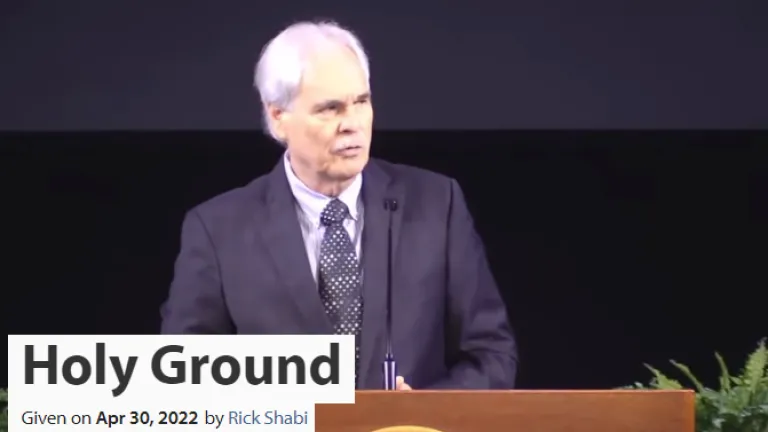

Rick Shabi
This transcript was generated by AI and may contain errors. It is provided to assist those who may not be able to listen to the message.
Going through the Ten Commandments one month or one at a time each month. And we talked about the Sabbath last time, the Fourth Commandment. And we divided the Sabbath into two parts because it's a very... it's a huge subject and a very important day in God's sight. There's a lot of things that the Bible talks about the Sabbath in both the Old Testament and the New Testament. Let's just turn back to Exodus 20. Now for a few minutes here we'll recap what we talked about... recap about what we talked about last time because last time we focused on one aspect of the Sabbath and today we'll focus on a very different aspect. Exodus 20 and verse 8 says, Remember the Sabbath day to keep it holy. Remember it. Six days you shall labor and do all your work, but the seventh day is the Sabbath of the Lord your God. In it you shall do no work, you nor your son, nor your daughter, nor your male servant, nor your female servant, nor your cattle, nor your stranger who was in thin your gates. And last time we talked about how in six days we do all the work that is associated with living. We do the work that we go to, you know, five or six days a week. We do the shopping. We do our own entertainment. We do all those things that we have to do in order to keep our lives going. But on the seventh day we put all that behind us. We don't do any of those things on the seventh day. The seventh day God says is reserved for something else. And he set the example for us because in six days of creation he did all the physical work of creating. The heavens, the earth, the water, the seas, the lights in the heaven, fish, birds, animals, and man. He did all that in six days and he said the physical earth was finished. But then he created the seventh day because without the seventh day creation wasn't complete and without the seventh day we're not complete either. So in six days we do all those things and then we put that behind us. Verse 11, it says, in six days the Lord made the heavens and the earth, the sea, and all that is in them, and he rested the seventh day. Therefore he blessed the sabbath day and hallowed it.
Now let's turn back to Genesis 2 and verse 2 where we started last time. Genesis 2.
In verse 2 it says, on the seventh day God ended his work which he had done, and he rested on the seventh day from the work which he had done, and he blessed the seventh day and sanctified it. Sanctified means he set it apart. It's a separate day. We do different things on the seventh day than we do on the other days. And last time we focused on that. Last time we talked more about the things that we wouldn't do on the seventh day, the things that we do on the other six days. And you know those things, and if you have any questions about it, we can talk about that after services. And that's what sanctified, that's when he sanctified it, he set it apart, and he said don't do those things on that day. But he also says he blessed the seventh day. He blessed the seventh day. He set it apart for us not to do the things of the other six days, but he blessed it as well. And he sanctified it. Let's for a moment go over to 1 Peter 2. I want to... God sanctified the seventh day, but he also sanctified us as we read in 1 Peter 2 verse 9.
He called people us out of the world.
And he set us apart as well.
It says in 1 Peter 2 9, you are a chosen generation. Remember Christ said, you didn't choose me. He says, I chose you. You're a chosen generation, a royal priesthood, a holy nation, his own special people, that you may proclaim the praises of him who called you out of darkness into his marvelous light. He sanctified us, he called us, he set us apart, and there's a purpose he did. That says that you may proclaim his praises, the one who has called us out of darkness into light. We once weren't a people, but now we are the people of God who had not obtained mercy, but have obtained mercy. God set and sanctified his people, and he sanctified the Sabbath day. Now, we read one of the purposes that God sanctified his people, that we might, through our actions in life, bring praise to his name. But over in Revelation 5, we find the other purpose that he called us out at this time, and sanctifies his people. In Revelation 5, and in verse 9, again, this is John, as he is in a vision at the throne of God.
And he hears the elders in heaven saying this in verse 9, they sang a new song, saying, You are worthy to take the scroll, of course, speaking of Christ, and to open its seals, for you were slain, you've redeemed us to God by your blood, out of every tribe and tongue, and people and nation, and you have made us kings and priests, kings and priests to our God, and we shall reign on earth. He called us, he sanctified us, we live his life, and he's got a purpose for calling us.
That purpose is what we read in 1 Peter 2.9, and what we read in Revelation 5, 9, and 10 as well. He called us to get us ready for his kingdom. He called us to get us ready for roles that he's prepared for us. We weren't looking for those roles, we didn't even know that they existed until he called us.
But he set us apart, called us, and during this life he's getting us ready for what we want, or what he wants us to do. God sanctified the seventh day. He set it apart as well, just like he did his people, but he also blessed it. What does it mean when God blesses something?
If I asked you, you know, has God blessed you, you would think, well yes, he's given me a good job, I have a nice home, I have a healthy family, you know, God has healed my illnesses, or is in the process of healing my illnesses, yes, God has blessed me. And oftentimes we think of blessings in that way. What has God done for us specifically? We might look around, and many times it's just material things. We think, yes, God has blessed us, and we see that in the Bible. We can go through Genesis and we see where God blessed a number of people there.
He blessed Abraham, remember? He said, I will bless you. And we see that Abraham was a wealthy man, and the descendants of Abraham, God has blessed. And we look around the nations that descended from Abraham, and we do see some material blessings. God also blessed Jacob, and when he wrestled all night with him, and Jacob really wanted that blessing, and he wrestled with him all night, and God said, I'll bless you.
You have my blessing. And then he went and worked. Or as he had the blessing from his father first, and as he worked with Laban, God enriched him. But was that all that the blessing was about? When God blessed Isaac back in Genesis 26, was it just physical blessings that God meant for those when he gives a blessing? Was it just to benefit us? Well, let's turn back to Genesis 26. And look at these three men. Often the Bible refers to the God of Abraham, Isaac, and Jacob. God specifically blessed these three men, and Noah as well, as you read in Genesis 9.
And in Genesis 26, we find Isaac. And to bring us up to the verse that we're going to be looking at here. He's been dwelling around the king of Bimlech. He goes through the process of letting of Bimlech thank his wife as his sister. And as God enriches him, there becomes a controversy between a Bimlech's men and Isaac over the wells. Now they want the wells that Isaac has, and he moves on. He moves on from there to another place. The wells are worked there. He moves on to another place.
What he shows by his life is that he's willing to do what people want him to do, and trusting in God that he will bless him wherever he goes. In Genesis 26 and in verse 27, a Bimlech is watching what Isaac is doing. Now Isaac, again, you know, there's a similar thing that goes on with Abraham, and we've talked about it in the last, you know, few weeks.
Isaac could have stood on his ground and said, listen, I dug this well. I'm staying right here. If anyone's going to move, it's going to be you that moves. But he doesn't. He just moves from place to place. And Abimlech watches this. And in verse 26, earlier in the chapter, God specifically says to Isaac that he will bless him. It says, Abimlech came to him from Garar with this other person, one of his friends and the commander of his army. And as Isaac said to them, why have you come to me since you've hate me and have sent me away from you?
Like, okay, what am I going to do this time? Now again, I've gone to another place, and now you're going to send me away again? But they said, we've certainly seen that the Lord is with you. We've been watching what's been going on, Isaac, and we can see your God is with you. So he said, let there now be an oath between us, between you and us, and let us make a covenant with you, that you will do us no harm since we haven't touched you, and since we haven't done anything to you but good, and have sent you away in peace.
You are now the blessed of the Lord. And they make this covenant, and they live in peace.
A very different script could have been written here. Isaac could have put his foot down and said, no, there will be perpetual war between us, because this is my land. This is my well. These are my flocks. But Isaac left a legacy of peace. They asked him to go, and he did, and Abimelech saw that. Now, God certainly blessed Isaac physically. He had flocks. He was a rich man, as it goes in those days. But God also blessed the people around him. They saw something in Isaac, and he blessed them with peace. Isaac was a peacemaker. God blessed Isaac, and it had physical ramifications.
But it also had a benefit to those around him, and they saw what type of man he was.
There was something about God, and something different in him that they had seen.
Now, we can go back, you know, a few chapters forward to Jacob. And you remember the story of Jacob and Laban. And Jacob was fooled a couple times, or at least one time, and married someone after he worked for seven years. But during the time that Jacob was there, and remember, he had gotten, he had gotten the blessing from Isaac through not-so-great means. But while he was there, Laban became very wealthy. Jacob was a loyal servant. Jacob did everything that would benefit Laban. And when Jacob was ready to leave, Laban says, and it's in Genesis 30, verse 27, I know that I've been blessed. I know that I've become wealthy because of you.
He says that to Jacob. God blessed Jacob, and you know the story of the Speckled Goats, and how God enriched him as well. But with Jacob there, that blessing didn't just benefit Jacob, it benefited Laban as well. Back in Genesis 12, the blessing that we all know very well, when God talks to Abraham and gives him his blessing in Genesis 12 and verse 2, he says, I will make you a great nation. I will bless you, and I will make your name great, and you shall be a blessing. I'll bless you, he says, but you will be a blessing.
I'll bless those who bless you, and I'll curse him who curses you, and in you, or we might say through you, or in you all the families of the earth will be blessed. Abraham was blessed. Abraham was a very wealthy man. But with that blessing, everyone was going to receive a blessing. God used Abraham. God used his faith, his obedience, and his complete confidence in God. He rewarded that just as he promised the Israelites, or well, I guess we're in Genesis, but later on when he brought the Israelites out of Egypt, he said, if you do these things, if you obey me, if you have your faith in me, trust in me, let me lead you. I'll bless you. And he did that to Abraham. But he makes it clear in this blessing to Abraham, in you, everyone's going to be blessed. There's physical blessings and there's spiritual blessings. And we know that through Abraham's seed came the Messiah, without which none of us are here. None of us have a future. None of us would even be here if it wasn't for Jesus Christ. We can learn something about God's blessing when he blesses something, what it means. Now a few sermons ago, you'll remember that I referenced the 1828 Webster's Dictionary. Remember that when I was talking about the definition of meek and how back in 1828 they picked up on what the biblical term for that was. I went back to the 1828 Webster's Dictionary to see what it talks about bless. Does bless today have a different meaning for us than it did maybe back in 1828? And they give five possible definitions of bless most of which we know. It can mean to enrich. It can mean, you know, we bless someone that you hope they have a better life. We bless our food and ask God on it. The fifth one that they have says, a blessing is given to consecrate something to holy purposes. And they specifically reference this Genesis 2 verse 3 in there. That when God blesses something, it's consecrated to holy purposes.
One commentary on that said, a blessing is a way for God to work through someone or something.
A blessing can be a way for God to work through someone or something. It's not always just about that person. It's not just about him making that person rich. We see that with Abraham. He gave him blessings that we would think of as blessings, but he worked through them so that everyone was benefited. And God worked through him and his obedience and faith. We see that with Isaac. Abubamalek saw and was able to be at peace with him. And we see that in Jacob as God enriched others around him. God blessed the Sabbath day. If you read in Genesis 1, he blessed the animals when he created them. He blessed mankind.
Certainly God wanted nothing but good. But when God blesses something, he also works through it, that others are blessed as well, and that his purpose might be known. God blessed the Sabbath day. He blessed it. It's a day. The day can't own anything. The day can't be enriched. But God blessed the Sabbath day because through it he was going to work. And it was going to be a blessing to us. Let's turn back to Deuteronomy 5. In Deuteronomy 5, we have Moses recounting the commandments here before he dies, and he's reminding Israel of where they've been. He's repeating the law to them as he is about to depart. He wants them to keep walking with God and to remember what they've been through. And so he repeats in Deuteronomy 5, the Ten Commandments. And in the beginning in verse 12, he talks about the Sabbath day. Now the other commandments are word for word. Back to Exodus 20, but in Deuteronomy 5, after Moses has been keeping the Sabbath day for years and Israel has, there's a few words that are different. One of them is the first word. Deuteronomy 5 verse 12, observe the Sabbath day to keep it holy as the Lord your God commanded you. Exodus 20 says, remember, Deuteronomy says, observe.
Now the Hebrew word translated observe there, and I think in the Old King James it says keep, is Shemar. S-H-A-M-A-R. When you go back and look at the word Shemar, here's what it means according to Strong's, good cordons. It means to guard, protect, put a hedge around it, preserve.
So Moses is saying, you know, certainly remember, but he's saying put a guard around that Sabbath day. It's sanctified, remember? God set it apart. He's saying guard it, preserve it, protect it, put a hedge around it. Moses is telling them don't let, don't let go of it, don't lose sight of it, because if you lose sight of that, we have examples that we read last time where the nation of Israel disappeared. They lost their promise because they lost sight of the Sabbath day.
So Moses is saying observe it, keep it holy as the Lord your God commanded you. And then he goes through and talks about the separation. Six days you do all the work of life, the seventh day you reserve for God. And then in verse 15 he says, remember that you were a slave in the land of Egypt and the Lord your God brought you out from there by a mighty hand and an outstretched arm. Therefore the Lord your God commanded you to keep the Sabbath day.
Now that's different than Exodus 20. In Exodus 20 he says remember creation. Remember that in six days God created the heavens and earth. And if we go back and look at the Sabbath day in creation, it was the one time in history, history to date, that man, God, and creation were in perfect unity, perfect harmony. Everything was perfect on earth. And when we think about the Sabbath day, we remember back to those times. None of us have experienced that in our lifetime where there's perfect harmony between God, man, and his creation. Romans 8 18 talks about a future time when man, God, and the creation will be at one again. But we remember back to that and realize what God intended, what the beauty of that Sabbath day was back then. Moses says, remember that you were a slave. You were held down. You were going nowhere. You were in Egypt and there was absolutely no future for you except that God delivered you. You no longer were slaves. He took the bonds and yokes off of you. Now you are free. And he's laid promises in front of you, promises of a land, promises of the future, promises that he would be with you. And all he requires is that you live the way of life that he says will lead to this. What does the Sabbath day do? What are some of the things that God wants us to see in it? Let's go back to Exodus 31 for just a minute. We were here last time as well.
In Exodus 31 and verse 17, again, God is talking to Israel about the seventh day. And he says, it's a sign between me and the children of Israel forever. And remember, forever means forever. From antiquity to futurity. The word olam in Hebrew, olam. But he says it's a sign between you and me. And he repeats that again in a later verse and he repeats it in Ezekiel 20 a couple times as well after the people have been taken into captivity because they haven't been keeping the Sabbath the way that he wants. It's a sign between you and me. Now, when we think of a sign, we think of something that identifies us. You know, I have a sign on my mailbox that says our address. So people know my address. That sign says this is the house you're at. If you have a business, you have a sign out in front of it so people know, come in there, that's where they belong. The sign identifies us with his God too. We keep the Sabbath day as he says. But again, if we go back to the Hebrew word for sign, it really means or it's strong says that it can be translated as a monument.
So if we read in verse 17 here, therefore the children of Israel shall keep the Sabbath. Verse 17, it's a monument between me and the children of Israel forever. Okay, it's a marker, a monument. When we think of monuments, we think of things, you know, that we remember when we see them. We drive along the countryside. We see a historical monument. It reminds us of something that happened in the past. We go to a cemetery. There's a monument. It reminds us of the person that lived during that period of time. And that verse can be translated. It's a monument. Well, that would sound like Exodus 20. It's a monument to what God created. That's what he wanted in the Sabbath day. Perfect unity, harmony, and cooperation between God, creation, and man. It says it could also be translated a beacon. It's a beacon. So we can read verse 17 and say, it's a beacon between me and the children of Israel forever. A beacon, light, something that we go to that guides us through life, guides us out of darkness into the future. Moses talked about you were slaves. You had no future. You were in total darkness. But then God brought you out. And God, even before the Ten Commandments were given at Sinai, showed Israel the Sabbath day. When they were in the wilderness and he began giving them manna and gave them the specifics of what they should do and how they should handle that day.
It was a beacon. A beacon to them of what God would do. Through that Sabbath day, he showed them what his purpose was. The six days he provided for them, the seventh day rest, and when they did, God was very loyal to them and he was pointing them toward a future, a future they didn't have before. So when we think of the Sabbath day, it's a sign between God and his people, but it's a monument. And it's a beacon, something that shows the way to what God wants for his people. It's a blessing. It's something through which he works, something that's been set aside for a specific purpose. We can be turning over to Leviticus 23.
What would God have us do on the Sabbath day? Last time we talked about the things we don't do, and we went through a number of verses, what do we do on the Sabbath day? If it's a set-apart day, if it's something that we do things differently than we do the other seven days of the week in every aspect of our lives, what does God want us to do?
Well, Leviticus 23 verse 1, he lists the Holy Days or the Feast Days.
And in verse 2 it says, speak to the children of Israel, say to them, The Feast of the Lord, which you shall proclaim to be holy convocations, these are my feasts. Six days shall work be done, but the seventh day is a day of solemn rest, a holy convocation. You shall do no work on it. It's the Sabbath of the Lord in all your dwellings.
So he repeats the command there, don't do any work on the Sabbath day. It's a holy convocation.
Remember, God blessed the seventh day. It's a sign, it's a monument, and it's a beacon to his people and those that follow it. And he says in Leviticus 23, you're not doing the work of the other six days of the week, but on this day, I want you to convene.
I want the people who are following me, he says, to convene. I want you to be together as a group.
I want you to meet together. Now, we look at our lives, and it's tough. If we were going to meet on another day of the week, some of us work on Sundays, so Sunday would be out. Some of us work on, everyone in here would have something else, a thing of life that's going on the other six days of the week that would prevent us from being at a place to meet. There's only one day in common that we all have in common that we can get together and we can meet, and that's on the Sabbath day.
Now, God, remember, sanctified his people, you and me. He's got a purpose as he blesses those people, and that purpose is to prepare for what our roles in his kingdom will be. Just like the ancient Israelites, he's given us promises of the millennium, promises, and a beacon, a light to see what the world will be like in the kingdom or in his millennium.
If he's going to prepare a people, he needs to gather them together.
You know, the years I worked, a few times I had people that were in the National Guard.
And I really, the National Guard is a nice institution in America, but there were things that those people had to do as part of that. They weren't on call, or they were on call all the time, but they weren't on active duty all the time.
And as I worked with them, they would say, you know, there was one week in the month that they had to reserve just to go and train for that National Guard.
And then two weeks out of every year, as long as they were in it, they had to reserve that time and they had to be away. So they always knew when those two weeks were, and they always knew, you know, we can't be available on this weekend of the month because we have this that we're committed to. And I don't know exactly what went on during those one weekends a month, but I know that they were probably being trained and they were going through so that they were ready. If they ever got called in because of any disturbance or anything that they were called to, they had to have that time to be ready.
And very much the same sense. God would want His people to be ready. Sure, we pray every day during the week. Sure, we study every day during the week. Those are the times that God works with us individually, but He wanted His people and He called them together. It just makes sense. If He's getting ready a people for the Kingdom of God, He has to have them together. Now that's in Leviticus. Let's turn back to Hebrews. Hebrews 10. Verse 24.
Let's start with verse 23. It says, Let us hold fast the confession of our hope without wavering. Let's hang on to that beacon. Let's hang on to our hope and not doubt it, but march continually toward the light. For He who promised is faithful. He will bring about what He said He will. And let us consider one another in order to stir up love and good works. Well, we do that with each other, right? I mean, if we're only in our homes six days a week, well, today we have internet, today we have phones, we can kind of stir up love and good works with each other by the way we are in contact with each other during the week. But we can do that on the Sabbath day, as we're together. And He says specifically, not forsaking the assembling of ourselves together. That says, God says it's important, just like He said in Leviticus 23, don't forsake the assembling of yourselves together, as is the manner of some. Because even back in those days, there were some who just decided that they didn't need to be assembled together on the Sabbath. But exhorting one another, and so much the more, as you see the day approaching. Exhorting one another, we do that with each other. You know, back in Exodus 31, 17, I didn't read through those whole verses. Do you remember? It says that God rested, and it specifically says God was refreshed on the Sabbath day. He was refreshed and rested on that seventh day in creation.
Refresh, again, if you look at the Hebrew word, says that it's like God breathes into us new life on the Sabbath day. He inspires us. He makes us clean. It's like a different day. I hope that when sunset comes on Friday, you feel a difference in your homes and a difference in your lives when the Sabbath comes. It just has a different feel about it. God is with us all seven days of the week, but He sanctified and He blessed the Sabbath day. And one of the things He says to do one is meet together, encourage one another. We're all in this together. He's called us out. He's given us a great purpose and He's preparing us for something. And use that time, He says. Use that time to be together. God is glorified when He sees His people together and being prepared. Well, that's one thing we can do. There's, of course, others. But let's turn back to Luke 4.
Whatever we do in life, there's one example we look to. And if we want to please God, if we want to please Jesus Christ, if we want to be true to our calling, if we want to do what He wants us to do, we look back to Jesus Christ. It says He's our example in everything. Jesus Christ was even baptized. Even baptized. To set an example for us that you must be baptized in order to enter into the kingdom of heaven. He didn't need to be baptized, but He did it as an example for us. And in Luke 4, we find Him keeping the Sabbath day. Luke 4 and verse 16 says, He came to Nazareth where He'd been brought up. As His custom was, He went into the synagogue on the Sabbath day and stood up to read. You see what His custom was? What He did, among other things, was He went into the synagogue. He went in to meet, just exactly following what Leviticus 23 in Hebrews 10 says. He went into the synagogue and stood up to read. So it wasn't just a gathering of people and a social activity. He stood up to read something to Him, and He was handed the book of the prophet Isaiah. And when He opened the book, He found the place where it was written. The Spirit of the Lord is upon Me, because He's anointed Me to preach the gospel to the poor. He sent Me to heal the brokenhearted, to proclaim liberty to the captives, and recovery of sight to the blind, to set at liberty those who are oppressed, and to proclaim the acceptable year of the Lord. That's what He read in their presence. He said, God has sent Me to take off all the yokes. God has sent Me to correct all the suffering and the pain, to set people free so that they can be what God wants them to be.
And then it says, He closed the book. He gave it back to the attendant and sat down in the eyes of all who were in the synagogue were fixed on Him. And He began to say to them, Today the Scripture is fulfilled in your hearing. So all bore witness to Him and marvel that the gracious words were proceeded out of His mouth, and they said, Isn't this Joseph's son?
Isn't this the young boy that we saw playing around in this neighborhood?
The point is, Christ did that. Some would say that after He died, they no longer needed to keep the Sabbath day He fulfilled it. I'm not going to turn you to these Scriptures, but let me give you a few that you can see the apostles after Him kept the Sabbath and went into the synagogue just like He did, and it says, As their custom was. You can write down Acts 17, too.
18, 4. Chapter 13, verses 27, 42, and 44. Chapter 15, 21. You can go back and read those, and if there's any doubt what God's or one of the things He wanted on the Sabbath day, that would be it. But you know, one of those words that Christ spoke that day, He said a lot. Of course, He said a lot for humanity. He said a lot of what God wants to do, and all too often we don't even understand the bondage that we're under and the yokes that are on us, and He's going to take all those off. But you know what else Christ did, and those words fit it, too? He took the yoke and the bondage off the Sabbath day as well. Back in those days when He was there, the Pharisees and the Jews had absolutely loaded down the Sabbath day. I think the count is somewhere in the 600s of all the things you couldn't do. So if you were a Jew living in that day, you couldn't walk but just this far. You couldn't carry anything above this weight.
There's a lot of things you couldn't do on the Sabbath day. So was it a delight to them, or was it a day that they felt like in total bondage, totally weighted down about by everything they couldn't do, and by having someone analyze or judge every action they made? Certainly as Christ walked through the land, there were people, only people watching what He was doing, and there were a lot of things that they talked about and said, you shouldn't be doing that on the Sabbath day. You shouldn't be doing a number of things, as we'll see here in a moment. He freed up the Sabbath day. It had become a drudgery to people. It had become a burden to people. They were afraid to even move because of the Sabbath day. Certainly they wouldn't say it was a delight. It was a sign. They were doing it because they loved God, but they weren't getting anything out of it. What they were getting was hammered by everything they did, and God never intended the Sabbath day to be that. He intended it to be a blessing. Something, as He says in Isaiah 58, 13, and 14, that we would call a delight, that we would look forward to that day. Something that would be the highlight of our week. Something that we would come out of it with renewed vigor, renewed energy, refreshed, as God said He was refreshed, ready to face the next six days of work after that. Christ came into a world that had killed the Sabbath day for all practical purposes. There was absolutely nothing people were getting out of it except afraid of what they weren't doing. And through His example on the Sabbath day, He began to unleash some of those things so that we could begin to see what the blessing of it was. Remember, it's a beacon. It's a monument, but it's a beacon to the future. That's what God wanted it to be. Something that would be a light to us as we lived it, and as a blessing to us as we walked through it. Now, let's... let me turn back to Ezekiel 20 here before we go further. I want to read... again, a few verses I read last time.
In Ezekiel 20 verse 15. Because God gives us the Sabbath day, and it is a sign. It's a monument and a beacon to us, and it is something He wants us to do. It's not... it's not... well, it's something that is important to God. And when we don't do it, we have the example of a people who lost their promise for it, and that's because they profaned it. Let's read in Ezekiel 20 verse 15. I raised my hand in an oath to them in the wilderness, that I wouldn't bring them into the land which I had given them. Told them I'm not going to give you what I promised you, the land flowing with milk and honey, the glory of all lands. And why? Because they despised my judgments, and they didn't walk in my statutes. They profaned my Sabbaths. For their heart went after their idols.
He didn't give them that promise because they didn't keep His commands, and they profaned the Sabbath day. They didn't use it for what He was intended. To them, it wasn't a delight. They looked at it as another day to do whatever they wanted to do. And then He says, My eyes spared, My spared that group. But I said in verse 18 to the children of the wilderness, Don't walk the way your fathers walk. Don't defile yourself with their idols. I'm the Lord your God. Walk in My statutes, keep My judgments, and do them. And He says, Hello, My Sabbaths. Keep them separate, and they will be a sign, a light, and a beacon to you, that you may know that I am the Lord your God. And then He says, that generation didn't do it either. In the middle of verse 21, He says, They profaned My Sabbaths. And I said, I would pour My fury out on them. We have the legacy of Israel. Israel who saw God demonstrate the Sabbath day to them, and yet they profaned it. And He took them out of the land He gave. And now He's called us. And now He's given us an opportunity to be part of a kingdom, the promises that He's made for us. We don't want to make the same mistakes that ancient Israel made. We want to walk in God's way and count important the things that He counts important. Now let's go back to the New Testament and look at Christ again, because as He came to earth, He did give us a sign. He did give us an example of what we should do. One of the things that He did was His custom was to go into the synagogue and convene with them. And in that day, one of the times He was there, He said, I'm going to free man up. I came so that you could realize your potential. And as He walked through the land and He knew full well what was going on with the Sabbath day, and that it wasn't what He intended, He did things that angered the Pharisees. Let's look back in Mark 2 and verse 3. I'm sorry, Mark 3 and verse 1.
He answered the synagogue again, and a man was there who had a withered hand. So they watched Him closely, whether He would heal Him on the Sabbath so that they might accuse Him.
Do you see kind of the attitude that was there? They were watching Him. Is He really going to do this? We're ready to nail Him on this one. They watched Him closely. Would He heal on the Sabbath so they might accuse Him? And He said to the man who had the withered hand, step forward. And He said to them, is it lawful on the Sabbath to do good or to do evil, to save life or to kill?
They just didn't answer. And when He looked around at them with anger, being grieved by the hardness of their hearts, He said to the man, stretch out your hand, and He stretched it out, and His hand was restored as whole as the other. He simply said, be healed. And that was against what the Pharisees thought you should do on the Sabbath. And yet, He healed that man. And it says here in verse 6, they went out, and they immediately plotted with their Herodians that they might destroy Him.
Now, how in anyone's imagination can it be wrong to heal on the Sabbath?
And yet, you can read through the Gospels and see that many times Christ healed specifically on the Sabbath. In fact, one commentary says, and I didn't go through to count up all the number of times, there's more occasions of Christ healing on the Sabbath day than any other day of the week.
It's like He was showing them it is lawful to do good. This label, this stone, this yoke that you placed on the Sabbath day doesn't even make sense. The Sabbath is a blessing, not to the man who had the withered hand. Or over in another place, when it talks that Christ walked along the pool of Siloam, among all the people who were sick there waiting for the water to remove. Remember that? That's in John 6, I think it is. And He picked one man out, and He healed them. And even that man, who had been crippled for 38 years, the Jews were ready to hang Him on that because He healed and did good on that. The Sabbath was a blessing. Do you think the man with the withered hand, do you think the man who was crippled for 38 years on the Sabbath day, and the number of others that He did, do you think that they saw the Sabbath day as a blessing to them? Did they see something that the Messiah, the Son of God, came, that He freed them up? Was He being a beacon to them of what could happen? Something to look forward to that the Sabbath day pictures? The Kingdom when there won't be any more? Lame. No more death. No more illness, pain, strife. Was He pointing them to that day that in the Sabbath day, there is the release from all these things when everyone is living God's way? I dare say those people who were healed on the Sabbath day had a different vision of the Sabbath day after that. They saw it as a day of blessing. They saw it as a day to delight in. They saw it as a day that we look forward to what God has planned for mankind, and a day that we can be blessed, refreshed, delighted, or delight in that day. Back in chapter 2 here in verse 27, Christ gave a monumental statement when He said, the Sabbath was made for man and not man for the Sabbath. He gave it to man as a gift. He gave it to them to delight in, a day to be refreshed. Therefore, He says, the Son of man is Lord of the Sabbath.
He taught us how to keep it. Back in Matthew 12.
From time to time, I'll have someone call on call and talk about the Sabbath day. No one in the church—these are brand new people who were calling in—there was one man in particular who I remember calling. He wasn't from this area, so if he ever shows up in church, he won't be sitting in this unless he moves to Jacksonville here, unless he's in Jacksonville or moves there. But he had been trying to keep the Sabbath day, and he called and he said, this is really hard. He came to church another a couple times in another one. He goes, I don't even know what to do with the day. He goes, even if you go to church, he goes, there's another 22 hours. What do you do? And he was a type A personality. I mean, he was always wanting to do something. And it was like, well, when I went to church on Sunday, I went to church on Sunday, I came home, I mowed the lawn, I did this, I did that, and it was a day that I could get all these things done. And he was having a hard time with it. And he came a couple times, and he went back to his other church because he just couldn't figure out, what do I do with the Sabbath day? How do I rest? How do I do nothing? And we would talk about the things you could do, but he just couldn't get apart from the fact that it was a day to do other things as well. And we talk about assembling together. And certainly that's one of the things that God says, but there are other things that are okay. And I know sometimes kids growing up will say, man, the Sabbath seems forever. We can't do this, we can't do that. And we don't want our children to feel that way. There are things that are okay, you know, for us to do, but just not the things of the other six days of the week. Here in Matthew 12, verse 5, we have... oh, Matthew 12, verse 1. I wrote down 5, but it's verse 1. We have Christ again on the Sabbath day. It says, that time Jesus went through the grain fields on the Sabbath, and his disciples were hungry, and they began to pluck heads of grain and to eat.
Now, you have a picture here of Christ walking with his disciples out on the field. He's the Lord of the Sabbath. And they were hungry, and the natural thing to do was pick up a head of grain and eat it. The Pharisees hopped right on it. They said, can't do that. Shouldn't be plucking anything, even though it takes a second, seconds, second to do that. Christ was out in nature. There's nothing wrong with taking a walk for the right purposes to be refreshed. It's the day that God wants us to be refreshed. He doesn't want us constrained to just being in the house. We don't want to put on ourselves the same level of can'ts or can't-do's that the Pharisees did so that the Sabbath day becomes a burden. It's a day that God created to be a delight. A day for a blessing. A day to be refreshed. Not doing the things of the other six days of the week, but picturing the unity, the harmony, the oneness with God that he wants us to have. We can do that with each other. He was walking with his disciples here, and it's okay to eat. Remember what God called us for. He wanted us to point toward the kingdom. He desires that his people are one. He desires that we're producing the fruits of love, unity, accord, and he desires that we're preparing or allowing him to prepare us for his kingdom in his scriptures, in doing the things that we get ready for the time that he's called us to participate in. As you go down here through Matthew 12, you find, you know, him saying, haven't you read in the law in verse 5 that the priests in the temple profined the Sabbath and are blameless. And I look around and, you know, someone this morning set up chairs.
That's not easy work. Someone set up a table and put some food over there. We set up a sound system.
That work is okay. In the tabernacle, there was a lot of work going on that day. It was all designed to point people toward God. Point people toward God. And he says, keep that in mind. That's what that day is for. It's a beacon for you. Keep the Sabbath day, he says. Observe it. Keep it holy. Remember what it's for and remember that it's a monument and also a beacon. The day that God calls his people together and gives us that time so he can point us to the future and get us ready for that time. Let's go back to Isaiah 56. I read this last time, and I think it's a fitting way to close here today. Isaiah 56 verse 1 says, Thus says the Lord, keep justice and do righteousness, for my salvation is about to come and my righteousness to be revealed. Blessed is the man who does this and the son of man who lays hold on it, who keeps from defiling the Sabbath, who realizes the Sabbath is a blessing and God is working through it. Blessed is the man who does this, who keeps from defiling the Sabbath and keeps his hand from doing evil. Don't let the son of the foreigner who has joined himself to the Lord speak saying, the Lord has utterly separated me from his people.
Not the case! Not the case! Anyone that God calls doesn't matter what ethnicity. You're part of the people of God, part of who he's preparing. He calls. Don't let the son of the foreigner who has joined himself to the Lord, who has heeded to his call and said, Yes, I will follow, speak, saying the Lord has separated me from his people. Don't let the eunuch say, Here I'm a dry tree. Don't worry about your physical abilities or your physical disabilities. Thus says the Lord to the eunuchs who keep my Sabbath and choose what pleases me and hold fast my covenant, even to them I will give in my house and within my walls a place and a name. They have a place. They have a name. They have a position that God is preparing them for, too, regardless of what we think our inabilities or shortcomings are. And he says in verse 5 that that place and that name is better than that of sons and daughters. I'll give them an everlasting name that shall not be cut off. Also the sons of the foreigner who joined themselves to the Lord to serve him and to love the name of the Lord to be his servants, everyone who keeps from defiling the Sabbath and holds fast my covenant, even them I will bring to my holy mountain and make them joyful in my house of prayer. Their offerings and sacrifices will be accepted on my altar, for my house shall be called a house of prayer for all nations. The Lord God who gathers the out-kites of Israel says, yet I will gather to him others besides those who are gathered to him.
God makes a promise to everyone. He's not bound to just one group of people, certainly his group of people, but no ethnicity, regardless of what your physical disabilities are or any problem. If you choose to follow God, when he chooses you, he will prepare you. He will make you ready. He will give you the promises that he has given. He will lead us into the kingdom. Our eyes need to be on him, our focus needs to be on him, and one of the beacons toward that kingdom. Besides all the other commandments that we do as we learn to live the way of life, that will be extant on earth, one of the beacons that points us to that way of life is the Sabbath day. Remember it and keep it holy.

Rick Shabi (1954-2025) was ordained an elder in 2000, and relocated to northern Florida in 2004. He attended Ambassador College and graduated from Indiana University with a Bachelor of Science in Business, with a major in Accounting. After enjoying a rewarding career in corporate and local hospital finance and administration, he became a pastor in January 2011, at which time he and his wife Deborah served in the Orlando and Jacksonville, Florida, churches. Rick served as the Treasurer for the United Church of God from 2013–2022, and was President from May 2022 to April 2025.
