
Roy Holladay
This sermon was given at the Panama City Beach, Florida 2012 Feast site.
This transcript was generated by AI and may contain errors. It is provided to assist those who may not be able to listen to the message.
Rather than God has not called us to fail, He wants us to endure to the end, whenever that end might be, for all of us. The end could be different. I could walk out here tonight and be run over by a car, and my end has come. So the end can be different from all of us. God doesn't want us to quit or to give up. He doesn't want us to stop. He wants us to continue on and endure to the end. Let me cite to you from history a man that you're all familiar with, all of the setbacks that this gentleman had, all the problems and difficulties that he was faced with. He failed in business back in 1831. He was defeated for the legislature in 1832. He failed in business again and went into bankruptcy in 1834. Not a real good streak going here. His fiancé died next year, 1835. He had a nervous breakdown in 1836. He was defeated for election two years later in 1838. He was defeated for the U.S. Congress a few years later in 1846. He was defeated again for the U.S. Congress in 1848. He was defeated for the U.S. Senate 1855. You'd think by this time he just called it quits. He was defeated for the U.S. Vice President in 1856. And he was defeated again for the U.S. Senate two years later in 1858. He was elected President of the United States in 1860. Now, we all know him by the name of Abraham Lincoln. So, yet, look at all of the setbacks this gentleman had. And yet, he arose to be one of the greatest presidents that we have ever had. Abraham Lincoln is an example of a man who would never quit. He had so many disappointments in his life. Yet, he continued forward. God has called every one of us sitting here today to succeed in his kingdom. God has not called one failure. He will not call anyone who he considers a failure. God is going to give us all an opportunity. We may have disappointments, but as Mr. Armstrong used to say, I've read the end of the book, we win. And that is true. The Western society that we live in, the age that we live in, exerts a tremendous pull on our time, on our interests, and our attitude. And we're all faced with that. When you leave here and go back to work, you will hit the ground running. And some of you will get back late tonight, 6 or 7 in the morning. You're off to work, and you're going to be faced with just earning a living. In Revelation 3 and verse 14, you might remember a script of Revelation 3.14. It indicates that one of the prevalent attitudes at the end time would be people would be Luke Warren. They would not be on fire, they would not be zealous, but they wouldn't just be cold or unconverted. They would just simply be Luke Warren. I think the stress of work, of living, the time consumption, of entertainment, all the electronic gadgets that we all have, create a lot of stress. It's just easy to quit struggling to give up. But our faith that we have will be in proportion to the time we spend with God, the time you spend with God in private prayer and study of His Word. The Bible tells us in the book of Romans that faith comes by hearing, and hearing by the Word of God, I think chapter 10, 17. Our faith must rest upon what God tells us.
Our study must be mixed in with prayer and having a proper relationship with God for us to understand. How many people do you know who can speak Greek, Hebrew, Sanskrit, you know, anything Aramaic you can think of, and they're dumb as a doornail or doorknob when it comes to understanding the truth of the Bible?
They don't have it yet. God has not opened their mind. John 663 tells us, John 663, that is, the Spirit who gives life, the flesh, prophets, nothing. Christ said, the words that I speak to you are spirit and they are life.
So the words of this Bible, of this book that we all have on our lap, these are spirit and they're life, and they give us eternal life. They point the way.
Faith also comes from having experience with God. That's called obedience.
The more we obey, the more God blesses us. He intervenes on our behalf, and He is with us as we walk. Brethren, when we leave this festival, tonight or tomorrow, we must stay motivated. We must stay turned on as servants of God. We must not let anything cause us to stumble, all by the wayside. Yet every year, I come back to the feast and I see and I know of individuals who just didn't make it. They gave up. If you ever ask yourself what motivated the men of old, why did they stay faithful, why were they loyal, why did they not quit? Let me cite the example of Abraham. God called Abraham when he was an Ur of the Cal D's, and God asked him to leave his country, his job. He apparently was a brilliant scientist when he was an Ur of the Cal D's, and he and his family, he had to leave his family, his friends, his neighbors, and go to a country he knew nothing about. And what if God asked you to do that? As far as we know, he could have possibly been the only one on earth converted or who understood God's truth at that time. There may have been others, but we don't know that much about them. How would you like to be the only person in your country that you know obeying God, or in your city, or your area, who know the true religion? Now God would appear to Abraham every once in a while, sit down and talk to him, and he'd be gone. And we don't see that many times where God necessarily appeared to him. I'm sure he did more than recorded in the Scriptures. He did not have a Bible to study. There wasn't no Bible at that time. He had to reflect on what God explained to him. So what motivated him? What turned him on? Well, chapter 11 of the book of Hebrews, in verse 8, Hebrews chapter 11 and verse 8, we read this about Abraham. We find that by faith Abraham obeyed when he was called to go out to the place where he would receive as an inheritance, and he went out not knowing where he was going. So God told him to go, and he just went. By faith he dwelt in the land of promise, as in a foreign country, dwelling intense with Isaac and Jacob, the heirs with him of the same promise. For he waited for the city, which has foundations, whose builder and maker is God. Now he looked to the future. He looked to the New Jerusalem. Where in the book of Genesis do you find it recorded that God sat down and talked to Abraham about the New Jerusalem? That would imply that God talked to him about New Heaven, New Earth.
Where do you find that recorded? It's not there. And yet God discussed it with him.
He looked past the millennium, past the white throne judgment. He looked into eternity, and he realized that God was going to come back to this earth, or come to this earth, set up his kingdom, and that there would be a New Jerusalem. And God explained that to him. And so he kept this vision in front of him. Brethren, God has given us a vision life-wise. I mean, all we have to do is open the Bible and go back and read, study, reflect, think, meditate, cogitate, go over the scriptures, and God reveals to us his plan and his purpose.
What about Moses? Let's go over here to verse 24 in the book of Hebrews. Moses grew up in Pharaoh's house. He had all of the privileges of Egypt. He was a general.
He had wealth. He had power. He had position, prestige. People bowed down before him. He would walk around. He was greatly respected. But he did not have a Bible to go by either, did he? In fact, he wrote the first five books in the Bible. So when he started out, he didn't have that. Let's notice in verse 24 of this chapter, By faith Moses, when he became of age, refused to be called the son of Pharaoh's daughter, choosing rather to suffer affliction with the people of God than to enjoy the passing pleasures of sin. He knew what sin was. He knew what God's law was. And he was not about to give up God's calling for temporary pleasure. See, sin is pleasurable. If sin, immediately, every time you sinned, if you got zapped, you know, a bolt of lightning, somebody hit you on the head, stomp on your big toe, you'd say, I don't think I'll sin. This hurts. No, sin is pleasurable, but it's temporary pleasure. Sin always has kickbacks. And the problem is, most people do not equate the sin with the kickback, with the problem, with the pain, with the suffering that goes on. So consequently, they keep doing it. In verse 26, we read, "...as seeming the reproaches of Christ's greater riches than the treasures in Egypt, for he looked to the reward." So what did he look to? To the reward that God was going to give. "...by faith he forsook Egypt, not fearing the wrath of the king, for he endured as seeing him who was invisible." He knew that there was a God. He had faith, conviction. And so therefore, he looked to the reward. So rather than both of these men of God look to the future, what God had in store for them, what does God have in store for us, for all eternity? What is God planning for us? What are you going to be doing?
We like to use terms like million years, billion years into the future.
That doesn't work. What will you be doing for eternity?
Because eternity is not measured in years. It's measured in eternity. It's forever. And so what will you and I be doing at that time?
When the millennium is over, the white throne judgment has passed. The lake of fire has burnt the earth up. What is it that we will be doing? Well, 1 Corinthians 2 and verse 9 gives a little inkling. 1 Corinthians 2 and verse 9, we read this, As it is written, I has not seen nor ear heard, nor has entered into the heart of man the things that God has prepared for those who love Him.
You see, we human beings are limited by our five senses. We cannot comprehend through our five senses what God has in store for us. We haven't even thought of it, the Bible says. It's not entered into our heart the things that God is preparing for us in the future. Now, you might ask, well, what is it that God has for us in the future? Well, here it says, things. What are things? Well, they're things. There are things that God is doing and preparing. I mean, He's working on it right now.
Things that He will share with us. Perhaps positions of rulership, responsibilities, duties. But He is preparing these things. Things is plural. And we know nothing about it. And even if God were to reveal it to us, we would not comprehend it. See, that's the point. We're physical. God is Spirit. He lives in the Spirit dimension. And when He begins to explain things to us about the spiritual dimension and what our jobs and duties are going to be, we'll probably say, huh?
But once we're in God's kingdom, things will become clearer to us at that time. Jesus Christ, this was read earlier in the feast, is preparing service opportunities for us. When Mrs. Ebbity came and wanted her two sons to sit on the left and right hand of Christ, he said, it's not mine to give, it's for whom the Father has prepared. So God is preparing positions.
I don't care what your name is, God is preparing a duty, responsibility for you and for me in His kingdom. What will you take into the kingdom of God? What will you go into the kingdom of God with? We know we'll be given eternal life. Will you take your house with you? Take your car with you? Take your iPad? Your computer? iPhone? None of those are going to go into the kingdom. What will go into the kingdom is Godly character and the knowledge of God's way that we've gained in this life.
God's way of life, His character, His heart, His mind, His purpose, His plan, all of that will go with us. The physical will not be there.
The will of God must become our will. The plan of salvation and the fulfillment of that plan, as I explained on the first Holy Day, arose from God's heart and from His will, His desire to share and to give. From His heart of love and good pleasure, He wanted to create a family. He wanted to share His existence with others. And so God created this plan of salvation, created the physical environment. In Ephesians 6 and verse 6 tells us, Ephesians 6, 6, about serving.
We are not to do it with eye service, as men pleasers, but as bond servants of Christ, doing the will of God from the heart. God expects us to come to the point where we do His will, what He wills for us, obedience. And we do it from our heart, not just our mind.
We just do it with the mind we won't endure.
In fact, as the L'Onita Greek lexicon says about this verse, it says that it could be appropriately rendered, but with your whole being do what God wants.
With our whole being, God accepts nothing less. When you were baptized, you said that you would give yourself completely to God. And when you had hands laid on you, God gave you His Spirit. You said that you would obey Him. You made a commitment to Him. That you would put Him first above all. And God holds us to that commitment.
In Matthew 22, verse 37, what is it that God requires of us except to love God with all your heart, all your soul, all your mind, and as Luke says, with all your strength? It adds that word.
Many languages, it's impossible to take those three different words for the heart, the mind, and for the soul, and to translate it.
So, another good translation of this verse would be, you shall love the Lord your God with all your desire, with all that you think, or you must love God with all of your being. That's what that verse is telling us. We are to love God with all of our being. You see, conversion, what you and I are going through and experiencing right now, is a heart issue. Not just an intellectual issue, yes, intellectually. We have to understand God's law, His way of life. But how many people do you know who intellectually agreed with the Sabbath and the Holy Days? God's way of life, and you're no longer following that way of life. There was something missing. God says He writes His law in our hearts, in our minds. So, it's got to be written in our character, in who we are.
Too many are converted only in the mind, and they agree with an argument or a philosophy. And they say, yeah, I can see, you know, that you should keep the Sabbath. Somebody comes along with a little more persuasive argument, and they go along with it. I've had a number of people tell me over the years that UCG comes closest to having the truth that I know of.
It comes close to what I believe or agree.
Their own intellect is the standard that they're going by. They think that they can judge what is right from wrong. But what did God say about David? That he was a man after his own heart. He was a man who loved God with all of his being.
Rather than we will not endure if our belief is based only on intellect. It must also be based upon our complete being, on who we are, on our heart. God's law, his way of life, has to be a part of us. So that if we didn't have this book, you know, if all the Bibles were destroyed, you still know which day is the Sabbath. You still know that you're to honor your parents. You still know what God's laws are, and we are to keep those.
God's will and desire must become our will and desire. Let's go back to Isaiah 57. Isaiah 57, verse 15.
With that in mind, understanding what God requires of us, we need to realize that these promises that God gives to us, of eternal life and a future with him and his kingdom, are based upon our willingness to submit ourselves completely to him. Notice what it says here about God, verse 15, Isaiah 57. For thus says the high and lofty one, who inhabits eternity. I dwell in the high and the holy place with him, who has a contrite and a humble spirit. That's what God's looking for, contrite and humble spirit, to revive the spirit of the humble, to revive the heart of the contrite ones. But I want you to notice that God inhabits eternity. The word inhabit means to dwell or to tabernacle.
God wants to tabernacle or dwell with us, but he's also tabernacled in eternity. The word eternity means perpetuality forever.
God dwells in the spirit dimension. He's not subject to time. You and I are subject to time. As Titus chapter 1 and verse 2 tells us, he says that you and I have the hope of eternal life, which God who cannot lie, so God is the great Amen, he cannot lie, promised before time began. So even before time began, before the physical creation, God had promised eternal life.
The human family was created for a special purpose, to share life, His level of existence, to share future eternity with God. God promised eternal life before time began. When did time begin?
See, God has always existed in eternity. One of His names is Yahweh, which means the eternal, the ever-living one. God is not subject to time. A thousand years with God is a day. Our day is a thousand years.
God can do in a day what it would take us a thousand years to do. In fact, He could probably do it in a few seconds.
God is not subject to time.
Time began when God created the physical universe, put the earth in orbit. We measure time by the rotation of the earth a day.
You know, the moon going around the earth on a month, and the revolution of the earth around the sun, a year.
There is coming a time, brethren, when you and I will exist in eternity.
And that means there will be no measurement of time as we know it.
When you talk about eternity, you might sit down and have a conversation. One of the nice things about coming to the feast is the fellowship, being able to spend more time with God's people and talk to them.
What if you sit down with somebody and measured in our time a year went by, and yet, you know, you're in eternity and you're just sitting there and you're talking.
Well, you and I are going to exist in eternity. 2 Peter 1, verse 10, tells us that there's going to come a time when you and I will step into that dimension. We won't do it as physical human beings because we could not exist there.
2 Peter 1, verse 10, notice, Therefore, brethren, be even more diligent to make your call and election sure, for if you do these things, you will never stumble. For an entrance will be supplied to you abundantly into the everlasting kingdom of our Lord and Savior, Jesus Christ.
So God is going to create an entrance, and we will abundantly be blessed. The good news translation of these verses says it this way, so then, my brothers and sisters, try even harder to make God's call and choice of you a permanent experience. If you do so, you will never abandon your faith. You never give up.
In this way, you will be given full right to enter into the eternal kingdom of our Lord and Savior, Jesus Christ. Brethren, God has been waiting 6,000 years for us. He's been waiting for his family, and he's had to see one member after another of that family, light the dust, be put in the grave, and waiting for the resurrection. There's going to be a whole nation, the nation of God, born in one day. The Father and the Son had planned all of this out even way before the angels were created. The physical universe was created. The word abundantly here in the Greek is a phrase that describes a welcome given to an Olympic winner or hero. This past summer in London, we had the Olympics.
Swimmers, gymnastics, basketball teams, all these people come home. They have ticker-type parades. Everybody salutes them, and yet there's coming a time when God will salute us as we enter into his kingdom. The contemporary English version translates to verse 11. Then the Lord and Savior Jesus Christ will give you a glorious welcome into his kingdom that will last forever. A glorious welcome that will far surpass anything, any honor given to an athlete or a politician today. Just think, Jesus Christ will be there. The resurrection takes place. You come up and you see him for the first time. And he says, well done, good and faithful servant. Those are two words we want to hear. Well done. And he puts his arm around us, and he says, welcome to the kingdom. Welcome to the family. You've made it. You're going to live forever. And he says, well done, John, Betty, Kathy, Bill, whatever your name might be.
And you will be there in the kingdom. And you'll look around and you'll see angelic hosts. You'll see other people who have been resurrected. And you will just be stunned trying to take it in. The road entrance here means the road into. And it's a door that God will open wide at that time, and you and I will enter into his kingdom. We will step into a different dimension, the spirit realm. It coexists today. We have the physical realm. Spirit veins can go from the spirit into the physical, but you and I can't pass into the spiritual. I've never walked through a wall. I've never gotten into the spirit dimension, but we will be capable of that at that time.
Rather, we will pass through the resurrection and be made immortal. It's interesting that the Bible states that only God has immortality in 1 Timothy 6 and verse 16. To stop and think about that, only God has immortality. He's immortal. The word immortality, most people just generally think of one's sense, means to never die again, to never die again, to be made immortal.
But vines gives an interesting definition of the word. Vines says in the New Testament, it expresses a nature not of life itself, but strictly speaking, only of a quality of life, as the quality of life of God, the resurrected body of the believer. When you and I receive immortality, there is something about immortality where we don't die that adds a quality of life that only God possesses. And you and I will be given that, and we will possess it, and we will enjoy it. So, brethren, there is going to come a time when all mankind has been given a chance of salvation. Those who reject God's way will cease to exist. They will die the second death in the lake of fire. Notice in 2 Peter chapter 3, Peter describes what will happen after the Great White Throne Judgment. There is going to be a lake of fire that everyone who rejects God's way will be thrown into. Verse 10 here, 2 Peter 3.10, but the day of the Lord will come as the thief in the night in which the heavens will pass away. Now, notice, the heavens, as we know them, will pass away with a great noise, and the elements will melt with fervent heat. The earth and the works that are therein will be burned up. Therefore, since all these things shall be dissolved, so burned up, elements melted, done away, dissolved, it says what manner of person ought you to be in holy conduct and godliness? How should we act? It says, looking for and hastening the coming of the day of God, because of which the heavens will be dissolved, being on fire, the elements will melt with fervent heat. Nevertheless, we, according to His promise, look for a new heaven and a new earth in which righteousness dwells. So, brethren, there's going to come a time when the heavens will be reconstituted, remade, and the earth will be a new earth, a new heaven. And at that time, only righteousness will dwell therein. No more sin, no more rebellion, no more stubbornness, no more hard-headed individuals, only righteousness. Only those who live the right way will be there and have the right heart and the right mind. Only those who love God and Jesus Christ with all their being will inhabit that plane of existence. God will not give eternal life to somebody who does not meet those specifications. We have to inhabit and come to have that type of character. In Revelation 21, verse 1, we read of this time of the new heavens and new earth. It describes this time. In verse 1, it says, I saw a new heaven and a new earth for the first heaven and the first earth had passed away. Also, there was no more sea. Now, the question is, is the new heaven and new earth spirit or physical? When I say spirit, can the physical endure forever?
Physical, by its very nature, is temporary.
Whatever the composition of new heaven and new earth is, it will last forever. It's going to continue on. So, I'm not here to weigh in one way or the other. I'm just here to tell you that it will continue on forever because the new earth becomes God's center of government from where he rules. Right now, God has a throne in the third heaven. He has a throne room. And it's been around for a long time. He's going to come to this earth and he's going to begin to rule from here. Just something for us to think about because God will have to reconstitute this earth and the heavens in some way. And we will see it. Verse 2, I, John, saw the holy city, New Jerusalem, coming down out of heaven from God, prepared as a bride adorned for her husband. So, the New Jerusalem comes down and it appears to be the home of the family of God, but also specifically of the bride, because it talks about that it's prepared as a bride adorned for her husband. I'll never forget when my wife and I got married from the Lore Gardens at Ambassador College. And she came walking down that aisle in a beautiful white dress and a veil. And she was absolutely the picture of beauty and loveliness still is. But, you know, coming down that aisle, she had prepared dress herself, her hair was just right, her clothing was just right, and she had to marry somebody like me, which I was very thankful for. But this is the way the New Jerusalem will be. It's like a bride prepared for her husband.
And it will be our home. It will be the city for the family of God forever, eternity.
Now, notice in verse 9 of this chapter, it says, One of the seven angels who had the seven bowls filled with the seven last plates came to me and talked with me, saying, Come, now I'll show you the bride, the Lamb's wife. And he carried me away in the spirit to a great and high mountain and showed me the great city, the holy Jerusalem, descending out of heaven. Having the glory of God in her light was like a most precious stone with a jasper stone, or like a jasper stone, clear as crystal. Brethren, the bride of the Lamb, that's the church today, is being prepared for her husband. Just like my wife was prepared to walk down the aisle, today you and I are being made comparable or compatible to our husband. You might remember Adam named all the animals. He looked around, there were orangutans, monkeys, and apes, but there was nobody who looked like him. Nobody he could marry. Nobody on his level.
God created Eve, and she was perfectly compatible to him, a perfect health need, one who was comparable to him. Eve was a special creation, if you remember, the only being created who did not come out of the dust of the ground directly. She was created out of Adam. Now, Adam was a type of Jesus Christ, first Adam, second Adam.
The Father is today creating a bride for his Son, for Jesus Christ, one who will be of his kind, of his level, who will be made comparable to him or compatible to him in attitude, in character, in heart, in mind, and ultimately in substance. We're being created today because Jesus Christ lived in us. He gave his body for us, just like the first Adam gave of his body to create the woman. He shed his blood to make it possible for us to become a part of the bride, and so therefore you and I are part of that bride. When we're resurrected into the kingdom of God, we will have the glory of God as we see here the city. In the resurrection, God will give the resurrected saints a glorified body, and we will shine like the sun. Spirit beings generate and give all energy and power and radiance in the spirit dimension. The city will be a reflection of God's glory. Now, it's significant here that the light is not just a bright light, like you go out and look at the sun. It is a light that comes radiating out from God-like light to a precious stone. So there's beauty there. Around the throne of God, you might remember reading in Revelation 4 and 5, it describes like a rainbow of colors. God will radiate beauty and colors. Let's notice in verse 12. In verse 12, you find that there are 12 gates and 12 angels at the gates, and the names written on them are the names of the 12 tribes of the children of Israel. As Mr. Ahs referred to this morning, we will forever be reminded of the fact that God worked through Israel, that God, that you and I have to become a part of spiritual Israel today. The Israel of God is a descendant of Abraham and to be a part of the family of God. And every time we walk through one of those gates, we'll see Benjamin, or we'll see Manasseh, or we'll see Ephraim, and we will be reminded of God's plan. Verse 14 says there are 12 foundations, and they bear the name of the 12 apostles and the Lamb.
Remember the church today is built, Ephesians 2, 20, on the foundation of the apostles and prophets, Jesus Christ himself being the chief cornerstone. We'll forever know how God built his family, how he used the apostles in doing that, and that Jesus Christ is the chief cornerstone.
In verse 15 and 16, we find that the city is a square, and it's laid out, as it says here, 12,000 furloughings. That means, furloughing, you measure it out, is 1,500 miles square.
Think of a city 1,500 miles square at its base, we're talking about, and it's also 1,500 miles high.
What shape is the New Jerusalem? Is it a cube? Some people think it's a cube. Is it a pyramid? Probably most people are split between those two. What if it were terraced or stepped?
Like a pair of steps going up. And so, maybe you have the first layer, and for a few miles you have beautiful gardens, terrace, maybe streams, and then behind that, dwelling places, offices, responsibility, go up a little half a mile, another terrace, and then you go up a little further, another terrace. As you get closer to the top, the God Himself, Jesus Christ, and those who God has given the greater responsibilities will be there. We don't know. You know, you can ask me, what do you think, cube, pyramid, terrace? I don't know. When we see it, guess what?
We will know, because we will be able to see it. But I think it's interesting to think about, I mean, this is going to be our home forever. Think about having an office 500 miles inside the city 200 miles up. You can't see anything. Everybody else is surrounding you. Wouldn't it be nice to have a terrace and then to have offices behind that? Who knows what all goes on behind that? Well, we find that God is going to come to this earth. As verse 3 says, I heard a loud voice from heaven, saying, Behold, the tabernacle of God is with men. He will dwell with them and they shall be His people, and God Himself will be with them and be their God. God the Father, who has sought out with Jesus Christ and counseled and come up with this great plan, will see His heart, desire, His will fulfilled. A family of billions of beings, all on the God plane, less in power, less in brilliance, but eternal members of His family forever. He will always be the Almighty God, the all-powerful God, the eternal God. But we will join that family. And as verse 4 tells us, God will wipe away every tear from their eyes. There shall be no more death, nor sorrow, nor crying. There shall be no more pain, for the former things have passed away. Why will there not be any death, tears, pain, sorrow? Because the former things have passed away. What are some of the former things? The word former means first things. You ever heard this commercial, new and improved?
Well, this is going to be new and improved. The former things would include physical bodies. Now we have spirit bodies. What include the flesh, what include the pulls of the flesh. We will no longer be subject to death, pain, crying, and all of that, because we're no longer flesh. Spirit does not die. If God gives us a spirit body, we will exist forever.
There will not be the lust of the flesh. There is no more flesh. Not be the lust of the eyes. We'll have eyes, but we won't have our own desires at that time. Neither will we have pride of life. We will have humility and submission to the Father forever. Notice in Revelation 22, verse 1. He showed me a pure river of water of life, clear as crystal, proceeding from the throne of God and of the Lamb.
And in the midst of its street and on the other side of the river was the tree of life, which bore twelve fruits. You go back and you read in Galatians 5, there are nine fruits mentioned of God's Spirit. Here there are twelve, so there's something perhaps we don't know yet or understand that would be classified with that. And there shall be no more curse but the throne of God, in verse 3, and the Lamb shall be in it, and His servants shall serve Him.
The tree of life is mentioned as well as the river of life, both of the symbolic of God giving eternal life to all who are willing to follow Him. Why are there no more curses? I want you to notice there's something missing here that was in the Garden of Eden. And what that is? The tree of the knowledge of good and evil. It's gone! It's no longer there. God, you and I will have overcome that. We will have overcome the devil. There will only be the tree of life.
There will only be blessings in God's way. Curses will not be allowed at that time. Hold your place here, but with all of that in mind, let's back up to Psalm 16, verse 9, Psalm 16, and verse 9 here. David, likewise, understood God's plan. He knew there was going to be a resurrection. He says, Therefore my heart is glad, and my glory rejoices, and my flesh also will rest in hope. For you will not leave my soul and shield, nor will you allow your holy one to see corruption.
You will show me the path of life, and in your presence is fullness of joy. Once we're in the kingdom of God, we will have joy forever. Sometimes it's hard to be joyful, happy, excited. We will have joys our minds can't even phantom at that time. It's this joy, fullness of joy, and at your right hand, our pleasures evermore. We know what brings us pleasure in the physical realm, but in the spirit realm, we will have pleasures that again our minds can't even imagine.
What is it that God has in store for us that will give us pleasure? Well, let's go on over here to chapter 17 and verse 15. Chapter 17 verse 15. And we read here, David said, I will see your face in righteousness, and I shall be satisfied when I awake with your likeness. So he knew that he would be resurrected, and he would be like God.
And, brethren, we will be like God. The former things have passed away. The first things are no more there. The heavens and the earth have been reconstituted. Now, let's come back to Revelation 21 again in verse 5. And God says in verse 5, Behold, I make all things new. God is going to make all things new.
God is in the process of doing that now. You and I have a new heart, a new mind, a new attitude for new creatures, new beings, new covenant. God is in the process of starting that right now. Old things are passing away, but in the future, God says old things will pass away, and all things will be new. Everything! So God will do things in a new way.
Newness begins now, but in the future, all things will be made new. What will be made new then? I'd like to encourage all of you to study. When you have a chance to go home, look up the word new and just go through the Bible and look at what is it that God has promised us. We know there's going to be a new heaven, a new earth, a new Jerusalem. We will have new jobs, new duties. We'll have a new name. You could go on and on. The Bible talks about a number of new things. Let's notice in verse 6, he said to me, it's done. I'm Alpha Omega, the beginning and the end, and I will give of the fountain of the water of life freely to him who thirst.
The expression, it is done, is not the same expression as Christ used when he said, it is finished. When Christ said, it is finished, he means I've completed the job you sent me here to do. I have sinned. I'm willing to die. The sacrifice for sin is completed. He had fulfilled everything the Bible had prophesied. The words here, it is done, means to begin to be or to come into existence, implying origin, result, change of state, and place. So when God says it is done, he's talking about what he is going to do with the new heaven, new earth, new Jerusalem, resurrection, family of God, and all of that. He looks around and he said, it's done. I'm accomplishing the new creation. It's going to be accomplished. The very fact that he uses the term Alpha Omega, meaning the beginning and the end, points to a title of God who transcends time, guides the entire course of history. He was there at the beginning. He's there at the end. He made sure that everything came to pass as he said it would. And when we reach this point, he can say it's done. We've come to that point. It refers to God's sovereignty overall. And then in verse 7, we get a glimpse into the future when it says, He who overcomes shall inherit all things. Same expression is used in Hebrews 1-2, where it talks about Jesus Christ has inherited all things. You and I are co-heirs with Christ. Whatever He has inherited, we will. So, brethren, we will inherit what our Father owns. And what does He own? Everything! Universe! And you and I will inherit it. There'll be a new Heaven, though, and a new Earth that we will inherit at that time. Now, you and I will have a very intimate relationship with God. Let's notice in chapter 22 and verse 5, I think, a very important principle. There shall be no night there. So, on the new Earth, no night, meaning no darkness, no evil, no wrong, no misunderstanding, only the truth. They need no lamp or light of the Son, for the Lord God gives them light. So, God's glory and brilliance is so powerful that it illuminates the whole Earth. No need of light there. And then it says, they shall reign forever and ever. Okay, millennium's over. Why, throne judgment's over. Few Heaven, few Earth. What are we going to reign over?
Stay tuned. God will tell us. Yeah, I'd like to be able to say I found this secret scripture back here that reveals all. But I haven't found that yet. What I have found is 1 Corinthians 15 that says God will ultimately be all in all. So, at that time, all who live, all who exist, God will be all in all. He will be over everything at that time. So, brethren, God is going to be totally in charge. Verse 28 in 1 Corinthians 15 says, there comes a time when the Son himself will be in subjection to the Father, so that the Father will be all in all. He will be over. He will be the ultimate sovereign, the ultimate authority. He will be the one who is completely, ultimately, supreme. So, when you see some of this, and we've only scratched the surface, I mean, how can you begin to even describe some of this in our limited vocabularies and language? Brethren, doesn't it make sense that you and I don't want to give up? We don't want to quit. We don't want to stop. The end of the race is so near. If you've seen a runner, maybe running a mile, he runs three and a half laps and he quits at the very end before the race is over. Let's notice God's admonition. This is a scripture that I think is something we could read every piece, and probably should. Hebrews 13 in verse 5.
Hebrews 13, 5 and 6. We'll close with this because our God has given us a promise.
Notice what he says here. Let your conduct be without covetousness, be content with such things as you have, for he himself has said, I will never leave you nor forsake you. Now that's a promise from God.
West's word study of the Bible says it this way. I'd like to quote from West. It says, the reason why the child of God can and should obey these admonitions is now given.
The words he has said are in the Greek in the intensive form. He himself has said.
This isn't just what somebody came up with. This is what God himself has said. So what follows is a promise and a guarantee from God himself.
The word to leave is not the usual word meaning to leave, but it means to send back, to relax, to loosen, not to uphold, or to let sink. So God says, I will not leave you. In the Greek, as West says, there are two negatives here. And English makes it a positive.
But in the Greek, it only helps to strengthen the negative. Should be translated. I will not cease to sustain and uphold you. I'll not leave you. The word forsake comes from three Greek words. It's a compound word. One of the words means down, the other means to leave.
It has the idea of forsaking one, suggesting rejection, defeat, helplessness. The meaning of the word is that forsaking someone in a state of defeat or helplessness in the midst of hostile circumstances. You and I may be going back into the world into some hostile circumstances. It's not a friendly world out there. There is a devil. Not everybody loves God's way. The word in its totality means to abandon, to desert, to leave, and straight to leave helplessness. This word has three negatives in front of it in the Greek.
And it's a triple assurance from God. It is, I will not, I will not, I will not let you down, leave you in a lurch, leave you destitute, leave you in a strait, helpless, or abandon you. That's what it means. So God says, I'll not leave you, and I will not forsake you. I will not, I will not, I will not, I will not, I will not.
So how many times did he have to say it? He has said that he will be with us.
So notice verse 6. So we may boldly say, and brethren, this is what we need to say, the Lord is my helper. I will not be afraid, and as it should be translated, what shall man do to me? What is it that a man can do to you when our God can resurrect us?
He can make us a spirit being in his family. So our Father has promised to never leave us. He won't quit on us. Brethren, don't you quit on him. We are his sons and his daughters, and God is waiting for every last one of us.
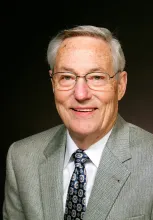
At the time of his retirement in 2016, Roy Holladay was serving the Operation Manager for Ministerial and Member Services of the United Church of God. Mr. and Mrs. Holladay have served in Pittsburgh, Akron, Toledo, Wheeling, Charleston, Uniontown, San Antonio, Austin, Corpus Christi, Uvalde, the Rio Grand Valley, Richmond, Norfolk, Arlington, Hinsdale, Chicago North, St. Petersburg, New Port Richey, Fort Myers, Miami, West Palm Beach, Big Sandy, Texarkana, Chattanooga and Rome congregations.
Roy Holladay was instrumental in the founding of the United Church of God, serving on the transitional board and later on the Council of Elders for nine years (acting as chairman for four-plus years). Mr. Holladay was the United Church of God president for three years (May 2002-July 2005). Over the years he was an instructor at Ambassador Bible College and was a festival coordinator for nine years.
