
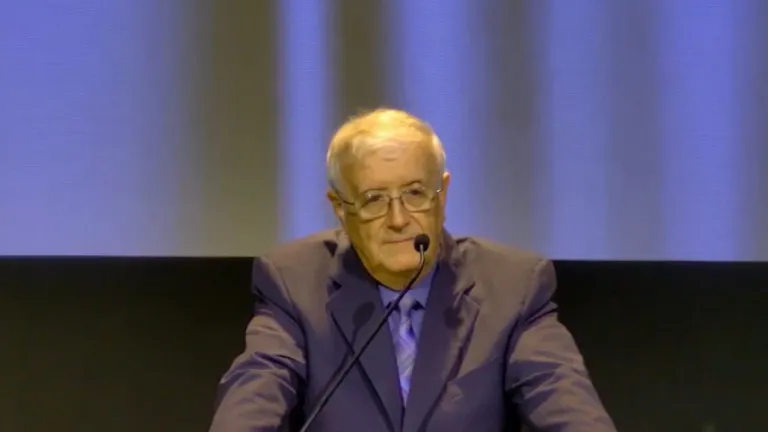

Jorge de Campos
This transcript was generated by AI and may contain errors. It is provided to assist those who may not be able to listen to the message.
I have a sad event in the news about this family that was ambushed and just killed with little children killed in Mexico. It's really a very sad story. And then after they shooting that car, they just burnt the car and people were killed. Some of the children survived, but it really is a very sad story. And when we look at situations like this, we can only pray, we can only pray that kingdom come.
It's our only hope. But situations like this make me think of judging and judgment. I was thinking of calling it judgment and judgment because there's two basic phases of judgment. One is the judging process and then the final judgment. And quite often I think about the situation because I also went through some situations when the country where I was born and they went through independence. Some people were terribly butchered and went through great suffering.
And I think about a time when everyone will resurrect because you and I know, know everyone will resurrect and there's a day of judgment. But the day of judgment is not just that suddenly they resurrected and there's a final judgment. It's more like a day of judging with a final judgment at the end. So that's what I want to talk to you about today is this judging process and the final judgment.
So I want to talk a little bit about it and how it affects us. Now, let's look at, for instance, at the man's system. Even in man's system, say somebody commits a crime, in many cases there is a time of probation where the person is given some opportunity to maybe be released under certain controls which, granted sometimes, in this world they fail. So under certain controls to see that he is through change and then at the end of a certain period a judgment is given to say, well, the person is cleared or still committing the same crimes, it's going to go back to jail.
Now, even man's system, which is very weak, has this, let's call it, approach of giving a person a chance to overcome and repent. Would therefore God be any less judge than that? Or just a net? Because there is a time of probation, which is what I'm calling a time of judging, going through that judging process of cleansing, an opportunity to repent and learn and change, of living and practicing through a time of learning to overcome and trusting God in the process.
And in a sense, it's like you and I. Our Christian life, yes indeed, we have sinned and we were talking in the car about how we now live a new life, but even in that we are overcoming, we are changing, we are becoming better people. And we have to overcome till the end. And we do that with the help of God's Holy Spirit and we're becoming more and more of a new man, we're becoming a new person and Christ is in us.
And that process, as we know, is the sanctification of the Holy Spirit, sanctification of the Holy Spirit. And then there is a final decision, say, when we die and there's a resurrection, where there will be, in the first resurrection, which is a better resurrection, that means a resurrection to eternal life. Or, in other words, the first resurrection, in other words, mercy is applied and we're forgiven and we have eternal life. Or then we are judged, not being the first resurrection, but going to the second death.
And so there is this process, this time of judging, of discerning, of overcoming, and then there is a final judgment. So, in a sense, it's like these two stages in the judging process. One is a stage wherein there is a time of overcoming, of applying certain choices, of discerning. And the end result of that is, at the end, will either be shown mercy or will be judged. Will either be shown mercy or will be judged, in other words, will be condemned. So there is, like two stages, one is a process of judging, of overcoming, of discerning, and then there is, at the end of that, a day in which mercy is applied or you condemned.
And in the case of mercy, that means that you are judged, but you are judged with a hand of mercy. In other words, you are rewarded for eternity to be in the kingdom of God with eternal life. And then there's the other alternative, is that you are judged, at the end of that period, to be punished for eternity in the lake of fire.
Now, you and I know scriptures like 1 Peter chapter 4 verse 17, so let's look at that very quickly. 1 Peter chapter 4 verse 17. 1 Peter chapter 4 verse 17.
1 Peter chapter 4 verse 17, it says, For the time has come for judgment to begin at the house of God. So which phase of this judgment process is talking about? Obviously it's talking about that judging process, because judgment is now happening in the church of God. In other words, we are going through that first stage of being judged, yes, but that we have an opportunity to overcome, to change, to use God's Holy Spirit, to become better people, to approach the Holy of Holies, as you read in Hebrews 10, in a new and living way, through Christ that went through the veil. And we can go to the Father and ask for mercy and forgiveness, and that obviously will be granted because we are in Christ. But we are now learning and becoming better people. And so, judgment has begun in the house of God. In other words, we are going through this judging process in God's church, as God's people. The intent is to make us white. The intent is to make us ready for the married supper, spiritually speaking, of course, for us to be ready, for us to be accounted worthy, as we read in Luke 21, to stand before the Son of Man that is coming. But then we continue reading in verse 17, and if it begins with us first, what will be the end of those who do not obey the Gospel of God? And yes, it begins with us, but it will happen to everybody. And what will be the end, at the end of this process, if you don't obey the good news of the Kingdom of God, which is, if you don't put to practice what we know we need to put to practice. So, what is the Kingdom of God? Well, we know scriptures like Matthew 6, 33 says, you seek you the Kingdom of God, right? So, the Gospel of the Kingdom of God is that we must, therefore, look towards the Kingdom of God. We've got to seek, and it says, in Matthew 6, 33 says, seek you the Kingdom of God and His righteousness. It was God's righteousness, not my righteousness, not your righteousness, not our self-righteousness, but we seek God's righteousness. And then we read other scriptures, like it says when Christ was talking to the Pharisees. It says, the weightier matters of the law is justice, mercy and faith. So, as we look at the law, and as we strive to be more like Christ, we need to put those principles, being just with people and showing mercy, and walking in faith in a way that we know. And we're going to keep going until Christ's coming. So, that's the judgment process. We've got to go through it. And the rest of the world will have their first chance, which they've never had, in the Second Resurrection. So, then at that time, Christ will come. Christ is the one that is coming. That when it is coming is the time of the judgment of the dead. In other words, those that are dead will be judged to be in the First Resurrection, or be judged to be in the future Resurrection. And when Christ comes, He will execute righteous judgment. So, turn with me to Revelation 19, verse 11. Revelation 19, verse 11. It says, Now I saw heaven open, and be all the white horse, and he was sat on him, was called Faithful and True. It was Christ was on this white horse. And in righteousness, He judges. Christ will judge in righteousness, and make war in righteousness. So, Christ judges in righteousness.
And when Christ judges in righteousness, and He sets up the kingdom, you and I will be there. And what will you and I do? You just have to read a little further in chapter 20, verse 4. And it says, And I saw thrones, and they that sat on them, which is as resurrected, because these are the ones that says that are resurrected and live and reign with Christ for a thousand years. And it says, I saw thrones, and they that sat on them, and judgment was committed to them. It was us, as the resurrected saints, at that time, will be delegated to us to judge under Christ. So think about Christ will be like the supreme judge, and then He delegates other judges under Him to execute that process of judgment under Him. So the question is, are we now learning to judge? Because in the world tomorrow, we will be judging under Christ. As we'll see in a moment, all judgment has been given to Christ, to His authority, delegated to Him. And He in turn will delegate sections to different judges. It's like today you got the Supreme Court, and then you got other courts under Him. So it's got that delegation. Are we learning to judge now? We're covering this topic, which is kind of a difficult topic, as we will see, because it does say in Matthew 7, verse 1, it says, judge not. So are we learning to judge? So we're going to discern this and analyze this subject carefully. Look at 1 Corinthians chapter 6. So we just saw in Revelation 20 that we will sit on thrones and judge. But look at 1 Corinthians chapter 6. So in front of 2 witnesses, so Yah is the second witness saying basically the same thing.
It's talking about that Yah is going to people outside of the church to discern on certain matters. And in verse 2 it says, do you not know? Don't you know, don't you get it, that the saints will judge the world? Wow!
1 Corinthians chapter 6 verse 2, don't you know that the saints will judge the world? And if the world will be judged by you, are you unworthy to judge the smallest matters? Now.
So it is an interesting subject or a worthwhile subject to actually get into it a little bit more specifically for us to understand this. Because then it continues in verse 3, do you not know that we shall judge angels? In other words, we won't even judge human beings, we'll judge even angels.
How much more things that pertain to this life? And brethren, we got a number of God's early days, for instance, even think about the feast. You look at scriptures like in Deuteronomy 31, it says, keep the feast and it says, and rejoice so that you may learn to fear God.
So how does that tie together? Because righteous judgment is judgment based on the principles that you fear God, and you're going to do what God wants you to do, not what you want to do it for your own selfish purposes and goals. You see, there will be justice. There will be justice. And we will have to execute judgment in righteousness, because Christ will execute judgment in righteousness, as we saw in Revelation 19.11. And you will delegate some of that activity to the saints and the reams, so they will be doing the same thing that Christ does, judging righteously.
So how do we do that? The key is obviously fearing God, having absolute respect to God, because as we fear God, we put God first, we're going to do it according to God's way, not my selfish motives. So we need to be learning how to judge, so that we'll be able to judge with Jesus Christ. So now that we understand the difference between judging and the final decision of judgment, we need to be learning this judging process, so that we can be judges under Christ, judging righteously. Remember, God is a judge, not you, not me, and God is delegated to Christ. And that's why we read scriptures like Matthew 7, verse 1. So let's look at that very briefly, because I mentioned that earlier on. That says, Matthew 7, verse 1, judge not that you not be judged. But is that a dichotomy? Because I just finished reading in 1 Corinthians 6, that we'll judge the world. How come can't you judge in the smaller matters? Because now it says, judge not that you not be judged. Or is it in one case talking about stage 1, and in another case talking about stage 2? In other words, is it in one case saying we need to be exercising and practicing and learning this judging process? But it's not our duty today to pass that final decision-making of the judgment, that condemnation. And that really is the answer to it. We are to be learning this judging process. We are to be learning to judge, to discern the first stage. But we, in today's physical life, it's not our responsibility, has not been yet delegated to us to pass the final decision-making of that judgment, the second stage. So let me go through it again and talk about these two stages. The first stage is the judging process. In other words, is the stage of discerning or distinguishing or separating the good from the bad?
For instance, you and I see dirt, and what do we do? We wash our hands, right? See our hands are dirty, watch. That is a discerning of separating good from bad. It's a very simple human example. We also see clean and unclean meats.
What you gotta do? You gotta be continuously reminded to separate the clean from that clean and not eat the unclean. Besides the physical benefit of making sure that you don't get unhealthy and things like that, there is another big spiritual lesson from it. The spiritual lesson is that you have to be watching what you eat all the time, particularly when you go to a restaurant or when you're outside your home or when you go shopping.
You gotta read the labels and see, well, has this got pork or not? Or whatever. The lesson is, it's gotta be in our minds, continuously, this discerning, this separating, this distinguishing, this judging, or whether this is bad or this is good. And the spiritual principle therefore is, we gotta be continuously discerning what we hear, what we see, what we observe, whether it is bad or good, and not allow that into our minds.
Just like we don't allow food into our stomachs, the spiritual analogy, we don't allow those wrong thoughts into our minds. We gotta be discerning, we gotta be distinguishing, we gotta be judging. That is a judgment process. We gotta be judging. And that ties in about being clean, about being sanctified, about being merciful. All that ties in. And so that also ties in with forgiveness. That when people do wrong, you gotta be able to forgive and we gotta apply forgiveness. And if possible, the key word is if possible, reconcile.
Why do I say if possible? Because forgiveness takes one. Reconciliation takes two. You see, if you forgive, you let it go. That's just between me and God. I forgive, let it go. Reconciliation takes two. You gotta make your effort and the other person is gonna make the effort as well.
It takes two to tangle. If two are not working on reconciliation, there will not be reconciliation. But if possible, be reconciled with all men. You do your part. But if the other person is not doing their part, there's nothing else you can do. Look at the example. God, through Christ, has reconciled us to Him. So He's done His part for us to be reconciled to God. But if you and I, or individuals in the world, do not do their part of being reconciled with God, there's no reconciliation between those people and God.
Because it takes two to tangle. God has done His part and the individuals have to do their part for it to be reconciliation. Likewise between two brethren, for instance. If it's possible, be at peace with all men. But you can do all your part and you can forgive and you can do it, you can be prepared.
But if the other person does not want to walk together with you or tangle with you, you're not gonna tangle. It's as simple as that. So that is the first stage of judging. It's a discerning process.
It's a separating process. It's a determination, this is good and this is bad. And we need to learn to do this in our life today. And then there's the second stage. It's the final decision making, the Day of Judgment, which is the condemnation or the passing the sentence that you clean and mercy is applied. You see, so there is that second stage, which is to throw away, to destroy, to cannot be fixed, therefore it's condemned. And that is not our role today. That has not been delegated to us today. Because that final decision making is God's and has been delegated to Christ, but not to us.
So brethren, we have to therefore learn to execute righteous judgment. We've got to have to have the fear of God. And therefore we have to do everything we can to do everything with justice the right way, according to God's way, and to apply mercy and to be forgiving and merciful.
And then take the step of faith, walking faith, that's why it says justice, mercy and faith, that I'll do that in faith, then maybe the other one will do that as well. So if it be possible, do everything to be a peace with all men. But you and I do not have the judicial authority to pass a spiritual sentence. You know, we do not have the judicial authority to condemn a person. That's God's. But our responsibility is to be judging, to be discerning, to be separating what's right and wrong. Look at James chapter 4. James chapter 4 verse 11 and 12.
James chapter 4 verse 11 and 12. Do not speak evil of one another, brethren, but he who speaks evil of a brother and judges his brother. In other words, he has already, when he speaks evil, he has passed a judgment.
He has condemned. And he speaks evil of the law. How can he speak evil of the law?
Because the law says it's not your job. And if you are doing what the law says, it's not your job, you are saying the law is wrong. And therefore he's speaking evil of the law. And therefore you're judging the law. He says the law is wrong. I should be doing this when you shouldn't because it's God's right, not yours. But he says, but if you judge the law, you're not a doer, but a judge. You see, it makes sense when you look at it from this point and start tying it all together. Why? Because there's one law given which is God, who is able to save and destroy. And God has delegated all this work to Christ.
Who are you to judge another therefore? It's not our right. You see, that second stage is not our right of condemning or passing judgment or saying this person is bad. It's not our job. It's not our job. That's why it says judge not. That's why it says judge not. In other words, don't condemn. Now look at John 7, verse 24. John 7, verse 24.
And there's a situation here that has run about the time of the feast in A.D. 30. And they were trying to kill Christ. You look at verse 19, why did you see to kill me? And people say, no, you are a demon. Nobody's trying to kill you. Well, they were trying to kill you. That's a fact. And then he's talking about circumcision on the Sabbath. And are you angry with me because I healed the person on the Sabbath? And it's not wrong to do good on the Sabbath. So you're judging me. Now look at verse 24. Do not judge according to appearance, but judge with righteous judgment.
We ought to judge with righteous judgment. And what are we to judge? The discerning, the separating good from evil, not condemning. But we ought to judge now that stage one, the discerning. Hey, what Christ was doing was not bad. He was doing good on the Sabbath. There's nothing wrong with doing good on the Sabbath. So judge with righteous judgment. Why? Because you fear God, you put God first, and you're concerned with what is the interest of God first. You see, God's law tells us what is right and what is wrong. Isn't it? God's law tells us what's right and what is wrong. And therefore, it is our job to discern right from wrong. In other words, it's our job to learn to make choices. Isn't it? We need to discern to separate right from wrong. We need to make choices. And that discerning is judging. Stage one, as I was talking about. But it's not condemning. Stage two. It's just that stage one.
If you've been around in the church for a while, you'll remember Mr. Armstrong would always go back to the two trees.
The Tree of Life and the Tree of Knowledge of Good and Evil. The Tree of Life means that you trust God to decide for us what is right and wrong, what is good and what is evil. And you believe God that He says, this is right and this is wrong. Therefore, God tells us what is right and what is wrong. That is God's law tells us what's right and what is wrong. You believe that. That's the Tree of Life. The Tree of Knowledge of Good and Evil is, I do not trust God to tell me and decide what's right and wrong. I'll decide for myself. It's my right to decide what's right and wrong. And that's what's the problem with the world today. You're watching the news. Well, it's my right. This is right. This is wrong. Well, that's the way I see it, the way I understand it. That is the Tree of Knowledge of Good and Evil. In other words, you decide for yourself what is right and wrong. Or in other words, you do not trust God to decide what's right and wrong. Or in other words, that's the Tree of Death. You see, God gave to Adam and Eve two trees, a Tree of Life and a Tree of Death. The Tree of Life is God decides what's right and wrong. The Tree of Death is you decide for yourself what's right and wrong. But God gave us a choice.
That's why you read in Deuteronomy 30 verse 19. I don't have to turn there now. You know it pretty well. He says, I set before you today life and death. Choose life that it may be well with you.
In other words, I set before you life and death, judge, discern. Make a judgment of what is right and what is wrong and do what is right, so it may be well with you. That is stage one.
How many of us have year after year kept Passover or heard sermons during the time of Passover? How many times have you and I heard this scripture read 1 Corinthians chapter 11? Let's go to it. 1 Corinthians chapter 11. I was related to the Passover. 1 Corinthians chapter 11.
And we're going to start reading in verse 28. But let the man examine himself. Haven't we read this so many times during the time of Passover that he says, we come to the Passover and make sure you examine yourself. 1 Corinthians 11 verse 28. But let a man examine himself. And so let him eat the bread and drink the cup.
We are told to examine ourselves. That is self-judgment. Think about it. That's self-judgment. That is the surname for yourself. What is right and what is wrong and am I adhering to that standard of the Tree of Life? Because God tells us what's right and wrong. Am I comparing myself to that and am I doing that? If, if, you and I are self-examining ourselves, and if you and I, therefore, are self-correcting ourselves with the help of God's Holy Spirit, then God does not have to judge us. Right? Because we've judged ourselves. And that's what it says.
For He who eats and drinks in an unworthy manner, eats and drinks judgment to Himself, not discerning the Lord's body. Well, look at verse 31. For if we would judge ourselves, we would not be judged. If we do the self-examination, if we do the self-examination, the self-judgment, if we're judging ourselves, God's not gonna judge us. Because we've already done that part.
And Yah is talking about in the context that you examine yourself so you don't hurt the brethren. So you judge yourself making sure that you're doing things in a worthy manner so you don't hurt the brethren. Because that says, not discerning the Lord's body. Oh, yes! You can look at it purely, physically. There you are. You're not understanding the sacrifice of Christ. But you can look at it spiritually. Because you and I have been baptized into the spiritual body of Christ, which is the true Church of God. So if we treat bad a brother or a sister, if we say something bad of a brother or a sister, if we are therefore doing stage two of judging in a brother and a sister, we're not discerning Christ's body. And if we're not, we're gonna cause hurt. That's why for this reason, verse 30, many are weak and seek among you and many sleep. In other words, many have died. How many people in the Church have suffered? Because of other people in the Church and many have actually died of heart attacks or whatever it is, because of things that have been done in the Church to hurt one another. Because we're not judging ourselves. So it's not wrong to judge stage one, but it is wrong to condemn stage two.
Look at Romans chapter 12 verse 18. This is a scripture that I made reference to it a little earlier, but now I just want to read it. Romans 12 verse 18.
Romans 12 verse 18.
If it is possible, as much as it depends on you, live peaceably with all men. In other words, do all you can to be at peace. In other words, to be reconciled. Do all you can. Now, if the other person doesn't do their part, then it's not possible. But if you're doing your part, it's not your fault if there's no reconciliation, because you're not responsible. If the other person doesn't do their part, then it's not possible. But if you're doing your part, it's not your fault if there's no reconciliation, because you're doing your part. If it is possible, live peaceably with all men. Do your part in reconciling. And look at verse 19. Beloved, do not avenge yourselves. Don't put yourself in a position to pass the judgment and tell him, you are wrong, and therefore that justifies me to do this to you. And therefore that justifies me to tell you this or whatever.
Because as we read earlier on, then you're judged with the law, not a doer. So that says, Beloved, do not avenge yourselves, but rather give place to wrath. In other words, leave it in God's hands.
Trust God. Leave it in God's hands. Or is it easy? No. Why? Because maybe I feel like I need to tell that person that he or she has done this wrong. And it's my right. You see, it's Matthew 18. I've got to go and tell the brother that he has done wrong. Maybe if the sin is big enough to do that, but if it's not, can't you forgive and let go?
You know, there's a thing about forgiveness, isn't it? And let go. So it says, give place to wrath for its reason. Vengeance is God's, our repay. Leave it in God's hands. Let God sort it out. We don't trust God that he's going to sort it out. Oh, I've got to do it because I don't trust God. Well, obviously you don't think that way, but it's just the point is we've got to leave it in God's hands. Therefore, if your enemy is hungry, feed him. If he's thirsty, give him a drink. And in so doing, you'll heap calls of fire in his head. Why? Because if he is not repenting and forgiving and repenting to God and coming back to you and whatever it is, you doing your part. Hey, the calls of fire is God's revenge. God's wrath will be on him or her. Do not be overcome by evil, but overcome evil with good. We've got to do our part. We've got to do our part.
Look at Matthew chapter 5. In Matthew 5, when we are praying, that's part of what's called the Lord's Prayer, but it's the model of prayer. Matthew chapter 5. Sorry, that's before the Lord's Prayer. I'll go to the Lord's Prayer just now. But before that, Matthew chapter 5 verse 23 through 26, and it's talking about, have you not heard? Don't be angry. Don't say, ragged. Don't say, you fool. Look at verse 23. It says, Therefore, if you bring your gift to the altar, and then remember that your brother is something against you, leave your gift there before the altar and go your way. What does that mean in practical terms for you and I?
In practical terms for me and for you, when we are before the altar, we are before God's throne in our prayers. And if you and I are praying to God, and a thought comes to your mind and says, I haven't sorted this out with that brother or sister. It says, stop your prayer and sort that problem out. Do your part. If it's possible, do everything. It's possible to be at peace with your brother. And forgive and let it go. First, be reconciled to your brother and then come and offer your gift. Then come and continue the prayer. It's really thinking about it's part of this first stage of judging, of discerning, of deciding to do the right thing. Is it easy? No. It's not easy. It's not easy. Now imagine when people have died, and imagine those people that died in Mexico this past week, and they'll be resurrected in the second resurrection. But what if those drug lords that never knew God, never knew Christ, are resurrected with them in the second resurrection, and now they've got to look at each other, and they've got to reconcile. Is that going to be easy? No. No. That's why they need a bit of time, maybe a hundred years. But it's going to take time! But they're going to have learned the truth. They're going to come to repentance. They're going to receive the forgiveness for Christ's blood. They're going to be overcoming. They're going to be working and making progress. And they're going to reconcile. That's going to take time.
Granted, every man will be judged according to their works, so there are consequences. Even then there will be consequences. I'm not saying, oh well, they'll just be everything clean and no problem. There are consequences. They'll be judged according to works. But if the people repent, the ones that have done that atrocious evil, and they repent, and they have paid whatever it is through their consequences, and they repent, and they humble before God, and they want forgiveness, what about the one that the crime was done against them? Will they forgive? And that's hard. It's hard. When the crime has been done against you, and you've got to forgive, you know, it's like Stephen said when he was down, forgive them because they don't know what they're doing. That takes something. That takes a lot. So we have to reconcile, and imagine the people in that second resurrection. It won't be an easy time. It'll be a difficult time. That's why I need some time for it. It's not like one day or two days. It'll be, as we think it will be, based on Isaiah 65, 20, 100 years. So that'll take time. And that's what we do, and we pray, and that's what we're told in the Lord's Prayer, which I was mentioned to you a little earlier on, that it says in Matthew 6, verse 12, And forgive us our debts as we forgive our debtors. Do we forgive? We all need forgiveness. We all need forgiveness.
And then a little lighter, verse 14 and 15 says, For if you forgive man the trespasses, your heavenly Father will also forgive you. But if you do not forgive man the trespasses, neither will your Father forgive your trespasses. Quite plain. Quite plain. And so, yes, we mustn't judge, as we read in Matthew 7, verse 1. Don't judge. In other words, don't do that second stage of condemning. But look at Matthew 7. We've seen that we're there, or nearly there. We just completed Matthew 5 and Matthew 6. And now look at Matthew 7. It says, Judge not that you not be judged. In other words, don't condemn that you're not going to be condemned. 4, verse 2. With what judgment you judge, you will be judged. In other words, what measure you use will be measured back to you.
Therefore, we need to judge righteously, because you and I want to be judged righteously. With verse 3 through 5. And why do you look at the speck in your brother's eye, but do not look at the plank in your own eye? In other words, are you self-righteous and you think, well, I'm great, but this person's after this terrible sin. Well, just you being self-righteous is a big sin. Or how can you say to your brother, let me remove the speck from your own eye and look at the plank in your own eye? So, hypocrite, first remove the plank from your own eye and it was your self-righteousness. And then you'll see clearly to remove the speck from your brother's eye, because we need to judge righteously, not based on our needs, but on God's standard, the Tree of Life. 6. Do not give what is holy to the dogs. No cost your pearls before swine, lest they trample them under their feet and turn and tear you in pieces.
That's a very powerful. If we don't discern correctly, and we kind of apply this incorrectly, in other words, we kind of allowing wrong to continue, because we're not discerning it correctly. It's going to hit us back.
It's going to hit us back. You see, that's unrighteous judgment. If we're allowing, or in our minds, we're allowing that wrong spirit. Therefore, for us in the Church, we must discern, differentiate, separate, but not condemn. Look at 1 Corinthians 5. 1 Corinthians 5. Starting in verse 9. I wrote to you in my epistle not to keep company with sexually immoral people.
Yet, I said it did not mean with the sexually immoral people of this world. You see, that rising to the point of you can't do this with people not in the Church, because you're costing your pearls before swine. You've got to apply this to people in the Church, or if the coverages of extortion are adulterous, then you would need to go out of the world. But now, verse 11, I have written to you not to keep company with anyone named a brother who is sexually immoral, or covetous, or an idolater, or a reviolent, or a drunkard, or an extortioner, not to even eat with such a person.
So you're applying this discernment to people that understand, and they say, look, you're doing these things wrong in a laughing kind way. I can't associate. I can't go with you because you're doing these things. You know better. I can't be with you. Come on. So it's in a kind, loving way. For what have I to do with judging or those who are outside? Do not judge those. Do you not judge those that are on inside? Aren't you making a discernment and distinguishing with those inside? But those who are outside, God judges. They will put away from yourselves the evil person.
So you and I need to discern, not condemn, but discern and separate good from bad, but talking about those in the church in love. Not passing final judgment, but we've got to address problems in the church, and that's a challenge to the ministry. Because the ministry has a job to do, and it's not easy to be a minister. And when there are situations like that, you've got to be careful. Sometimes it's not your responsibility to step in, but that's weird. Then when Matthew 18 comes in, you talk to the brother, you go and talk to him, and if he doesn't listen, you talk to one or two women.
But then the problem is going to be big enough, because then you take it to the church. And the church says, well, if he doesn't do anything about it, by series, quote-unquote, you've got to leave the church. You don't want to do that for some small little sin. That's going to be a big serious matter.
So you've got to be careful. So continuing in 1 Corinthians, we just finished reading verse 13. So let's move on to the next chapter. Chapter 6, verse 1, that's what it says. Don't you know that the saints will judge the world? And we need to learn now to judge, to discern, to separate. And as we learn this, and as we do it in the right way, we will learn to show mercy as well.
Because in the end, you're either going to be shown mercy, or you'll be condemned or judged. Simple as that. In the end, you'll either be shown mercy or be condemned. With the same measure you apply, the same measure you're going to get back. What do you want? What do I want? We want mercy. So let us all now apply mercy as much as we can. As we show mercy, and we shall love in kindness towards others. It was interesting in the sermon that the word joy refers to Kara, or Carise, which is related to that charity, which is also, joy is an inner contentment.
And if you are doing this and you're showing mercy, you will have that joy, because you don't have that bitterness against the other person. And remember, brethren, mercy triumphs over justice. Look at James 2, verse 13. James chapter 2. James chapter 2. Mercy triumphs over judgment. Chapter 2, verse 13 in James. You see, for judgment is without mercy, to one we shall know mercy. But mercy triumphs over judgment. Sorry, I said justice just now. I did not mean that.
I meant over judgment. In other words, mercy triumphs over that condemnation, the final condemnation. That means, if we are showing mercy by us showing mercy, by us being forgiving, which is not easy, particularly when people hurt us badly. But when we're doing that, and we're making an effort for reconciliation, and we're doing our part and leaving the rest in God's hand, and we're showing mercy, that will be shown back to us. That is part of the concerning good from evil, and that we need to apply now.
As we read, if it's possible, be at peace with all men. What about the other person? Oh, while I've done my part, what about the other person? Well, it's God's job to work with the other person, and God's Holy Spirit and God's Word. That's... that leave it in God's hand. God's working with you and me and us. We do our part. The other person, you do your part, you pray for them, but leave it in God's hand. Jesus Christ is the final judge. Look at John chapter 5 verse 22. John chapter 5 verse 22.
For the Father judges no one, but has committed all judgment to the Son. God has delegated all judgment to Christ. Jesus Christ is the final judge. He's the one that is going to sit on that great white throne and judge. It has been committed to Jesus Christ.
And everyone will be judged according to their works. And that is the job of Christ, to pass that final judgment. It's His job to separate the sheep from the goats, and His job to say, enter you the kingdom. Enter you the way of joy. It's His job. Therefore, look at 2 Peter chapter 3. Verse 11 through 18. 2 Peter chapter 3. Verse 11 through 18. Right at the end of Peter. Therefore, verse 11. 2 Peter chapter 3. Since all these things will be dissolved, right at the end everything will be dissolved. What manner of persons ought you to be in holy conduct and godliness? Looking for and hastening the coming of the day of God, because of which the heavens will be dissolved. Being on fire and the elements will melt to fervent heat. Nevertheless, we, according to the promise, look for new heavens and new earth in which righteousness dwells. You know what? Beyond all this, the new heavens and new earth, righteousness will dwell. That's why it says there will be no more pain, no more tear, no more cry, but really true, fulfilling joy, as we are in the sermon here. And continue. Therefore, beloved, looking forward to these things, be diligent to be found in peace without spot and valence. Yes, be a peacemaker and consider that the long suffering of our Lord in salvation, and like Christ had to suffer wrong, we also have to suffer wrong. And then we jump to verse 17. You, therefore, beloved, since you know verse beforehand, beware, don't fall from being steadfast and loyal to the end. Don't fall in the wrong way. Don't fall in trying to condemn people or speak bad, but rather grow in the grace, in the loving kindness, in the love and joy and peace of God's Holy Spirit, which is knowing Christ, living in us, and the knowledge of our Lord and Savior Jesus Christ. Because to Him is the glory of now and forever. Look forward to that time of eternity when you and I will have joy forever, happy and at peace and fully reconciled. There's no arguments between people. That's what we look forward to. So therefore brethren, we need to now be growing in the process of judging so that we learn to discern good from evil, so that we may be there with Christ when it comes back.

Jorge and his wife Kathy serve the Dallas (TX) and Lawton (OK) congregations. Jorge was born in Portuguese East Africa, now Mozambique, and also lived and served the Church in South Africa. He is also responsible for God’s Work in the Portuguese language, and has been visiting Portugal, Brazil and Angola at least once a year. Kathy was born in Pennsylvania and also served for a number of years in South Africa. They are the proud parents of five children, with 12 grandchildren and live in Allen, north of Dallas (TX).
