
Don Ward
This transcript was generated by AI and may contain errors. It is provided to assist those who may not be able to listen to the message.
What the world needs now, what we need now, what everybody needs now, we need encouragement, we need help, we need hope. All week long, and by the way, this week was sort of like the Dickens' shortest of times, the longest of times. This week was one of the shortest and longest weeks of my life. I asked myself through the week, what is the main thing that each person in our congregation needs, and for that matter, what is the main thing that each person in the whole wide world needs at this time? Is it a sermon about, understanding more clearly some doctrinal point, is it a sermon about oral conditions, describing those which all of us tune into Fox, so we think we know it all there? Or is it hope and help in facing the great trials that every person on earth is facing at this critical, crucial juncture in human history?
With all the bad news in the world, we sure could use some good news. As you know, the word gospel, euangelium, is a word from which we get evangelism. The word gospel literally means good news. If you would turn to Mark 1 and verse 14. This is where Jesus begins his earthly ministry, and as he begins his earthly public ministry, what was he preaching? He was preaching good news. He was not preaching the bad news of the day. He was preaching good news. So we're at Mark 1.14. Now after Jesus was put in prison, Jesus came into Galilee preaching the gospel, the euangelium, the good news of the kingdom of God.
The good news of the kingdom of God. And saying the time is fulfilled and the kingdom of God is at hand, repent you and believe the good news. And the world has basically rejected the good news, the gospel of the kingdom of God. And of course, the great condition for entering the kingdom of God, he said, repent and believe the gospel. The good news of the coming kingdom of God was the central theme of Jesus' message. And we must cling to the good news of the coming kingdom of God.
Rehearse it, believe it, live it, know it. We are in tough transitional times, and things are not going to get better. The Apostle Paul writes in Hebrews 10.38, or as Paul wrote this epistle here to the Hebrews before the destruction of the temple and preparing the way for the transition into the new priesthood, that is, the priesthood of Melchizedek.
Of course, Christ had already been sacrificed, risen, ascended to heaven, and the terms of the new covenant were being laid out. And the Apostle Paul writes, If any man draws back, my soul shall have no pleasure in him. That's Hebrews 10.38. If any man draws back, my soul shall have no pleasure in him.
I believe that regardless of our spiritual state, our ability to face what lies before us can be improved. Each one of us can become more equipped in our battle against the forces of evil of this day. Remember back a few months ago, I tried to get us involved in enthusiastic expectation and enthusiastic participation. It's difficult to just work up enthusiasm within ourselves.
We need a source to nourish our expectation of better days. I believe that every person on earth needs encouragement and comfort at this time. We need the strength and the wherewithal to keep on keeping on. Then you stop and ask yourself, What can I say that will provide expectation, enthusiasm, encouragement, and comfort? What can be said that hasn't been said?
Well, there's really probably nothing that can be said that hasn't been said. But we need to say what we need to say today. Many times I feel that I'm in need of the same thing. And we all feel that way from time to time. Then I realize we must look at the source of comfort and strength. As I said, it's difficult to work up faith, to work up enthusiasm, to work up the things that really matter just on our own.
We need the source of comfort and strength, welling up within us. We can all be filled with courage, strength, and unspeakable joy if we're in tune with the giver of every good and perfect gift.
And James 1, 17, 18 says, Every good and perfect gift comes down from the Father of lights, with whom there is no bearableness, neither shadow of turning. Now let's look at Philippians 4 and verse 4. Philippians 4 and verse 4, and Peter and the Apostle Paul here, talks about how we can be enthusiastic, we can be filled with expectation, we can be encouraged, and it has to do with tuning into the right source.
And the right source is the Word of God, as we shall see shortly. In Philippians 4 and verse 4, here is a command, Rejoice in the Lord always, and again I say rejoice. Of course, that doesn't mean that you're joyful when someone dies or someone is on what they call their death bed or someone is struggling, trying to overcome whatever it is that they're trying to overcome.
Peter talks about, even though now we're in manifold trials, knowing this, though, that the trying of your faith is more precious than gold tried in the fire. So he continues here. So we read that 4 again. Rejoice in the Lord always, and again I say rejoice. Let your moderation be known unto all men, the Lord is at hand.
Be careful, which means be anxious for nothing. Don't be worried about anything, it says. Be careful, be anxious for nothing, but in everything, by prayer and supplication. And supplication is a continuous attitude of going before God and supplicating, asking. You know, Paul worded sometimes he would say, I beseech you brethren by the mercies of God, supplicating with them.
And this is talking about supplicating with God. By prayer and supplication, with thanksgiving, let your requests be made known unto God. Now, look at verse 7, because verse 7 tells you what will be the result of this. And the peace of God which passes all understanding shall keep your hearts and minds through Christ Jesus. So that's one of our first big steps there, is verses 4, 5, and 6.
It says, then you'll experience the peace of God which passes all understanding. So we need to look to the source of peace and comfort. And so, once again, we're going to read at this juncture what we read during the announcement section, 1 Corinthians chapter 1 and verse 3. So please turn to 1 Corinthians, 2 Corinthians chapter 1 and verse 3. 2 Corinthians chapter 1 and verse 3.
Blessed be God, even the Father of our Lord Jesus Christ, the Father of mercies, and the God of all comfort. So here is the source. As I said earlier, it's difficult to work enthusiasm, encouragement, rejoicing, and all of that up just within ourselves. We need some source, some springboard, and the Word of God provides that, who comforts us in all of our tribulation that we may be able to comfort them which are in any trouble, wherewith ourselves are comforted of God.
So we live in a negative age in which every nuance of speech and body language is critiqued and judged. We have those who sit in the seat of the scornful and say, where is God in all of this? Why is God allowing all of these things to happen? Of course, that answer is very easy. It is because God, the way of God, has been rejected by humanity and He's gone His own way.
But we can say no to negativism and claim the promises that God extends to those who seek Him. We can claim to the promise of love, joy, and peace in the kingdom of God. In fact, the Bible definition is, the kingdom of God is love, joy, and peace in the Holy Spirit. It's in Romans 14 verse 17. We can claim to the promise of love, joy, and peace in the kingdom of God. God communicates His will and His way to us through His Word.
So our basic premise today is taken from John 6, 63, which I have quoted roughly 50 times in recent years. The flesh profits nothing, it is the Spirit that quickens. The words I speak, they are spirit and they are life. The flesh profits nothing, it is the Spirit that quickens.
The words that I speak, Jesus Christ saying the words that He speaks, they are spirit and they are life. See, spirit is a source. So the Word of God and the Spirit of God bubbling up in us serves to energize.
We either believe what God says, or we are left to believing and doing what our own minds can conjure up, or the mind of someone else. And so many people mix their own notion of what God is like with what they have made Him to be. God is the way that is revealed in the Bible.
They profess to know Him and yet they refuse to obey Him. And you can end practically any, if you're in a debate with regard to back and to with 1 John 2-4. 1 John 2-4 says, If any man says that he knows Him and keeps not his commandments, is a liar and the truth is not any. I mean, that's what the Bible says.
They profess to know Him, yet they refuse to obey Him in the great tests.
If any man says that he knows Him and keeps not his commandments, is a liar and the truth is not any. If you want to be filled with Spirit and life, then you must hide the Word of God in your heart so it becomes your foundation for your approach toward life. Look at Psalm 119 verse 9.
Psalm 119 verse 9 has so many applications. It's one of the ways that you can overcome obsessive, compulsive behavior, various addictions. It is through hiding the Word of God in your heart. And when the urge to do whatever the compulsive, addictive behavior is, you open your pages of the Bible to hear, get on your knees and you pray, you cry out to God. Verse 9, Wherewithal shall a young man cleanse his way? By taking heed thereunto according to your word, with my whole heart have I sought you, or let me not wander from your commandments. Your word have a hidden in mine heart that I might not sin against you. The Word of God must become our meditation. As the Psalmist writes, O how love I your law, it is my meditation all the day. It was our first hymn today. O how love I thy your law. Meditation means to think about and to dwell on, to reflect on. What would you do if such and such happens? What is your course of action? Jesus Christ set the example, and he told us the words that he speaks are spirit and life. If we really believe God means what he says, then we have to do what he says. The Apostle Paul had to contend with many trials and sufferings while doing the work of God. Paul wrote 14 epistles. Paul traveled the known Mediterranean world, went as far west as he could. Some say he even went as far as Britain. But let's look at 2 Corinthians 10.22. 2 Corinthians 10.22. Here we get a glimpse of what Paul suffered while doing the work of God. Not suffering, as not in the limelight as Paul was. Not having the commission put upon him that he had at his conversion. Paul, I'm going to send you to the nations. 2 Corinthians 10.
I want chapter 11. 2 Corinthians 11.22.
The 2 Corinthians is basically Paul's defense against the accusations that the Corinthians continually brought against him. They accused him of many different things and criticized him. They criticized that he didn't visit. They criticized that his words were heavy when he was away, but not so heavy when he was there. They criticized him for the way he spoke. Whereas Apollos, on the other hand, was an eloquent, gifted kind of speaker. But Paul here, unlike most cases where he debases himself, says, I'm going to boast a little here, he says. So this is 2 Corinthians 11.22. Are they Hebrews, talking about some of the accusers and false ministers? So am I. Are they Israelites? So am I. Are they of the seed of Abraham? So am I. Are they ministers of Christ? I speak as a fool. I am more in labors, more abundant, in stripes above measure, in prisons more frequent, in deaths often. It was like he faced so many situations of, am I going to make it or am I going to die in this situation? Of the Jews, five times received die 40 stripes, save one. The 39 stripes, five times, and the whip that they used could shred the flesh on your back. Three times was I beaten with rods. Once was I stoned. Three times I suffered shipwreck a night and a day I have been in the deep out the sea trying to get to shore. Injournings often in perils of waters, in perils of robbers, in perils by my own countrymen, in perils by the ethnos, the nations, the Gentiles, in perils in the city, in perils in the wilderness, in perils in the sea, in perils among the brethren, in weariness and painfulness, in watchings often, in hunger and thirst and fastens often, in cold and nakedness. Besides those things that are without that which comes upon me daily, the care of all the churches.
So none of us have even remotely experienced what the apostle Paul experienced. He was doing the work of God. He was carrying out from God a special commission.
And yet he went through all of that, and I'm sure that not everything is listed there. Now let's look at Philippians 4 again in verse 11. And here Paul gives us somewhat of a key once again as to how he was able to endure all of that and keep moving on. And that's one of the main purposes here today, is how we can bind the source, the wherewithal, to keep on keeping on, and not to draw back. Philippians 4 verse 11. Not that I speak in respect of want, for I have learned in whatsoever state I am therewith to be content, whatsoever state.
I know how to be abased. I know how to abound. So often he was abased. Very few times was he praised and set forth as an example. Everywhere and in all things I am instructed both to be full and to be hungry, both to abound and to suffer need. Then he said, I can do all things through Christ who strengthens me. See, there is the source. Once again, the words I speak, they are spirit and they are life, but you have to believe them. You have to meditate on them. You have to inculcate them, make them a part of your life. Notwithstanding, you have well done that you did communicate with my affliction. Finally, the Philippians did communicate. Communicate means to send him what he needed in his time of trial. The reason Paul could be content with whatever state he was in was because of his living, active faith. He knew and knew that he knew that God was faithful, who had promised, and that trial would pass. All trials will eventually pass. It may be in our death, it may be in our lifetime, but God has promised his saints rest. All of these verses that we have read are telling us to keep the big picture burning brightly in our minds. The big picture of the kingdom of God. Jesus Christ came preaching the good news of the coming kingdom of God. Paul writes in 1 Corinthians 2 verse 9, I is not seen, ear has not heard, neither has it entered into the hearts of men what God has prepared for those who love him. We can't even imagine what lies ahead. We are two thousand years down the road from the days of Christ and the Apostle Paul, but the promises are just as sure as they were at that time. I am convinced, have been convinced for a long time, that the reason many people become lukewarm and disinterested and fall away is because they become lackadaisical.
I was encouraged by the attendance figures that we just saw. I think it's 49 present here today, but there are 52 online. Generally, for every person online, there are at least 1.6 to 2 other people. Because we come, become lackadaisical. Lackadaisical is, to me, another word for laity-seism. Lackadaisical sounds much like laity-seian. Neither hot nor cold, they take things for granted, begin to view the sacred things of God as mundane and commonplace. All I have heard about Jeremiah before, in the class this past week, I held up a manuscript, a notebook of an outline that I did for Jeremiah when I was a student at Ambassador 50 years ago. It was dated May of 1970, 50 years ago, an outline of Jeremiah. It was 38 pages, single-spaced. We did outlines of Isaiah, Jeremiah, Ezekiel, Revelation. You can only imagine how many hours it took to do that.
We did it with zeal, and we did it because we wanted to learn. Once you do something like that, you're in a sense writing a mini-commentary.
But each one of us can ask ourselves, are we taking things for granted? Are we beginning to view the sacred things of God as mundane and commonplace? Another reason many people become lukewarm is because they're looking for an excuse. They're looking for a loose brick. They're looking for an excuse to take the easy way out and retire to the junk heap of could-have-beens. How sad the saddest words of men or pen is those of he could have been, something like that. He could have been, but he wasn't. He quit. She quit. He didn't hold to the end of the row.
There are no loose bricks in the Word of God. Not only. Every promise is sure. There is no slack in His promise. There's no wavering in His love for you. All of this stuff we come up with about why we're unhappy, discouraged with this or that is just that. It's stuff. You know, stuff, maybe... What if we were to take stuff out of language? Nobody in the world could use the word stuff.
As the saying goes in the grand scheme of things, it doesn't amount to a hill of beans. As I've said so often, as the Bible says, if you don't attain to the kingdom of God, that's all I mean. You could have your 70-80 years of fame, but if you don't attain to the kingdom of God, it's all in vain.
We oftentimes think we're justified in what we're doing. We don't like the way so-and-so looks at them. We don't like what so-and-so said. We don't like the way the minister talks. We feel like everybody's judging us. We feel like we don't belong. We would rather be somewhere else. But what we need to be concerned about is not what man thinks or what man judges, but what God thinks and what God judges. Even though people may be mistreating you, these kinds of feelings and attitudes are not from God because He's promised to never leave you or forsake you. Those kinds of thoughts are thoughts of doubts planted by the adversary, Satan the devil. If God be for you, who could be against you? It's Romans 8.31. This little essay, What Satan Fears Most. What Satan fears most is a man on his knees, not vast marching armies with great weaponry. He knows he can stand against the power of men to engage us in battle, his mere sport to him. But a man on his knees with his head bowed in prayer is something quite different to the prince of the air. For when he sees us in prayer to our God Most High, he knows we have seen through his devilish lies. That's why Satan, that's what Satan fears most. A man on his knees, and we'll keep him trembling if her prayers never cease. If you repent of your sins, exercise faith in the sacrifice of Christ for the forgiveness of sin, then the peace of God which surpasses all understanding should be abiding within each one of us. We all need to be reminded what Jesus says in Matthew 28.
I'll reverse that. Matthew 11 verse 28. Matthew 11 verse 28 through 30. Come and learn of me, my yoke is easy, and my burden is light. Oh, I don't want to be geared down, weighted down with all those dos and don'ts. The God I serve would never want me to have to do that. I just have to be a good person.
All of man's righteousness is as filthy rags as what Paul writes in Romans. None of those kinds of thoughts really amount to anything. Come and learn of me, my yoke is easy, and my burden light. And you coupled that with 1 Peter chapter 5 and verse 7. 1 Peter chapter 5 and verse 7. Come and learn of me, my yoke is easy, and my burden is light.
There's great liberty in the perfect law of God. The perfect law of liberty sets you free from fear, ignorant superstition, and the dogmas of man.
1 Peter 5 and 7. Casting all your care upon him, for he cares for you. God wants us to encourage one another, to lift one another up. There are three main purposes of prophesying. If we notice now 1 Corinthians 14. 1 Corinthians 14 deals with spiritual gifts. What are the purpose of spiritual gifts? What is the purpose of spiritual gifts? In 1 Corinthians 14 and verse 1. Paul showed us the more excellent way in chapter 13, that is to become love as God is love. Then he turns back to spiritual gifts because he started chapter 12 with spiritual gifts. In chapter 14, follow after charity, that is love. That is the greatest thing that exceeds all others to become as God is. God is love. Follow after charity and desire spiritual gifts, but rather that you may prophesy, inspired speaking, teaching. For he that speaks in another language, though he speaks in another tongue, speaks not unto men, but unto God. For no man understands him, how be it in the spirit he speaks mysteries. So Paul admonishes, hey, you want to make sure what you say is understood. He that speaks in another language edifies himself, but he that prophesies edifies the church. Now verse 3. He that prophesies speaks unto men to edification and exhortation and comfort. So what we want to do is to edify. Edify means to build up, to build up. And so that is the purpose of spiritual gifts, to build up so that everybody profits from whatever it is you have to offer. Now look at Galatians chapter 6, over a few pages. Galatians chapter 6. Here we see concerning the love and sharing one another's burdens. Galatians chapter 6. Brethren, if a man be overtaken in a fault, you which are spiritual, restore such a one in the spirit of meekness, considering yourself lest you also be tested the same way. You do it, and this could happen to me, but it's happening to him. I'm going to help him. Bear you one another's burdens and so fulfill the law of Christ.
For if a man thinks himself to be something when he is nothing, he deceives himself. But let every man prove his own work, and then shall he have rejoicing himself alone, and not in another. For every man shall bear his own burden. Let him that is taught in word communicate unto him that teaches in all good things. This word communicate, koi noue. Koi noue means the communion of fellowship to become a sharer, to be made a partner, to enter into fellowship, to join oneself to an associate, makes oneself a sharer or partner.
Let him that is taught in the word communicate unto him that teaches in all good things. We all have within our power to encourage one another through words and deeds. Look at Proverbs 18.1. The Bible talks about the power that is in the tongue. The power in the tongue, it can be a weapon of life, should say spring of life, or it can be a weapon of death. Proverbs 18.1.
Proverbs 18.1. Though a man desires having separated himself, seeks an inner mettle with wisdom. A fool has no delight in understanding, but his heart may discover himself. When the wicked comes, then comes also contempt and with ignomie reproach. The words of a man's mouth are as deep waters, and the wellspring of wisdom as a flowing brook. It's a wellspring of deep waters. Now, look at verse 21. Death and life are in the power of the tongue, and they that love it shall eat the fruit thereof.
In other words, if you misuse it, it will come back upon you. In Proverbs 25 and verse 11. Proverbs 25 and verse 11. A word fitly spoken is like apples of gold in pictures of silver. One of the greatest keys to being encouraged is to encourage others. So if you feel like a person is judging you, how about dumping a bowl of encouragement on his head?
Look at Proverbs 25 and 21. Down a few verses. Proverbs 25 and 21.
Proverbs 25 and 21. If your enemy is hungry, give him bread. Give him bread to eat, and if he be thirsty, give him water to drink. For you shall heap coals of fire upon his head, and the Lord shall reward you.
Proverbs 25 and 21.22 is in harmony with the living sacrifice chapter of the Bible. What would you say is the living sacrifice chapter of the Bible?
Let's go to Romans chapter 12. Romans chapter 12 is the living sacrifice chapter of the Bible. It starts off with beseeching us to be living sacrifices. Then it tells us how. It contains some of the most direct and most difficult things to perform in all of the Bible.
In Romans chapter 12, verse 1, I beseech you therefore, brethren, by the mercies of God, that you present your bodies a living sacrifice. Not a dead sacrifice, but a living sacrifice.
Holy, acceptable unto God, which is your reasonable service. By reasonable service, this means this is really what's expected of each one of us. And be not conformed to this world, but be you transformed by the renewing of your mind, that you may prove what is the good and acceptable and perfect will of God. And of course, the Bible reveals the perfect and acceptable will of God. For I say through the grace given unto me, to every man that is among you, not to think of himself more highly than he ought to think. Time after time, Paul reminds us of that. But to think soberly, according as God has dealt to every man, the measure of faith. For as we have many members in one body, and all members have not the same office, so we are many, our one body in Christ. And notice this, one of the most important phrases in the Bible.
And every one members one of another. See, how are we members one of another? The fact that we all have the same spirit that is in God, is in Christ, is in each one of us. And through that spirit, we are linked to the source, to God, to Christ. We are begotten children of God, to be born glorious radiant spirit beings at the resurrection. Having then gifts differing according to the grace of divine favor that is given to us, see, God does give gifts to men. We could turn to Ephesians, I want, and read the verse. He gives gifts to men, whether prophecy, let us prophesy according to the proportion of faith, or ministry, let us wait on the ministering, or he that teaches on teaching, or he that exhorts on exhortation, he that gives, let him do it with simplicity, he that rules with diligence, he that shows mercy with cheerfulness, and let love be without jealousy, dissimulation, abhor that which is evil, cleaved without which is good. See, we all have different gifts. Of course, a lot of people look at people and say, you ought to have every one of these. I don't know of anybody that has every one of these. Maybe there is somebody. And we all probably have a little bit of some of all of these, but some are very much far more gifted in certain areas than others, and others are far more gifted than the some in other areas. Each man having gifts different from one another. But whatever it is, what the message is, useful to use it.
Then the rest of the chapter is specifically telling you and telling us how to become living sacrifices. Verse 10, kindly affectionate one to another with brotherly love, in honor, preferring one another. Not slothful or slothful, fervent in spirit, serving the Lord, rejoicing in hope, patient in tribulation, continuing instant in prayer, praying throughout the day all along the way, distributing to the necessity of saints, given to hospitality, bless them which persecute you, bless and curse not. Then it begins to get down to the rubber meeting the road aspect. Rejoice with them that do rejoice, weep with them that weep. Be of the same mind one toward another, mind not high things, but condescend to men of low estate. Be not wise in your own conceits. Recompense to no man evil for evil. Provide things honest in the sight of all men. If it be possible as much as lies in you, live peaceably with all men. Dearly, beloved, avenge not yourselves, but rather give peace under wrath, for it is written, vengeance is mine, I repay, says the Lord. Therefore, if your enemy hungers, feed him. If he thirsts, give him drink, for so in doing you shall heap coals of fire on his head. Be not overcome of evil, but overcome evil with good. That is the living sacrifice chapter of the Bible. That's really what we've been called to do and become. It is difficult, and what does it require? Once again, it requires giving up self, giving up this world, and saying no to Satan the devil. It is true, becoming a living sacrifice, that we learn to comfort and encourage one another with the same consolation that Christ provides us for our trials. So now let us notice Lamentations. Lamentations chapter 3. Jeremiah came on the scene, and Jeremiah had to tell Judah that they should surrender to the Babylonian army because God was going to use the Babylonians to punish them for their sins. So we come to Lamentations. Jeremiah wrote this as the lament after the destruction of Judah and also the burning of the temple by the Babylonians. So in Lamentations chapter 3, we'll begin in verse 15. Now you can't imagine some who are attending the Bible study can begin to get a glimpse of what Jeremiah faced in all of the things that he had to contend with in performing the mission that God had given him, and knowing that after all was said and done that the Babylonians were going to come, that Judah was going to be taken captive, that Jerusalem was going to be sacked and the temple burned. And so the lament, verse 15 of chapter 3, He has filled me with bitterness, He has made me drunken with wormwood, He has also broken my teeth with gravel stones. Can you imagine having gravel in your mouth and trying to chew on it, breaking your teeth? He has covered me with ashes. You have removed my soul, my life essence, my life potential, far off from peace. I forgot prosperity, and I said my strength and my hope has perished from the Lord. Remembering my affliction and my misery, the wormwood and the gall, my soul has them still in remembrance and is humbled in me. This I recall to my mind, therefore I have hope. Okay, he gives a picture of just some of the things, verse after verse, and chapter after chapter of this kind of description of what he went through. But then he turns to the hope.
Verse 21, This I recall to mine, therefore have I hope. It is of the Lord's mercies that were not consumed, because his compassion's failed not. They are new every morning. Great is your faithfulness. The Lord is my portion, and my soul therefore will I hope in him. The Lord is good to them that wait on him, to the soul that seeks him. It is good that a man should both hope and quietly wait for the salvation of the Lord. See, no matter what the situation or the circumstance is, we keep that in mind that God will keep his promises. This essay, I asked God to take my pain away. God said no. It is not for me to take away, but for you to give up. I asked God to make me my handicapped child whole. He said no. Her spirit was whole. Her body was only temporary. I asked God to give me patience. God said no. Patience is a byproduct of tribulation. It isn't granted. It is earned. I asked God to give me happiness. God said no. I give you blessings. Happiness is up to you. I asked God to spare the pain. God said no. Suffering draws you apart from worldly cares and brings you closer to me. I asked God to make my spirit grow. God said no. You must grow on your own, but I will prune you to make you more fruitful. I asked for all things that I might enjoy life. And God said no. I will give you life so that you may enjoy all things. I asked God to help me love others as much as he loves me. God says, ah, finally you have the idea.
The choice of whether we're going to wallow in the pity pits of self-pity, or whether or not we're going to look to the hills for strength and encouragement, is up to us. Let us look at one of the greatest trials that a person faced has recorded in 1 Samuel 30, in verse 1. It is 1 Samuel 30, verse 1. It is a trial that David had to endure. This trial was not as great as you remember when David numbered Israel against God's word, and scores of people died, innocent people died, because the leader sinned against God.
It shows you one of the reasons why leadership is so important. I look back at our time. You have tried those who say they are apostles and are not.
I look back at our time. Where could we have been if leadership had taken us in the right direction? Where could we have been? But we are where we are, and we have to make the most of it. In 1 Samuel 30, verse 1, it came to pass when David and the men were come to Ziklag in the third day that the Amalekites invaded the south and smitten Ziklag and burned it with fire. He had taken the women captive that were therein. They slew not any, either great or small, but carried them away and went on their way. David and his men came to the city, and behold, it was burned with fire. Their wives, their sons, and their daughters were taken captives. Then David and the men that were with him lifted up their voice and wept until they had no more power to weep. And David's two wives were taken captives, Ahenonom and Jairilis, Lydis, and Abigail, the wife of Nabal, the Carmelite. And David was greatly distressed for the people spoke of stoning him, because the evil of all the people was grieved, every man for his sons and his daughter. But David encouraged himself, and the Lord his God.
Brethren, here today we have shown you how you can encourage yourself and the Lord your God.
He encouraged himself and the Lord. What does that mean? How do you encourage yourself and the Lord? By studying, meditating on the sheer mercies and promise of God. Once again, Psalm 119, verse 97, David writes, Your law is my meditation all the day. No night in shining armor is going to come along and pull any one of us from the depths of despair, if that's where we are.
No night in shining armor is going to deliver us from our trial, per se. But there is a great deliverer that we can call on and count on.
There is no one who is coming on a great white horse to deliver us. But in the future, there is one coming on a great white horse, who is currently sitting at the right hand of the Father, whoever lives to make intercession for us.
So let us focus ourselves in plight and fight the good fight of faith. Let us focus, get our focus off ourselves and our plight, and fight the good fight of faith. The keys to being continually encouraged is to keep God in the foreground. The foreground of your mind, what you heard about in the sermonette, coming like Christ. To think on His name and all that His name represents. To hide His word in your heart, for those words are spirit in their life. To meditate on His word. Put on the helmet of salvation, which is hope. And keep the big picture burning brightly in your mind and heart. To claim the promises that look forward with eager anticipation and expectation of the coming Kingdom of God. Then, when that comes to pass, the Church will be at rest, and all of humanity will be able to share in the good news.
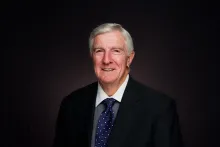
Before his retirement in 2021, Dr. Donald Ward pastored churches in Texas and Louisiana, and taught at Ambassador Bible College in Cincinnati, Ohio. He has also served as chairman of the Council of Elders of the United Church of God. He holds a BS degree; a BA in theology; a MS degree; a doctor’s degree in education from East Texas State University; and has completed 18 hours of graduate theology from SMU.
