

Paul Moody
This transcript was generated by AI and may contain errors. It is provided to assist those who may not be able to listen to the message.
Thank you very much, Mr. Gothels. Once again, good afternoon, everyone. As a congregation, if you could please join me, I'd like all of us to turn to Zechariah 4 and verse 6. Zechariah 4 and 6 may be a familiar passage to many of you that do study the Scriptures, but I would like to use it as a foundation to begin the message this afternoon and then conclude with the same verse at the end of the message. I would hope that by the end of the message that this verse will read somewhat differently. I'm often reminded of the saying that says that the poem that is read by the man at 80 reads differently than when he was 20.
We'll see if that maxim can apply to Zechariah 4 and verse 6. Let's notice what it says here. So he answered and said to me, This is the word of the Lord to Zerubbabel, not by might nor by power, but by my spirit, says the Lord of Hosts. This afternoon, based upon what we have just read, I have a fundamental question that every Christian needs to ask themselves, and that is, where in does our strength come from?
Where does our strength come from? There can be no more fundamental question to ask than this and to grasp and to live by, to recognize the source of our strength and spiritual security. Why is that so important? It is so important because knowing or not knowing the difference can be the difference between life and death, both physically and spiritually. God's word gives us an example and gives us a story to understand why it is so important to understand where our strength does come from. It supplies the story of a man who was given so many incredible gifts, such a fantastic start, a man whose birth was prophesied, a man who was called to be a deliverer, to be a champion of his people.
And yet, in much of his life, in much of his life, his life was singly, squandered. I've often thought about it. I mentioned this this morning as I gave the same message in Redlands. Oftentimes, you and I can go through graveyards that are favorite pastime, but it's quiet there. You can look at those markers and you can see where it says so-and-so. Then it says, born here, died here.
Then there's normally something underneath, father, mother, loving father, loving mother, beloved couple, children, whatever. And then sometimes there's a little epitaph underneath there, a little saying. Wonder if you came up against a gravestone and you look down there and you saw simply that squandered their life. Squandered their life. Would that stop you in your tracks? And or if that's enough, maybe you'd go down to a couple other gravestones down the line. And you look down and you see another one says, used, used in spite of himself. Not because of himself, but used in spite of himself. Well, let's take this a step further and let's understand that there's an example that I'd like to explore with you.
We've already covered Zechariah 4 and verse 6. I've now got your attention. I'm going to take you out of the cemetery and now we're going to go back into the Bible. And I'd like to ask that you join me in the book of Judges, Judges chapter 13. Judges 13 is a story of the Judge Samson, a man that was raised up to be a deliverer to the people of Israel.
So a danite, a man of strength, a man that we can learn from. Today, I want to share with you the story of Samson for four different reasons. Number one, to share with you how remarkably similar our calling is to that of Samson's. Number two, to sober us, to sober you concerning the waste of human experience.
Number three, we're going to pick it up now, to inspire you that God can use us to the very last moment of our life. If we will humble ourselves and recognize Him as the Lord of our life, and from whence our strength comes. Number four, most importantly, to allow you to focus on where your strength therein lies.
Let's read Judges 13 together for a moment. Again, the children of Israel, verse 1, did evil in the sight of the Lord. And the Lord delivered them into the hand of the Philistines for forty years. How sad that you notice that first word. Again, again, and so often that was the pattern of Israel from the time of Moses forward. There'd be a time of following God, then there'd be a time of rebelling against God. There'd be a time when foreigners would come in and dominate them. They would repent.
God would restore their lives to them. And then a cycle would happen all over again. And they fell into the hand of the Philistines for forty years. A time of testing, a time of trial. And not only did God allow them to fall into the hand of the Philistines, but to recognize why. Because the Philistines were a more advanced people, had more advanced weaponry, which just broke into pieces the instrumentation that the Israelites had. But God had an answer to that, and it was to come through Samson. Now, there was a certain man from Zorah of the family of the Danites whose name was Manoah.
And his wife was barren, and he had no children. And the angel of the Lord appeared to the woman and said to her, Indeed, now, you are barren, and you have borne no children, but you shall conceive and bear a son.
Now therefore, please be careful not to take or drink any wine or similar drink, and not to eat anything unclaimed. For behold, you shall conceive and bear a son, and no razor shall come upon his head. For the child shall be a Nazarite, to God from the womb.
And he shall begin to deliver Israel out of the hand of the Philistines. God had a very certain commission for Samson. He would not finish the job. That would actually come under the time and the reign of King David. But he was to be the beginning. He was to start the deliverance. What an incredible blessing was visited upon this family.
And what incredible gifts would be visited upon Samson to be able to do so. It's interesting here that it mentions that he would be a Nazarite. I could talk about that for a moment. I realize that we have some individuals that are newer to the Scriptures, may not understand what a Nazarite was. A Nazarite was a very particular vow that could be taken under the Old Covenant. And you can actually find that in number six.
I'm not going to go to number six right now. I want to make this very, very simple because I want to get to the concluding point. But a Nazarite was known by specifically three different components. Allow me to share it. You can look at number six.
One was that he, as a man, allowed his hair to grow long. He did not cut his hair. He did not cut his hair. And that was as a sign of humility before his Maker, that he was subservient to his God and recognized that there was a force and that there was a power above him and that he would be in subjection. Another very key element of a Nazarite was simply this. You might want to jot it down. It's like a class. That's fine. And that was that he could not partake of any alcohol. He did not take anything that possibly might cause him inebriation. That was to avoid the possibility of temptation from his calling. Number three, interestingly, is this. That he could have no contact with dead things. He had to separate himself from anything that had died was dead. Why was that? Because under the laws of old, that was a defilement. Now, when you think about this, you had to have your hair grow long. You couldn't partake of alcohol and you couldn't come up against anything that was unclean. What would that do to you if you were a Nazarite? Can I have a comment from the audience? Pardon? Reservation? Isolation. Okay. Isolation. We'll get to that point in a moment. Anybody else? This is only pass and fail. There are no grades that are being let out here.
I always like that when the teacher said that pass or fail. Oh, don't have to. Okay. What do you think?
Going to be weird? Okay.
Peculiar people? Okay. Yeah. Okay.
I had a short sermon, so I'm just kind of getting it filled in with this time.
You already know better than that. You know me too well. Go ahead. Somebody else. What about this? That if you are under those strictures, are you not going to be careful with your life?
If you know that you are not to touch or to bump into anything that is dead or unclean, that you know that you are not to have alcoholic beverage pass through your lips, to know that you cannot have a razor come to your head, you're going to be circumspect about your life and how you walk and where you walk and who you walk with and who you above walk for and lives in your life. You had to be committed. You had to think. You had to be careful. Now, you're saying, are you talking about Sam... Hello? Are you talking about Samson? Well, that's why we're putting this together. How about you and I? Samson was under the old covenant. You and I, as Christians, are under the new covenant, and none of us in that sense are taking a Nazaritic vow. But we do take a vow, don't we? We do take a vow in that sense at baptism. We do say, and I do, and it is understood as a vow. And we also need to be cognizant. Now, we don't have outward signs like long hair on a man, and God allows us to partake of alcoholic beverages and etc., etc., but just think about it for a moment. So, you'll recognize that you're side by side with Samson, that we are to, as Christians under the new covenant, to have a life of humility before our God. Our hearts, not our heads, but our hearts are to be clothed, are to be covered, are to be exercised in humility.
Number two, we are not to be intoxicated by the world that is around us. We're not to become drunk on the ways of the world, not the world as the world, but the worldliness thereof, the culture and the society. We realize that when you read the Bible, it talks a lot about spiritual intoxication and to avoid that kind of foolishness. Number three, we've been called to be separate from dead works. We've been called to come out of this world. Revelation 18 says to come out of her, my people. Do not be partakers. Don't come up against her.
The verses in Paul's writings tell us what commonality does the clean have with the unclean.
Therefore, we're asking ourselves to consider our calling and to recognize how precious it is.
Now, in all of this, you and I have, like Samson, was prophesied. He was told that he would come.
What an incredible miracle that God performed upon his mother. It's actually one of God's favorite miracles, and that's to make something out of nothing. When you think of the different situations, the Bible, whether it be Samson's mother, you think of Hannah, the mother of Samuel, who God visited. You think of Elizabeth, the mother of John the Baptist. You think, of course, of Mary, the young Jewess, the mother of Jesus Christ. He took wounds that were empty and filled them for his purpose. And then he not only brought forth life, but he says, I'm going to give them a gift. I'm going to give them something special. You and I were nothing, but you and I had a birth.
You and I began a life through the sacrifice of Jesus Christ by the calling of God the Father.
And just like Samson, you and I were given a spirit of strength, a spirit of spiritual muscle to see us through, to be circumspect, so that we might be consecrated to God's service. So I think you see a lot of the parallels that are here between ourselves and Samson. But something happened along the way. And it's something that happened to Samson that happens to a lot of people of covenant. You might want to jot this down if you want you to stay, because we're going to cover this at the end. Samson made this mistake that a lot of people of the book make a mistake in. You're saying, well, what is that? I'm going to tell you right now. Samson made a mistake. He didn't recognize the difference between, are you with me? Substance and style. Substance and style.
He made the mistake of thinking style with substance. And we're going to find out where that led him to. Let's pick up the story in verse 24 of Judges 13. So the woman bore a son and called his name Samson. And the child grew and noticed the Lord blessed him. The Lord blessed him, poured out his purpose and his calling, and gave him strength that was unknown in that day, that he might deliver his people. Now Samson, verse 1, chapter 14, went down to Timnah, and saw a woman in Timnah, the daughter of the Philistines. And so he went up and told his father and mother, saying, I've seen a woman in Timnah over the daughters of the Philistines.
Now therefore, get her for me as a wife. And then his father and mother said to him, is there no woman among the daughters of your brethren or among all my people, that you must go and get a wife? I put the emphasis on get because it kind of tells you a little bit about Samson, because that word's going to keep on coming up. To get a wife from the uncircumcised Philistines. And Samson said to his father, get her for me, for she pleases me well. But his father and mother did not know that it was of the Lord, that he was seeking an occasion to move against the Philistines. For at the time the Philistines had dominion over Israel. So Samson went down to Timnah with his father and mother, and he came to the vineyards of Timnah. And now to surprise a young lion came roaring against him, and the Spirit of the Lord came mightily upon him. And he tore the lion apart as one who had torn apart a young goat, although he had nothing in his hand.
I remember growing up back in the 50s and 60s and watching those old Johnny Weissmiller Tarzan movies. But this is real! This is real! And Luchma won't say no hands but no weapons. He just did it! But he did not tell his father and mother what he had done. Well, what'd you do today? Oh, I killed a lion. Okay, no, you... Kinda like when you're, you know, growing up and you go home and mother and father say, well, what'd you do in school today? I killed a lion. No. So he didn't mention anything. And then he went down and talked with the woman and he pleased Samson well, and she pleased him well. And after some time when he returned to get her, he turned aside to the carcass of the lion, and behold a swarm of bees and honey were in the carcass of the lion. And he took some of it in his hands and went along eating. And when he came to his father and mother, he gave some of it to them and they also ate. But he did not tell them that he had taken the honey out of the carcass of the lion. So his father went down to the woman and Samson gave a feast there for young women used to do so. Young men used to do so, pardon me. And it happened when they saw him that they brought 30 companions to be with him. Then Samson said to them, let me pose a riddle to you. Now, this was the favorite pastime of antiquity. Remember, they didn't have Nintendo's or computers or games on television or NFL football or even the Olympics. Olympics did not come till about 700 years after Samson. So this, what did they do back then for entertainment? They used their minds. How novel! And even kings would tell riddles. Riddle telling was something very special.
He said, let me pose a riddle to you. If you can correctly solve and explain it to me within the seven days of the feast, then I will give you 30 linens of garment and 30 changes of clothing. In other words, I'll buy out the store for you. But if you cannot explain it to me, then you shall give me 30 linen garments and 30 changes of clothing. And they said, impose your riddle. That we may hear it. So he said it to them. Out of the eater came something to eat, and out of the strong came something sweet. Now, for three days they could not explain the riddle. But it came to pass on the seventh day that they said to Samson's wife and Tysure husband that he may explain the riddle to us, or else we will burn you in your father's house with fire.
Have you invited us in order to take what is ours? Is that not so? Then Samson's wife wept on him and said, you only hate me. You do not love me. You have posed a riddle to the sons of my people, but you have not explained it to me. And he said, well, look, I've not even explained it to my folks.
So should I explain it to you? And now she wept for another seven days, all during the time of the feast, all during that time. And then finally it happened on the seventh day, told her because she pressed him so much. And that's going to be very interesting as we go through the story of Samson, the external pressures that were on him, bent him, bowed him, and swore at the blessings and the gifts that God had bestowed upon him. So the men of the city said to him on the seventh day before the sun went down, what is sweeter than honey and what is stronger than a lion? And he said to them, and so they said, what is sweeter than honey and what is stronger than a lion? They got it. And he said to them, if you are not plowed with my heifer, you would not have solved my riddle. Heifer is a young female, and they were not normally used for hard work. It would be unthought of back then to use a female for that kind of situation. Basically saying, you trespassed. You went where you should not have gone. Now notice what it says here. Then the spirit of the Lord came upon him mightily, and he went down to Ashkelon and killed 30 of their men, took their apparel, and gave the changes of clothing to those who explained the riddle.
So his anger was aroused, and he went back up to his father's house. And Samson's wife was given to his companion, who had been his best man. And after a while in the time of wheat harvest, it happened that Samson visited his wife with a young goat. And he said, let me go into my wife, into her room. But her father would not permit him to go in. Her father said, I really thought that you thoroughly hated her. Therefore, I gave her to your companion. Is not her younger sister better than she? Nice dad, right? And all this conversation. Just think, how are you doing, ladies? Okay. Please take her instead. And Samson said to them, this time I shall be blameless regarding the Philistines if I harm them. Very interesting. Something that we want to consider. Let's take a break in the story. Understand two key points here. Number one is to recognize, remember that as a Nazarite and as a covenant person today, we are to stay away from worldliness.
But God puts us right in the middle of the world. Remember what Jesus said on the last night of his life? He said, Father, keep them. You keep them. He didn't say beam them up. That would have been so much easier. Are we all in agreement? Beam me up. I want out of this world. He said, no, you keep them right there. And have you ever noticed that how God deals with covenant people, whether of yesteryear or today? He doesn't send us to the North Pole. He doesn't send us to the South Pole. God's people are not to be isolated. They are in the world, but not of the world. The world was for Samson just on the other side of the hill. And there's a tymnah waiting for each and every one of us. It depends upon where as a covenant person we put our attention. And we devote the gifts and the strengths that God has given us. And we remember that we are to be a humble people, that we are consecrated, that we are to remove ourselves from the dead things of this world.
And that we're to focus on God and not to be intoxicated with a system that's around us.
God did not take ancient Israel and put them down in Tierra del Fuego. How many of you know where Tierra del Fuego is? How many of you care where Tierra del Fuego is? Tierra del Fuego is down there where the the penguins are at the very bottom of of of Argentinian. Down there in what is called the Straits of Majung. It's way down there. Not too many things happening down there except penguins on the rocks. He doesn't put his people down there. He puts his people in the midst of people. You say, oh okay, that's why we're in San Diego County. That's why we're in Riverside County. That's why we have five or six or seven million people around us. He didn't call us to be hermits. He did not call us to be monks. He didn't call us to be sisters in a convent. He calls us to be in the midst of his creation, to glorify him, to magnify him, and to remember why we're called. Now what's interesting is you notice some of this language that's happening. It says that the Spirit came upon him. Did you notice that? It says the Spirit came upon him. We have to understand that in the Old Testament and under the Old Covenant that God's Spirit was transitory. It was somewhat in her—excuse me—it was non-personal in that nature. In other words, it would come and it would go. It came upon need and then would seemingly evaporate. It came upon Samson and would leave.
Therein lies the difference with Samson's time and ours. God's Spirit under the New Covenant comes and stays inside of us. It resides inside of us. In that sense, that Shekinah presence comes into the temple that God has set apart. When he talks about us in the book of Corinthians about our bodies being the temple of the Holy Spirit, the word there is NAOS, which means Holy of Holies. Remember how the Shekinah, that cloud, would literally come into the Holy of Holies back in the wilderness and also in Solomon's temple? That's what God does when he gives us his ultimate gift, his Holy Spirit. It resides inside of us. With that thought, then, we need to even be more careful about the tymnas that are happening in our life. Samson had a problem. You know what his problem was?
It was with his eyes and what he chose to keep them on and to take in. Isn't that interesting as we get to the end of the story? What is the issue that comes up at the end of the story with Samson? His eyes. And they're taken out. The curse does not go causeless. We'll talk about that as we get there. We notice then, just for sake of time, I'm going to kind of move rapidly because I want to get to chapter 16. We notice that there are a number of situations that occur. He ties up the foxes. He puts torches on their tails. They go and they light up the fields of the Philistines. Then what happens is there becomes this recycling of vengeance. The Philistines take it out on the Israelites. The Israelites come to Samson and say, you know, we're kind of for you, but this is kind of getting a little tough. We're not going to do it again, but we're just going to turn you over to nice countrymen. It's getting a little hot down here, so we're going to move you over and he breaks his bounds. I want to share something with you with that famous story. If we'll come down here, verse 14, chapter 15. When he came to Lehi, the Philistines came shouting against him. Then notice the Spirit of the Lord came mightily upon him. Remember, back then it was not personal and it kind of came and it went. The Spirit came upon him.
And then the Spirit of the Lord came mightily upon him and the ropes that were on his arms became like flax that is burned with fire and his bonds broke loose from his hands. And he found a fresh jawbone of a donkey, reached out his hand and took it and killed a thousand men with it.
That's a whole lot of people. We probably have maybe 50 or 60 people here today, so just start multiplying. 20 times as many people that are here today, this Danite took the jawbone of a donkey and liquidated it. And we're not talking about a furniture sale. He liquidated them. But notice what he says, with the jawbone of a donkey heaps upon heaps, with the jawbone of a donkey. And here's the key thing I want to share with you.
I have slain a thousand men.
I might want to circle that if you're daring enough. I. Where was God?
Where was the setting apart in his mind? Where was that God that was above that head of hair that was on his to call him into subjection to a sovereign entity? It was all about him.
So different than a young Jew, two to three hundred years later, that would go into the valley against a giant and say, you know, by the way, Goliath, you're coming down. Because the battle who who can help me with this? Go ahead, Marley. The battle is the Lord's and he will take you down this day. Do you begin with me? Do you begin to see a problem here of this covenant individual that is slowly moving away from the understanding of what even his Nazaretic vow was about?
Let's continue. And so it was when he had finished speaking that he threw the jawbone from his hand and called the place Ramath Lehi. And then he became very thirsty. So he cried out to the Lord and said, You have given this great deliverance in the hand of your servant, and now shall I die of thirst and fall into the hand of the uncircumcised. So God split the hollow place that is in Lehi, and water came out and he drank and the Spirit returned and revived. And therefore he called it in Gokhor, which is in Lehi this day. And he judged Israel 20 years in the days of the Philistines.
Chapter 16, verse 1, last chapter. Now Samson went to Gaza, and he saw a harlot there, and went into her. Just what you want your church leader to be doing. Just what you want the leader of your... I'm saying that I think you do understand there's a point of sarcasm in that. We don't want our leisure story to be that. And when the Gazites were told Samson has come here, they surrounded the place and lay and wait for him all night at the gate of the city. And they were quiet all night saying, in the morning when it is daylight, we will kill him.
And Samson lay low. That's where that expression comes. That we use sometimes about laying low.
Comes right out of your Bible. And he lay low.
Till midnight. And then he arose at midnight, took hold of the doors of the gate of the city, and two gateposts, pulled them up, bar and all, and put them on his shoulders, and carried them to the top of the hill that faces Hebron. What was that all about? Here he'd done, he had gone into a prostitute, into a harlot, and then he showed off his strength. Could God have done this a different way? You know, God can even use our foolishness and our lack of wisdom. He can even use our vanity at times, ultimately, to bring about his purpose, or should I say, even work around that. God could have done this a different way. He did allow it. And Samson was just simply like a bull in a China closet, and using his gifts. But here's where I want to wind up today for you, and I want to bring you to point, and it's an extremely inspiring and encouraging point.
Chapter 16, verse 4. And it happened that he loved a woman of the Valley of Zorak, whose name was Delilah. And the lords of the Philistines came to her and said to her, entice them and find out where his great strength lies. And by what means, we may overpower him, that we may bind him to afflict him, and every one of us will give you 1,100 pieces of silver. You're going to be a rich lady!
All you have to do is be a traitorous human being!
So Delilah said to Samson, please tell me where your great strength lies, and with what you may be bound to afflict you.
Now, this is kind of really interesting. It just came a thought, and that's simply this. This just kind of really reminds me of people today that on television that get on reality programs or some of these talk programs, where they're asked questions that should never really go out over the air, like, what kind of people are these? I mean, why would you do that to yourself or your family, or to even answer those questions? But I speak outside of the message.
So he said, tell me about it, honey. And Samson said to her, he had the non-wherewithal to answer. And Samson to her, if they bind me with seven fresh bowstrings, not yet dried, then I shall become weak and be like any other man. So the Lord of the Philistines brought up to her seven fresh bowstrings, not yet dried, and she bound him with them. Now, men were lying in wait, staying with her in the room. And she said to him, the Philistines are upon you, Samson, but he broke the bowstrings as a strand of yarn breaks when it touches fire. And so the secret of his strength was not known. Then, the Lila said to Samson, look, you have mocked me. You've told me lies. Now, please tell me what you may be bound with. So he said, or if they bind me securely with new robes that have never been used, then I shall become weak and be like any other man.
Therefore, Delilah took new robes and bound him with them and said to him, the Philistines are upon you, Samson. And men were lying in wait, staying in the room, but he broke them off his arms like a thread. Delilah said to Samson, until now, you have mocked me and told me. You know, what a way of turning the conversation around. Did you notice that? It's like, poor me. She's trying to do away with him and keeps on coming back. Nice gal. Delilah said to Samson, until now, you've mocked me. Tell me what you may be bound with. And he said to her, if you weave the seven locks of my head into the web of the loom, so she wove it tightly with the baton of the loom and said to him, the Philistines are upon you, Samson. But he awoke from his sleep and pulled out the baton and the web from the loom. Then she said to him, how can you say, I love you when your heart is not with me? You've mocked me these three times and have not told me where your great strength lies. And when it came to pass, when she pestered him daily with her words and pressed him so that his soul was vexed to death, that he told her all of his heart.
Now, the commentaries say that probably this did not happen, like on an Olympic schedule, where the men were coming through the door every 15 minutes to get the show done, so that it could fit on NBC. The first three were probably over some stretch of time. Otherwise, Samson was not just dumb. He was insane. So it was probably over a period of time. But now we're going to come to the climaxer and lessons that I want us as a congregation to learn. And hopefully it's what God wants us to learn. Then he told her all his heart and said to her, no razor has ever come upon my head, for I have been a Nazarite to God from my mother's womb. If I am shaven, then my strength will leave me, and I shall become weak and be like any other man. And when Delilah saw that he had told her all his heart, and we'll get to the rest of the story in a moment, there's two things I'd like to bring out here. What have you learned in this last chapter in the story of Samson and Delilah? What's happening here? This is a man called of God and a person under covenant, one who is to abide under the auspices of the Ten Commandments. Do we have a problem here? As the movies just say, we have a problem, Houston. What's the problem here? What is going on with Samson? What's he doing here to Delilah? Pass and fail, no grades. He's breaking one of the Ten Commandments. Three times he has. But see that Roland, he's lied. He is a liar. He is not a truth-bearer.
He bears false witness. He's not being a person of covenant. And it says, your sin shall cut you off from God.
Not only that, but the lies are toying around with another individual.
He's not being a good person.
The curse, as the proverb says, does not go causeless. Let's notice something else he says. Notice, and this is the substance of what I bring you today. He says, you want to know about my strength? I've been a Nazarite to God from my mother's womb. If I am shaven, then my strength will leave me. Where did he think that his strength came from? Brian, go ahead. Yes, he thought that his strength was in his hair. That his hair gave him the strength. The hair was a style. It was a style on a Nazarite. It was to convey that the Nazarite understood the substance, the depth, the meaning of relationship with the God of the universe, the one that had brought his people out of Egypt.
And that he, in his sense, bowed in his mind and his heart, and recognizing where his strength went, that he was nothing without that relationship with God. That God at his birth had consecrated him, set him apart to be a part of the solution. Do you realize that you and I at times, even under the New Covenant, can sometimes take the responsibilities that come along with it as we obey God to recognize that the substance is God? And it touches simply the things we do.
The things that we do are essential because God is our God and that he is our Lord. But our strength comes from the throne of God and having relationship and understanding and sacrifice to that and not to allow anything else come between that.
How good are you at separating substance from style? Style is not God. Substance is God. God has a relationship with us. He does in our covenant experience because we've surrendered ourselves to the Word of God. Yes, there are things that we do, but the doing doesn't save us.
God is our Savior because we understand that thus we do those things. But in his mind, he has separated the doing from the sovereign. He put all of his energy into his hair rather than his energy towards the relationship with his God. When Delilah saw that he told his whole heart, she sent and called for the Lord of the Philistines, saying, Come once more, for he has told me all of his heart. So the Lord of the Philistines came up to her and brought the money in their hand. Then she lulled him to sleep on her knees. That's a good boy. You can go to sleep now. This story is interesting. And called for a man and had him shave off the seven locks of his head. And then she began to torment him. And his strength left him. And she said, The Philistines are upon you, Samson. So he awoke from his sleep and said, I will get out as before at other times and shake myself free. But he did not know that the Lord had departed from him. It's not that his hair was cut off. The hair was the style. He had already departed from God. It was not the hair cut off, but his lack of understanding where the source of his strength came from that relationship. And his strength was cut off. What does it say in Zechariah 4 and verse 6? Not by my, nor by my power, but by your spirit. Says the eternal of host.
Then the Philistines took him and they put out his eyes and brought him down to Gaza. They bound him with bronze feathers and he began to be a grinder in the prison. However, the hair of his head began to grow again after it had been shaven. Now, a couple thoughts. Very interesting.
In times of yore, it's often times that when leaders and or kings were taken, one of the first things that went out were, yes, the eyes. You see that even with the king of Judah, when he was taken, his eyes were taken out. More so with Samson, because you know what?
Samson had a problem with his eyes and with his wandering eyes and where those eyes took him.
Again, as it says in the proverb, the curse does not go causeless. Then notice what it says here.
It says here that he was put into fetters and he became a grinder in the prison. His life had been going around in circles for years, for 20 years. So God granted him the rest of the decision. Your life is going around in circles. You're going to go around in circles. You're not going to be looking around. All you can do is think about a life that could have been so much more consecrated to me. I want to show you something that maybe you've never understood or seen in this. Notice what it says. However, verse 22, the hair of his head began to grow again after it had been shaven. What does that mean? Were the Philistines dumb or something?
Weren't they watching his hairdo? Think about this for a second.
Here's what I want to share with you. What I receive out of God's Spirit is it directs me to look at this. It wasn't so much his hair that was growing. It was his humility that was developing.
As he went around and around and around, sure, his hair was growing. But I think that humility that was bringing him back into relationship with God was being used. Now, the Lord of the Philistines gathered together to offer a great sacrifice today gone so they could rejoice. They said, Our God is delivered into our hands, Samson the enemy. And when the people saw him, they praised their God. For they said, Our God is delivered into our hands, our enemy, the destroyer of the land, and the one who multiplied our dead. So it happened when their hearts were merry. They said, Call for Samson that he may perform for us. So they called for Samson from the prison, and he performed for them. Yes, much of his life, unfortunately, had been the life of clowning around. And so he was going to give one more performance. And they stationed him between the pillars. And then Samson said to the lad who held him by the hand, Let me feel the pillars which support the temple so that I can lean on them. After you read this story, the next time you're talking to somebody and they're leaning on a doorframe, you're going to start thinking if you know the end of the story.
Now the temple was full of men and women, and all the Lord of the Philistines were there. About 3,000 men and women on the roof watching while Samson performed. And then Samson called to the Lord. This is the most important verse that I want to share with you this afternoon to inspire you and to encourage you. Though Samson called to the Lord, saying, Oh Lord God, remember me, I pray. Strengthen me. You are my strength, not my hair. Strengthen me.
I pray just this once, O God, that I may with one blow take vengeance on the Philistines for my two eyes. And Samson took ahold of the two middle pillars which supported the temple, and he braced himself against them, and one on his right and the other on his left. And then Samson said, Let me die with the Philistines. And he pushed all of his might, and the temple fell on the Lord's, and all the people were in it, so that the dead that he killed at his death were more than he had killed in his life. And his family came down and buried him. Now we begin to conclude. And this is what I'd like to share with you on the Sabbath day. Here is Samson, somewhat of a life squandered, God always working around him to bring out his purpose. Perhaps that's our stead today. Perhaps some of us in San Diego or La Mesa or Alpine or Chula Vista or wherever we live. You and I have been going around in circles. Perhaps you and I have been squandering some of the gifts that God so readily wanted to bestow upon us. Perhaps to a degree, even as a covenant person, we have not been using all of the blessings that God has in store for us. Perhaps to this point, if on our tombstone it might be an epitaph, they didn't use it. Life wasted.
The beauty of Samson is this. And this is the hard part for us to get through sometimes. It's at these moments that the breakthroughs come. Sometimes because of what we have done with our lives or not done with them, we feel inadequate. We feel inferior. Maybe we're embarrassed. Oh, God's tired of me. And that is the hope that we have to all come through. To recognize that it is at that moment that God is bending over and listening and welcoming us to come back into relationship with Him. There's nothing that we're going to do that He's not going to understand because Jesus Christ is indeed at His right hand. But sometimes because we've been wrapped up or caught in our sin, or we're paying those penalties of our sins, therefore we go backwards rather than go forward to God's mercies and to experience His grace. It is at that moment, it is at that moment that we come back into relationship with God and He can still use us. Perhaps some of us in this room, and we have our smiley faces today on the Sabbath day because after all it's Sabbath and we have our smiley faces on, but that doesn't mean that we don't have this other life that we go out to Monday, Tuesday, Wednesday, Thursday. That common desperation of that, the what is it, the expression, the desperation of the common man, and to recognize that maybe some of us are spiritually desperate, family desperate, emotionally desperate. And we say, you know, God, I've been going around in circles all my life just like Samson. I've been close, but I've been far, and I've been being used in spite of myself. Use me, Father! Use me! Help me to humble myself. Help me to go back and to remember my covenant vow in baptism. Help me to be your humble servant. Help me to run away from the ways of this world that entice like the horror of Gaza or Delilah. Help me to flee temptation.
Help my eyes to honor you, my ears to honor you. I'm a member of the body of Christ. And as a member of the body of Christ, my feet are to do your walking. My arms are to do your reaching. My tongue is to do your speaking. I'm to magnify. I'm to glorify you. I'm a part of the solution.
Now, when you and I look at Samson, you say, Oh, how glorious! He went out in flaming technicolor, just like Victor Mature did back in the Cecil B DeMille movie. I think it was Hedy Lamarr that played Delilah. Oh, Samson! He said, Oh, how glorious! I'll share something with you. It was glorious, but I'll tell you something it's even harder to do. Rather than die for God and to take 3,000 people with you, it's more glorious to live for God and to live for 3,000 people around you, being a covenant person of spiritual integrity and knowing where your strength comes from.
Can we do that in San Diego? Can we be a people of God, covenant people? I want to share one more thing that is really... Can I share something really neat with you for a moment? This gives me great encouragement, knowing where my life has been at times. We have a wonderful God and to recognize that sometimes when you see... Do I dare say these characters that are in the Old Testament?
That in the New Testament their wrongs don't follow them. Think of a Job, 42 chapters of anxiety, and yet when it comes to the New Testament, what is mentioned about Job other than the patience of Job?
And when it comes to Samson, the man that brought down the house by leaning on those pillars, he is put there right in Hebrews 11 as a pillar of the faith. And his sins do not follow him. God remembers us when we come to him. We humble ourselves. We are consecrated before him. We are his child. He is our God. The Christ is our Savior. We are a covenant people. We humble ourselves and we say, you do with me whatever you want because I die daily.
Zechariah 4 verse 6. Join me one more time and maybe now we put some flesh on the bones of the Scripture today when God gives us encouragement through the words of Zechariah. Zechariah 4 verse 6.
So he answered and said to me, This is the word of the Lord to Zerubbabel, not by might nor by power, but by my spirit says the eternal of host.
I'd like to just share something with you for a moment. I hope I can get through it.
That is that during Dennis' sermon that I got noticed from the hospital that my mother died.
I didn't want to bring it up during the sermon because I didn't want you to think of me being up here giving that message because today I had to run the circuit. I know that my mother would have wanted me to run the circuit and I have tried to be a loving son for many, many years to my mom. We were not just mother and child. We just happen to be buddies.
Always had been. I thought, what a more apropos place to be able to hear about my mother's death and to consider her resurrection than San Diego because this is where we first came into this way of life 49 years ago. It's a long time. Many of you will probably not be able to be at the service, but my mother back, my brother had died in 1959 and he was my hero. He was a fantastic guy. He's buried over here at Mount Hope Cemetery. My mother had been a very religious woman, even began searching more. That's been many of our stories over the years when God touches us and we have to go deeper. I remember about 1960 she picked up a book. It's called One Man's Destiny and it was the story of a brahm, the man who walked away from the world and followed the compass that God set before him. It's always impacted me to recognize that life is a journey, just like a brahm. To recognize God sets a compass before us and we go and sometimes the crowd doesn't come with us, but to recognize that God is always out there in front of us, not just a pillar of fire or at night or a pillar of cloud by the day, but that He guides us.
I will miss my mother, but I will look forward to seeing her in the kingdom. I don't talk about my family oftentimes because, well, all of you have your families and situations that are going on.
This last year and a half, even, visited upon Susan and I has been interesting and it's been a blessing. I don't know if many of you know that my mother had Alzheimer's the last year and a half, so God has been good. That's what I told Susan when I went out and took the phone call that God is good.
I told you before many, many years ago when I was a young trainee, volunteer Mr. DeCotch, and I used to go into a room where somebody had just died, we'd oftentimes beat the paramedics.
The first thing that Mr. DeCotch would always say, this was the good side of Mr. DeCotch, the one thing that he would always say, is that God has been good. And this young 23-year-old guy said, you've got to be kidding! There's a corpse over there! But that has been the mentor that I had, was a good mentor. And it's always given me a compass in life to recognize that God said that He will never leave us nor forsake us. And that when you look for God's goodness and you put that in the middle of your life and work your way from that, then we recognize that everything is going to be okay. This last year and a half have been very special for my mom and I. She was living at a board and care facility just over the hill from us because we just frankly could not take care of her 24 hours a day. And I would go over and I think Diane and Roland will know this and I've talked to Bill about this a little bit because Bill lives over in that area. I think I have been over every dirt dusty road in Winchester and Hemet because I'd always tell my mom, do you want to go out for another adventure? She said sure. And anybody that's ever been to Riverside knows how bumpy and dirty and dusty some of those roads are. But she never complained.
And we would sit and we would just sit and we would watch the sheep together. We'd watch the wheat grow together. We'd have on some beautiful manavani music and she'd have a coke and I would put french fries in her mouth to make sure that she was getting some weight. And so when I look back over the last year and a half it's really been a it's been a ride. It's been an adventure.
I have to say this because when I was a boy I was pretty adventurous like most boys are, but I was really adventurous. Climbing cliffs and you think of La Jolla, all those rocks that are out there. And at low tide they'd say, come on mom, let's go. Oh no, I remember the last time. No, come on, we're gonna do it. Whether it was at La Jolla or whether it was the rocks up in Laguna, you know, here everybody on shore is watching. You hear my mom and I cliffhanging on the different rocks as we're going around. And so I'd say we're going for another adventure. We're going for another ride. So I don't I don't know about that. You're gonna be all right. You're with Robin.
And even the last year and a half, even in the the darkness that was besetting her with her mind, she would always ask, where's Robin? Because she knew that everything was gonna be all right. And really, again, just like the lesson I shared, it wasn't Robin, because that would be like Samson's hair. It was about God. And I was God's gift to her that she had wanted. She couldn't have me. She did have me. She got me. And we had a lot of adventures in life. So it has been a really good ride with Thomasina H. Weber. My mother was a very, any of you that I know Paul and Jackie have been to Chicago. My mother was very much a German American from Chicago, from the suburbs. Whether you're on the south side or whether you're in the suburbs, there's only one attitude in Chicago. It's Chicago. It's a city that has the shoulders that carries the world. And that's very, whenever you meet a Chicagoan, you know you're meeting a character. And of course, you know my dad. And so that she's now at rest. We look forward to that wonderful time in the future when there will be no separation. There'll be no pain. There'll be no more sorrow. And I'll be able to be a part of that family with her. And I'll be able to see Thomasina H. Weber. And I'll be able to say, Hi, Mom. We've got another adventure, and it's for eternity. Mr. Gothels.
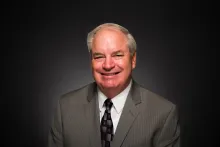
Robin Webber was born in Chicago, Illinois, in 1951, but has lived most of his life in California. He has been a part of the Church of God community since 1963. He attended Ambassador College in Pasadena from 1969-1973. He majored in theology and history.
Mr. Webber's interest remains in the study of history, socio-economics and literature. Over the years, he has offered his services to museums as a docent to share his enthusiasm and passions regarding these areas of expertise.
When time permits, he loves to go mountain biking on nearby ranch land and meet his wife as she hikes toward him.
