

Anthony Wasilkoff
This sermon was given at the Branson, Missouri 2019 Feast site.
This transcript was generated by AI and may contain errors. It is provided to assist those who may not be able to listen to the message.
Good afternoon to you. Welcome back to Afternoon Services, as has been stated. Really appreciated the finale from our choir. All we have to do now is have one more congregation on him and have a closing prayer and go home. And that will be a fitting conclusion. But we have a few more details to cover. Hope you had a lovely lunch at noon break, of course. And so far, no mention has been made regarding the storm in the early hours of the morning, unless I missed it sometimes.
My concentration lapses. We were awake for several hours due to the alarm on cell phones telling people to seek shelter. And then sirens went off for a while, tornado sirens. And so the winds got particularly boisterous for for a while. And it looked like the real thing. We turned on the TV and watched the radar out of Springfield, Missouri to see how that storm was tracking. It was the real thing. It's uncanny that there was a storm Friday night about to hit Florida and a storm about to hit us. And in fact, it did to some degree last night on the verge of the concluding day.
It is the eighth day. And so we had a hard time getting back to sleep. Probably you did too. Although I did hear from some people who slept through the whole thing. And that's a gift to be able to have that much ability to concentrate on restorative sleep.
Amazing capacity, a remarkable and a wondrous gift. It's been wonderful being here with you for this year's Feast of Tabernacles this last great day, last great day in the afternoon. And I still marvel at the wondrous significance of the feast when we share it together as we do in this locale. A is for alibi. B is for burglar. C is for corpse.
D is for deadbeat. E is for evidence. F is for fugitive, etc. Some of you know exactly what I'm referring to and others of you are thinking, that's not the way I learned the alphabet. Sue Grafton is the New York Times best-selling author of the Kinsey Milhone Mystery Series. And she has been so good that when you are immersed in one of her books and even afterward you begin to believe that there really is a Kinsey Milhone who lives in Santa Teresa, California, who is a private investigator and lives in a converted garage and dines fairly often on nutritious Big Mac burgers.
But she's just a fictitious character, but she writes so convincingly in these series of mystery books that the character imaginary though she is seems real. And she also supposedly prepares and eats peanut butter and pickle sandwiches, which I do not, but perhaps some of you may. As a child, as a little boy, I used to read party boy books. Perhaps you did too. The Secret of the Old Mill, the Tower Treasure, the House on the Cliff. My intent was to read a chapter and then stop and then read the next chapter the next day. But usually on the last page of a given chapter, the last paragraph, the author would include something that hooked me, something that intrigued me.
I had to know what would happen next, so I would read the next chapter. And as I got to the last page, the last paragraph of the next chapter, the author again would put in a hook. And I had to know what would happen next. And so I would read the next chapter.
And of course, by then, your parents would catch you with the flashlight under your covers. Eventually I read through all of them. And I hate to tell you about this, but I also began reading Nancy Drew books. Hearty Boys for boys and Nancy Drew for girls. But they too are written or were written really well, really effectively, with the following books that were featured. The Secret of the Old Clock, The Hidden Staircase, The Clue in the Diary, The Crooked Bannister, and many, many other titles that in themselves draw the attention of a child.
And you want to read how Nancy Drew is going to solve the mystery related to the title of the book. It seems virtually everyone loves a mystery. My wife and I enjoy watching PBS because they often have mysteries from the United Kingdom, from the UK. And that has a very serious and sometimes comedic element to it, but meaningful and usually wholesome to watch.
Now, similarly, we look at the Holy Bible as the greatest mystery book ever written. Interestingly, the Holy Bible has information that you can find nowhere else, and yet it remains largely an unread book, particularly in our increasingly secular society.
There was a time when the Holy Bible was read fairly regularly by most of the US populace. That's diminished significantly. And yet you can find so many truths that answer life's mysteries right there in the books of the Bible, cover to cover. And it's, of course, a book that we treasure, that is so meaningful to us. You may remember the first time you got your own Bible, your very own personal copy. And probably you have multiple copies of the Holy Bible that you refer to and bring along with you, and you have on your smartphone probably various versions of the scripture you can access fairly easily.
Open your Bible now, please, for the first scripture for this afternoon message, the concluding message of the day and concluding message of the week, Matthew 13. Matthew chapter 13, and we'll start reading in verse 1. Matthew 13, chapter 13, verse 1, where we find Christ Jesus poised to undertake a teaching opportunity. On the same day, we read, on the same day Jesus went out of the house and did what? He went out of the house and sat by the sea. Jesus was an outdoors person. Many of you are also outdoors people. He didn't spend all of his time indoors.
He went outside, and he particularly enjoyed the seashore. He enjoyed... And one of the benefits we have in this part of the country in Branson is it's so scenic. It's so beautiful. You have unexpected things like tornadic activity that you haven't been counting on, but God protects his people. But the beautiful rolling hills, the greenery is magnificent, the attractions here, the theaters, the performances here, mostly of Christian value. We're grateful to be able to meet here in this lovely theater year after year. We look forward to the possibility of a return because of what the area has to offer. The same day Jesus went out of the house and sat by the sea, and great multitudes were gathered together to him so that he got into a boat and sat, and the whole multitude stood on the shore.
So this is called improvisation. An audience shows up. There's so many people there that he decides, okay, I'll sit on the boat. That will become the stage. The seashore will become the place where the audience stands, and I'll speak to them, which he did. Now probably if you're an outdoors person, you know that sound carries over water remarkably well.
We had a situation where we couldn't get into a home after we had been transferred one year, and we were staying in the cottage for a few months, where it was three miles across Lake Okanagan. Some of you maybe have been to Penticton for the Feast of Tabernacles. At that portion, the lake was three miles wide, and you could hear people whispering three miles away.
So be careful if you're whispering or talking near a body of water. Sound carries really well. He spoke many things to them in parables, saying, Behold, the sower went out to sow. And this describes what the Gideons have acquired as their logo, where a gentleman is walking in the field, he has a sling over his shoulder, it contains seed, and he's sowing. He's sowing the field, which was not unusual at one time.
You could sow an acre or two, doing so, and fairly evenly. And interestingly, this process of reaching in, grabbing a handful of seed, and then using an ark to distribute it, this is called broadcasting. It's the method of broadcasting seed to sow a field. And hence, we had radio broadcasting, television broadcasting, which we utilized for many, many years for the World Tomorrow radio program, presently the Beyond Today program.
In internet usage, though, we tend to narrowcast, although you still can broadcast. And from time to time, people ask us, well, who is your target audience? When you preach the gospel, who is your target audience? And we say, everybody. Everybody's a target audience, because sometimes people are called who are very young, middle-aged, and sometimes elderly people are called. We received the program, sorry, a phone call to a recent issue of Beyond Today magazine that you subscribe to. And this particular reader was in her 90s.
She lost her husband in World War II. She lost her father in World War I. She wondered why God was still keeping her alive. She read the magazine July-August issue, and the light came on, and she said, now I know why I'm still around.
I still have things to learn. She subscribed to the magazine. So it's never, never too late for someone new to come along who is looking for truth. Reading through here in the next section, the parable of the sower, as he sowed, some seed fell about the wayside, and the birds came and devoured them. Some fell on stony places where they did not have much earth, and they immediately sprang up, and because they had no depth of earth, when the sun came up they were scorched, and because they had no root, they withered away.
Some fell among thorns. Thorns sprang up and choked them. Others fell on good ground, yielded crop, some a hundredfold, some sixty, some thirty. And Christ said, He who has ears to hear, let him hear. And the disciples came and said to him, Why do you speak to them in parables? And he answered and said to them, Because it has been given to you, notice the words here, it's been given to you to know the mysteries of the kingdom of heaven.
Elsewhere in the Gospels it's referred to as the kingdom of God. In Matthew it's referred to as the kingdom of heaven. It's been given to you to know the mysteries of the kingdom of heaven, but to them it has not been given. To understand the plan of salvation isn't easy.
It's mysterious. It's difficult to comprehend. It's hard to comprehend in its fullness. There are mysteries in the physical realm and there are mysteries in the spiritual realm. For instance, here are some physical realm mysteries. Why does the sun lighten our hair but darken our skin? Why can't ladies put on mascara with their mouths closed? Why don't you ever see the headline, psychic wins lottery? Why does the word abbreviate abbreviated, why is it such a long word? Why do doctors call what they do and lawyers also a practice? Here are a few more physical realm mysteries.
Why is lemon juice made with artificial flavor while dishwashing liquid is made with real lemons? That's a mystery. Why is the man who invests all your money called a broker? Why isn't their mouse flavored cat food? It's only flavors people like, but mice would really like, and there isn't any. How strange. Why don't they make planes out of the material used for the indestructible black box?
Why don't sheep shrink when it rains? If you have a wool garment, it shrinks, but sheep don't shrink out in the rain. Why they call it apartments when they're all stuck together. And why can you eat a big meal at noon and be sleepy all the rest of the day, but if you eat a big meal at supper, you stay awake all night? Why is that? And why does the Feast of Tabernacles speed up at the halfway mark?
And why as we get older do Feast weeks go faster and faster and faster? Those also, in their own way, are mysterious for us. 1 Corinthians 4. Pursuing this first part of the theme as we look at the meaning of the day, picking up on where others have already addressed it effectively this morning. 1 Corinthians 2. Let a man so consider us as servants of Christ. We've seen so much wonderful service this week, as was mentioned by our Feast Coordinator. We appreciate all of you who have served on the scene, before the scene, after the scene.
There's an enormous amount of work that has to be done. I admire the parking crew each day and the ushering crew each day, and special services, and information table, and the music program. I can't imagine having a feast of tabernacles without music. How inspiring it is and how it gives us such a huge lift to have music. Let a man so consider us as servants of Christ. We have our security people as well and other crews.
And also stewards of the mysteries of God. What is a steward? Reference was made this morning to a steward. A steward is a manager authorized to distribute the secret truths of God, or a trustee authorized to distribute the secret truths of God. Remember a book written some years ago by White-Haired Pastor General called Mystery of the Ages? Still out there? You can Google it, and you can get it online.
You can write into certain sources and get a copy. It was good reading then, still good reading today. We used to have stewards and stewardesses on airplanes. We used to have food on airplanes too, if you remember. Full meal would be served. But that was in the olden days. And stewards on ships, I heard said because a stewardess on a plane looks after the passengers and apportions the accoutrements that are there to benefit the passengers, including food or drink.
Somebody related that a steward came to our stewardess to his row and asked him, would you like a snack? And he said, well what are my choices? And she said, yes or no? Those are the choices. So we have reduced service these days on our conveyances. We've been recipients of, as it says here, the stewardship or stewardness of the mysteries of God. Where throughout the week, as you've heard sermonettes, split sermons, sermons, Bible studies, you've said, oh I've never understood that before. Oh I've not understood it quite that way before.
This has been a revelatory message to me, particularly useful and applicable. We've received these wonderful portions of additional truth filling out the picture of God's wonderful way of life. It was on to say in the next verse, moreover it is required in stewards that one be found faithful. So at the Feast of Tabernacles we are faithfully teaching what you are aware of. There are no new truths that you come away with saying, well that's totally new to me.
I didn't realize that the one pure language of the world tomorrow was going to be Ukrainian. That would be a new truth. It would also be an untrue new truth. You come away with what you already know and that is reinforced in a remarkable and a wonderful, wonderful way.
The mysteries of the kingdom of God that are so filled out for us during Feast Week. 2 Samuel chapter 12. Moving more toward the central element of today, last great day, the eighth day of the Feast. Somehow it's come upon us ever so quickly. 2 Samuel chapter 12 verse 15. Here's an event from the life of King David that was tragic for him and enshrined for us in the Word of God in Scripture. Several references made to situations like this, in fact, this morning. It says in verse 15, 2 Samuel chapter 12, And Nathan departed to his house, and the LORD struck the child that Uriah's wife bore to David, and it became ill.
The infant son, child of David and Bathsheba, suddenly became terribly, terribly, fatally ill. Reference made to that earlier today. We had an experience where our first child was born six weeks premature. We did not know if he would survive. He was kept in the hospital for that duration, and we hoped he would, didn't know that he would, prayed for him to survive. It's an amazing thing when you see a newborn, and occasionally you'll hear a newborn cry, and you can tell by the cry, that's a newborn. And as they get to be a month old, they don't sound as the way a newborn sounds.
The sound of the of the cry changes. But once I heard that first cry, I urgently wanted him to live. Wasn't sure if he would or not. Similarly, King David wanted this infant to live. So much so, well, you know what he did next. David therefore pleaded with God for the child, and David fasted and went in and lay all night on the ground. So the elders of his house arose, went to him to raise him from the ground, but he would not, nor did he eat food with them. And he did this for seven days. Now you fasted not too, too long ago on the Day of Atonement, and 24 hours on the Day of Atonement can seem like a long time.
There was a time when some of us, when we were younger, more vibrant, might fast two or three days, but a week, that's that's a long time. But he was very serious, and he felt guilty, no doubt, because of the illness of this little one. Then on the seventh day came the past that the child died, and the servants of David were afraid to tell him that the child was dead. For they said, indeed, while the child was alive, we spoke to him, and he would not heed our voice.
How can we tell him that the child is dead? He may do some harm. He may harm himself. He may pull the pen because of his grief and his guilt. When David saw that his servants were whispering, David perceived that the child was dead. Therefore David said to his servants, is the child dead? After seven days of fasting, he still was aware of his surroundings.
He was still perceptive of what was occurring around him, and they said, yes, he is dead. A clear, straightforward answer. David arose from the ground, and this always intrigues me. Each time I read verse 20 of what he does and the sequence in what he does, what he does. David rose from the ground, washed, then anointed himself, then he changed his clothes, then he went to the house of the Lord and worshipped, and finally he went to his own house.
And after that, when he requested, they said, food before him, and he ate. That's after seven days of not eating. And he still didn't rush to eat. Then a servant said to him, what is this that you have done? You fasted and wept for the child when he was alive, and when the child died, you arose and you ate. And he said, and these words are compelling, convicting.
Verse 22, while the child was alive, I did fast, and I did weep. For I said, who can tell whether the Lord will be gracious to me that the child may live, but now he is deceased. Why should I fast? Can I bring him back again? I shall go to him, but he shall not return to me. As I read this, and as we read this together, I wonder how much did King David know about God's plan? He had some knowledge of it, but how much did he know what its extensiveness? Did he comprehend that someday this one week old infant would be resurrected, come back to physical life? Did he comprehend that someday this little one would grow up in a different world, but will have an opportunity to reach adulthood?
Did he know that? To what degree did he know that? We don't know. He doesn't tell us. Also, what is conspicuously absent here is Bathsheba. For seven days, we read about King David. We don't hear anything about Bathsheba. She does appear in the next verse. Let me comment about this regarding the meaning of the day.
Not all deaths are the same. Not all deaths have the same impact. If you look at what is called the home's stress scale, some of you are familiar with the home's stress scale. It starts with zero, ends up with a hundred, and then it gives you weights. The death of someone from work, the death of a neighbor, the death of a colleague, the death of a distant relative.
They all have different impact on us. Which death is the most difficult to take? It's really hard, and a loved one does. Reference has been made to that all week. There are people that we have kept the feast with here in this facility that are not here. And there are people who are probably here who won't be here next year that we will miss terribly. And it doesn't mean that necessarily the oldest one of us will not be here next year. It doesn't always work that way.
It varies significantly. But when you look at the loss of a child, and in this case King David lost a one-week-old infant, we could have lost our first born child. Did not. We lost a grandchild that was one day old. And it was one of the most difficult funerals I've ever attended. To attend and to see a tiny casket, to have an outdoor service. I didn't do the ceremony someone else did.
Very difficult service to attend. Some of you have lost a mother, a father. Some of you have lost a husband, a wife. It's really terribly difficult. And no matter how hard we prepare ourselves for that of introality, when it happens, it's going to be more difficult than we think it will. Somebody put it this way. When you lose your spouse, it's like losing your right arm. You never get used to it, but you learn to live without it.
It's part of God's plan, part of his lesson for us. I think to make it less personal and as a reference, George Burns. Some of you remember George Burns. George and Gracie Allen. What a remarkable pair they were. From Vaudeville, to radio, to television, his career was going nowhere fast until he met Gracie Allen. She became the superior of the act. They were together on radio, then they were together on television, and then she decided 18 years on radio, eight years on television, then she retired, and he soldiered on by himself.
He had scheduled to perform on his 100th birthday, and he had a good philosophy towards life. When he was asked as he was facing major heart surgery, are you nervous? And he said, why should I be nervous? The surgeon, he should be nervous. He's doing the operation, not me. Remarkable philosophy toward life. But he was honest enough to say when he lost Gracie after their years of marriage that he was hit much harder than he thought he ever would be.
And he explained how he would go visit her every month, go to the cemetery, spend time at the headstone where she was buried, and tell her jokes. And then see you next week, next month. He saw her once a month, and he'd bring her new jokes. So once you hadn't heard before, and he would...
it was his way of therapy for himself. All deaths are not the same. 1 Corinthians chapter 15. 1 Corinthians chapter 15. And we'll begin reading in verse 47. 1 Corinthians chapter 15 verse 47. Of course, you know that this is the resurrection chapter. Starting in verse 47, it says, The first man was of the earth made of dust, and the second man is the Lord from heaven.
We human beings are clay models. We're clay models, and someday we hope to be spirit beings. First man was of the earth made of dust, the second man is the Lord from heaven, as was the man of dust. So also are those who are made of dust. And as the heavenly man is, so are those who are heavenly.
As a child, great one or so, I'm not sure if you had this experience, we used to make mud pies. Little mud pies. It was all pretend. We never ate them, but we made little food, the dishes, and when my kids were small, and my daughter in particular, I would have tea with her from imaginary stoves on an imaginary prepared table. But mud pies, I think of, they were preparing for real culinary experiences.
We are clay models, and we're going to be spirit beings, and we look forward to having new bodies, bodies that don't wear out, that don't deteriorate. As we are born the image of the man of dust, we also will bear the image of the heavenly man.
Now verse 15. Now this I say, brethren, that flesh and blood cannot inherit the kingdom of God. And so does corruption, nor does inherit corruption. Behold, I tell you a mystery. We shall not all sleep, but we shall all be changed. The state of the dead is a mystery. One of our booklets that we have, our information table, has been put away, and I think the booklet was available earlier in the week. What happens after death?
Do most people know what happens after death? Most people don't know what happens after death. It is a mystery. What happens after death? Does anyone know anybody who came back to tell us? On Halloween, Houdini was supposed to come back. Remember the incredible Houdini who escaped everything? Then he died prematurely, and he said, I'll be back, and I'll tell you the state of the dead.
And he still hasn't made his debut. He's still missing, but he said he would. Remember Steve Jobs? How many of you know who Steve Jobs is? I've heard that name. Most of you have. Well, he was 56 when he died. He battled cancer for eight years. He had a biographer who interviewed him time after time, and then 60 Minutes interviewed the interviewer, and they asked, what did you learn about Steve Jobs? He fought cancer for eight years, and the interviewer said, I remember sitting in his backyard in the garden one day, and he started talking about God.
He said, sometimes I believe in God, and sometimes I don't. I think it's 50-50, but ever since I've had cancer, I've been thinking about him more. And I find myself believing a bit more. I kind of, maybe it's because I want to believe in an afterlife, that when you die, it doesn't just all disappear, that you've accumulated somehow it lives on, the experiences you've had. Then he paused for a second, and he said, yeah, but sometimes I think it's just an on-off switch.
Click, and you're gone. It's all gone. It disappears. It vanishes. And he paused again, and he said, and that's why I don't like putting on-off switches on Apple devices.
Isn't that interesting? Genius though he was. He still didn't know what would happen to him after he breathed his last. And that's one of the reasons I have a laptop. I don't have a smartphone. I have a flip phone. It has a little crank on it, magneto. But it can't track me. But I still use a laptop, and in using the laptop, I used to turn it off regularly until an I.T. guy saw me, turning off the computer after using it, and he gasped. He literally gasped. And he said, don't do that. Don't turn it off, because there's all kinds of things that can go wrong. Put it to sleep. So I'd always now never turn it off unless it needs to be upgraded or updated or something, and put it into the sleep mode. And that's the mode I want to go in when I die. So it can have the same effect. 1 Corinthians 15. Let's turn next. As we develop this theme a little bit further, Ezekiel 37. Ezekiel 37. Which, of course, is one of our standard scriptures for the afternoon message on the last great day. Chapter 37. We'll read the first section of this chapter.
The hand of the Lord came upon me and brought me out into the spirit of the Lord and set me down in the midst of the valley, and it was full of bones.
Sometimes you've been out for a walk, no doubt, and maybe it's been a farmer's field or a pasture, and you'll come across a skeleton, that of a cow or horse or a moose. And you'll know that this was a living thing at one time. Sometimes the skeleton is intact. Sometimes it isn't. But this is talking about human remains. He caused me to pass by and all around. And behold, there were very many in the open field, and indeed they were very dry. And he said to me, Son of Man, can these bones live?
And so I answered, O Lord God, you know. It's a beautiful answer. Someone asks you a question, and you'll say, well, tell me, tell me what you think. Again, he said to me, prophesy to these bones and say to them, O dry bones, hear the word of the Lord. Thus says the Lord God to these bones, surely I will cause breath to enter into you, and you shall live, and I will put sinews on you, and bring flesh upon you, and cover you with skin, and breathe in you, and you shall live, and then you shall know that I am the Lord your God. You're familiar how there are individuals who do forensic restorative work. They are reconstructionists. They'll have facial bones or certain parts of the human skeleton, including the skull, and they're able to use their artistry to restructure what the person looked like, how tall they were, and their external features.
So I prophesied as I was commanded, and as I prophesied, there was there was a noise, and suddenly a rattling, and the bones came together bone to bone. I brought some sound effects as to what this might have sounded like.
Sounds a little scary, actually, this time of year. These are just cedar shoe inserts. They worked really well. When I was a child, I listened to the radio a lot. They used a lot of sound effects. You would just listen to the radio, and you would hear shells, coconut shells, and there were horses running, and you had to imagine what was happening as you listened to the radio.
I normally don't use sound effects in my speaking, but on the last great day, I usually do because we're saturated with so much listening. This is an astonishing real event that is going to happen. There was rattling. These bones came together. Indeed, I looked, and the sinews covered the bodies, and the bodies appear. And so on, there's breath that comes from the wind that God provides.
So I prophesied as He commanded me. Breath came into them. They lived and stood upon their feet, an exceeding, great, massive army. And He said to me, Son of man, these bones are the whole house of Israel. They indeed say, our bones are dry, our hope is lost, and we ourselves are cut off. Therefore, prophesy, and say to them, Thus says the Lord God, Behold, O my people, I will open your graves and cause you to come up from your graves and bring you into the land of Israel.
And you shall know that I am the Lord, and when I have opened your graves, O my people, I brought you up from your graves. I will put my spirit in you. You shall live, and I will place you in your own land, and you shall know, you shall know that I am the Lord, and I've spoken it, and I will perform it.
As I was reviewing this chapter this past week, I thought of the spiritual song, the dry bones song, that we used to hear. That is so meaningful. The bones, foot bones connected to the heel bone, the heel bones connected to the ankle bone, the ankle bone is connected to the knee bone, the knee bone is connected to the thigh bone, the thigh bones connected to the hip bone.
The hip bones connected to the back bone, the back bone is connected to the shoulder bone, the shoulder bone is connected to the neck bone, and the neck bone is connected to the head bone. And the rest of the song goes, them bones, them bones gonna walk around, them bones! Them bones gonna walk around, them bones, them bones going to walk around. Now hear the word of the Lord! These people had respect for God's word. This is This is going to happen. This is going to be real.
And it's describing this massive cemetery. I occasionally visit cemeteries, particularly when there are relatives there that I wish to see. I hadn't seen my grandmother and grandfather's burial spot. I had never met them. For those who have grandparents that they've spent time with, that they used to visit, who they can relate to, posthumously, I envy. Because I never met not one grandmother, not one grandfather.
I'm pretty sure he had four of them. Never met any of them. Although I have gone to the burial spot of my pioneer grandparents in Saskatchewan, who died in 1938-1942, respectively. They set aside a portion of their homestead for a pioneer cemetery. There are maybe two dozen people buried there. And I went to pay my respects to photographs of their burial places. The writing is still in Cyrillic, that is, Ukrainian, and it says, Tuts Porchevaia, Kyriowa Hadukevich, which means, Here rests Cyril Hadukevich. And then beside him, his spouse. Here rests. It used to be that you, and this was describing for us in chapter 37, essentially a cemetery. If you go to a massive military cemetery in Europe, or in Washington, D.C.
area, there's no doubt that that's a cemetery. But in some instances, cemeteries are made to look like parks. And you'll drive by and you think, What is that? You don't even know it's a cemetery anymore, because it's a sign of the times in which we are denying the reality of death. They say, in the long run, in the long run, in the long run, in the long run, we're all deceased. And so we plan accordingly, but we shouldn't get morbid, because we know what God's plan is all about.
One of the first double dates I had as an ambassador called the student in Pasadena, California, was to go to Forest Lawn Cemetery. The one that John Danver sang about, because it was a beautiful place to visit. It's like a park, instead of like a cemetery. But the old-fashioned cemeteries have the monuments, the record, the message, and then often on the gate, it's the right-earned gate, and often it says, at rest. Significantly. At rest, anticipating what is yet to come.
Revelation 20. We addressed this this morning. Let's review it quickly. Revelation chapter 20, verses 4 and 5, and then verses 11 and 12. Chapter 20, verses 4 and 5, and then 11 and 12. And I saw thrones, and they sat on them, and judgment was committed to them. And then I saw the souls of those who had been beheaded for their witness to Jesus for the Word of God, who had not worshiped the beast or this image, and had not received his mark on their foreheads or on their hands, and they lived and reigned with Christ for a thousand years. That's what we just finished commemorating.
The wonderful, soon-to-come millennium. We just finished rehearsing it. And actually, in a way, during the year, as you observe the Sabbath, it's sort of a glimpse into the world tomorrow. But it's only one day. And here at the feast, it's seven days, and so we can refer to this as a dress rehearsal. This is a dress rehearsal for the millennial rule of Christ.
We've just experienced it. Now, notice the next section. But the rest of the dead did not live again until the thousand years were finished. And these are the people we are concerned with today. These are the people we focus on today. Because so many of us have had loved ones who were not in the faith, who will not be resurrected at the beginning of the millennium, but will be resurrected after the millennium comes and goes during this portion of time. Verse 11, Then I saw a great white throne, and him who sat on it, whose face the earth and the heavens fled away, and there was found no place for them.
And I saw the dead, small and great, standing before God as we heard, and books were opened, the books of the Bible, and another book was opened, which is the book of life. And the dead were judged according to their works by the things which were written in the books. They'll have a hundred years to overcome, to develop, to mature, to progress. One of the events we saw this week, we didn't go to many exhibits, but one of the attractions we saw was the Titanic.
Well worth seeing, very educational, takes time, but they have laid it out beautifully. If you haven't seen it, I would encourage you to see it next year. If you're staying for a few days, you could see it later this week. I don't receive any residuals from it.
Maybe the church could, but they have laid it out very beautifully. RMS Titanic set sail April 10, 1912. Four days later, crew spotted a looming iceberg. Thirty seconds after they spotted the iceberg, the Titanic struck the iceberg, scraped the side of the hull. It was said by one of the tour guides that if they had stayed on course and the ship had struck, the bow had struck the iceberg, it would have survived. Because they tried to miss the iceberg, they scraped the side of the hull and pierced those watertight compartments.
Two hours, forty minutes later, the Titanic was gone. Total number of people aboard, about 2,200. Survivors, 700. The number who perished, 1,500, who died ever so quickly. They didn't have enough lifeboats aboard for everyone. And those lifeboats, they had on board that were utilized, many of them were partially empty. They left people to drown when they could have rescued them. But they didn't need a full complement of lifeboats, because after all, this ship was virtually unsinkable. And some say it was said even God Himself cannot sink the Titanic. The wrong thing to say. So many people perished, including the captain, who had been a captain for thirty-eight years. It was to be his concluding trip.
He was going to retire. He never made it. That was April 1912. They found the Titanic, as you probably know, in September of 1985, and were astonished to find how many accoutrements they could still recover. And that hadn't totally deteriorated, but they didn't find any human remains. No skeletal remains, no vestiges, there's no signs of human life. But they found a lot of things human beings used. Some of the bodies that they recovered were buried in Newfoundland, but most of the bodies have simply disappeared.
They vanished. So what happens to them? Well, notice the very next verse, as you read on. And the dead were judged according to their works, by the things which were written in the books, and the sea gave up the dead who were in it. All of those people who perished from the Titanic, somehow, someway, the sea will give up the dead. I'd like to refer to United News, current issue.
This was on the information table. You will have received this, probably, in the mail on page 9. There is a superb article written by one of our members, who describes the death of her brother, who was in the Air Force on a routine training mission out of Florida. A formation of three or four planes, they went out of permission, flew back around to recover the formation.
The wingtips hit, and planes crashed into the ocean, and his body was never recovered. And it destroyed her mom and dad. And then she found this scripture, the sea gave up the dead, pointed it out to her mother, and how much it encouraged her mother to realize, I will see him again. Beautiful article. Well worth reading. Matthew 12. And we'll start reading in verse 38. Matthew 12 and verse 38. We've covered already Isaiah 65, 18, 19, and 20, so I will not touch on that today.
But I would like to cover Matthew 12. At this point, we'll read verses 38 through 42. Verse 48. While he was still talking to the multitude. Matthew 12. I'm sorry that was verse 38 now. I beg your pardon. Then some of the scribes and Pharisees answered, saying, And he did. This evil and an adulterer's generation wanting some kind of vindication from Christ, or worth some kind of authentication. No sign will be given to them except the sign of the prophet Jonah. For as Jonah was three days and three nights in the belly of the great fish, so will the Son of Man be three days and three nights in the heart of the earth.
And now notice, particularly verse 41, looking at the meaning of the day, last great day, eighth day of the feast. The men of Nineveh, you know about them, the city of Nineveh, the people of Nineveh will rise up in judgment with this generation and condemn it.
Notice this important detail. When will the non-Israelite people be resurrected? The Ninevites at the same time the Israelites are. Israelites are resurrected, and the Ninevites are resurrected as well. The men of Nineveh will rise up in the judgment the last great day, the hundred-year period, with this generation and condemn it because they are repented at the preaching of Jonah, and indeed a greater than Jonah is here. The queen of the south will rise up. Remember, she visited Solomon in the judgment. With this generation, again, Israelites, non-Israelites, resurrected at the same time. The queen of the south will rise up in the judgment with this generation and condemn it, for she came from the ends of the earth to hear the wisdom of Solomon, and indeed a greater than Solomon is here. This is going to happen. This massive resurrection typified by Ezekiel 37. At this time, billions and billions of people are going to come up out of the graves, out of the oceans, wherever they died. What are you going to do with all of them?
This is going to be a real event. The logistical problems will be enormous, significant. Union soldiers, for instance, rise up over there, and Confederate soldiers rise up over here. Hutus will rise up over there, and Tutsis will rise up over here. Vegetarians will rise over there, and cannibals will rise over here. Hatfields will rise over there, and McCoys will rise over here. Do you suspect we'll need some sort of police force? Probably, for the first little while, we will need a police force. They'll have their very last thoughts on their minds, of what they were thinking of before they died. Some will be moaning and groaning from a terrible, hideous disease. Others will be wondering about their swords, what happened to my sword, what happened to my spear, what happened to my cutlass, what happened to my rifle. Others will be concerned about the screeching tires and the blinding headlights that they last had in their consciousness before they succumbed. There'll be those who died peacefully in the sleep, and those who went down aboard the Titanic, as I referred to, or Lusitania, or battleships or warships of the past, Spanish galleons, and those who were torn apart by lions in the Roman Colosseum, and those who died in outer space aboard space shuttles and other space vehicles and star wars to come.
And you know one of the first things we'll have to do? We'll have to clothe them. A hatfield will come out to start looking for a McCoy until he realizes, I need some clothes! Remember Lazarus?
And you know what the second thing is? We'll need to do? We'll need to feed them.
They will not have eaten for thousands of years. Think of how hungry they will be.
Remember the little girl that Christ resurrected? And he said, give her something to eat?
She was hungry. It's only been a few hours deceased. Some will ask for a hamburger. Some will ask for pork chops, and you'll say, sorry. No more chitlins. They'll be thirsty. And of course, thirdly, we'll be teaching them. We'll be teaching them about God's way of life, God's loss, the Ten Commandments, how to live in peace and harmony with their neighbors, how to dress properly, how to eat properly, how to behave properly. And for 100 years, we'll have the first real opportunity to repent and to accept Christ as personal Savior, to be baptized, to overcome, to develop. So on my list, I have here clothing, food, housing, education, employment. We'll have so much we need to do for them that are practical requirements of this wonderful 100-year period, the last great day that we are looking forward to, so very, very much. Ephesians chapter 1. Ephesians chapter 1. Ephesians chapter 1 verse 7. Ephesians chapter 1 verse 7. In him we have redemption in Christ Jesus, who have redemption through his blood, and forgiveness of sins according to the riches of his grace, which he has made to abound toward us in all wisdom and prudence, having been made known to us the mystery of his will, the mystery of the plan of salvation that eventually will include everybody as we have heard, the mystery of his will according to his good pleasure, which he has purposed in himself, that in the dispensation of the fullness of the times he might gather together in one all things in Christ, but which are in heaven and on the earth in him. In him also we have obtained an inheritance, being predestined according to the purpose of him who works all things according to the counsel of his will, that we who have trusted in Christ should be to the praise of his glory.
There is the story of a minister, a preacher, a pastor who was contacted by one of his parishioners one day, and she was beloved in the congregation elderly and said to him, look, something has come up. I'd like you to come over to my house today if you can. He said, I guess I can clear some time and I'll be over at three. Will that work? And she said yes.
And he came over at three and sat down in her home, which was a pleasant home, a little small, and she explained to him that she had just received confirmation from her doctor that she had a terminal condition, that an undetected tumor had been discovered, and that she had six months left to live. And the minister said, well, I'm really sorry to hear this. And she said, don't be. I've loved a full life. I'm happy with what has happened to me and I'm ready to go.
But I do want to talk to you about arrangements. I would like to make arrangements ahead of time with your involvement. So they looked at the hymns that she really enjoyed, her favorite scriptures that had meant so much to her, memories that they had shared together in the congregation, various functions, socials, they'd had potlucks. So they talked through the details of how the funeral would occur. And it's one of those important things that as we get a little older, it's really important for us to pre-plan our arrangements so that our loved ones aren't wondering what it is we are expected to do. We had one lady who was nearly 100, but she made all of the arrangements for the day that she would die and her funeral, including the menu of what would be consumed on that particular day. She planned it all in advance. And I occasionally go to the cemetery and visit her. I don't tell her jokes. Just talk to her, as it were, and anticipating her resurrection. This little lady said to the minister who was visiting her that afternoon at three o'clock, she said one more thing. When they bury me, I want to have my old Bible in one hand and a fork in the other. And he said, a fork? Why a fork? And she said, well, because in this congregation we've had so many wonderful meals and so many wonderful banquets and so many wonderful potlucks. And on those very extra special occasions, when they would clear the table of the plates and the usual cutlery, those who were clearing the table would say, keep your fork. And that's when I knew they had extra special dessert coming, because otherwise with a spoon you can eat pudding and jello any time. But if they said, keep your fork, that meant they had good stuff like chocolate cake and pecan pie. So keep your fork. And so I want when people see me in my casket, in my blue dress, which I have selected to wear, I want people to ask, why is she holding a fork? And I want you to be able to say, because the best is yet to come. The best is yet over the horizon. The good stuff is still going to be served.
And so it is for us here at this year's wonderful Feast of Tabernacles. We have rehearsed the Millennial Week. We've had a glimpse of the last great day. We have a glimpse even beyond that of the New Jerusalem. And know that the best is yet to come with the Feast of Tabernacles, the last great day, New Jerusalem, and all of the wondrous eternity that yet awaits us.
As was asked recently, are you ready to go home yet?
Well, we have so much to do. We have a gospel to preach. We have our light to shine. We have enough in our rucksack to last us through till Passover. We have work to do. We have a gospel to preach. We have people to be prepared for the wonderful return of Christ, being assured always that the best is yet to come.
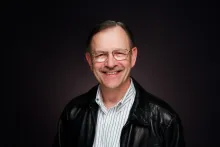
Tony grew up in a small town in Saskatchewan and became a member of the Church of God as a teenager as a result of listening to a radio program on CFQC Saskatoon starting in 1962. Today he and his wife, Linda, wear multiple hats in UCG including working at the UCG-Canada National Office, serving on the Canadian national board and pastoring several congregations. They have served in various pastorates in the United States and Canada.
The Wasilkoffs have two grown children (Paul and Cheri), a daughter-in-law (Coreen), a son-in-law (Jared Williams), four grandsons (Logan, Anthony, Jayden and Colton) and a granddaughter (Calista). They enjoy staying in touch with their grandchildren as much as possible in person and failing that, via the remarkable features of Skype.
