
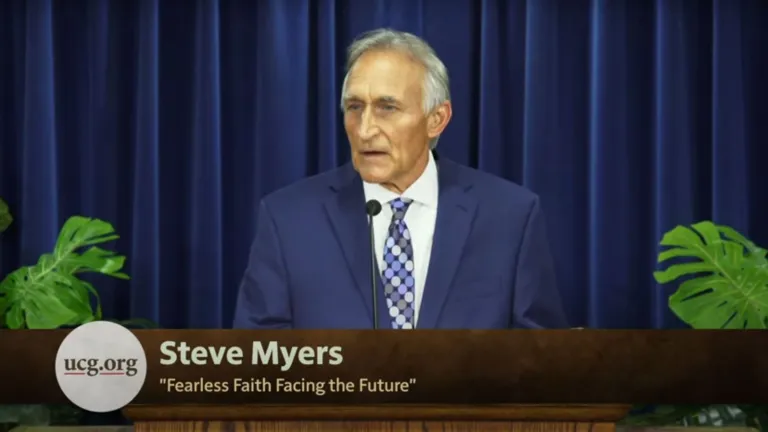

Steve Myers
In good times and especially in times of loss and trial, we need to always be mindful that God is our ultimate refuge and strength, a very present help in time of need. He will always be there, even if all our physical things are swept away.
This transcript was generated by AI and may contain errors. It is provided to assist those who may not be able to listen to the message.
Well, brethren, as we've already mentioned, this past week was one of heartache, one of challenge to so many in our community here in the Spokane area. Wildfires that erupted last Saturday, driven by the wind in certain parts of our city as they went. Evacuations happened rather rapidly. Mr. Schmidt and I were down in the Tri-Cities speaking, and I'm told emergency alerts were going off on everybody's phones here. During the service, as that fire was blowing through, and frankly, it's one that impacted our region in a very dramatic way.
I believe last night I heard a quarter of the city of Spokane is evacuated. You know, big numbers, big impact and displacement. And many people around our region have lost everything. You know, as our homes just burned to the ground in a matter of minutes. All they could really do was get out of the way of the racing flames and essentially be at the result of and the impact of that devastation.
You've watched the news throughout the week, I'm sure. The pictures coming out of the hardest hit areas really tell a heartbreaking story. As of today, over 900 structures have been damaged or destroyed. And you think about that, that's a number, obviously that's massive, but you think about those structures, those are people's homes. You know, where they live their lives and raise their children and surrounded by their personal things. It was their place of peace as people's businesses. Maybe a home was spared, but maybe their employer's business burned. It was personal property, it was memories, it was all these things that just in really an instant went up in flames.
So again, those pictures are very, very heartbreaking. I'll just say, when our family was displaced a number of years ago from the mudslide that hit our property, we were fortunate in the perspective that even though the house was damaged and we were displaced and it was ultimately condemned, we could go back and we could collect our things. You know, the photo albums and all those personal things, we could gather those up and take them with us and plant roots in another spot, but for those who have just simply fled the fire and lost their home, they don't have that option.
And if you watch the news, the stories are filled with people just kind of kicking through the ashes looking for a wedding ring or looking just for a memory of things that really aren't grabbable anymore. It lives in their mind, but the loss isn't so much just the structure, it's their life memories that were tied up in that. So really, so much has happened. Again, fortunately, no direct losses here, no loss of life that I'm aware of, which is incredible given the scope of this. And, you know, we've heard stories from friends that literally were driving through burning neighborhoods with houses and trees on both sides of the road on fire as they drove out very dramatic circumstances.
And so we thank God for the blessing of that. And although a number were impacted by the evacuations and few had close calls, He has preserved those most important things in our lives, which is life, family, one another, and most importantly, above all, our ability to carry on in a relationship with Him. Those indeed are the most important things. The losses are hard, and those are a struggle, especially for those impacted personally.
But again, it's times of trial and trauma that cause us to at times stop and evaluate truly what is most important. And the blessing it is to be able to carry forward with those things. Brethren, the events of these last several days have reminded us just how quickly life circumstances can change.
Those things that seem so stable in one moment can be gone in a blink of an eye in ways we weren't expecting. And when you have things like homes and possessions and routines interrupted, what happens is you begin to feel vulnerable. Maybe you begin to feel insecure because those were routines of security, places of security. And you feel, in many ways, exposed when you no longer have them as you once did.
They were the familiar anchors. And when that happens, it's easy for our sense of, again, security in life to be taken away as well. Again, if our confidence and if our focus is rooted primarily in those physical things. Times like these remind us of a very important reality as the people of God. And that is, while things in this world are temporary, God is not. God is not. And I believe this ties back into what Mr. Neff was addressing, that these things that happen in our life that are very direct and personal, God knows intimately what we're going through.
And what we can grab hold of and take our confidence from is that even though everything we can see and feel and touch is temporary, the God who created us for a purpose for eternity is not. He is eternal. He is from everlasting. And He will exist into everlasting. And He is our God. And indeed, He is constant and faithful and unchanging. And that is where our security must always be, even in the midst of life's storms.
So, you know, we can look at and empathize, and many people have experienced things in life that are really heart-wrenching, that we've had to work our ways through, as Mr. Neff was discussing today. But again, hopefully we've always held on to the anchor that God is our hope. He is our foundation. He is the one who sees us through. He will make all things right in the end. Today, I want to focus on God's part in all of this. The title of the message is, Our Refuge in Times of Distress. A Refuge in Times of Distress. And I want to begin with an anchor scripture that's very familiar to all of us. Psalm chapter 46.
If you'll turn there, please. Psalm chapter 46. This psalm was written for God's people during a time of distress. And yet, I want us to notice that it doesn't begin by focusing on the trouble. It begins by focusing on God. Psalm chapter 46 and verse 1. It says, God is our refuge and strength, a very present help in trouble. We have a song in our hymnal that we sing often written from these words.
A very present help in trouble. Therefore, the psalmist says, in light of this reality, we will not fear. Even though the earth be removed, and though the mountains be carried into the midst of the sea, though the waters roar and be troubled, though the mountains shake with its swelling, the point is, we will not be afraid.
It doesn't mean that things happening around aren't dramatic and fearful things, but it means our perspective is anchored in something beyond the physical. This psalm is describing a world experiencing incredible upheaval, mountains being moved, and oceans being shaken, ultimately nations being shaken. Those things that we would look around and say, well, that's permanent. Now, the trees might burn off, but the hills and the mountains are still permanent. The ocean is still permanent. But again, this is describing circumstances where everything that seems stable becomes uncertain.
But the psalmist doesn't begin, again, with the disaster. What does he begin with? Well, he begins with God. He begins by describing our God. And you know, that might seem like maybe a small detail up front, but in reality, it changes everything about our perspective. Because when we encounter trials, so often our focus is on the trial. And I would say rightly so. Okay. If the flames are coming towards your home, that's a trial. Focus on that. Get out of the way.
You know, pray for blessing and help and protection in the meantime as well. But, you know, we can tend to even move forward from that with our focus coming back to the trial. Back to the trial. We have the news reports that bring that up every day. And I follow those every day because we want to know what the updates are. But again, our focus, as the psalm directs us, first and foremost, must be centered on God.
God first. And that order matters. Because if we begin with a problem, then our fear very quickly grows larger than our faith. Because that's where our focus is. Don't ignore the problem. Right? We work through it and we address it. But if we begin with God first, then we view the problem through the lens of His power and His faithfulness. And it reminds us that God is present with us, even in the midst of the storm.
And that is the greatest anchor we could have. Even when the physical is in jeopardy. Even when things that seem stable around us are coming apart, the reality is that God, the permanent fixture in our life, is there. And He will see us through. I'd like to break the remainder of the message down into three points based on Psalm 46, verse 1. And it's my hope that as we look at it, it will give us just a deeper confidence, a deeper peace in the midst of whatever may come. This is the jump-off point, but there are so many scriptures throughout the Bible, old in New Testament, that reinforce God's presence, God's blessing, God's help in our time of need.
So again, three points. Again, very, very basic but profound based on Psalm 46, verse 1. Point number 1, God is our refuge. God is our refuge.
You know, a refuge is a place of security, right? It's a place of safety and protection. In ancient times, it might have been a fortified city. You know, you look at the Bible and they're cities that are built like fortresses and they're fortified. There was a wall around the city. There was a gate that could be shut and locked. Even maybe a moat around the city and a bridge that could be pulled up to you. You locked down that city and you secured it. And the adversary wasn't coming through. That was a fortress. That was a refuge in many ways. The Bible could describe refuges as strongholds. You recall the life of King David on the run from Saul. And it says in a number of places that he dwelt in the stronghold of a particular region. And that could be a cave, a cleft in the rock. It could be whatever. But it was a place of safety and protection physically. But David always knew, as you read through the Psalms, he always knew that his ultimate refuge was not in that physical place. It was in God. A stronghold, therefore, is, at least in the physical sense, a protected shelter. And so the beauty of Psalm 46 is that it points beyond every physical refuge we could imagine. And it declares God himself as our refuge. As the one that you run to, that you have safety and protection in. Because understand, every physical refuge can fail. But the refuge we take in God stands forever. You and I have witnessed firsthand this past week, in fact, that physical shelters can be lost. You know, if it's a wooden house, the fire can come through, and it can be reduced to ashes. Right? It can be lost. Look in parts of the world where people have built structures out of cement block, in rebar. There's a lot of that in West Africa. But in comes the earthquake. Right? And it just shakes that into rubble. Places where people have built houses and the flood has come through. The mudslides have come through. Again, every physical shelter, every physical refuge, can be taken away. Possessions can disappear quickly. And these fires have shown us that even things we consider to be permanent can be lost. But God cannot be shaken. And God cannot be moved. And He cannot be consumed. And He remains the secure refuge of His people perpetually. It's a theme all throughout the Psalms. I was interested to hear, as we sang our opening hymns, many of our songs focus in that direction. Right? Our rock, our salvation, our refuge, our hope. We sung those songs and they do reinforce indeed what is here. Psalm chapter 91 contains some very encouraging thoughts to ponder. Again, it's sobering times like these that bring us back to this focus. But, brethren, this should be our focus, and I hope it's our focus at all times. Because it carries us through the good times as well as the difficulties. Psalm chapter 91 and verse 1 says, He who dwells in the secret place of the Most High shall abide under the shadow of the Almighty. It's talking about safety and protection. The author of Psalm 91 isn't attributed here, but it's thought to probably be Moses. Moses wrote Psalm chapter 90, and this follows on the heel of that. But, abiding under the shelter of the Almighty.
Verse 2, I will say of the Lord, He is my refuge and my fortress, my God. In Him I will trust. Surely He shall deliver you from the snare of the fowler, from the perilous pestilence. He shall cover you with His feathers, and under His wings you shall take refuge. His truth shall be your shield and your buckler. You shall not be afraid of the terror by night, nor of the arrow that flies by day, nor of the pestilence that walks in darkness, nor of the destruction that lays waste at noonday.
Brethren, these are very encouraging words because God is described as the shield.
You think of an army out in battle, and arrows that are flying back and forth, weapons that are being swung, and the shield was what the soldier stood behind for safety and protection from those assaults. God is described as the shadow, dwelling in the shadow of the Almighty.
I want you to put that in context by thinking of ancient Israel as they went out of Egypt and across the wilderness. Think about the fact that the pillar of cloud was there by day. God's presence among them, and it wasn't just leading the way, here we go, that's what He was doing, but again, a pillar of cloud. What does a cloud do in the desert for those that would be in its presence? It casts a shadow of protection. It casts a shade to protect from them being scorched in the sun, to protect them and to take them in care as they journey along the way. That's how God here is described, dwelling in the shadow of the Almighty. He's described as a refuge and as a fortress of those who trust in Him. And so it's language that emphasizes God's divine protection and care that extends beyond all physical limitations. Again, our physical refuge in our places of safety, in our places of comfort, those have value to us, but anything physical can vanish. But the refuge we have in God will not be moved.
It doesn't mean God's people won't ever see trial or trouble in this life, but rather means that cannot separate us from the presence of the care and the love of God. The fact that He goes with us, that He is our God and we are His people, and we are sustained through no matter what would come. The language of mountains being shaken and the earth being moved, I mean, that's symbolism that we anticipate in terms of end-time events. So the point is, no matter how bleak it looks just to get out and drive on our roads here in eastern Washington and be under this heavy cloud, we recognize it's nothing compared to what lies ahead. And the blessing, though, for God's people is their refuge in Him.
It doesn't mean the trial won't come, but it means nothing separates us from God's presence and care. As long as we put our hope in Him. The Psalm doesn't say, God gives me a refuge, as in, He provided a place that I can run to, you know, a brick house as opposed to a wood house. No, it says God Himself is our refuge, and that's an important distinction, because refuge isn't merely something God provides, it's something that's found in His presence. So ultimately, brethren, we're talking about a relationship, aren't we? A relationship where we draw near to God and He draws near to us, and that safety and security ultimately is tied up in Him. He blesses us with the physical, and we get enjoyment and peace and comfort through those things. But again, truly what matters is the refuge He provides. It is a relationship. That picture helps us to understand much about what the Bible teaches, about God's care for His people. We have the imagery of, you know, under His wings. You've probably all seen pictures of, you know, an eagle or other birds, howlbell. If they have young with them, they'll gather them under, when there's a storm or there's danger, under their wings and cover them over and hunker down and offer that protection. And for the little chicks, that's a place of safety and security. And it's the visual image we're given about God's love and relationship towards us. Indeed, the Bible shows us that the greatest comfort is found not in avoiding the storm altogether, but in knowing that God is with us no matter the challenge. That's where the comfort truly comes from. King David understood this well. You know, on more than one occasion, he found himself in a tight situation where dependence on God was his only refuge. Psalm 61, verse 1. Psalm 61, verse 1. I appreciate David's willingness to open up on the pages of what is the Bible for us about all of these experiences, about the impact of God in his life. Psalm 61, verse 1. He says, Hear my cry, O God, and attend to my prayer. He says, From the end of the earth I will cry to you, and when my heart is overwhelmed, lead me to the rock that is higher than I. Again, we sang about that. You know, a rock is something that seems permanent, doesn't it? And of course, God is our rock, our salvation. The one that David ran to in his time of need. Verse 3, he says, For you have been a shelter for me, a strong tower from the enemy. I will abide in your tabernacle forever. I will trust in the shelter of your wings. So again, he's describing the same safety and security that we can find, again, through our relationship with God.
And so when we consider natural disasters and things that might happen around us, when we consider what has occurred here just last week in the Spokane area, it is natural to pray for protection. We should pray for those who have been displaced. We should pray for those who are on the front line, fighting these fires and are putting their life on the line in service to others. We should pray for God's mercy.
We should pray for rain. You know, those are all appropriate things that we ought to be praying for. But at the same time, our prayers need to be grounded in something deeper than the hope that God will resolve it in the way that we desire. He says, Bring your petitions before me. Cast your cares upon his throne.
Okay, so we do pour our heart out to God. We do make our requests. But understand, we need to put our confidence in the fact that whatever tomorrow brings, God will not abandon his people. That even in the midst of trial, and some go through those trials, God is there. And God is the shelter, even in the midst of the storm. Nahum chapter 1. Nahum chapter 1 and verse 7. This is my challenge to find scripture for the sermon.
Nahum chapter 1 verse 7. Dr. and the minor prophets, Jonah, Micah, Nahum. Nahum chapter 1 verse 7. The confidence and the peace and the hope that God gives us. Nahum chapter 1 and verse 7. He says, the Lord is good. And he is good. But sometimes people ask, if God is good, how can he let all of these things happen? Well, again, he is good, and he is just, and he is merciful.
And the day is coming when his kingdom will be established. And none of this will exist. I look forward to that day. The Lord is good as stronghold in the day of trouble. And he knows those who trust in him. So notice again, this promise is rooted in a relationship. God knows those who trust in him. Which means he is aware of every circumstance we face, every burden we carry, every prayer that we bring before his throne. And as we learn to rely on him rather than our own strength, we discover that he truly is our stronghold. And again, it is a relationship, brethren.
And through that we find peace, we find comfort. Even in the midst of the trial and the struggle, it doesn't mean those hard things go away, but it means we can walk through them with confidence. We can deal with them by the strength that God gives us, knowing he will never leave us or forsake us. Most of us probably think of our homes as our refuge from the world. You know, I know I do. It's like you're out there battling it out all day long, and you come back to your home. You're surrounded by your stuff. You close the door. You leave the world out there. And you breathe a sigh of relief, and it's like it's peace.
You have your family. You have your memories. And it is, in that sense, our refuge. And there are places of that rest and comfort. But again, recent events have reminded us that even those places are temporary. And when they get intruded upon, it can be very difficult for us as human beings to adjust.
You know, if that is where everything is tied up, then you've just lost everything. But again, that's why God invites us to dwell in him every day. That's how Psalm 91 started. Psalm 91 again said, So God's refuge isn't simply a place that we run to when life falls apart. It's the place we dwell each and every day as we walk with him. Indeed, he is our refuge and our strength, found in an intimate relationship. He is our God, and he will see us through. Point number two, from Psalm 46, verse 1. Point number two, God is our strength. He is our refuge. He is our strength. Now again, refuge was a place of safety and security, but strength is something different than that altogether.
Strength pertains to the ability to endure, right, to continue, to carry on faithfully and not be moved by these things in which we'd encounter. One of the lessons that trials teach us is that our human strength has its limits. You know, we can do everything right. We can do everything to prepare. Cut all the trees down around your house. Plant a green space. Irrigate it. Make a defendable spot. But the day may come where some great event comes roaring through, and you simply have no alternative but to get out of the way.
Your physical strength can only do so much. And that's the reality that trials remind us, remind us that our human strength has limits. The point is, God is never interrupted by these things, and He never intends that we live our Christian life based upon our strength and our ability. He calls us to depend on Him. Isaiah 40. Here, the prophet speaks to a people who are in need of this reminder. Where does your strength come from? Judah here has largely turned the back on God, pursued false gods, not returned to Him. They're walking a very fine line here of being expelled out of the land.
And yet, you know, if you go toe to toe on the battlefield with, let's say, the Babylonians, you're at a great disadvantage apart from God. And so here Isaiah is pulling their focus away from their circumstances and back to the greatness of God.
Isaiah 40, verse 28, says, Verse 30, Isaiah says, Remember who your God is, whether you're old or whether you're young, whether you're strong or whether you're weak. You will face something in this life that tests your physical endurance. Remember who your God is. He is the creator of the heavens of the earth, never grows weary or tired or faint, never reaches the limit of His ability. And again, He is your God in your refuge. Trust in Him, run to Him, and He will give you what you need when you need it. Again, physical strength has limits. I've spent times in my life where I've just been literally exhausted and is like, I don't have an ounce left, but God gives you what you need when you need it.
About 10 years ago, I was out at a youth camp in Nigeria, the same place that Darla and I will be going on this trip. And it's this beautiful strip of land. We boat up from the backside across fresh water, and then it's about a quarter mile wide strip of land, palm trees. The front side has the ocean crashing in the waves.
And about 10 years ago, we were out swimming in the waves. We were playing around in the surf, and some of the young adults from that region of Nigeria at the camp came out and joined us. And of course, most of them can't swim. They had life jackets on, and they're staying pretty close to shore.
But after about 20 minutes, the surf really started kicking up. The drag of the waves was getting strong. So we just said, it's time for everybody to get out. And we got out, and I look back, and here's one of the young adults, and he's got this look of... It wasn't panic, but it was great concern on his face because he was being pulled out. And he had a life vest on, although he couldn't swim. He had a life vest on, so that kept him afloat.
But also, he put him at the mercy of the current. And he had gotten caught in a current that was probably a riptide of some sort that was pulling him out quickly. So I went in after him, and you had this close set of breakers, and he had a break in the water, and then you had the far set of breakers. And by the time I caught up with him, it was past the far set of breakers. And there was a point where I said, Paul, in my mind, you've crossed the point of no return, because now I realize I'm at risk going after him, and we're out there.
But I caught up with him, and he's got the life preserver, and we managed to kick free of whatever was dragging him out, and we started making our way in. But now the waves are pounding on us, and dragging us out, and pounding on us. And we get between the two sets of breakers, and Ben Light had made his way out from shore, and caught him, and was making his way back with him, and I got hit by a wave, and drug back out. And I got caught up in this cycle.
Maybe you've seen videos of people like they're in this cycle of it smashed in and drug out. And smashed in and drug out, and I was in that, in between these two breakers, set of breakers coming in. And I literally was so exhausted that I didn't think I could make it to shore. I just started praying.
Right? That's where you run, where you have nowhere else to go. And I just prayed to God, help me, you know? I've got nothing left. And literally my foot brushed up against something under the water. This is way over my head, but there was a sand berm that had built up from this action of the waves coming around.
And it was about this wide, maybe 10 inches at best. And if I got up on that, on my tiptoes, I could just keep my nose above the water. And I was trying to catch a breath, and a wave would knock me off, and I would scramble back on, get a few breaths, and it would knock me off. But it gave me just enough to recover what I needed, and eventually fought my way to shore.
God gives us what we need when we need it. He renews strength when our strength is gone. I mean, literally every time I go back there, I think about that, because that's the closest I've ever come to drowning in my life. We don't go in that water anymore.
We've done a couple baptisms there, and you bury a few people out there, and that's the limit to the use of those waters.
But again, when physical strength is gone, and when mental strength is gone, and when our spiritual strength is struggling, run to that refuge. Cry out for help. God is our strength, and we need to depend on that every day.
Again, it's about a relationship.
Isaiah said, this applies to those who wait on the Lord. Again, a relationship. Those who trust in Him, those who know His faithfulness, those who give themselves over to His perfect timing. God, not now. Okay. I will wait, but I know it is in your hands. And that makes it okay.
Brethren, this level of trust is essential, especially when we're facing circumstances beyond our control.
And those times we're reminded that our strength doesn't come from having every answer. It comes from knowing the One who does, and maintaining that relationship with Him.
Isaiah 41, again here, verse 10, just across the page, because the thought carries on.
Isaiah 41 and verse 10 says, Again, don't forget who He is. He says, God doesn't tell us to ignore the difficulties, because when they're real, they're real.
But what He does tell us is not to be overwhelmed by them, not to be overwhelmed knowing that He is there.
He is our guide. He is our shelter. And He is our strength. And while we may not know what challenges lie ahead of us, and what our family will face, or what our world will face, we get a glimpse through the Scriptures, but we don't know the details. We do know that through this relationship with God, that He will meet us there, and He will see us through. That's a promise of His Word.
That's a promise that gives us comfort and stability, even in the midst of the storm, even in the midst of whatever life's challenges would throw at us.
God said, I will strengthen you. I will help you. I will uphold you.
I think we understand these promises can be administered in different ways, and that's God's call.
There's times in the Bible, actually, so many stories we look at and we gain courage from because someone was in distress. They cried to God, and instantly He delivered them. But how many other stories are there as well, where someone cried out to God and God said, just wait?
Or God said, not today.
Or even God maybe said, no. But even in the midst of the no, He said, I am here, and it's enough.
The apostle Paul experienced that.
2 Corinthians 12.
2 Corinthians 12. I mean, think about Paul, how powerfully God used him, how much he did in the name of Jesus Christ.
And yet Paul himself received an answer from God that wasn't quite what he was looking for.
But it was the answer he needed.
2 Corinthians 12.
Paul says, Paul says, Again, God had used him so powerfully to proclaim the Gospel to do miracles.
Right? Paul had raised the dead, healed the sick, and now he is himself dealing with the thorn in the flesh.
And the Bible doesn't tell us exactly what it is.
We suspect perhaps something with his vision. There's hints to that throughout the Scripture.
I mean, you get stoned enough times, get hit in the head with enough rocks. I can get that.
There's trouble here.
How many concussions can you sustain and not have consequences from it?
But here Paul is in this circumstance.
And in verse 8, he says, And he said to me, He says, Okay, we're talking about strength.
And so Paul experienced, you know, many trials in his life and actually many deliverances.
And he lines those things out for us in a number of places.
You know, night and day in the deep, shipwrecked, stoned, beaten, forty stripes, minus one, three times.
All these things that God allowed him to go through.
And yet he performed mighty miracles in the name of God.
And he said, I should be exalted above measure by the abundance of the revelations.
You know, all the things that God showed him, lest he should think too much of himself.
God says, I'll let you carry this. And you know what? It may be a hindrance in your mind, Paul.
But it is a blessing in terms of what I can do through you because of it.
And so we see here a particular trial that God chose not to remove.
And again, verse 9 gives the answer, and he said to me, My grace is sufficient for you, for my strength is made perfect in weakness.
And it reveals something about the way God sometimes worked.
You know, Paul, he wanted removal, right? He wanted healing.
But God provided strength to endure it.
Have you ever been there?
Cried out to God, deliver me from this.
And God said, I'm here. It'll be okay.
But no, you're going to carry this nonetheless. But he gave you the strength to endure.
That's part of the blessing as well.
That's part of the blessing as well.
God used this trial in Paul's life to develop faith, patience, humility, and dependence on him.
And it wasn't like, Apostle, heal thyself.
Right? He had to come to God and receive God's answer and carry forward still as a faithful servant.
Of his.
So, Paul said in the last part of verse 9, Therefore, in light of God's answer, most gladly I would rather boast in my infirmities that the power of Christ may rest upon me.
Understand, he wasn't celebrating the suffering. He was celebrating the faithfulness of God, even within the suffering. God always gives us what we need when we need it.
And included in that is the strength to endure.
Point number 3 from Psalm 46, verse 1.
God is a very present help in trouble.
He is our refuge. He is our strength.
He is our very present help in trouble. This concept, it brings Psalm 46 together and puts a bow on it. I hope it brings you comfort, a very present help in trouble. This is about God's presence, about His proximity, about His closeness to us. But again, it's about a relationship.
Draw near to God, He'll draw near to you.
It's important because our greatest need isn't always for God to remove the trial, but for us to know that we aren't facing it alone.
Have you ever walked through something and thought, boy, I'm not alone? Or thought, I don't want to go through this alone?
Human beings like other human beings. We like not to have such a struggle that we face without somebody else just even to give an encouraging word or to hold our hand. To go through things alone is very difficult. I don't like to go through things alone.
Here recently, it wasn't a trial. It was a circumstance, though. You know, last Holy Day season here in the spring, I made my first trip to Liberia, and I flew into that country, really, with no church support. We don't have a congregation there. It was a group we were communicating with over the course of the last three years. But no church support in that way. Strange country, strange hotel, strange city, all of this. I didn't want to go alone. Now, I could have, sure, but I took someone from Ghana with me. Stephen Koussi came with me. He's from Africa. He knows the lay of the land, different country, but similar culture, and we went together. You know, Christ sent the disciples out two by two, and I think there's strength in that. So I didn't go alone. But, of course, I was never alone. God was with me. And really, that's the only way I can even get on the plane in Africa. It's not about no risk. It's about knowing God is with you. Because if you read the State Department warnings, you'll never go. But God's with you. And on a strip, Darla will be with me as well. So, double-e, I won't be alone. But the blessing is, He is there. Jesus Christ didn't want to be alone in His time of distress. What did He say? Could you not even watch with me for one hour? The final night on His life, He's praying to His Father. He's in distress. And the disciples are sleeping. He couldn't even watch with me one hour. He couldn't give me a little company, a little support. An angel had to come and strengthen Him. Of course, He was never alone. Ultimately, the disciples fled the eleven at His arrest. They fled. But, of course, God was with Him. And He sustained Him through that trial. Brethren, God's Word gives us the assurance that no matter what we encounter in life, He won't abandon His people when the going gets tough. He won't flee from unpleasant circumstances, and He remains with us both in the good times and the difficult times. If that relationship has been cultivated and maintained, He is there. Draw near to God. He'll draw near to you. Deuteronomy 31 reinforces this point. I just love the fact that we can go throughout the Old Testament and prove this principle. We can go throughout the New Testament and prove this principle. It's how God works with His people. Deuteronomy 31, here Israel is preparing to go up into the Promised Land without Moses. He's not able to go in, but He's preparing them to face challenges that will be there when they arrive. But He reminds them who will be with them as well. Deuteronomy 31, verse 6, He says, For the Lord your God, He is the one who goes with you. He will not leave you nor forsake you. Indeed, their confidence was to be based on the fact that they weren't going to be alone. That God would be with them, watching over them, protecting them, fighting their battles for them, if indeed they would submit themselves to His lead. If only they would have believed. Again, a very present help. Very present help. If only they would have believed. Brethren, God has given you and I the very same promise today as well. If only we'll believe.
Hebrews 13, verse 5. These are words of incredible comfort, especially in times of distress. But these are words that are always here. Read them, study them. When life's good, don't forget where your refuge is.
Hebrews 13, beginning in verse 5.
Very comforting words. No matter what is happening, this is a promise. Verse 6. So that we may boldly say, in light of this knowledge, our confidence, we can proclaim with our very lips, The Lord is my helper, I will not fear. What can man do to me? Do we boldly say that? We must. Indeed, we must. Because there's a connection made here, God's presence produces confidence. That's what Paul is saying. God's presence produces confidence. When we know that He is with us, we're confident, Just as Israel should have been confident, we look at them and sometimes we shake our head and say, What was wrong with those people? Look at the promises God made. He's made the same promises to us. I'll never leave you nor forsake you. And, brethren, that must give us confidence. It gives us assurance, Knowing we aren't facing whatever it might be alone. Notice the confidence we can all have.
Let's conclude in Romans chapter 8. This is the confidence and the faith and the trust that we can carry forward with every day.
God is with me. Romans chapter 8 and verse 35. Again, the Apostle Paul, who understood so many things by the experiences he endured. In Romans chapter 8 and verse 35, Paul asks the question, Who shall separate us from the love of Christ? I mean, is there anything possible that could come along if we are maintaining that relationship and drive a wedge between it? Who shall separate us from the love of Christ? Shall tribulation or distress or persecution or famine or nakedness or peril or sword or mudslide or wildfire fill in the blank? What can separate us from the love of Christ? As it is written, verse 36, For your sake, we are killed all the day long. We are counted as sheep for the slaughter, yet in all these things we are more than conquerors through him who loved us. For I am persuaded that neither death nor life nor angels nor principalities nor powers nor things present nor things that come nor height nor depth nor any other created thing shall be able to separate us from the love of God, which is in Christ Jesus our Lord. No separation, Paul says. No separation. Only presence. Presence in the good times, presence in the difficult times as well. Brethren, Psalm 46, verse 1 doesn't tell us to pretend that trouble doesn't exist, but it does tell us where to turn when it comes, who to run to, where to abide. God is our refuge and strength, the psalmist wrote, a very present help in trouble. No matter what challenges we may be facing personally or as a community, as a church, or even what the world would face at the end of the age, you and I can take confidence in knowing that he himself has said, I will never leave you nor forsake you. Indeed, brethren, that is a true refuge you can trust.
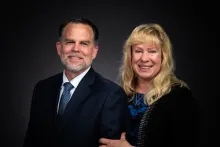
Paul serves as Pastor for the United Church of God congregations in Spokane, Kennewick and Kettle Falls, Washington, and Lewiston, Idaho.
Paul grew up in the Church of God from a young age. He attended Ambassador College in Big Sandy, Texas from 1991-93. He and his wife, Darla, were married in 1994 and have two children, all residing in Spokane.
After college, Paul started a landscape maintenance business, which he and Darla ran for 22 years. He served as the Assistant Pastor of his current congregations for six years before becoming the Pastor in January of 2018.
Paul’s hobbies include backpacking, camping and social events with his family and friends. He assists Darla in her business of raising and training Icelandic horses at their ranch. Mowing the field on his tractor is a favorite pastime.
Paul also serves as Senior Pastor for the English-speaking congregations in West Africa, making 3-4 trips a year to visit brethren in Nigeria and Ghana.
