
Don Ward
This transcript was generated by AI and may contain errors. It is provided to assist those who may not be able to listen to the message.
We're calling this a split sermon as more like a Bible study, and it ties in with what I've been talking about with regard to one of the great truths that identifies us as the true church of God. What is the greatest and most deceptive recorded lie in the history of the universe? So let's title the sermon Satan's Greatest Lie. What is Satan's greatest lie? This lie has deceived and enslaved humanity from the most highly intelligent intellectual to the least educated illiterate person. Virtually all religions—Catholicism, Protestantism, Judaism—and Eastern religions teach that humans have an immortal soul that never dies. From this belief, they teach that upon death a person's soul goes to either heaven or hell or in Eastern mysticism to some other place where it is perfected further before it can enter into the final state of bliss, which they might call nirvana or something else.
We could conclude from this that they do not understand the begettle and birth process that one must go through in order to inherit eternal life. We do not have abiding within us to inherit eternal life. The Bible speaks of it as an inheritance, as a gift. Even though Protestant churches talk about being born again, they don't remotely understand the process of begettle and birth in the true biblical sense. Moreover, they do not understand the plan and purpose of God in bringing sons and daughters to glory in the family of God. They believe that if a person confesses belief in Jesus, he or she is born again like magical on the spot. And they also believe in eternal punishment. Since the soul doesn't die, then obviously if you don't go to heaven and enjoy, quote, eternal bliss, then you would be punished forever, tormented in hellfire.
So they would teach that the soul cannot be destroyed. One of the great questions in theological circles is what is the origin of the soul and when and how does it enter into a person? Now, in the first part of this sermon, we're going to be talking in what I would call a rational sense. A lot of it is built on what would constitute sound logic and also what does the Bible say. And some people may say, as in this telecast that I referenced in the announcement of Mr. Myers interviewed various people on the street with regard to three days and three nights and other questions surrounding Easter, it was like they dismiss it all by just saying, well, I know that Jesus died for my sins and that's all I need to know and just go on with life and they don't really dig and don't really understand. You know, in Matthew 7, it says, many shall come to me in that day and say, Lord, Lord, have we not done all these wonderful works in your name? And he lists some of those works. But then the reply by Jesus is, depart from me, you workers of lawlessness. I never knew you. So you can be as sincere as you want to be. You can do all kind of good works. But yet, at the same time, there is a way, a prescribed way to the road of salvation, to eternal life. So, once again, great questions in theological circles of what is the origin of the soul and when and how does it enter a person. So we have three questions. What is the theorized origin of the immortal soul? And when does the invisible immortal soul enter a child, either an embryo or a newly born child? So when does that happen and how does it happen?
And, of course, what is the origin? The origin, the when, the how? Three questions. There are several variations with regard to the origin of the soul, but it can all be broadly summarized as coming from the following two sources. The two main beliefs as to the origin of the soul. One, God directly creates each individual soul either at the moment of conception or some later time. Now Mormons believe that God created souls at some point in eternity and they are ready and waiting to inhabit a newly born child. Actually, they teach it is at the point of conception. So, as you may know, Mormons have, especially in the fundamentalist sexed S-E-C-T-S of the Mormon Church, a man may have several wives and he may have dozens of children. I know one of the leaders in the Mormon Church has claimed that he had 50 children and many, many wives.
Then, so you have that of God directly creates, and a second one is what's called traducianism. T-R-A-D, I put an N in there, I shouldn't put an N, is traducianism. T-R-A-D, U-C-I-A-N-I-S-N. Traducianism, that the soul comes from the parents by natural generation.
Logically, that belief means that Adam and Eve were created with the ability to generate souls in their offspring, even though they're invisible and you wouldn't know when it happened. The views of when and how a soul is implanted in a human body can also be summarized by two main beliefs. The traducian view is derived from the Latin tradux, T-R-A-D-U-X. And tradux means a branch of a vine. So this means that every human being is a branch off his or her parents.
Now, what is the logical fallacy of this thinking? As we will get into what scientists have to say about this a little bit later, in which science claims that only the material world exists, there is no immaterial, there is no spirit world. So they assert, those who hold to traducianism, that God is the efficient cause of the origin of the soul, they assert that the parents are only the instrumental cause of the new human soul. So what they're saying is that God works in concert with parents, that God indirectly creates the soul through the parents. Of course, exactly how that happens, who would know? That is to say God causes being while parents causes becoming. Traducianism holds that humans are thus a unity of body and soul. However, regardless of the view that one holds regarding the origin of the soul, they all believe that upon death the soul departs from the body. And this, of course, the vision of body and soul is called dualism, which the Gnostics taught. We'll talk about that a little more later on. Christians believe that upon death a soul departs from the body, and once again it goes to heaven or to Gyanaphai or to hell, as they call it. Non-Christian religions believe that a soul goes to a different host or place for further purification. But virtually every religion on the face of the earth, the doctrine of the immortal soul is inextricably linked to their belief system.
Creationist believes that God directly creates souls and implants the soul into the body at conception, or when the embryo is implanted in the womb, or at birth. There are like three stages there. You don't want to get too technical. The initial fertilization of the egg forms a zygote, and it lasts about two weeks, which then morphs into an embryo, and the embryo is that which is implanted. The embryo grows into the fetus and then born. So whether at conception or at birth, really the belief is essentially the same that God directly creates and implants. Now with traducianism, they believe that the parents play a role in conjunction with God in creating the soul. As we are going to see a little bit later, how this thinking permeated the western world and eventually all of the world began to a large degree with Greek philosophy and eastern mysticism.
So there are a lot of different theories. There's no clear, quote, view as the origin of a soul and when and how it is implanted into a human being. Many of the commentaries will state that the origin of the soul is first revealed in Genesis 2.7. So if you go to Genesis 2.7, a verse which hopefully we can quote, Genesis 2.7, the Lord God formed man of the dust of the ground and breathed into his nostrils the breath of life and man became a living soul. The Hebrew word that is translated soul is neifesh. This verse in no way asserts that Adam had a soul, but rather Adam is a soul, which literally means he is a living being. Or another way of saying it is, he is a being with life potential. Now the Hebrew word neifesh is first used in Scripture in reference to animal life. So if we go back there to Genesis 1 and verse 20, Genesis 1 and verse 20, and God said, let the waters bring forth abundantly the moving creature that hath life. Guess what the Hebrew word for life is? It is neifesh.
Bring forth abundantly the moving creature that hath neifesh, or which in other places translated soul. So you see to some degree the Bible equates life or life potential with soul or state of being. Adam became a living soul, and the fowl that may fly above the earth in the open firmament of heavens. And God created great whales and every living creature, and the word creature here is neifesh. So neifesh, which is translated soul, is also used of an animal creature of every living creature that moves, which the waters brought forth abundantly after their kind, and every wing foul after his kind, and God saw that it was good. Notice that phrase there after their kind. The two greatest laws of biogenesis is one that each species produces after its kind, and life begets life. Of course, in evolution, life does not beget life. Somehow inanimate material matter begets life, and the kinds are produced through an evolutionary process. But upon the fossil record and searching, that is not the case. Life begets life, and kind begets kind. So we can conclude here that scripture makes it clear that the Hebrew word neifesh is a word that denotes a living, air-breathing creature, including humankind. In the broadest sense, the Hebrew word neifesh and the Greek word sukei, and sukei is the Greek word for soul. Neifesh is used in the Old Testament over 750 times. About 450 times it is translated soul, and some 150 times, these are ballpark numbers, it's translated as life. And then there are several other various translations of neifesh and other words. And sukei is used 150 times or so, a little over 150 times in the New Testament. And basically they mean life potential. There are four major systems that have attempted and continue to attempt to answer the great questions of life. The four systems are, now why are we bringing this up? Because which one of these systems can account for the origin of the soul? Can any of them? The four systems are true religion, false religion, philosophy, and science. I don't know if you've seen the recent commercial they're running on science in conjunction with the coronavirus. It's sort of scary. They don't run it very often, but it's in essence saying turn to science. Science is your savior. Science will bring about the good life. It will solve your problems. And of course, that's what humankind is turning to now to solve the coronavirus.
And science should be working on it, but at the same time, God is the one who could lift the virus overnight or over seconds.
So, Yabo's four systems, true religion, false religion, philosophy, and science, in each system has a principle methodology. Methodology is important. True religion relies on revelation. What things knows a man except the spirit of man. That's what, 1 Corinthians 2.10, then 1 Corinthians 2.11, how does a man know the things of God? It is by revelation. And then false religion basically relies on emotion and deceit and vanity. It appeals, false religion appeals to emotion and to vanity. One of the reasons why, like my relatives who are steeped in Protestantism, would not accept a refutation of immortal soul is that Mamo and Papa, or Anne and Uncle, whomever, name them, they are in heaven looking down on us right now. And that powerful appeal to emotion and to vanity, they won't give up. So false religion appeals to emotion, vanity, and obviously deceit. That's what Satan used in the Garden of Eden. Philosophy relies on human reasoning, and science employs the much-heralded scientific method that is based on empirical evidence and human reasoning. Empirical evidence means that which, in the broadest sense, that which can be measured, that which lends itself to measurement, like the five senses. Can you see it? Can you taste it? Can you touch it? And so on.
The unanimous agreement that what the peoples of the world call soul is invisible. No one says the soul is visible. It is invisible. Thus, if it is invisible, so then we now begin to get into lodging. If the soul is invisible, it cannot be verified through empirical evidence or human reasoning alone. If it's invisible, it does not lend itself to measurement. Who's ever measured a soul?
Philosophy relies on human reasoning, and it is even more limited than science. So, since soul cannot be detected by any of the five senses, nor can it be detected by any physical means, it cannot be measured or tested. So, by their own definition of verifiable truth, noted by their own definition of verifiable truth, science must deny the existence of an immaterial, immortal essence, abiding within humans. Yet, some scientists speak of the soul, and some have even said they have seen glimpses of proof of an immortal soul.
Philosophers can only postulate and theorize regarding the origin and existence of an immaterial, immortal essence, abiding within humans. So, we're left with true religion and false religion. True religion appeals to revelation from Scripture. Remember what the first article of faith is. The first article of faith, Hebrews 11-6, those who would come to God must, first of all, believe that He is and that He is rewarded of those who diligently seek Him.
False religion claims to use Scripture, but their methodology is flawed because they assume this is true of science, of philosophy, and false religion. They assume up front that an immortal soul exists. So, if you assume that an immortal soul exists, then you're left, you're only left with the task of, well, how did it come to be? How did it come into being?
Most peoples of the world, regardless of their religious persuasion, never question the origin of what they call soul. And most peoples never question how an immortal essence enters into a human body. They just accept it. It's handed down. It's like everybody knows that.
They just assume they have an immortal soul because that is what they've always been taught, heard. Yet, the Bible and science shows there is no credible explanation for the existence of a soul within human beings. Furthermore, if souls do exist, how does an immaterial essence, which science denies, how does it enter a human being? The human body functions. This is really important to follow this.
The human body functions through a series of chemical and electrical reactions that causes the body to respond to stimuli. When those chemical and electrical networks are disturbed, as in the case of an accident or in the case of a disease like Alzheimer's or some form of dementia, the person is no longer able to respond correctly. He has brain damage. He has nerve damage, either caused by an accident, either caused by disease.
In such cases of dementia or related diseases, it seems that if there were some kind of immaterial essence abiding in the person that plays any role in the person's thought or memory, it would spring into action. But alas, the imagined soul does not come to the rescue. It does not cure Alzheimer's. It does not cure the brain, the nervous system of a person who's been severely injured. The above should conclusively prove that even if an immaterial essence abides in humans, there's no relationship between the essence and the human body and mind.
In other words, the soul doesn't affect the body, and the body doesn't affect the soul, even if it should exist, which it doesn't. When the body and mind begins to deteriorate, the only remedy resides in prayer and God's intervention, a miracle from God, or some kind of medical treatment. And prayer and intervention from God introduces an immaterial spiritual power that is of faith and buttress by the Word of God. Do you remember Romans 8-17? Faith comes by hearing and hearing by the Word of God.
Well, all of this said, we're still left with the question, if an immaterial essence abides in humans, how did it come to be? Science as a discipline cannot explain it since they deny the immaterial world.
It does not lend itself, that is, that which can not be discerned empirically, does not lend itself to measurement. Philosophers can only espouse philosophical paradigms based on human reasoning. But even in approaching this subject, they present evidence of an awareness of the longing of humankind for that which is transcendent.
Philosophers realize, philosophers realize there must be something more to human existence than the physical world, so they attempt to explain that dimension through human reasoning. However, the weaknesses inherent in their methodology, that is, human reasoning, is limited to what the human mind can conceive. So how does the immortal soul, how does that lie, gain such a strong standing in the western world? How did it gain such a standing?
The Greek philosopher Plato developed a philosophical paradigm that espoused the notion that humans have a dual nature, and several spin-off religions.
The various Gnostic sects taught a form of dualism, that is, human beings consist of a good, pure essence that some might term soul, and then an evil body. And the goal of humankind is to purify the soul and be reunited with the body. And we shall see how illogical that is.
So in common language, Plato postulated that an immortal essence was housed in the material human body, the dualism. The essence was said to be invisible and immaterial. In order to live forever, one soul may need to migrate through several life cycles. This process was called transmigration of the soul. It was thought that through this process, a soul would eventually be purified and qualified to live in eternity, transmigration going from one life form to the other. Jager writes in the Harvard Theological Review, which a lot of people say, oh boy, Harvard Theological Review. But he writes the following. The Christian Fathers rejected the story of transmigration of the soul, but they accepted, accepted the immortality of the individual soul since they found it reconcilable with Paul's treatment of the resurrection and Jewish angelology. Well, Jewish and Christian angelology, because the Christian world and the Jewish world believes in angels, which are spirit beings, though they are created beings, and what we will be in the kingdom of God, we will not be a created being. And one of the great points of discussion back when the doctrinal wars were being waged in the worldwide church of God in the early 90s was the claim by them, that is, those who said you will never be on the God plane, that since humans are created beings, they can never be on the God plane.
But see, the answer to that, as we shall see later, is through begettle and birth. Because we are begotten of the eternal spirit and we are born of the eternal spirit, therefore we are of the eternal spirit. The same spirit that is in God is in Christ is in us, and that spirit is eternal. We'll talk more about that a little later. But angels, on the other hand, are created beings.
One of the most important facts in the history of Christian doctrine was the father of one of the most important figures, not facts, in the history of Christian doctrine was what was a person that some call the father of Christian theology, Erygian.
Erygian was a Platonic philosopher at the school of Alexandria. In the period of time, there was about the intertestamental period from the time of Malachi down to oh, the time of say 500 AD, about a thousand year period there. There developed several schools of philosophy and theology. One of these schools, this was after Christ came on the scene and was resurrected and ascended back, was this man named Erygian. He was at the school of Alexandria. There was a great school of learning in Alexandria, Egypt, and a great school of learning in Jerusalem. Paul refers to that. He was taught at the feet of Gamaleo, and also a great school of learning there in Asia Minor at Tarsus. Paul was from Tarsus, and his parents apparently sent him to Jerusalem at an early age where he was schooled in Phariseeism at the feet of Gamaleo. So, Erygian built a Christian theology, so-called Christian, the whole cosmic drama of the soul, which he took from Plato, and although later Christian fathers decided he took too much, that which they kept was still the essence of Plato's philosophy of soul, that indeed you were a dual creature, you had a soul, you had a body. It was for them, as for Plato, the significant expression of their spiritualism and immaterialism.
The Catholic theologian Augustine followed to some degree in the thought patterns of Plato. All immortal soul paradigms, all their models, must espouse some form of dualism, that is, humans consist of an invisible essence housed in a material body.
Perhaps the greatest challenge to all who hold to the great immortal soul lie is, how does an invisible essence communicate with the material body? If the soul does exist, how does it communicate? We've already seen from science, based on what they say they believe, it cannot communicate, because they don't believe that a material world, an immaterial world, exists.
Those who believe in the immortal soul lie teach that the soul is a seed of thought, emotion, and moral consciousness, also the seed of intellect.
In common language, when one speaks in terms of a person, oh, you know so-and-so, he has no soul. What they're really saying is something like, this person has no heart.
Or they may say this person's lost his mind or something like that. What we call mind is invisible. You ever seen a mind? Well, I got a good mind to give you a part of my mind.
And so we unload on a person.
Mind and heart consist of what really a person has learned. So the following verses illustrate this point, that mind and heart, when we speak of heart, he has no heart. We're talking about the, at the, look at Proverbs 4.23. Proverbs 4.23.
When we speak of heart, we're really talking about a person has no empathy, no sympathy, cannot be reached, cannot be touched. He doesn't think like other people. Somehow he's been hardened and his heart is hardened. The Bible has a lot and speaks a lot about a hardened heart. In Proverbs 4.23, keep your soul with all diligence or keep your heart with all diligence for out of it flow the issues of life. Keep your heart with all diligence for out of it are the issues of life. And akin to that is Proverbs 23. We want to read verses 6, 7, and 8. Proverbs 23. In Proverbs 23 and verse 6, 8. Eat you not the bread of him that has an evil eye. There are just certain people you get vibes from that person with regard to what's inside of them. Neither desire you his dainty meats or food, for as he thinks in his heart, so is he. So the seed of thought, what we call it, the Bible calls it heart, the seed of emotions and the seed of thought, the innermost being of a person. Eat and drink says he to you, but his heart is not with you. Remember, God says he looks on the heart and not on the outward appearance. He also says the heart is deceitful, desperately wicked. Who can know it? But the word of God knows it. The Hebrews 4, 12. The word of God is sharper than a two-edged sword, dividing and centered. The thoughts and intents of the heart of man. The morsel which he has eaten shall you vomit up and loose your sweet words. So as a man thinking in his heart, so is he. And then we are taught in Philippians chapter 4, verse 8. We're taught here, we're admonished here, of what to actually put into the heart, into the mind. In Philippians 4, verse 8.
You know, I wonder at times how much preaching and teaching really matters. Does it really make any change in anybody's life? In Philippians 4, 8. Finally, brethren, whatsoever things are true, whatsoever things are honest. Whatsoever things are just, whatsoever things are pure, whatsoever things are lovely. Whatsoever things are of good report, if there be any virtue, if there be any praise, think on these things. Keep your heart with all diligence, for out of it, blow the issues of life. As a man thinking in his heart, so is he. Thought is a precursor of action. Action is a precursor of habits, and habits is a precursor of character.
And so, mind and heart have to do with what we have learned, either by revelation or by being taught, or living in the environment in which we live. Some of the immortal teachers try to equate soul with spirit. However, scripture makes it clear that the only way, the only way that one can receive an eternal spirit essence is through repentance, faith, baptism, and the laying on of hands. And another scripture that we had read during the first split sermon here today was John 663. John 663. You need to understand it, not just be able to quote it.
The flesh profits nothing. It is the spirit that makes a life. The words I speak, Jesus speaking, the words I speak, they are spirit and they are life. So, the Word of God is equated with spirit and life. The words I speak, they are spirit and life.
So, the Word of God reveals the mind of the spirit. You want to know the mind of the spirit? Well, it's revealed in the Word of God. The Greek word sukei that is translated in the New Testament is the equivalent word of nafesh, is translated as soul in the Old Testament. The Greek word sukei appears about 105 times in the New Testament. It is most often translated as soul or souls. Interestingly, the first time that the word soul, sukei, is used in the New Testament is Matthew 10.28. So, if you go to Matthew 10.28, guess what it says? First time the soul is used in the New Testament. The first time the soul is used in the New Testament, Jesus is speaking and he's saying that it can be destroyed. In Matthew 10.28, fear not them which kill the body but are not able to kill the soul, Greek sukei, but rather fear him which is able to destroy both soul and body in Gehenna Fire. This verse shows that the soul, life potential, can be killed but it can only be destroyed by God. God the Father has the ultimate power to take one's life essence from them. Look at Revelation 2 and verse 11. Fear not him which is able to kill just the body but him that is able to kill the soul in Gehenna Fire. Where is the soul destroyed? In Gehenna Fire. It's destroyed. It doesn't live forever and they talk about eternal fire. Well, the fire burns throughout eternity. Hellfire burns throughout eternity but that which is thrown in there only burns as long as there is combustible material for it to burn. In Revelation 2 and verse 7. In Revelation 2 and then verse 7. He that hath an ear let him hear what the Spirit says in the churches. To him that overcomes will I give to eat of the tree of life which is in the midst of the paradise of God.
So the tree of life is the only thing that gives eternal life. Yet on the other hand, you look at Revelation 20 and verse 6. Well, I want to read before we go there. Look at Revelation 2 and verse 11. Revelation 2 and verse 11. Revelation 2 and verse 11. He that hath an ear let him hear what the Spirit says in the churches. He that overcomes shall not be hurt of the second death. So there is a second death and that second death takes away life potential or soul forever. Now look at Revelation 20. In Revelation 20 and verse 6. Revelation 20 and verse 6. Blessed and holy is he that has part in the first resurrection. On such the second death has no power but they shall be priests of God and of Christ and shall reign with him a thousand years. Now look at Revelation 20 and verse 14. And death and hell were cast in the lake of fire. This is the second death. The Bible makes it very clear there is a second death. Now look at Revelation 21 and verse 8. Revelation 21 and verse 8.
But the fearful, unbelieving, abominable, murderers, whoremongers, sorcerers, idolaters, and all liars have their part in the lake which burns with fire and brimstone, which is the second death. Now let's think about the Father and the One who became the Son of God. What they must have discussed in planning the great plan of salvation. One of the main characteristics that we attribute to God and the Bible attributes is that all of God's works are done in truth. That's Psalm 33.4. And of all of his characteristics, God is love. 1 John 4.8, 1 John 4.16 says that God is love. Everything God does is of truth, and it is out of love. In short, God is a logical, truthful, sound-minded, loving Father. With these words in mind, let us consider, based on the Word of God, factors we should consider when God and the Word were creating their great plan of salvation. First, we identify the reason why God and the Word created humankind. Why did he create us in the first place? Because he wanted to share who he is and what he is with humankind. Remember, God is love. Love is outgoing concern for others. That is the greatest characteristic of love. God and Christ, who are love, wish to share their love, their very being of who they are and what they are in a family setting. So the great challenge before them was to create beings in their image, but not of their essence, who could eventually be begotten and born in the family of God. Why not create them in their spirit? Because they wanted them to be born of the eternal spirit, not just created being, as the angels were. So God created humankind, ordained the great institution of marriage and family. And God created within humans the ability to reproduce through a process of begettle and birth. So in like manner, God and Christ developed a plan whereby humans could be begotten of the spirit, the spirit of God, the eternal spirit, and eventually born in the family of God at the resurrection of the just. This is the only way to live forever. It is through partaking of the tree of life of the eternal spirit. Humans are created from the dust of ground, made in the image of God, but they were not of the same essence of God and Christ. God is spirit. Humans are material made from the dust. So once again, the challenge was to develop a plan that would enable humans to be begotten of the spirit of God and born into the family of God at the resurrection of the just. And upon being born into the family of God at the resurrection of the just, they would be of the eternal spirit. Let's notice in Hebrews 9.14 where this phrase, this term, eternal spirit is used. I want to go to Hebrews 9 and verse 14.
In Hebrews 9 and verse 14, how much more shall the blood of Christ, who through the eternal spirit offered himself without spot to God, purge your conscience from dead works to serve the living God through the eternal spirit? Now we go to Romans 8.11. In Romans 8.11, we shall see that by the same spirit that God raised Jesus from the dead, he shall also raise our mortal bodies, and we will be of the same essence of God and Christ. We already have the earnest of the spirit, the begettle of the spirit, dwelling within us, the eternal spirit.
There is a physical birth, there is a spiritual birth. In Romans 8 and verse 11, but if the spirit of him that raised up Jesus from the dead dwell in you, he that raised up Christ from the dead shall also quicken, make alive your mortal bodies by his spirit that dwells in you. Just before Jesus Christ gave up the ghost, as it says in the scripture, he cried out to God and said, into your hands, command I you my spirit. And so the spirit essence, the life of Jesus Christ, was in the hands of God.
Now we look at Acts 2, 27. So the time that Jesus was in the grave, there was no consciousness. His soul did not fly off to heaven or any other place. In the scripture, it says that the dead know not anything. In Acts 2, verse 27, because you will not leave my soul in the grave, neither will you suffer your holy one to see corruption. Where was the soul, the essence, the life being, the life potential of Christ, it was in the grave.
It did not fly off to heaven. You have made known to me the way of life. You shall make me full of joy with your countenance. Me and your brethren, let me freely speak unto you of the patriarch David, that is both dead and buried, and his sepulchre is with us to this day. Therefore, being a prophet and knowing that God has sworn with an oath to him that of the fruit of his loins, according to the flesh, he would raise up Christ to sit on his throne. He, seeing this before, spoke of the resurrection of Christ, that his soul, his life essence, his life potential was not left in Hades and the grave, neither did his flesh see corruption.
This Jesus has God raised up whereby we're all witnesses. Then in Revelation 1 and verse 5, it says that Jesus Christ is the prototarchos, the first born from the dead. For God so loved the world that he gave his only begotten son, that whosoever believes in him should not perish, but have everlasting life. There is a birth to physical life. There is a birth to spiritual life. We read from Romans chapter 8 and verse 11, by the same spirit that he raised Jesus from the dead, he shall also make alive our mortal bodies.
So those who wanted to argue that we cannot be on the God plane because we're created beings, you see the fallacy of their statements, because we are begotten of the eternal spirit and we are born of the eternal spirit, the same spirit that is in God, is in Christ, is in each one of us. We shall live, we shall rule, we shall reign as eternal spirit beings in the kingdom of God. Remember, it says in Hebrews 2, that Jesus Christ is not ashamed to call them brethren.
The same process that Jesus Christ went through, we shall go through. We are going through. And so brethren, one of the great identifying signs of the Church of God, we understand and know that we do not have an immortal essence abiding within us, that the only way that we can attain unto eternal life is through being convicted by the word and spirit of God and then repent, exercise faith in the sacrifice of Christ, be baptized, receive the laying of hands, and the impartation of the eternal spirit.
And whether we live or whether we die at the resurrection, we shall be changed into glorious radiant spirit beings that live forever in the kingdom of God.
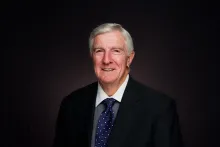
Before his retirement in 2021, Dr. Donald Ward pastored churches in Texas and Louisiana, and taught at Ambassador Bible College in Cincinnati, Ohio. He has also served as chairman of the Council of Elders of the United Church of God. He holds a BS degree; a BA in theology; a MS degree; a doctor’s degree in education from East Texas State University; and has completed 18 hours of graduate theology from SMU.
